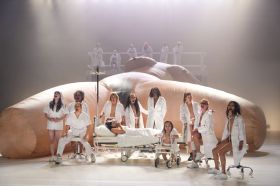
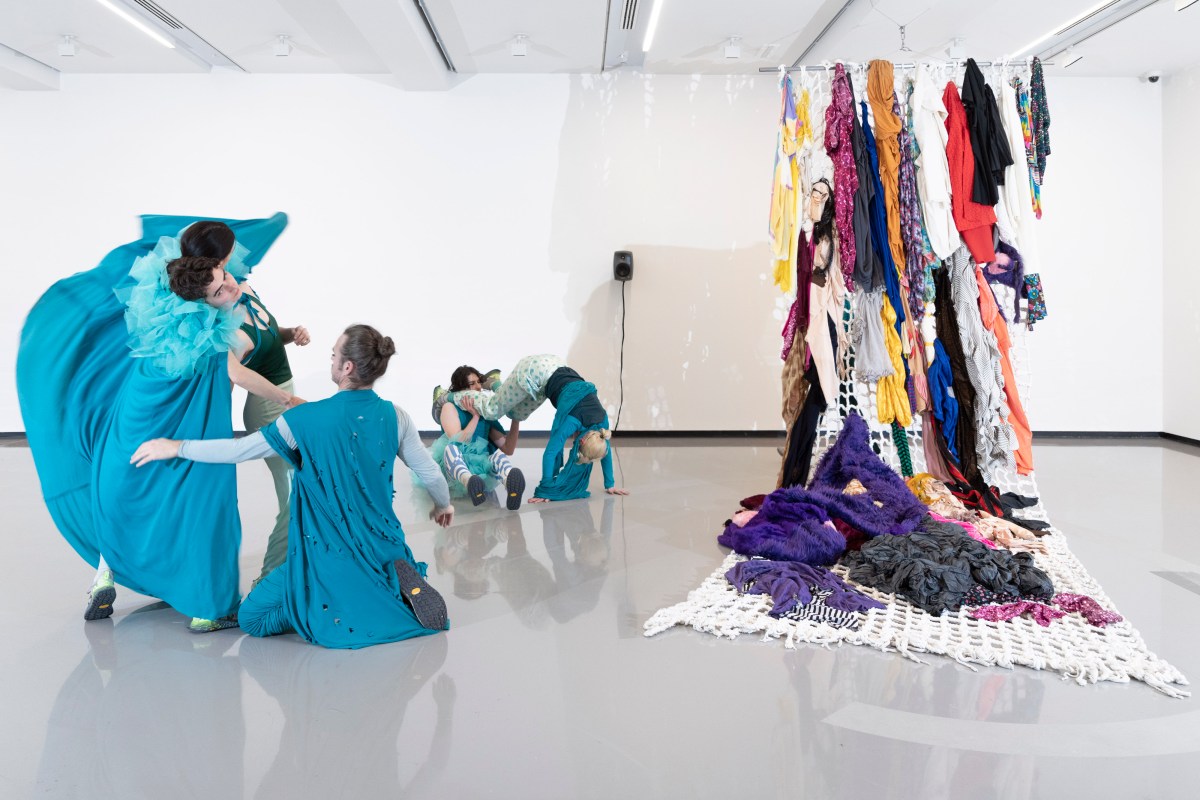
In recent months we have seen numerous dance performances and movement-based works taking place in galleries and museums.
This past week has seen Lucy Guerin Inc celebrating 21 years of choreographic practice at the Australian Centre for Contemporary Art (ACCA).
Last year Shelley Lasica presented the first iteration of WHEN I AM NOT THERE at the Monash University Museum of Art (MUMA) and it will be reimagined at the Art Gallery of NSW (AGNSW) from 22 May.
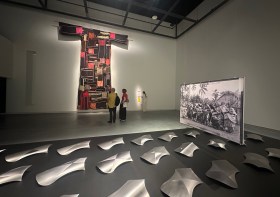
A dance performance by Riana Head-Toussaint also featured in the opening program for AGNSW’s new contemporary gallery, which led visitors to explore the architectural, social and historical contexts of the new building and the land on which it stands.
While at the outset it may seem as if we’re witnessing a sudden trend of dance in visual arts settings, the practice actually comes with a long history, both locally and internationally.
Dancing the music: Philippa Cullen 1950-1975, currently on view at McClelland Sculpture Park and Gallery, shows Cullen’s brief but innovative practice as a choreographer, dancer and producer. It highlights how she took dance to galleries and visual art spaces way back in the 1960s and 70s.
Dr Stephen Jones, historian and curator of the exhibition, tells ArtsHub: ‘Philippa had been doing Fine Arts with Donald Brook and also studying dance in Sydney when, internationally, John Cage and Merce Cunningham were working in the music and dance avant-garde in New York… She got into the idea that dancers’ bodies might be able to make the music [rather than dancing to it].’
Cullen’s explorations delved into technology and contemporary art to give dancers the autonomy to create their own music, but they also changed the way audiences interacted with her works and spaces.
Jones adds: ‘Dance is a visual art form, and Philippa’s works in many ways liberated others to explore dance beyond the stage… Performers back then also just needed space to present their works and ideas, whether that was in an auditorium, on the streets or in a gallery.’
Read: Putting the science behind performers’ well-being
Cullen set in stone the conceptual framework of dance as an interaction with space, something which has also been core to Lasica’s practice over the last 40 years.
Lasica tells ArtsHub: ‘When I first started working in this area I was very aware of the history of choreography in relation to other media and contexts. It wasn’t about making something that was new.
‘Philippa was performing in galleries in the 70s and, when I was very young, I performed in a gallery in collaboration with a number of different people, including my mother, Margaret Lasica.
‘I think the interesting thing at the moment is that visual artists are interested in choreography too, for example Alicia Frankovich’s work in Melbourne Now,’ adds Lasica.
WHEN I AM NOT THERE is a performance-exhibition, where ‘this idea of “to perform” and “to exhibit” involves a couple of different kinds of logic. They are not mutually exclusive, but they have different capacities’, explains Lasica.
These include how duration is considered in a gallery space and the movement of audiences, as well as existing works and objects.
Lasica says: ‘There are different things happening when people are physically engaged and can move around the space… In WHEN I AM NOT THERE, some of the objects are stable and some are not – the work becomes itself each day and these conditions are very exciting and interesting for us to work with.’
Audience expectations and behaviour
While artists are experimenting with space, both within and outside the context of their performance, seeing choreographic works in galleries and museum settings can also change audience behaviour.
Lasica explored this in the 1990s with a series of works titled Behaviour. She says, ‘It’s really interesting how the work and the performers can allow certain situations and that, for me, is part of the choreographic work’.
From an institution’s perspective, Lisa Catt, Curator, International Contemporary Art AGNSW says: ‘Working with Shelley and the way that she has really cleverly made this work and conceptually constructed it, has definitely prompted us to change the way that we have approached a live work in the Gallery.
‘What I’m most looking forward to in this iteration of Shelley’s work is that it will be on our Contemporary floor, and adjacent to the Archibald Prize exhibition. I think that encounter of seeing dancers and performers in the space, the unexpectedness of that, is something really amazing to offer within the museum experience,’ says Catt.
Changing what it means to document dance
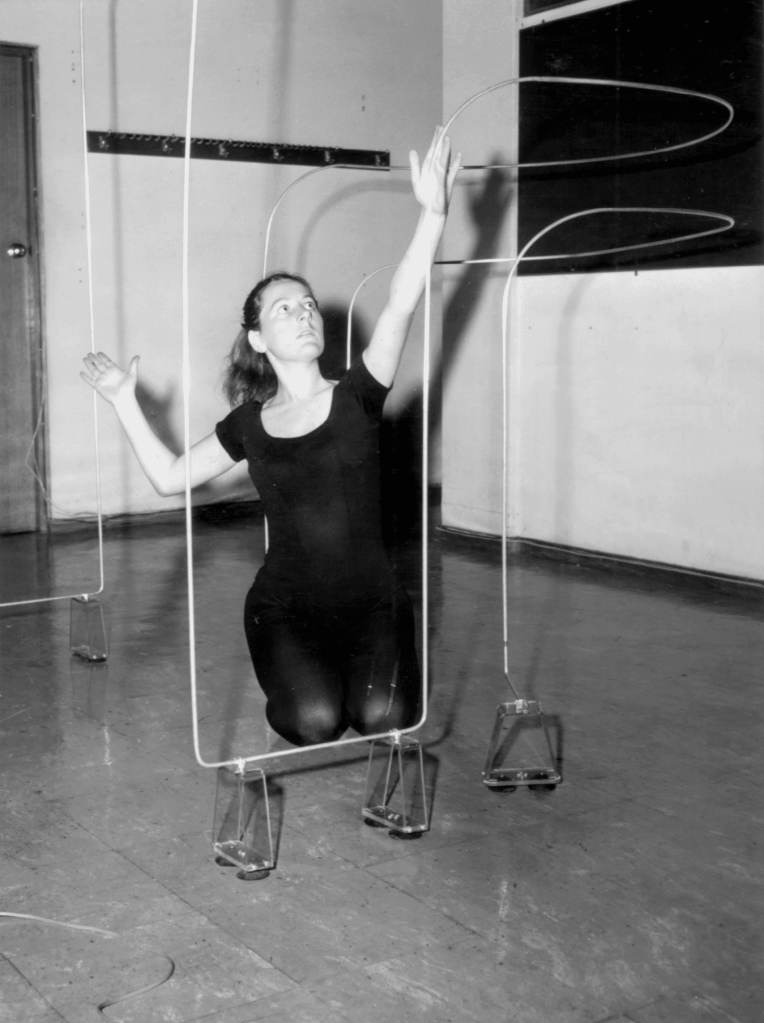
Another interesting aspect of Cullen’s archival exhibition is the nature of documentation in dance, especially in the context of visual arts institutions where collecting and conservation are ingrained practices.
As Jones notes, one of the difficult aspects of putting together an exhibition on Philippa Cullen is trying to find documentation, something to which much of his work is dedicated now.
One major project that seeks to further understand this is Precarious Movement: Choreography and the Museum, first launched in 2021 for a four-year period. It brought together five institutions, including AGNSW, MUMA, NGV, Tate UK and UNSW Sydney, to reconsider processes and protocols between dance artists and art organisations.
Both Lasica and Catt are part of the Precarious Movement project team.
Catt says: ‘I’m finding that really there is no single process when it comes to documenting performance, that it is case-by-case. But being clear about what’s possible with artists and having that discussion is something we’ve found to be very important.
‘The Gallery is really interested in renewing its commitment to performance, dance and live practice, recognising that they’ve always been a part of contemporary art.’
Lasica says, ‘It’s very important that there is a difference between documentation and the performance itself.’
She continues: ‘I was very adamant in the 70s not to have any documentation like video, because for me, that’s a different thing [to my work]. This is a very pertinent conversation in Precarious Movement around visual art institutions starting to collect and conserve choreographic works, and the big discussion “is it necessary?”
‘From my perspective, because of the way I’ve built my works, I don’t even know what’s going on all the time [as a performer]. Conservation also brings in the assumption that there is a stability and an immutability about the work,’ she adds.
Catt shares some of the other outcomes of recent research, including a reevaluation of the relationship between artists and institutions.
‘For someone like Shelley, documentation can’t capture everything. The choreographic material is very much in her body and the dancers’ bodies, and in this network of relationships that she has fostered over her career.
‘Something that the conservation team is really looking at at the moment is thinking about live practice as not necessarily about conserving the work in terms of outcome, but about how you care for and maintain relationships. It’s to move away from this idea that conservation only happens at the end, but to actually apply those principles of care throughout that whole engagement with artists,’ says Catt.
In many ways, looking through the lens of dance opens up a range of possibilities, alongside complexities, that challenge and propel the path of our collecting institutions.
Dancing the music: Philippa Cullen 1950-1975 is on view at McClelland Sculpture Park and Gallery until 17 July.
Shelley Lasica: WHEN I AM NOT THERE will be performed at AGNSW from 22 May to 4 June.