How can artists make the most of the rise in affordable art fairs?

Australia is one of the Affordable Art Fair's fastest growing markets. While there are opportunities for artists, the big investment also means there's a lot to weigh up before jumping in.
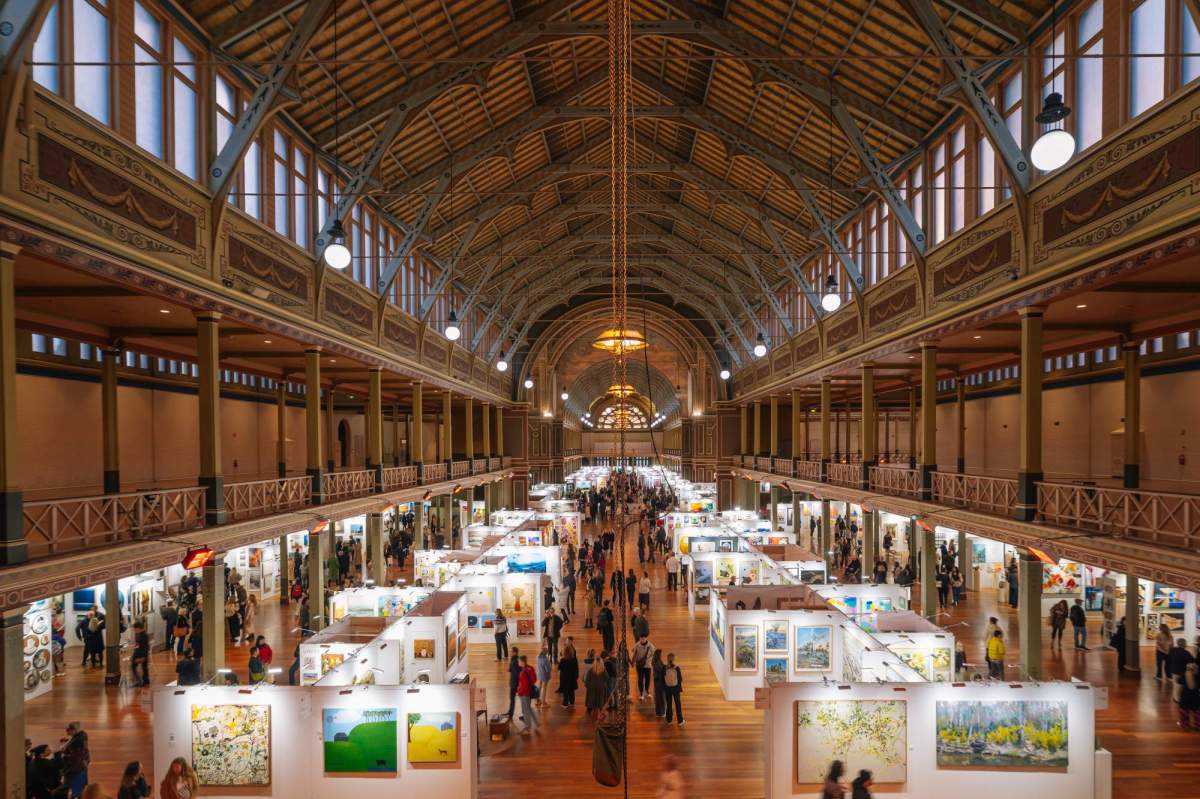
Affordable Art Fair Melbourne: an aerial view of the art fair venue showing hundreds of art stands.

While hardly a new phenomenon, the Affordable Art Fair movement, which began with a single annual event in London almost 30 years ago, now has global reach, with a presence in 16 cities across Europe, the US, Asia and most recently, Australia.

Since 2019, Melbourne’s version of the Affordable Art Fair has drawn strong local attention and generated healthy sales for artists, leading the UK-based business to extend its Australian presence to Sydney in 2022 and Brisbane in 2023.

Ahead of Melbourne’s eighth edition, which runs from 27 to 30 August, ArtsHub spoke to its regional Australia Director, Georgia Huestis, and frequent fair exhibitor Em Hatton, a Sydney-based artist, for insights on how artists are making the most of these opportunities.

Tip 1: Spend time understanding the Affordable Art Fair model

According Australia Director Georgia Huestis, the Affordable Art Fair takes an unpretentious, straightforward approach to connecting artists’ work with buyers, but leans on a gallery-led approach to maintain curatorial integrity.

As Huestis tells ArtsHub, a defining feature of the fair is that all its exhibitors must be groups of artists – rather than individual exhibitors – with every participating artist sitting under the umbrella of either a gallery or artist collective.

‘We require all exhibitors to display at least three artists at their stand,’ Huestis says. ‘That means we have a huge range in number of artists’ work included per stand, which for larger participating galleries could mean showing up to 30 artists, and for smaller artist collectives more like five or six.’

Huestis says that the first Melbourne Affordable Art Fair in 2019 included 55 stands and over 450 artists, with this year’s edition set to host just over 70 exhibitors and 600 artists, taking the Melbourne edition close to the fair’s global average of 79 exhibitors per event.

Melbourne Affordable Art Fair 2025. Photo: Supplied.

‘Even though the fair is relatively new to Australia, its sales figures represent one of its fastest-growing markets,’ Huestis tells ArtsHub, adding that the 2025 Melbourne Fair saw around 18,000 visitors through the door across its four days, resulting in sales of over 3800 artworks totalling $5 million (with the average price of work sold sitting at $1400).

ArtsHub: Ten editions on, has Sydney Contemporary kept its big promises?

For Heustis, these figures show ‘strong appetite’ for affordably priced works. ‘And I see that interest for myself when I stand on the door and talk to people as they leave with the art they have bought under their arm,’ she says.

‘They will often tell me that they’ve never bought art before, and that they didn’t realise it was so easy.’

Tip 2: Test the market for your work before applying

For Sydney artist Em Hatton, who has been working full-time as an artist since 2025, the Affordable Art Fair’s events in Australia have been a vital mechanism through which she has begun charting her path as a working artist, and also built a base of new collectors of her work.

That said, the artist hasn’t entered the Affordable Art Fair arena hastily nor overnight.

Sydney artist Em Hatton in her studio. Photo: Debbie Gallulo.

As Hatton explains, her experience as a regular fair exhibitor has taught her how best to approach the events.

Hatton admits her first Affordable Art Fair in 2024 required her to swallow hard while making a large upfront exhibitor payment – a fee she paid before knowing whether a single work of hers would sell.

‘You need to enter any Affordable Art Fair realising there is an element of financial risk,’ she tells ArtsHub.

‘But what’s good about this fair is that because artists have to exhibit in collectives, you’re sharing the upfront outlay [of your stand hire fee].’

With the smallest Affordable Art Fair exhibitor stands starting at around $10,000, this is indeed a large financial commitment for any working artist. (This hire fee also includes access to the fair’s publicity and advertising.)

Despite the potentially high entry cost – especially for artists exhibiting with just two or three other artists – Hatton, saw this outlay on her first Affordable Art Fair more like a calculated risk than a scary spend because she had already been testing the market for her work in smaller ways.

‘For years before I did my first Affordable Art Fair, I had been selling work and designs at smaller fairs, group exhibitions and design markets. I built a following from that and some confidence that there was demand for my style of work,’ she explains.

‘So, I would say to artists who are not represented by a gallery and who have never done an Affordable Art Fair before, you should definitely test the market through smaller sales opportunities like this before making your pitch to the [Affordable] Art Fair.’

ArtsHub: Melbourne’s Luna Park brings back real-life artists

Even then, acceptance is not guaranteed. As Huestis explains, ‘While the fair would love to say yes to everyone, we have to ensure we can grow our audience steadily so everyone involved can enjoy the success of it.’

She adds, ‘With demand for exhibitor spaces remaining strong across our three Australian fairs, applicants are encouraged to clearly articulate their vision and what will make their presentation stand out and set them up for success. 

‘We therefore ask each artist collective or gallery to provide information on their plans for their stand including what will make their stand and hanging plan different from the others, why their artists are showing their work together, and how their group of artists’ work complements each other.’

Tip 3: Establish a collective and formalise that arrangement

On that note, artist Em Hatton suggests taking a careful approach to ‘finding your people’ and choosing the right artists who share your values to exhibit with.

‘It’s so great that the fair allows artists to form small collectives to apply for a stand,’ she says.

‘Galleries still have such an important ongoing role to play in the sector and are so valuable in supporting artists’ career development. For artists who don’t have gallery representation, the Affordable Art Fair represents an opportunity to connect with audiences in a professional way through collectives. For me personally, it’s been a game-changer.’

Hatton says the artist collective she leads, and that she has exhibited with at Affordable Art Fair events, is called Oddball Gallery, and brings together 10 female and gender diverse artists whose works, while diverse in medium, sit harmoniously together in exhibition contexts.

Some of Oddball Gallery’s artists with, from left, Kirbee Lawler, Claire Cassidy, Laura Butler, Em Hatton, Gauri Torgalkar, Yang Qiu and Debbie Gallulo. Photo: Debbie Gallulo.

‘We formed Oddball Gallery to apply for the first Affordable Art Fair we did [together] in 2025,’ Hatton says.

‘It was really important for us to formalise that arrangement from the beginning because it’s essentially a business deal where we are all agreeing to share the risk of doing the fair, and to support each other in the sales of each other’s work, while claiming sales only of our own work that sells.’

Hatton adds that aside from being a good fit from a curatorial point of view, the relationships she’s formed with the other artists in the group have been incredibly affirming.

‘The relational and psychological safety factor is also incredibly important,’ she says. ‘Art fairs can be an emotional rollercoaster, and it makes a massive difference when you’re all there to support each other.’

She continues, ‘One thing that’s hard about being an independent working artist is that there can be scarcity mindset in the industry. At the end of the day, a purchase of a painting is a luxury good and not one consumers will make often, but it’s a big misstep to approach your work through the lens of competition.

‘Forums like the Affordable Art Fair support diversity and allow you to realise there are different buyers for different styles out there, and that’s true of Oddball Gallery too.

‘We all have our own styles and practices, but we are also really supportive of each other as women and gender diverse artists, and share a lot in common in that way.’

Tip 4: Plan your exhibition space carefully

Hatton’s final tip to get the most of any Affordable Art Fair experience is to invest in your stand’s display and ensure there is curatorial rigour to your hang.

‘Your stand must show a cohesive curatorial approach while defining a point of difference specific to your collective,’ she says.

‘It’s essentially a group exhibition, so you need buyers to feel they are stepping into your group show.’

An exhibitor at Melbourne Affordable Art Fair 2025. Photo: Supplied.

Tip 5: Spend time with your visitors

In addition to presenting a professional hang, Hatton says that being open and welcoming of visitors to your stand is essential, because another key feature of the fair is that it allows prospective buyers to talk to artists directly about their work.

‘People love to stop and chat, and we love to have a chinwag too,’ she says.

‘Also, as a collective, we often sell on behalf of each other, and through that we learn from each other and develop our own communication styles.’

Hatton adds that what’s most important is that exhibiting artists are there supporting each other, and for her personally, she has always either made good sales, met new people who show interest in her work, or has received commissions from her Affordable Art Fair experiences.

 ‘So, at the very least, it’s been an important momentum-builder for me,’ she says.

The Affordable Art Fair runs 27 to 30 August at the Royal Exhibition Building, Melbourne.

Discover more screen, games & arts news and reviews on ScreenHub and ArtsHub. Sign up for our free ArtsHub and ScreenHub newsletters.

ArtsHub's Arts Feature Writer Jo Pickup is based in Perth. An arts writer and manager, she has worked as a journalist and broadcaster for media such as the ABC, RTRFM and The West Australian newspaper, contributing media content and commentary on art, culture and design. She has also worked for arts organisations such as Fremantle Arts Centre, STRUT dance, and the Aboriginal Arts Centre Hub of WA, as well as being a sessional arts lecturer at The Western Australian Academy of Performing Arts (WAAPA).