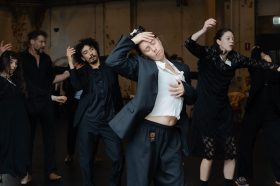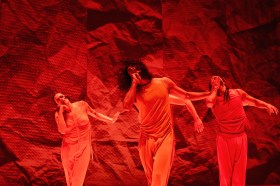
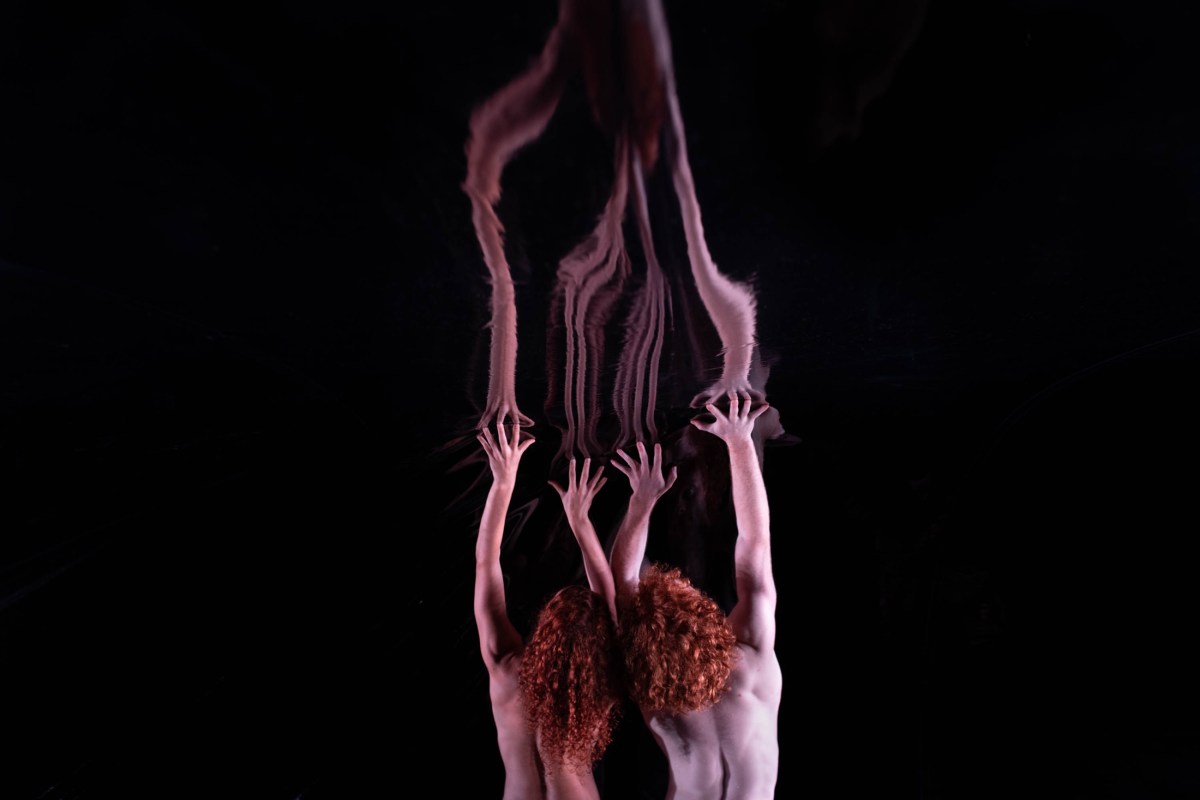
In the thick of RISING festival activity, and alongside the inaugural Australian Dance Biennale unfolding across Melbourne/Naarm, a rare and timely gathering took place. The Australian Dance Biennale Summit brought together artists, presenters, producers and advocates in a packed Flinders Street Station Ballroom – a sign, perhaps, of a sector eager to reflect, recalibrate and reconnect.
Presentations covered key challenges in the field today, but particularly collective practice and collaboration, and the challenges around developing audiences and proving value.
Hosted by Erica McCalman, the summit opened with a candid tone. Australian Dance Biennale Director Gideon Obarzanek then acknowledged those who were absent – and should have been in the room – setting a precedent for critical self-reflection.
Rather than celebration alone, the 2026 Australian Dance Biennale Summit was framed by an awareness of gaps, particularly around representation and inclusion, and the work still required to meaningfully address them.
Choreographer Amrita Hepi went on to extend this thinking, urging attention to what sits ‘just outside the frame’. She reiterated the paradox of dance: while it can be created in solitude, its significance is fundamentally collective.
Responsibility for its future, she suggested, is shared.
Australian Dance Biennale Summit – quick links
The growing appetite for Australian dance
Geoffrey Lim from the non-profit street dance community Cypher Culture brought data into the conversation. Lim highlighted findings from the recently released National Arts Participation Survey, which point to increasing public engagement, particularly at the intersections of cultures and disciplines.
Lim also noted that of all artform audiences, dance attendees are the most consistent – or as he called it, ‘sticky’ in their loyalty.
ArtsHub: Cost a growing factor in arts participation, finds Creative Australia survey
The need for collaboration
A presentation from international curator Sabrina Chen offered a reminder that artistic exchange thrives on long-term relationships. In an increasingly fragmented geopolitical landscape, she argued, listening in ‘two directions’ allows the work to bridge divides.
The panel Beyond the Premiere: New Pathways for Australian Dance went on to explore how works might move beyond their initial season. Wiradjuri choreographer Vicki Van Hout emphasised that, particularly in First Nations contexts, meaningful collaboration begins long before a work even enters development – through relationships built in everyday community spaces.
Van Hout also questioned whether artists should be responsible for packaging their work for presenters and audiences, noting the importance of critical discourse. As she said, ‘It takes 20 years to become an overnight sensation.’
Choreographer Stephanie Lake, Artistic Director of Stephanie Lake Company, offered a striking counterpoint when she talked about the evolution of Colossus, which expanded from a modest seed of an idea into an work that toured across 11 countries. Rejecting conventional advice to produce small, portable works, Lake instead embedded local engagement into each tour, building audiences through participation.
Asia TOPA’s Jeff Khan added to this by describing commissioning models that unfold over multi-year cycles across countries, grounded in trust and reciprocity.
Dancer Angela Goh reframed the question of longevity, applying museum conservation frameworks to dance. Her investigations into embodied transmission and film raise provocative questions about whether choreography might be sustained over decades – even while she acknowledged the power of the irreducible and ephemeral in dance.
Who wants this? Reframing the audience question
The second panel dived into how dance connects with audiences now. Audience development is a critical question for all artforms, of course, but facilitator Fergus Lineham, the CEO of Sydney’s Carriageworks, swiftly reframed the familiar question. Instead of ‘Who is this for?’, he asked ‘Who wants this?’ – suggesting that what’s needed is a shift in focus from intention to desire.
Panellists Georgia Henry (Canberra Theatre Centre) and Hannah Fox (RISING) agreed that dance offers something distinct – visceral, embodied experiences that offer immersion and emotional intensity – but this artistic mission exists alongside practical pressures.
As they described it, venues must balance competing demands and financial targets, and find the strategic alignment between works and audiences. Strategies that help include early engagement, targeted messaging and concise, accessible communication.

Brett Goebel from The Royal Family Dance Crew went on to frame audience-building in relational terms, suggesting that presenters seek to foster ‘friendship’ and necessary moments of connection in a screen-based culture.
When the conversation turned to advocacy, Fox stressed that in a climate where cultural engagement is often perceived as declining, artists and producers hold the responsibility for shifting the narrative – speaking to governments and donors about audiences, not just artworks.
Fox suggested that might also mean taking dance beyond traditional venues and into spaces where diverse audiences already gather.
Across the panel, a consensus emerged: storytelling is central but data alone is insufficient. The challenge for the sector now is to articulate why dance matters, and for whom.
Australia’s place in the global conversation
The Australian Dance Biennale Summit also considered the global context. The final panel of the day highlighted both the challenges of geographic isolation and the increasingly fluid relationship between Australia and the rest of the world.
Jay Wegman from NYU Skirball reported on the current state of dance in the US, describing an ecosystem marked by venue closures and declining international touring – challenges that are now being compounded by prohibitive costs, including visa expenses of around $10,000 per artist.
Despite these pressures, Wegman said appetite remained for ambitious work. European presenters echoed this sentiment, including Deniz Bolar from Hamburg’s Kampnagel. However, Bruno Heyndericks from the German ballet company Hessisches Staatsballett emphasised the need for Australian work to offer something exceptional to justify the touring costs.
Anna Cheng then flipped the script, outlining a contrasting, government-supported model in Hong Kong that sets dance in the middle of a major cultural precinct.
But when the summit concluded with roundtable discussions, it was clear that many were focused on immediate local problems, including the realities of regional touring, participation pathways, international exchange and evolving audience relationships.
It was a day of wide-ranging conversations, but several strong themes emerged. From an artistic standpoint, these included the negotiating tension between the inherent ephemerality of dance and the need for sustainability and longevity, and the necessity of structural change to support a diverse and interconnected dance ecology.
Other key themes of the Australian Dance Biennale Summit were the importance of long-term relationships over transactional models, and the need for sharper, more audience-centred communication.
If there was no single resolution, perhaps the value of the summit lay precisely in its openness. At a moment of both opportunity and uncertainty, the Australian dance sector gathered not simply to present work – but to listen, to question and to imagine what comes next.