People working in creative fields are often perceived as being more sensitive than their conventionally-employed counterparts, but is there any truth to the trope of the tortured artist?
Most chefs avoid advertising their anxiety alongside the daily brunch specials, and it’s generally frowned upon for a dentist (two-knuckles-deep in a patient’s jaw) to discuss their seasonal depression. But it’s perfectly acceptable for a writer, artist, or musician to reveal their innermost demons through their work.
Sometimes this is a conscious choice, and other times it’s a side effect of producing work mediated through unique subjective perception.
Creatives routinely expose their inner states to public opinion and potential judgement, and it would be easy to attribute the tortured artist trope to this relative discrepancy in exposure. However, the correlations between creativity and mental illness run deeper than a vague association between artists’ feelings and the public consumption of their work.
Art and mental illness – quick links
‘You can’t hide what you’re going through’
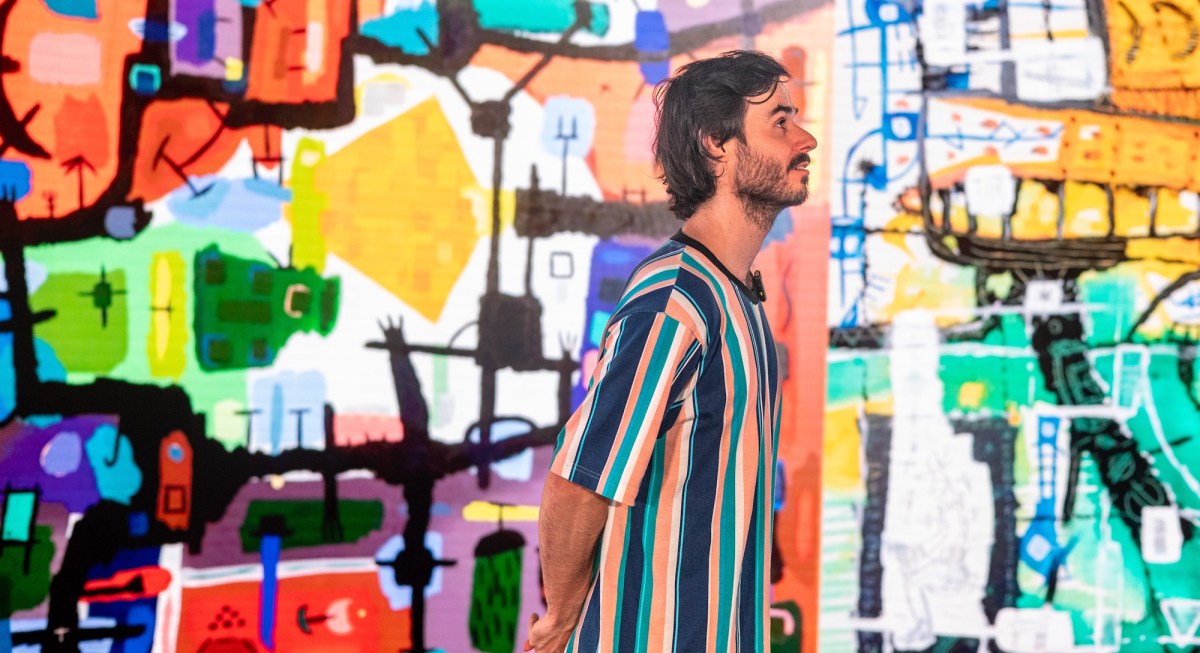
Sam Kissajukian is an award-winning visual artist and comedian who performed stand-up for over a decade before donning his artist beret. ‘It’s hard sharing such intense, vulnerable aspects of yourself,’ admits Kissajukian. ‘You can’t hide what you’re going through, and it does go into the work.’
Over the last five years, Kissajukian has garnered international recognition for his intense originality and distinctive artistic approach. His critically-acclaimed show 300 Paintings combines art and narrative to subvert and reinforce the myth of the tortured artist through comedic self-analysis.

Kissajukian’s foray into the visual arts began during a six-month manic period, during which he invented a new currency, designed a space museum and completed hundreds of paintings. A deep depression followed this creative surge, leading to an eventual diagnosis of bipolar disorder, which became the central focus of his subsequent work.
There are clear links between certain psychiatric conditions and specific artistic endeavours. For example, bipolar disorder is significantly overrepresented among visual artists, poets and musicians, whereas depression is more common among writers and artists. This makes sense in terms of basic cause-and-effect. Depression can exacerbate introspective thinking, and it’s easy to see how increased introspection could lead to the creation of emotionally-wrought works of literature and art.
But emotion can only be channeled into a creative work where a creative work exists in the first place. Van Gogh is remembered as a great painter because he painted, not because he cut off his ear; although the ear-cutting part is also memorable.
Creativity isn’t a symptom of mental illness, nor is it the cause. And yet, there is too much statistically significant overlap between mental illness and creative ability to dismiss the link entirely.
Creative traits
Original thinking, intense focus and the ability to connect highly disparate ideas are three common traits of people with bipolar disorder. They are also three characteristics of genius – a word that has been used in more than one review of Kissajukian’s work.
It’s worth noting that the word ‘genius’ doesn’t typically describe a more powerful version of a normal brain, but a brain that organises itself differently.
For example, highly creative thinkers have increased connectivity in regions of the brain that don’t normally cooperate effectively, such as the executive control network, a region of the brain associated with focus and cognitive filtering, and the default mode network, which is associated with imaginative thinking.
In most people, an increase in activation across one of these networks is accompanied by a decrease in activation across the other. However, neuroimaging has shown increased connectivity across both regions simultaneously in two specific groups of people: highly creative thinkers, and people with bipolar disorder.
Hypomania is a bipolar mood elevation that doesn’t reach full mania or psychosis, but does come with increased motivation, reduced inhibition, accelerated thinking and associative cognitive leaps. During hypomania, the prefrontal cortex takes a step back, resulting in less cognitive filtering and the generation of more ideas.
Hypomania can induce intense creativity, suggesting that a reduction in cognitive filtering (at manageable levels) could lead to heightened creative output. In other words, people capable of mentally organising informational overload are able to transform cognitive chaos into profound creative achievement.
The role of inhibition
Kissajukian describes the process of his own cognitive filtering as containing ‘so many moments for misinterpreting the reality around you that – in a way – you live in a fiction’.
Neurologically speaking, reductions in latent inhibition, which results in an excess of stimuli bypassing cognitive filters, can impair a person’s ability to ignore irrelevant information, resulting in an altered experience of the world. But – especially when combined with a high IQ – low latent inhibition can contribute to high-level creativity and originality.
Studies demonstrate that eminent creative achievers are seven times more likely to have low (rather than high) latent inhibition scores. Separate studies have also shown that low latent inhibition has also been observed in people with ADHD, people who are prone to psychosis and highly creative thinkers.
This maps neatly onto the assumption that artists are especially sensitive to non-essential stimuli, with intelligence contributing to the development of the skills involved in communicating this heightened nuance with innate originality and skilful execution.

‘We take in information through all our senses and then we filter it through our mind,’ says Kissajukian, in reference to his own perception of human subjectivity. ‘I only really have a very vague understanding about myself, which I find deeply hilarious. For me, the core of being a human is the failure to understand objective reality. In art, that is celebrated. And it should be celebrated.’
The artist as outsider
Art reflects the human condition on an acutely subjective level, and human subjectivity necessarily includes emotion. A brilliant artist who doesn’t think or feel within conventional parameters will necessarily be regarded as an outsider by most conventional thinkers.
Historically, outsiders are more likely to be othered – if not overtly ostracised – both socially and professionally. They may even be assumed to be tormented by their status as outsider, regardless of whether the artist perceives their innate difference to be inherently problematic.
If the word ‘genius’ describes a tendency to organise thoughts differently, and creativity is commonly associated with suffering, it follows that a creative genius trapped within a conventional environment might suffer – not from their own creativity, but at the hands of a rigidly homogenised world.
Could this misalignment between creative and conventional thinking live at the heart of the tortured artist trope and, if so, what role does art play in bridging this divide?
Kissajukian describes the perfect piece of art (if such a thing exists) as being ‘an absolute portrayal of the misunderstanding of reality’.
What if true creativity is the act of recognising that there is no such thing as objective reality, just infinite versions of malleable truths that break through our cognitive filters?
Perhaps we – as a society – should spend less time romanticising artists’ suffering and more time contributing to a culture that embraces cognitive difference, encourages creativity and leaves a healthier legacy than the self-mutilation of misunderstood post-impressionists.
Lifeline provides 24-hour crisis counselling. Beyond Blue, MindSpot and Medicare Mental Health offer support for depression and anxiety, while SANE Australia can provide support for people with complex mental health issues.