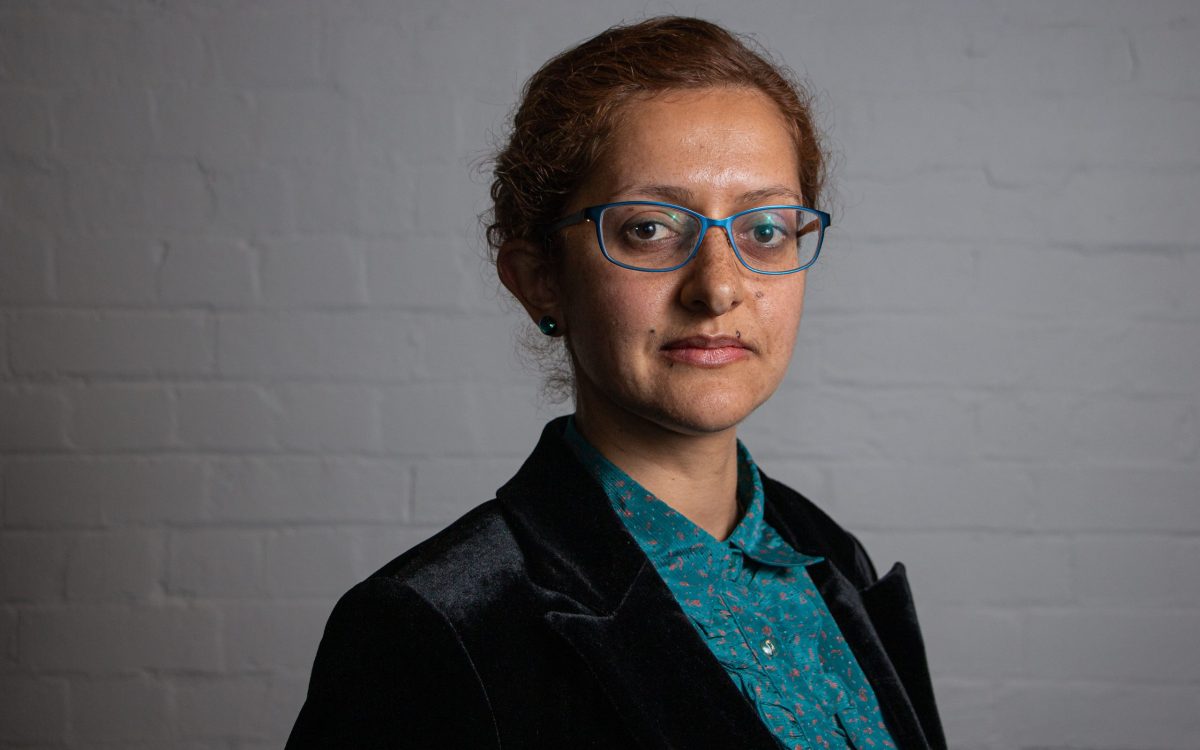
The Parramatta Dictionary by the celebrated Australian author Yumna Kassab is a living, breathing thing. Well – at least partly.
With a full print publication slated for 2026, the work currently exists in segments, with selected entries published on the Sydney Review of Books website as a kind of anticipatory offering. They reveal the fragmentary scope of the project – where the unveiled pieces function less as a preview, and more as evidence of the ongoing nature of documenting.
The first time I met the Parramatta born and raised writer was by happy coincidence, sometime in March last year.
I was with my friend Hajer after an after-work malatang, and we’d decided to go to Riverano for gelato (one of Parramatta’s only late-night spots that isn’t a pub or a games lounge). There, we bumped into my former lecturer, the writer Felicity Castagna – who was hanging out for dessert with none other than Kassab herself.
By then, Kassab had been working as Parramatta’s inaugural Laureate in Literature since December 2023 – an acknowledgement of her outstanding contributions to the local and national writing scene, including critically acclaimed titles The House of Youssef,The Lovers, and her most recent novel, The Theory of Everything.
As an emerging writer myself, you’d think I might have taken the opportunity to discuss the craft, or perhaps how seek advice on navigating the world of publishing.
Instead, we found ourselves discussing the merits of fruit-flavoured desserts and my deep-set fears of maternal mortality in childbirth – perhaps this is a testament to Kassab’s approachability, her unpresumptuous nature, her willingness to talk about anything.
Kassab: a writer with range
Kassab’s range is vast. With a background in medical science, she is also an educator, an Anne Rice fan and an avid Wanderers FC supporter. Her appreciation for people and place is palpable.
Kassab casts a searing gaze into the seemingly mundane with what can feel like X-ray vision and a tenderness that, it felt clear on my meeting, does not judge.
Kassab is a proud Parramatta local, save for two formative years she spent in Lebanon with family during childhood. At a time when her beloved Parramatta (or ‘Paris-matta’) is undergoing a significant period of urbanisation, gentrification and change, The Parramatta Dictionary feels timely and vital: a civic archive, a personal document and a literary experiment tied together by place.
On the Sydney Review of Books website, which hosts a selection of The Dictionary, Kassab’s project is described as ‘a personal catalogue of the institutions, sites, experiences and people making up the cultural life of a city’.
It is also, as she explained at the website’s launch event at Paramatta’s Phive in October, a record of genocide, written throughout a time of Palestinian devastation and resistance.
Kassab and ‘buried experiences’
The Parramatta Dictionary as it currently stands is far from a conventional local history. It is an experimental structure – an open, interactive text made up of fragments and vignettes and ‘buried experiences’ worthy of remembrance.
In ‘Cruise’, Kassab writes: ‘Driving into Parramatta, I begin pointing out sights to my friend. I realise how many of my memories are connected to this place, and how both driving and walking are central to remembering Parramatta.’
The entry reads like a map of consciousness where geography and memory are intertwined. Movement – cruising, drifting, and walking – becomes a metaphor for how we inhabit language, and how we traverse a place that is both familiar and estranging.
Kassab’s tone is her trademark: lucid, conversational, haunted by affection and what gets left unsaid.
In ‘Structures’, Kassab offers what could double as a creative manifesto for The Dictionary and beyond: ‘A story can be a line, a circle, a backflip, diversion, tangent, explosion, spiral, labyrinth, branch, cycle, arc, point, fragment, vignette, episodic, layered, serial, boundary, landscape.’
Kassab: the novel is not the centre
For Kassab, the dictionary form itself seems to be a refusal of linearity – a way of holding together dissonant forms and perspectives without forcing them into a singular, ordered narrative.
As she said at launch of The Parramatta Dictionary website, ‘the novel is not the centre of the literary world’.
In ‘City as Dictionary, City as Memory’, Kassab explores this, questioning the very definition of the novel itself. ‘If a novel can have a community and a place as its centre, then I write novels,’ she says, but: ‘If the centre has to be a single character, then I don’t write novels’.
This sentiment is visible throughout Kassab’s body of work. The House of Youssef, shortlisted for multiple awards, is often described as a collection of short stories about Lebanese migrants in Western Sydney. They are minimalist in tone, yet vast in focus and emotional range.
As James Jiang noted when interviewing her at the website launch, Kassab does a lot with a little. Even her novels, Australiana and The Theory of Everything resist the draw of a singular protagonist, instead assembling a tapestry of voices and perspectives.
The Parramatta Dictionary – even in its first iteration – extends this impulse. It becomes an act of structural experimentation and rebellion, re-arranging of how we think about narrative and character as tied to community and place.
Kassab: Same, Same, Different
In ‘Same, Same, Different’, Kassab writes about an artwork hidden down Market Lane. She says, ‘History in Parramatta is subtle. It may be under our feet, it may be part of a building’s side. To walk quickly is to ensure much of what’s here will be missed.’
These lines offer an insight into both her practice and her personal politics. To move too quickly through a place, or through a text, a history, or a culture, is to miss the layers of what lives and breathes beneath.
In true Kassab style, this entry insists on slowness and presence, bringing attention to what might otherwise be overlooked or ignored in the city’s acceleration.
Kassab’s lexicon becomes a record of a person in a particular place at a particular moment; reflecting the process of an artist writing in, around and about Parramatta.
There is a kind of echolocation at play as I type this from Nadia’s café in Parramatta Westfield, while simultaneously reading Kassab’s entry, ‘Nadia’s on a Friday’, in The Parramatta Dictionary.
It produces a strange doubling: seeing the place as I sit inside it, and seeing it again through Kassab’s prose. I imagine this must be how New Yorkers feel when their neighbourhood diner appears in a novel: the quiet thrill of being written into literature, of recognising yourself within someone else’s map of the city.
Known for her collegiality and generosity toward other writers, Kassab extends that ethos into the work itself. The online version of The Parramatta Dictionary operates as a self-reflexive archive, continually speaking of and to the creative ecosystem Kassab is part of, writers she reads and who are on her radar – Catriona Menzies-Pike, Nawal El Saadawi, Shankari Chandran to name a few.
Ruminating on the words of Paula Abood and Roanna Gonsalves, she ponders ‘what it means to engage with a community ethically, to ensure you’re not speaking straight over the top of them’.
In recording her city, Kassab also records a literary ecology of the people that live, work and write in Parramatta.
Across these entries, Kassab invites readers to think differently about what literature and place can be for the people who live in it. The Parramatta Dictionary is an evolving record and a meditation on how place and memory are constructed, how language roots and unroots us. It is an act of witness and invention, as well as creative intervention.
Kassab: another happy accident
The second time I met Kassab was a few months afterwards, another happy accident, at the same café.
‘I’m not allowed to take photos past this line,’ she said, delineating for me the line in the tile grout that marked council definitions of public and private space.
That threshold between what can be seen and what is withheld feels like the axis around which her work turns. Kassab’s Dictionary traces those boundaries – giving space to explore what ties and separates, what connects and estranges.
In doing so, Kassab gives us a new way of seeing Parramatta, and perhaps of seeing literature itself – not as a fixed form but as a field of relationships, where even the smallest details might shimmer with the weight of personal humanity and the stories that create our shared history.
The Parramatta Dictionary is scheduled for print publication by Giramondo in 2026.
This article is published as part of ArtsHub’s Creative Journalism Fellowship, an initiative supported by the NSW Government through Create NSW.