One of the best things about the Fremantle Biennale – which launched in 2017 and has just finished its fifth festival, SANCTUARY 25 – is that it has never wavered in being a site-responsive, largely outdoor program that transforms a city’s supposedly ordinary spaces into curious sites of risky artistic experimentation.
No other major Western Australian arts festival walks this ambitious path of inviting local and international artists to take over city spaces and use them as playgrounds for surprising and beautiful new site-specific works.
Nor does any other contemporary WA art festival encourage audiences to slap on some sunscreen, pick up a festival map and enjoy its offerings as a walking art tour that can be completed in a couple of hours or a whole day, depending on your appetites and interests.
The 2025 program was curated around the theme of ‘sanctuary’ and while the outlook was fairly diverse, it was also heavy on slow, meditative works featuring bassline audioscapes and dark immersive spaces.
Here are five works that, for their own unique reasons, stood out from the rest.
Fremantle Biennale highlights – quick links
Room Service
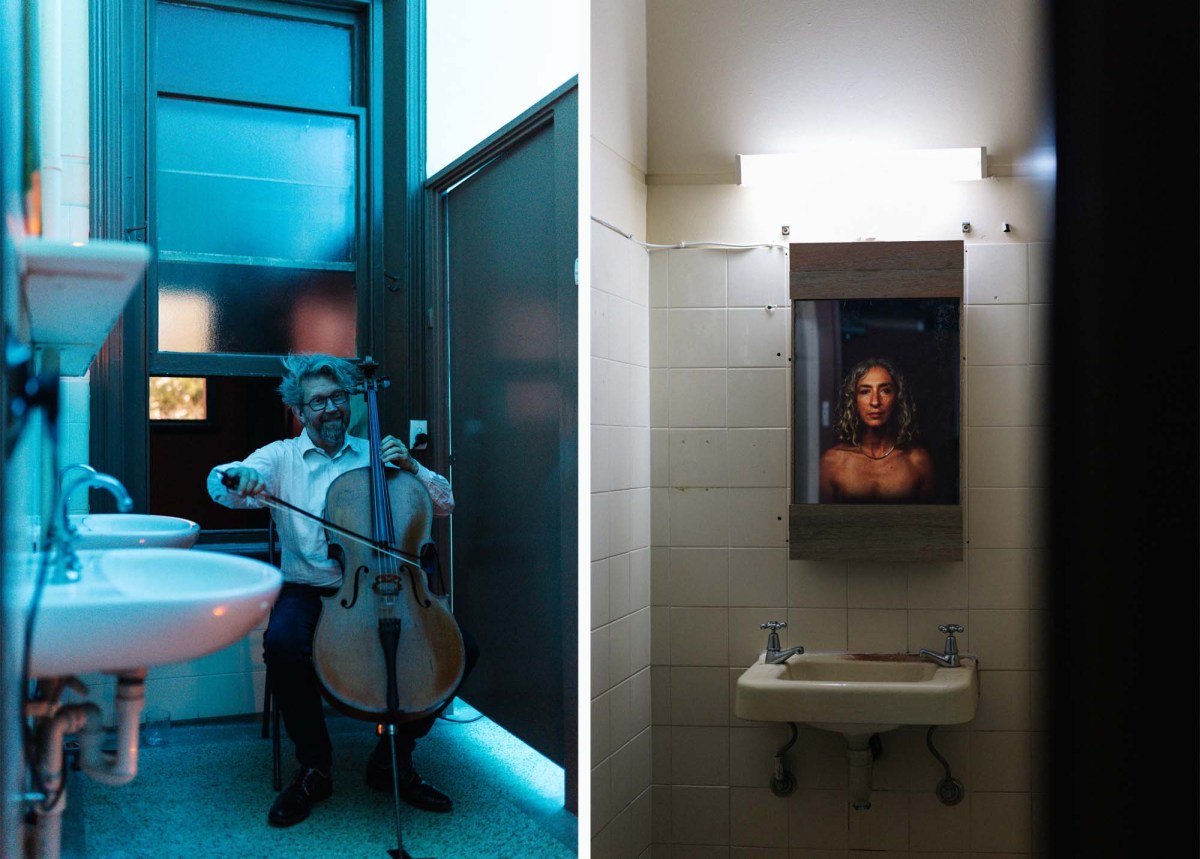
Room Service invited over 40 artists to take over the rooms of a soon-to-be renovated old Fremantle hotel, and was undoubtedly the festival’s greatest hit.
Only once before has Perth (Boorloo) experienced this kind of explosive artistic energy under just one roof. When artists Christian de Vietri, Ben Riding and Hannah Webb presented their legendary project Hotel 6151 as part of the Artrage Festival in 2002, a similar kind of wild chemistry was unleashed and in some ways, it’s a shame that 20 years has passed without another such event, until now.
For the Fremantle Biennale’s Room Service, the show’s curators – singer-songwriter Danielle Caruana and the Biennale’s Artistic Director Tom Mùller – and its creative producer Odetta Davison, invited audiences (or ‘hotel guests’) to be guided through its spaces by the artists (‘hotel staff’) where a bevy of live art installations, performances and interactive works unfolded around every corner.
Two examples (among so many that deserve high praise) are WA composer Iain Grandage and cellist Mel Robinson’s contemporary music work, which echoed through a hotel bathroom space; and Perth-based musician and performer Queency serenading audiences with French love ballads in an adjoining room.
An added bonus of Room Service was that local visual artist and professional tattoo artist Sam Bloor was on hand throughout to give audience members a free (permanent) tattoo of the 2025 Fremantle Biennale signature image or ‘SANCTUARY’ text if they desired it – and many did.
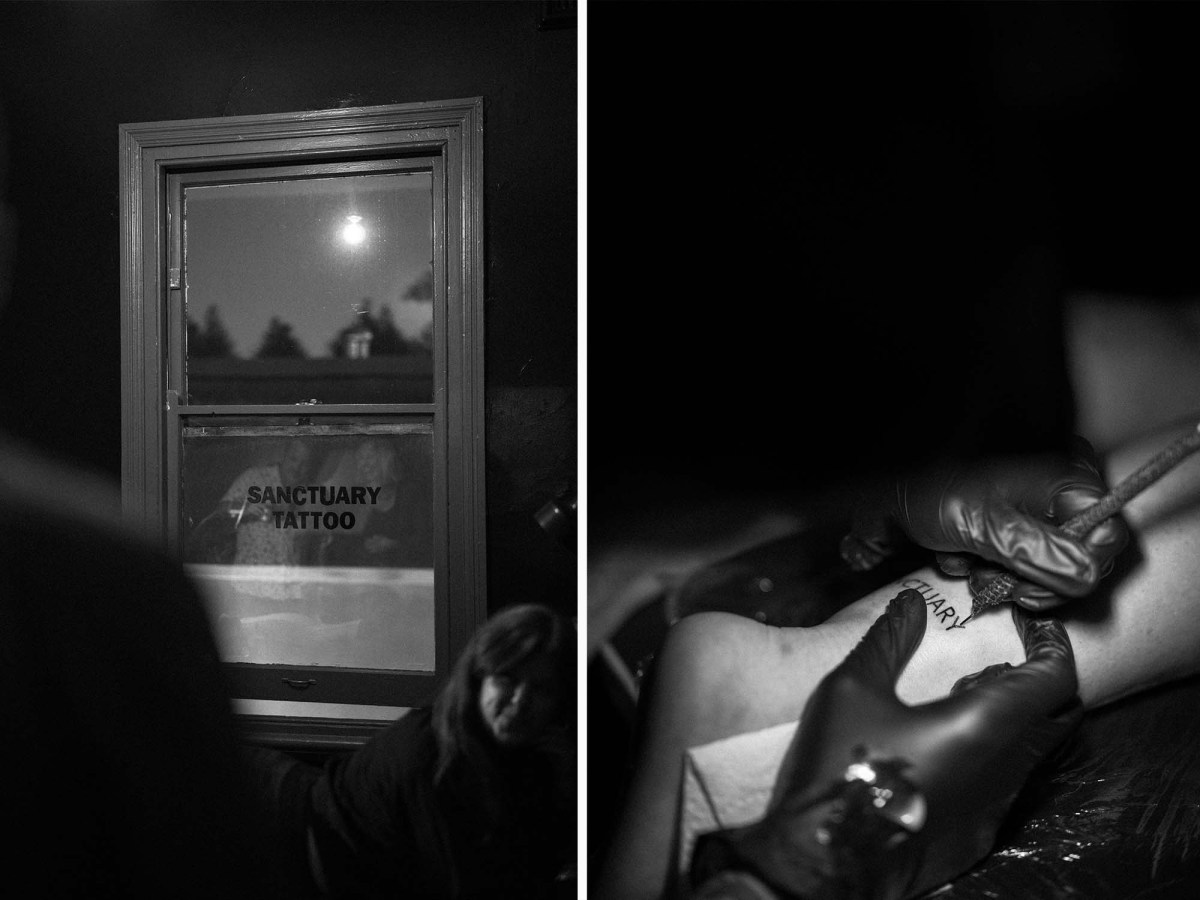
Ultimately, what is exciting about these ambitious site-responsive, live, ‘group show’ artworks is how much energy is generated, for both artists and audiences, when creatively-minded business people – in this case property developers – partner with visionary artists to allow durational new works to come alive on their sites. We need more of them!
Read: Data Dreams: Art and AI review: exploring artist-AI collaborations
Veil
On an entirely different note, and played in an entirely different key, was a work by Western Australian photographer Duncan Wright.
His exquisite piece Veil came to life within a very small tin shed which was placed on the sand in front of the ocean on Bathers Beach (Manjaree).
Its tiny shed structure was chosen by the artist because it belonged to his late grandfather and housed strong personal memories.
For biennale audiences, this little hut came to life as a small sanctuary where one could contemplate the ocean shoreline and its beach traffic through the lens of its pinhole camera – a cup-sized hole which was pierced through its ocean-facing wall – which cast inverted moving images of the outside scenes onto its interior walls.
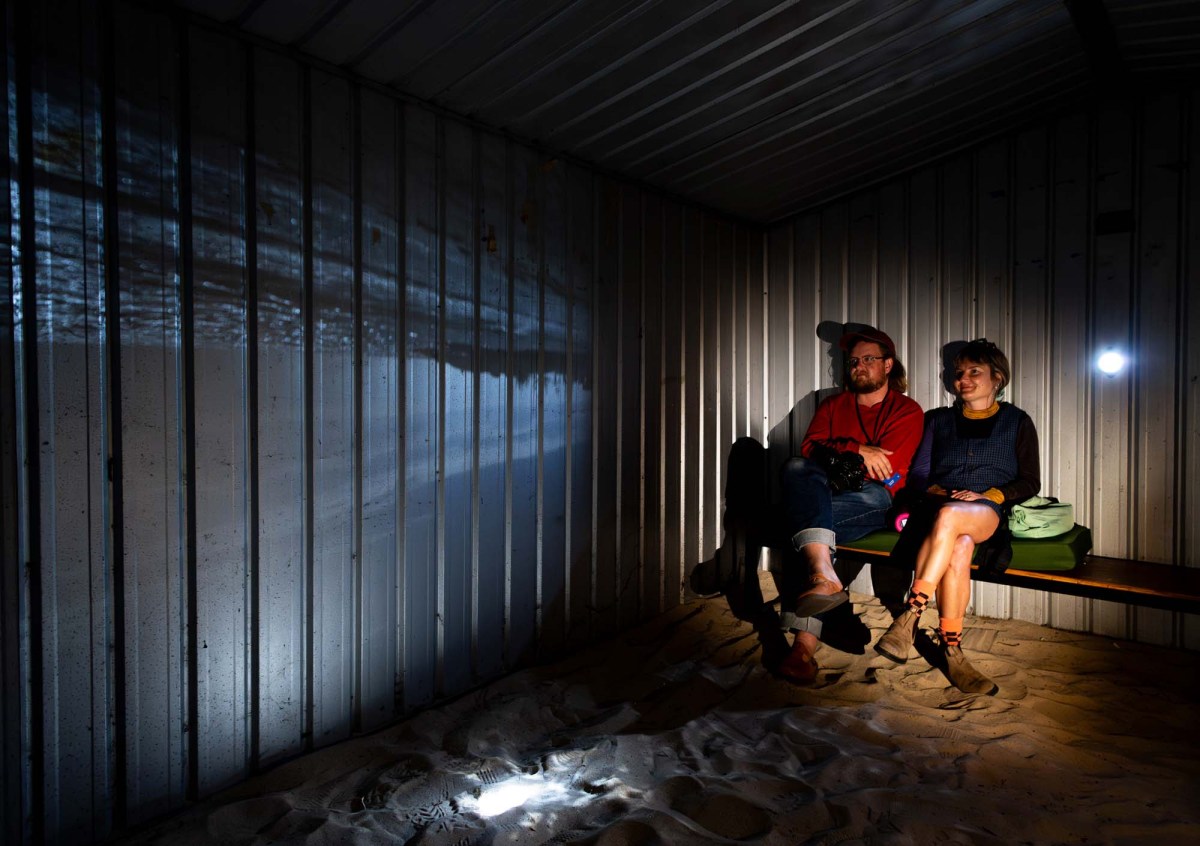
It was beautifully peaceful and this multi-layered site-responsive work was the festival’s magic little hideaway place.
That said, the tiny space got unbearably hot in the middle of the day. Perhaps if the work is shown again, there could be some kind of insulation or a fresh airflow system to ensure audiences can sustain the long sitting times this piece really deserves.
A Predatory Chord
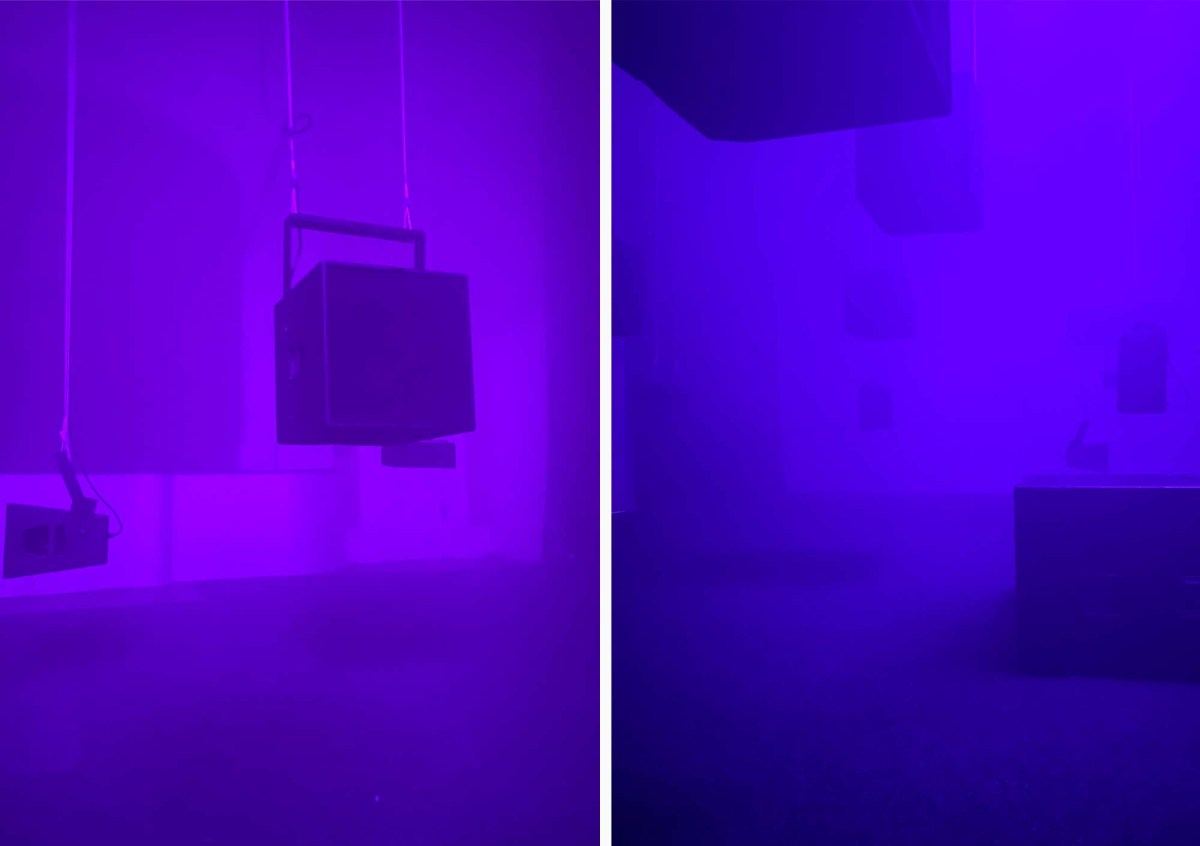
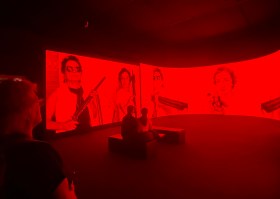
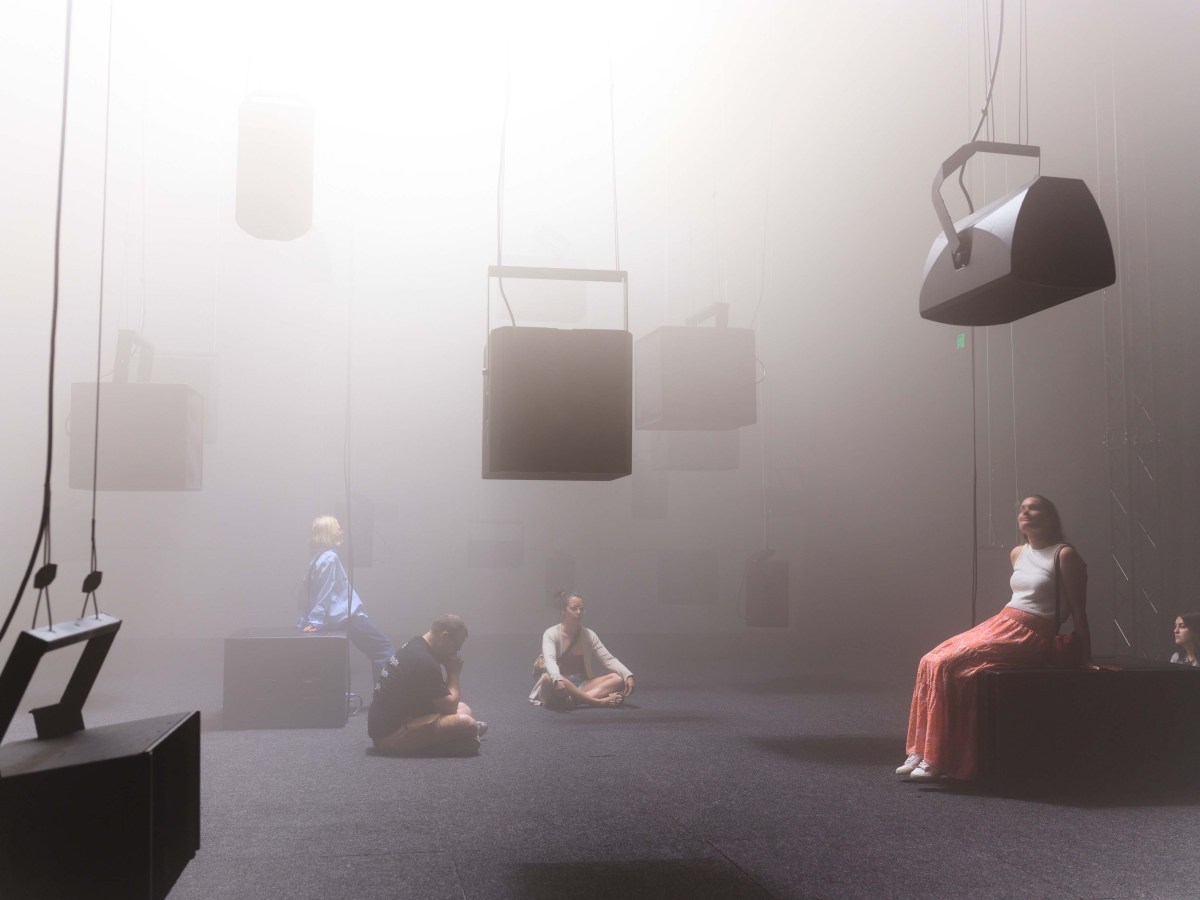
Headlining festival artist Ben Frost’s major installation work A Predatory Chord proved another immersive feast.
Housed in Victoria Hall in Fremantle (Walyalup) and open for ticket holders to experience for as little or long as they liked, this durational sound and light piece comprised a 20-minute abstract sound track, played on loop through 32 speakers suspended at differing heights throughout what is mostly a very dark space.
Many audience members chose to sit or even lie down in the room to experience the work which, despite the sometimes ominous, pulsing, heavy beats and occasional harsh strobe lighting effects, induced a strangely meditative state for many.
According to one of the show’s invigilators, it seems (surprisingly) that only a small minority of the work’s audiences felt unsettled and unnerved by the piece. The majority stayed for up to an hour to enjoy its sanctuary-like enclosure and feelings of transcendence.
Exhalation
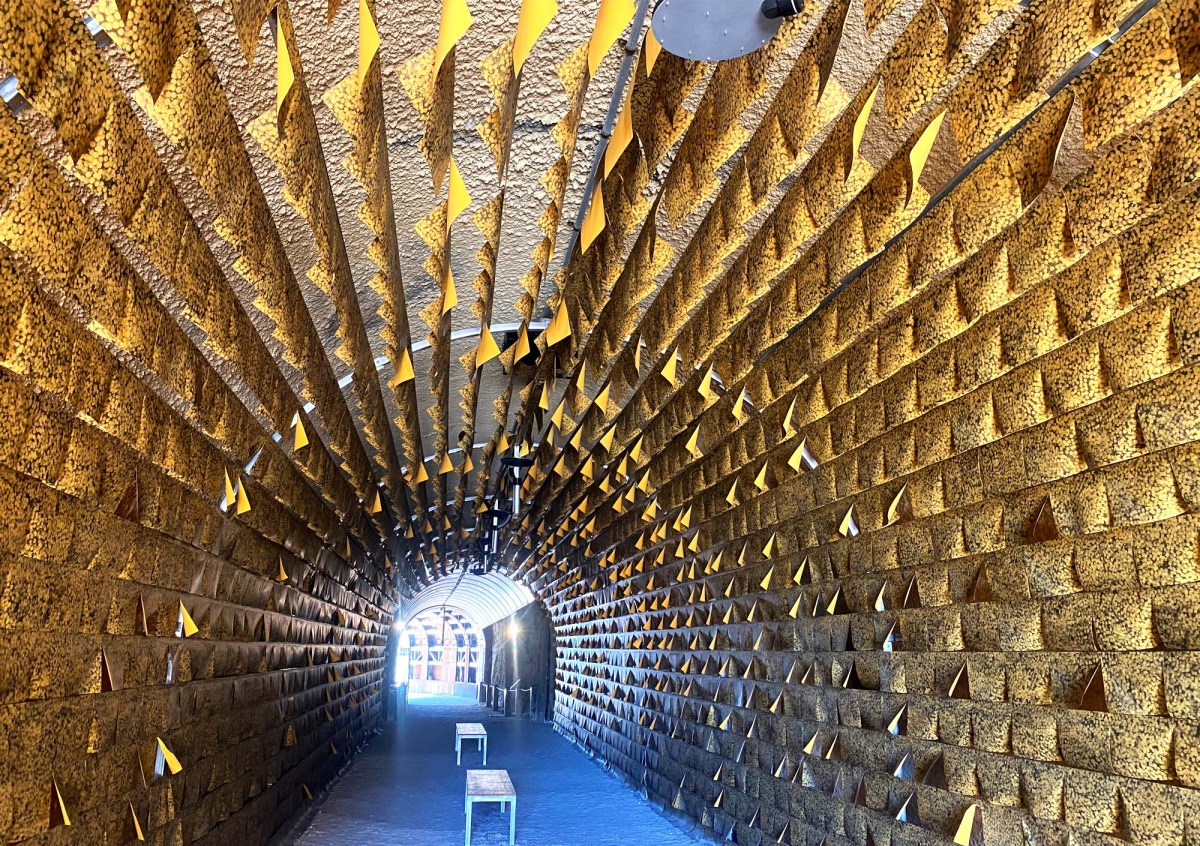
Another installation with beautifully transcendent qualities was the site-specific sound and visual artwork Exhalation by artists Madeleine Flynn and Tim Humphrey from Melbourne (Naarm) with Vuth Lyno from Phnom Penh, Cambodia.
Responding to the Whaler’s Tunnel site that takes Fremantle (Walyulup) visitors from its 19th century streets to the shoreline of Bathers Beach (Manjaree), the artists adorned the tunnel’s inside walls with printed paper, making the space come alive as a fluttering sculptural work whenever the wind blew through (which was often).
Against their soothing musical score, the artists’ delicately printed papers formed soft waves of motion as they were buoyed by the wind’s currents, transforming the passageway from a transit area for people to get ‘from one side to another’ to a place where audiences felt compelled to spend a long time ‘in the middle’.
Pool of Content
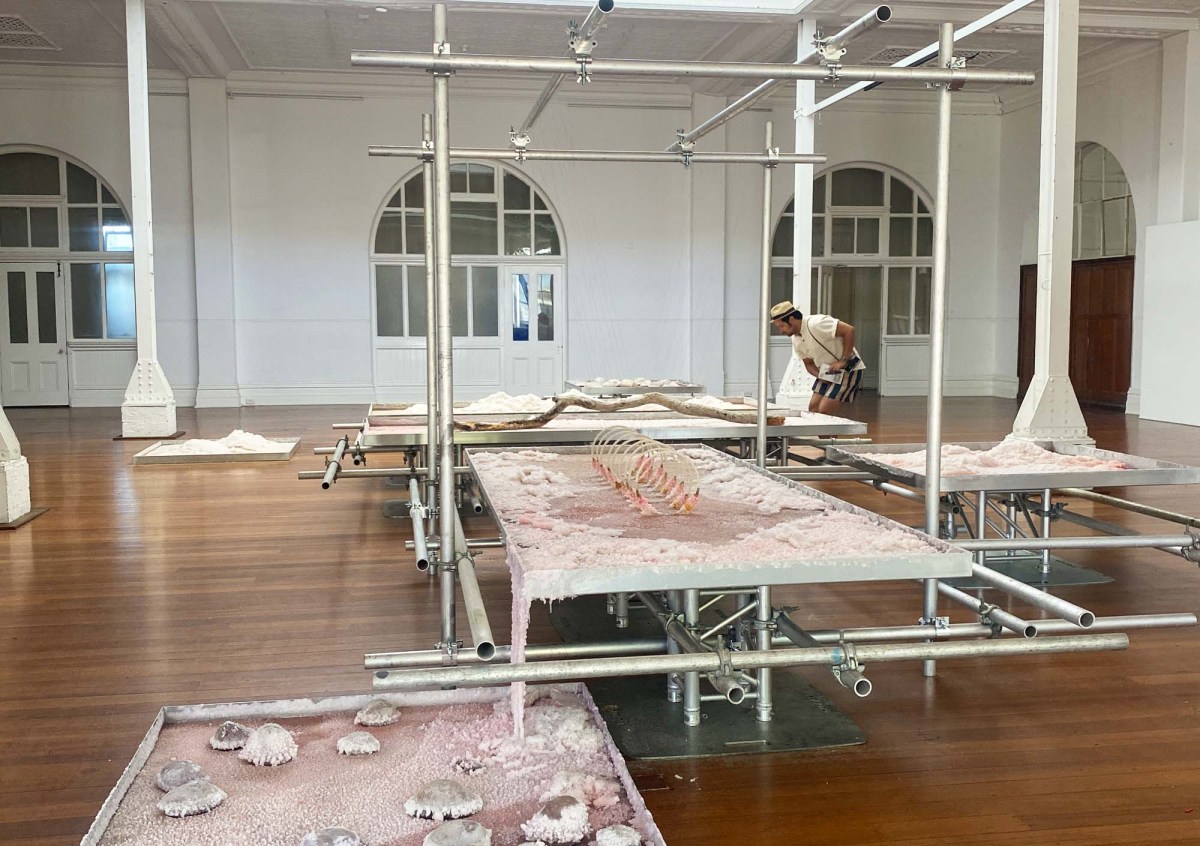
Also contemplative but more studious in style was Pool Of Content by Melbourne artists Wona Bae and Charlie Lawler at the Old Custom’s House in Fremantle (Walyulup).
Responding to the immensity of light flooding into this gallery space – with large windows and an extremely high ceiling with skylights – the artists explored the pink lake phenomenon that is well-known to many Western Australians and tourists.
But Pool of Content is a double-edged investigation of both the beauty and environmental dangers of these dazzling ‘natural’ salt formations.
The artists’ crystallising salt lake work and accompanying screen-based video piece allowed audiences to reflect on our environment’s delicate natural balance. It was also a chance to consider how – as the narrator (and poet?) of the screen work tells us – these saline environments are being ‘fractured under the weight of [their] own stillness’.
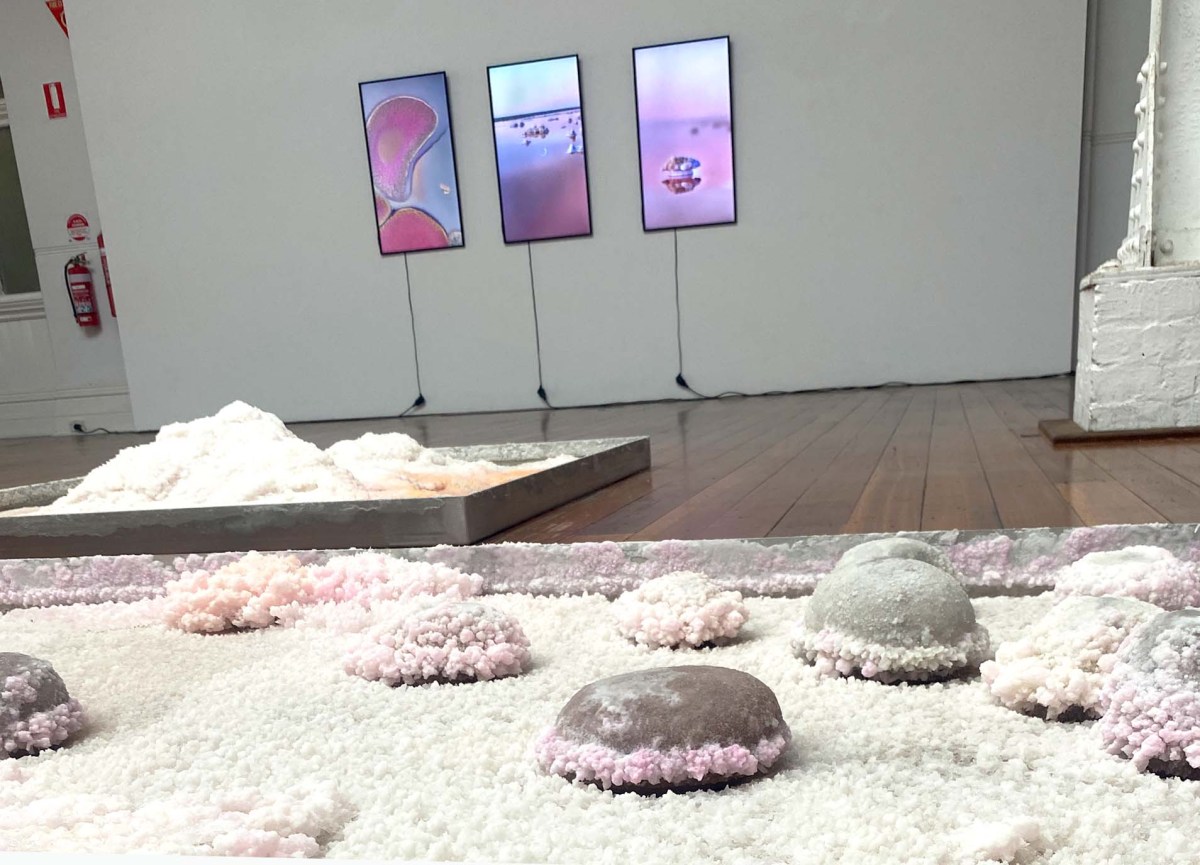
Yet Pool of Content shows that even within these seemingly still, stagnant structures, an abundance of fervent activity takes place at a microscopic level in these briny expanses.
Another line in their screen work contends that, ‘In the quiet crystalline world – life is endless’.
Indeed, Pool of Content offered poignant reminders of everything that is ancient, enduring, everlasting and monumental, while at the same time (remarkably) drawing us closer to the environment’s tiniest details and its delicate, ever-changing forms.