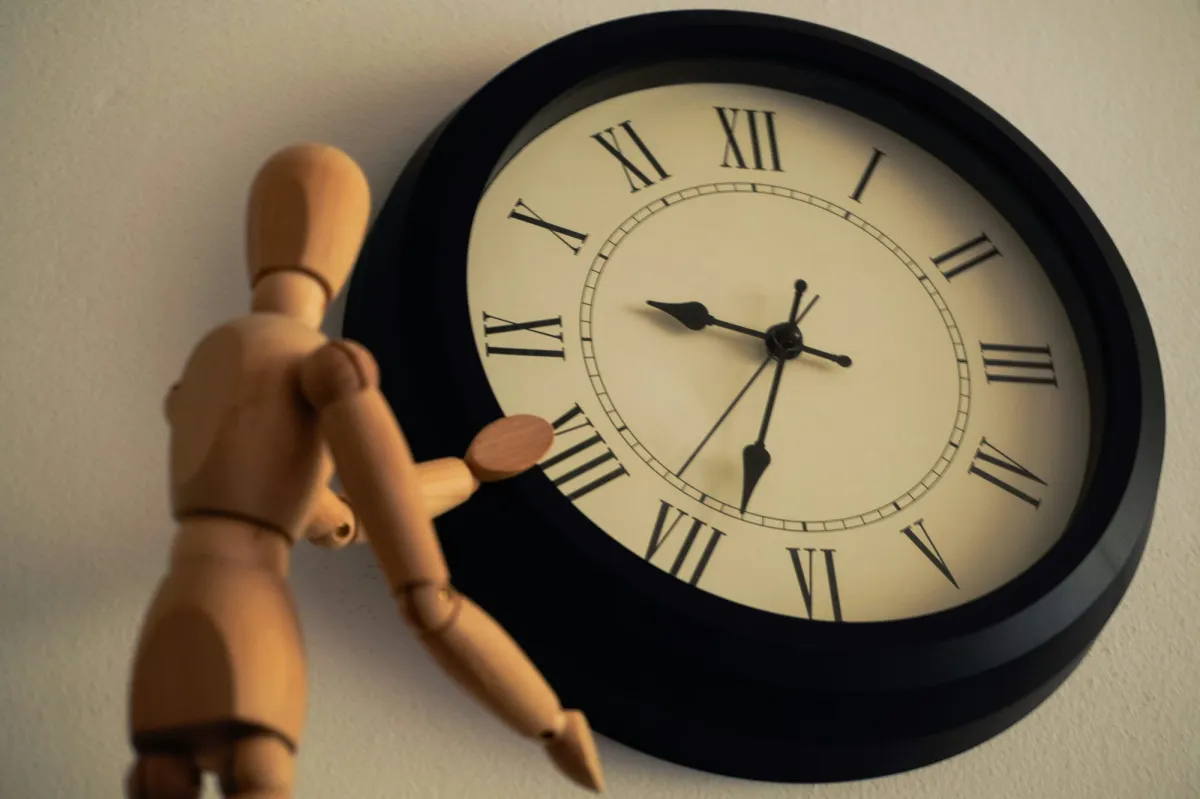
Each time I open a file in Adobe, I am greeted by the tiny suggestion: ‘This appears to be a long document. Save time by reading a summary using AI assistant.’ If I read these words enough times, my blood vessels will surely swell and rupture in an aneurysm.
Thirty years ago, in an industrial town shadowed by an escarpment and dotted with flame trees, I began my training in reading, critiquing and writing literature. In the university library, I knelt on the carpet between stacks, pulling out books and hauling them to my dorm in a pink PVC backpack. I sat in my small room, reading about plot structure, character, themes and motifs, the cultural contexts that shaped the writers — who were predominantly women — and their intentions. I learned how to find patterns in a book and to contemplate how they intersected with my own voice and craft.
I worked as a temp during my holidays but at uni, my time unspooled. I stayed up late reading, developed arguments for my assignments as I walked for the hour to and from uni, scrawled in a journal each day to improve my writing, and at lunch time sat under a tree on the lawn and read Virginia Woolf’s essays, Chaucer’s The Wife of Bath, and the poetry of Kamau Braithwaite.
Why, after all this training, would I want to ‘save time’ by using artificial intelligence to come to conclusions for me? Particularly when I am a disabled person whose disability has indelibly shaped their own reading and writing practices?
Crip time and Deaf time
I lost most of my hearing when I was four. To exist in the hearing world, I lipread and rely on technology to augment the remaining hearing in my right ear. It is an exhausting process, requiring intense concentration on lips and eyes while my brain whirrs furiously to decode sound and piece together conversations and context. Perhaps an analogy that non-deaf readers can relate to is travelling in a country where they are not quite fluent in the local language.
ArtsHub: Why is there so little nature writing by disabled Australian writers?
I usually don’t realise how tightly my muscles are coiled from straining to hear until the day after an event, such as a writers’ gig, or teaching a class. I wake so tired I cannot move. To recover, I write in bed, nap, work shorter hours and make up the time on the weekends when I have more energy.
After a conversation with fellow Deaf writer Fiona Murphy, we designated this Deaf time: the time needed to exist as a Deaf person, both to process sound and to recover from that processing.
In disability communities more broadly, the way disabled people experience time is known as ‘crip time’. It is a challenge to conventional ways of experiencing time, with disabled bodies moving slower, or faster, than nondisabled bodies do. In a world in which we are pressured to be productive, to use technology that will hallucinate and confabulate to deliver its answers, I think crip time is a feature, not a bug.
The Great Acceleration
In 2000, the year I moved to Sydney and commuted to uni on the train, reading novels and literary criticism as the carriages wended through tunnels and alongside the glittering ocean, biologist Eugene Stoermer and atmospheric chemist and meteorologist Paul Crutzen proposed a new geological epoch to reflect humans’ extraordinary impact on the earth: the Anthropocene. Crutzen nominated the industrial revolution as the start of this epoch, coinciding with James Watt’s invention of the steam engine in 1784.
From 1999 to 2003, the International Geosphere-Biosphere Programme, an organisation dedicated to studying climate change, was inspired by Crutzen and Stoermer’s proposition to build a more systematic picture of humans’ impacts on the earth. They chose 1750 as the start date and mapped socio-economic trends (such as primary energy use, paper production, water use, international tourism) and earth system trends (such as carbon dioxide, marine fish capture, tropical forest loss and ocean acidification) across 24 charts.
The IGBP team had expected to see a growing impact of humans from the start of the industrial revolution. Instead, they mapped a radical increase in human activity and resource consumption from around 1950 onward. These charts reflected what came to be known as the ‘Great Acceleration’.
In 2010 the charts were modified to reflect the uneven distribution of consumption, with the bulk of economic activity and consumption occurring in OECD countries. The impacts of the changing climate, including floods, landslides and fires, are being felt most strongly in the Global South. In Australia, although we are wealthy, the most disadvantaged people, such as disabled people, are still frequently left out of disaster planning.
The IGBP was disbanded in 2015. I wonder what the maps would reflect today, a decade later, particularly with AI data centres’ astronomical usage of water and energy.
I wonder, too, what role disability might play in slowing things down.
Writing and reading crip time
Rose Michael’s speculative climate fiction novel Else (2025) opens with a mother, Leisl, returning to her daughter’s school to collect her child, Else. Usually, Leisl is called to the school because Else, who is neurodivergent, is struggling, but this time it is because of rising floodwaters.
Leisl and Else flee the flooding city for their family homestead at the Ninch (the locals’ name for the Mornington Peninsula). Else’s release from the strict routines of school, with which she struggles, signifies an opening into a new mode of inhabiting the world.
She ‘likes anything that undermines time – a social agreement she seems not to have signed up to’. When the routines to which they are accustomed fall away, Else thrives. She and her mother ‘rely on biological timekeepers: their circadian clocks, hippocampal cells’. Else, ‘who is strong and stoic and built for this’ – that is, survival – attends to the natural world so closely that she learns how to find food for her mother and their nonhuman companions (a dingo and a magpie). Else flourishes in a world that does not adhere to the rigours of the clock.
In Deaf writer Fiona Murphy’s story Fatigue Markers, the protagonist joins an experiment that involves living in a dark cave in France for several weeks to analyse her body’s automatic rhythms. As the story progresses, it becomes apparent that the narrator is grieving.
The title refers to the bumps at the edge of a road that prompt drivers to stay awake, but as I read the descriptions of darkness and slowness, I interpreted the narrator’s experiences in the cave as a metaphor for the leadenness of fatigue that comes with deafness.
When the lamps go out, the narrator cannot tell exactly when it happened, ‘maybe it was an hour or even minute ago’. Without the light, the narrator’s sense of time alters, her body shifting into the nonhuman realm. She becomes ‘attuned to the rhythm of growth’ and her body ‘seems to thrive in the dark, like a mushroom or an immense carpet of moss’. As with Else, without the usual markers of time, the body is released into a new way of existing in the world.
In Speed and Politics (1977), French philosopher Paul Virilio argues that changes in transportation and technology changed the way we think. An increase in military speed – from soldiers on foot to bullets to drones – led to shrinking space. ‘In less than half a century,’ he writes, ‘geographical spaces have kept shrinking as speed has increased.’ Not only are space and time dwindling, but the rate of change is accelerating. We need to learn new platforms and software, and we need time to consider the implications and ethics of their utilisation.
Slowing down allows us to inhabit the world in a thoughtful way. Crip time resists superficiality and engenders contemplation.
The Homogenocene
Many alternatives have been proposed to the Anthropocene, because it cannot effectively capture the uneven ways that humans have impacted our planet (with much of the damage carried out by the Global North, and the Global South experiencing the fallout more savagely).
The Capitalocene (the age of capitalism), the Plantationocene (the age of colonisation and extractivism), the Eremocene (the age of loneliness) and, most recently, the Homogenocene, all place a different emphasis on structures that have created the climate crisis.
The Homogenocene is the age of sameness, a world of ‘fewer places with their own distinctive life’ because of human impacts on biodiversity. AI is part of this impact. Its data centres, which require massive reserves of water and electricity, are both an ecological nightmare, contributing to climate change and its cascading effects on humans and nonhumans, and a humanitarian horror, exploiting workers in digital sweatshops.
The large language models that they service are also homogenising our language and culture. Their sentences are anodyne, their capacity to inhabit the thinking that comes with bodily differences is non-existent. ChatGPT and Claude, because they have not been programmed by Deaf thinkers, cannot read a text the way a Deaf and/or disabled person can. Indeed, they cannot comprehend a text at all.
The Homogenocene limits variation in our bodies, ecologies and words.
Resisting acceleration
In my essay We Were All Deaf During the Pandemic from my collection Silence is my Habitat: Ecobiographical Essays, I write how life during the pandemic became like Deaf time: quieter, slower, more watchful. I argue that we should return to Deaf time to help us take stock of and respond to the climate crisis, to cultivate critical thinking, to rest rather than extract.
ArtsHub: Silence is my Habitat – Jessica White’s essays are a powerful search for connection
Perhaps this is one way of resisting the cult of productivity, or what Virilio refers to in The Administration of Fear (2012) as ‘the cult of speed’, which he describes as ‘the propaganda of progress’.
Virilio also notes that the increasing acceleration of technology will lead to accidents. Things will break. While techbros might think that moving fast and breaking things is something to aspire to, I lie awake worrying about our fraying cultural fabric. I fear that, if I cannot teach my students critical thinking, we will eventually be governed by leaders who outsource their decision-making.
Perhaps if we all inhabited Deaf time, our culture and planet would stand a chance.