
Painted Up: This vibrant exhibition challenges colonial perceptions of Aboriginal art

Dean Biŋkin Tyson artwork moves through ancient practices and modern materials at Redland Art Gallery.
Artist Dean Biŋkin Tyson on Country, 2026. Image courtesy of Seth LeBrese.

For artist and cultural practitioner Dean Biŋkin Tyson, painting is not a static act of image-making. Rather, it’s a living practice handed down through generations, one that is embedded in body, object and Country.

A Quandamooka and Gurang man who lives and works on his traditional lands in Southeast Queensland, Tyson’s work emerges from decades spent as a dancer, songman and bidiyamundu (didgeridoo) player. His transition into visual art, he explains, was less a dramatic shift than a natural continuation: ‘My roots are in cultural knowledge, and the art has come naturally with that … it didn’t happen overnight. It happened over many, many years of learning stories, dancing …’

CREATE EXCHANGE: Painted Up

Presented across two venues by Redland Art Gallery, Tyson’s new exhibition CREATE EXCHANGE: Painted Up demonstrates his vibrant and communal-minded art style, honouring and preserving cultural traditions while also pushing back against limiting colonial perceptions of Aboriginal art.

Materials range from canvas to animal skins, while collaborations with community practitioners reinforce the collective nature of cultural production. ‘[Aboriginal art] doesn’t have to be dot art on a canvas,’ says Tyson. ‘It can be so many things … blending our time now, but also our ancient culture.’

The term ‘Painted Up’ refers to the ritual act of painting the body, which Tyson describes as layered with meaning, this mark making also extending to objects or artefacts.

‘Sometimes people might just see that we apply the ochre,’ he says. ‘But there’s stories inside there … even the colours can be chapters of the story.’ Markings can denote identity, place and kinship, functioning ‘very similar to a uniform or military regalia, showing what Country you come from and who you are’.

This logic of mark-making and symbolism extends throughout the exhibition, where minimalist and abstract visual languages carry dense cultural information. Repeated motifs – such as the dolphin, an important totem for Tyson’s Ngugi lineage – anchor the work in ancestral relationships, while colour operates as both cultural and contemporary signifier.

Alongside traditional early tones of ochre, Tyson incorporates vivid shades of turquoise and aqua, which ‘represent a new and contemporary colour … but also the location where we live in Saltwater Country’.

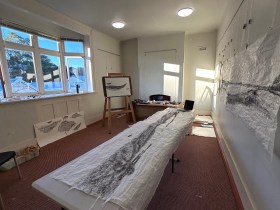
At the heart of the exhibition is a large-scale mural. Designed as a teaching tool, its composition resists linear storytelling in favour of an image-based narrative structure, allowing viewers to ‘reference and point to’ stories embedded across its surface.

Crucially, Tyson avoids stale, museum-style display conventions, instead foregrounding movement and lived use. Objects and artefacts like boomerangs and clapsticks are positioned alongside shadowed silhouettes, appearing as if in action.

This approach extends to the inclusion of ‘shadow boxes’ – assemblages of carved artefacts with complex histories. A contemporary form of Aboriginal art and craftsmanship, shadow boxes were originally produced in the 1970s in Aboriginal mission contexts. Often displayed in family homes and rarely sold outside communities, the practice reflects both cultural continuity and adaptation under restriction.

‘There’s a real sense of power and pride in that symbol,’ says Tyson. ‘Knowing the story and how it trickled through the cracks of the genocide and all the oppression.’ Two shadow boxes and a painted iteration appear in the exhibition, honouring both the makers and the intergenerational knowledge they carry.

‘I’m honoured to share culture … I will always have a flavour of colonial resistance in my artwork,’ says Tyson.

‘Art is a beautiful vessel to carry stories, because it asks questions,’ he says. ‘Like, I’ve made a spear in this exhibition with metal prongs, which is a testament to living in new times but still carrying on traditional practices.

‘You know, sometimes we hunt in a dinghy, and sometimes we go hunting with a fishing rod. It’s still the same thing, like painting – I might change my ochre and use acrylic paint, but the story still is the same.’

The exhibition sits within Redland Art Gallery’s broader CREATE EXCHANGE program, a three-year initiative fostering cultural exchange between Quandamooka artists and the wider Redlands community. Tyson describes it as ‘a connection … to make sure we don’t have a void between us,’ praising the gallery as a site for dialogue rather than display.

‘This [exhibition] is an invitation to be more intimate with the Country that you live on, work on, or that you visit … to feel connected as we do.’ With that connection comes responsibility – ‘to keep this beautiful place as abundant and as proper as we can’.

‘I invite our cultural ways of Quandamooka people to be known, shared and practised by non-Aboriginal people. Because we are all human beings at the end of the day, and we need to care for the land and the places and the spaces that we get to inhabit.’

Key Exhibition Details:

CREATE EXCHANGE: Painted Up – Dean Biŋkin Tyson
Redland Art Gallery: 7 April–9 June 2026
Exhibition continues at Redland Art Gallery, The Mezz at Redland Performing Arts Centre: 23 March–29 May 2026.

Artist in Conversation: 10am, Saturday 31 May 2026. Bookings and full workshop and event program available via gallery website.

Painted Up is part of CREATE EXCHANGE, a three-year program of artist-residency-style exhibitions and activations presented by Redland Art Gallery across its Cleveland venues. The initiative is supported by Haymans Electrical and Data Suppliers, Queensland Art Gallery | Gallery of Modern Art (QAGOMA) and Redland Art Gallery | Redland City Council.


Discover more screen, games & arts news and reviews on ScreenHub and ArtsHub. Sign up for our free ArtsHub and ScreenHub newsletters.

Alannah Sue is a writer, editor, theatre critic and content creator with a passion for arts and culture and all that glitters. She relocated to Melbourne in 2025 after spending over a decade embedded in the Sydney arts landscape and finishing up her tenure as Arts & Culture Editor at Time Out. In addition to contributing to ArtsHub and ScreenHub, her freelance portfolio also expands to editorial and copywriting for lifestyle and arts publications such as Limelight and Urban List, cultural institutions like the Sydney Opera House, and marketing and publicity services for independent artists. She is always keen to take a chance on weird performance art, theatre of all kinds, out-of-the-box exhibitions, queer venues, and cheap Prosecco. Give her half a chance, and she will get on a soapbox when it comes to topics like the magic of musical theatre, the importance of rigorous arts criticism, and the global cultural implications of the RuPaul’s Drag Race franchise. Connect with Alannah on Instagram: @alannurgh.