Coming off the back of Ellie Buttrose’s Golden Lion for Best National Presentation at the 2024 Venice Biennale for her presentation of Archie Moore’s kith and kin, all eyes are on Buttrose’s delivery of the 2026 Adelaide Biennial of Australian Art.
The pressure is unspoken; but Buttrose seems unfazed. She meets it with the same determined clarity that has come to define her curatorial voice – only this time, she takes a more circuitous, materially charged path.
Yield Strength: Adelaide Biennial
Responding under pressure
Opening the exhibition’s catalogue – which takes the format of a magazine to emphasise the temporality of survey exhibitions – one is invited: ‘Dear Reader, Yield Strength is an exhibition about limits.’
And it does push our limits.
Yield Strength is an engineering term describing the point at which a material, under force, begins to deform irreversibly. It is a precise metaphor for the cultural moment: how much pressure can bodies, communities, ecologies and institutions absorb before something gives?
In Buttrose’s hands, the stress test extends to the survey exhibition itself. Rather than smoothing the edges, she leans into friction – challenging popularist demands that have pressured programming in recent years.
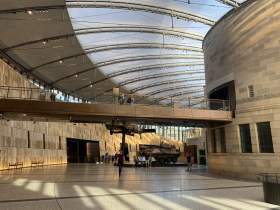
Staged across the Art Gallery of South Australia (AGSA), Samstag Museum of Art and the Adelaide Botanic Garden, the Biennial unfolds in three distinct registers. At AGSA, works billow outward, expansive and airy; at the Gardens they feel suspended in time; at Samstag, density prevails. Works flow into one another, closing down the space between object and viewer until spectatorship gives way to immersion.
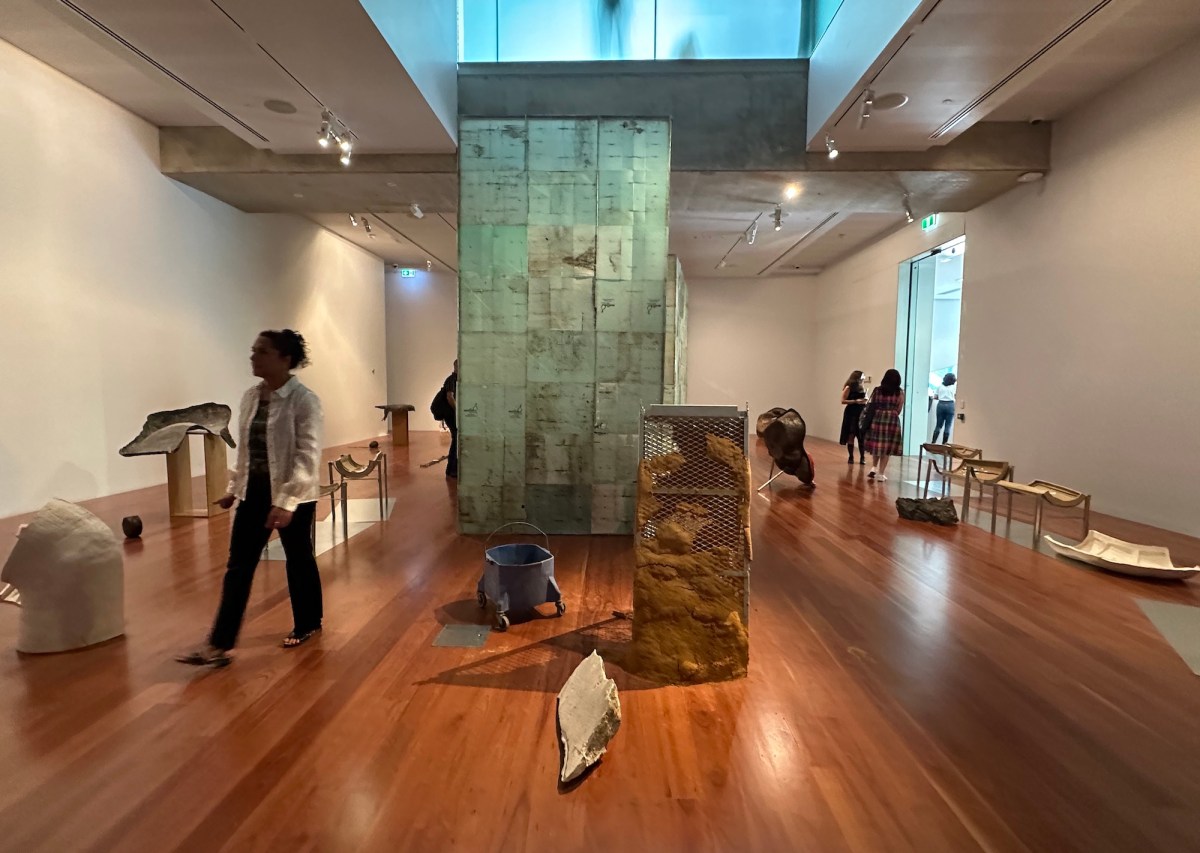
If one word encapsulates this edition, it is placement. Buttrose understands the liminal charge between works – the way meaning accrues not only within objects but in the air that separates them. Some juxtapositions are hard to read, quiet and slow-burning; others detonate, potent and charged. The exhibition’s rhythm relies on this push and pull.
A grungy honesty despite medium
There is a soft grunge aesthetic that pulses across this show, one that we haven’t seen in institutional shows for a long time. We have become so very safe. That refusal of polish has a cumulative effect: it’s shaped by artists, including Erica Scott, Charlie Sofo, George Egerton-Warburton and Isadora Vaughan; hessian, detritus and provisional structures embrace the abject and the unresolved.
What I love about this exhibition is its honesty. There is no flashy build out of walls.
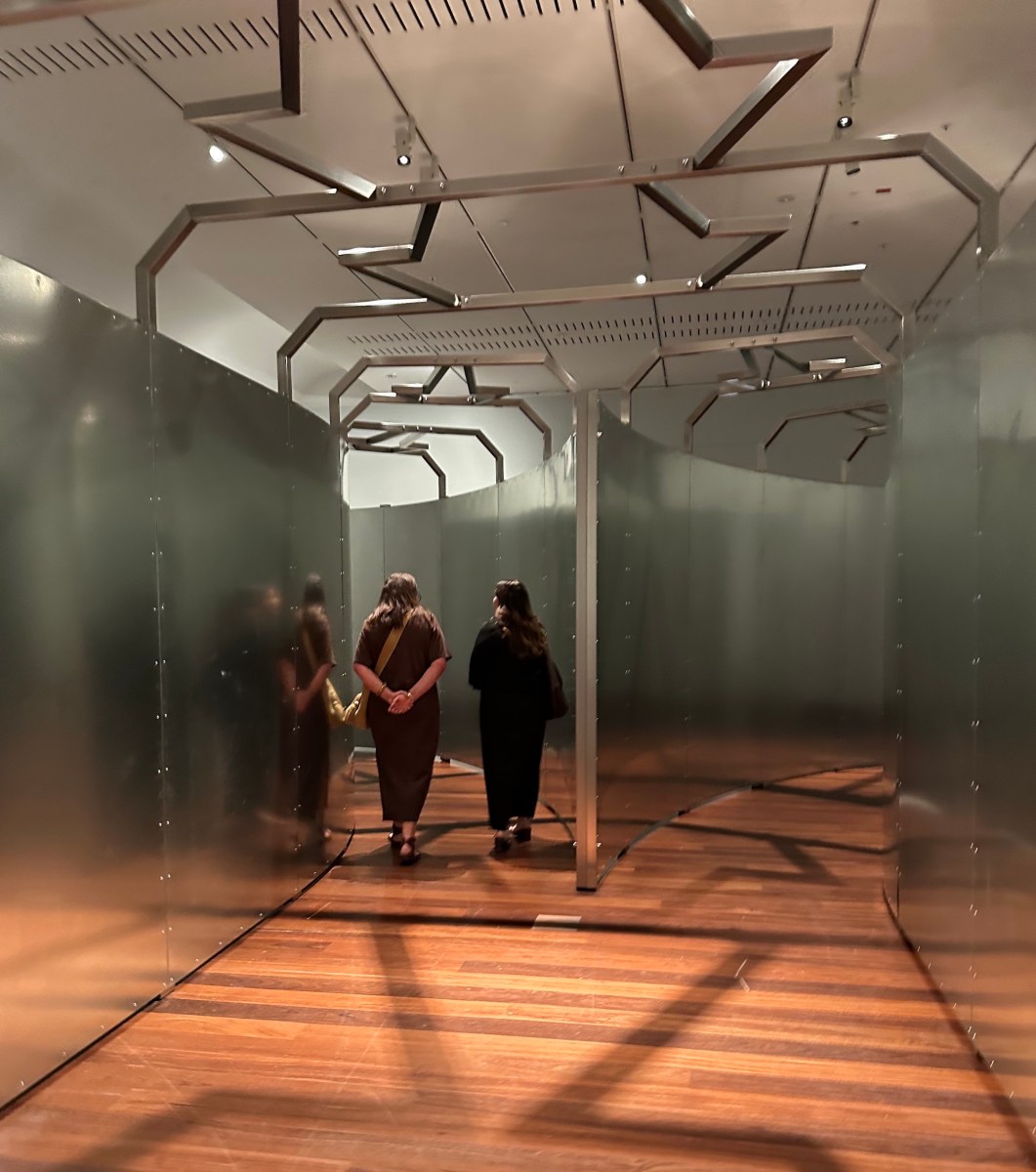
In fact, Buttrose leaves that to the artist on occasion, such as Jennifer Mathews’ takeover of the gallery’s passageways with the rural architecture of herding and containment.
She corrals visitors through narrow channels, forcing a bodily negotiation of space. In one configuration, audiences must choose left or right, each path delivering an intimate encounter with a solitary work. It is wry, distilled metaphor for contemporary society’s illusion of choice within pre-set systems.
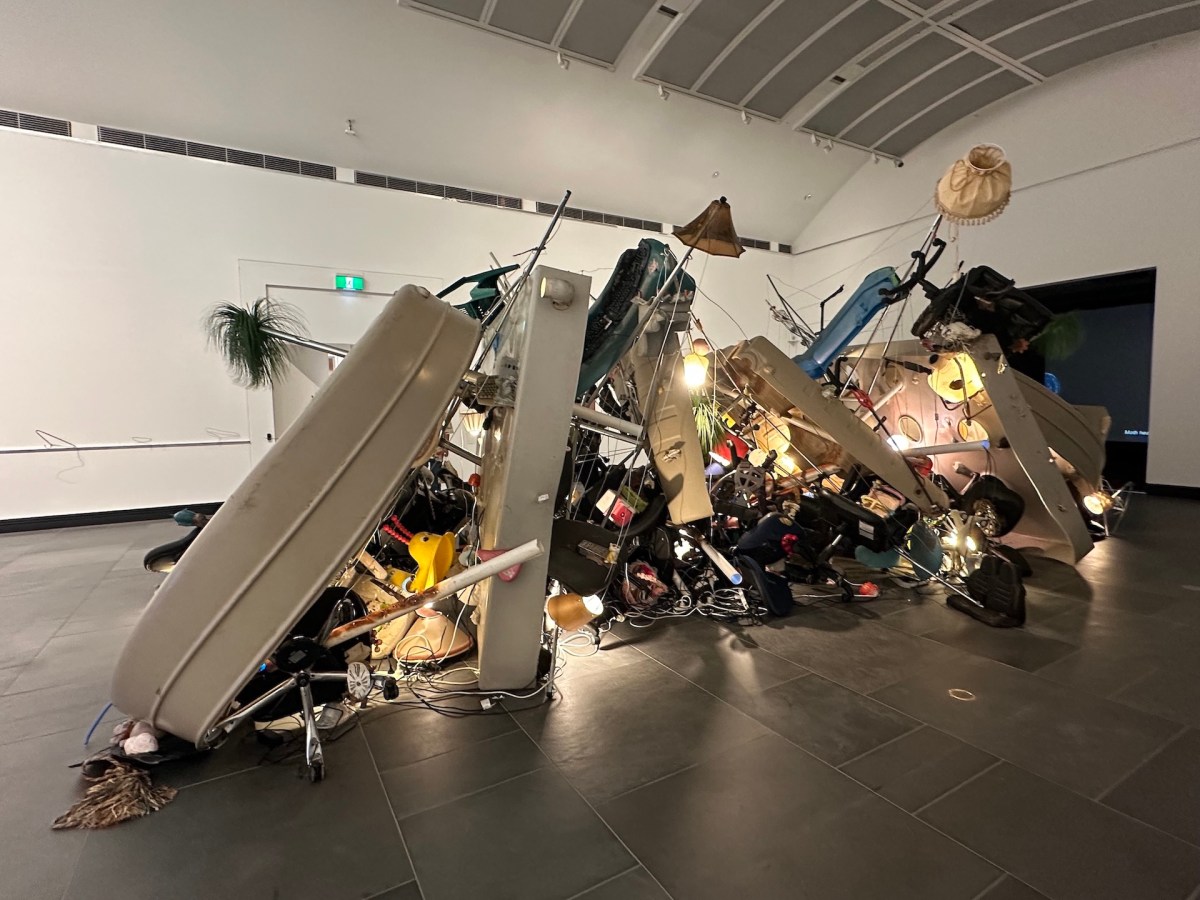
Buttrose’s pairings sharpen these readings. The charged domestic interiors of Prudence Flint – women in varying states of undress, surrounded by objects that both define – sit alongside a proliferating assemblage by Erika Scott.
Flint’s surfaces are taut, controlled, devotional to the minutiae of everyday life. Scott counters with a mushrooming accumulation of mass-produced plastic detritus, suggesting a future in which heirlooms are replaced by synthetic residue. The tension is electric. Value, hierarchy and sentiment are placed under quiet siege.
Buttrose revisits select artists across venues, a familiar device but deftly handled. Flint’s works, for instance, resonate differently when placed in proximity to Egerton-Warburton’s languid material investigations at AGSA and in the architecture of Samstag. These repetitions act as hinges, opening alternate readings and elongating time.
Compressing time through considered placement
The exhibition’s most conceptually lucid cluster – a kind of material shorthand for Buttrose’s Biennial – greets visitors at AGSA: Robert Andrew, Julie Nangala Robertson and Josina Pumani.
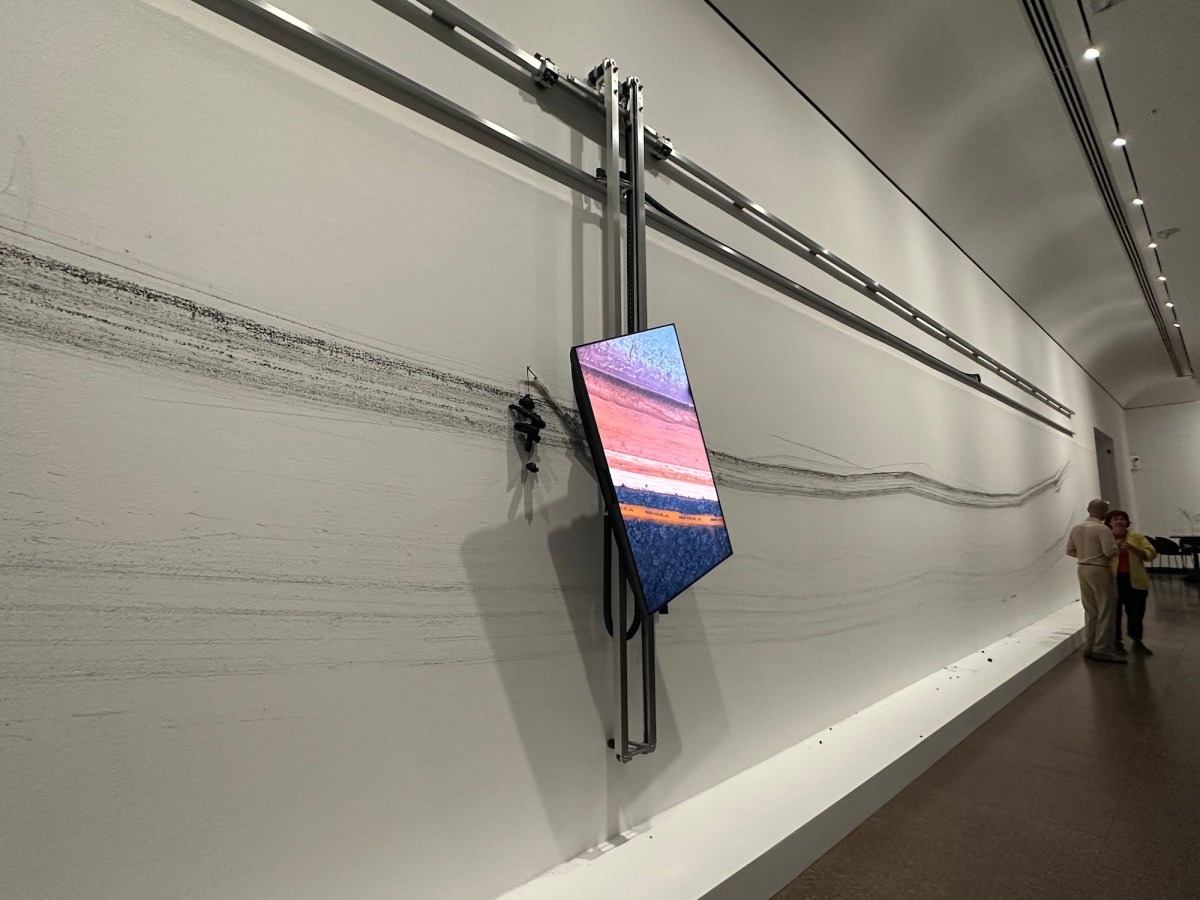
Andrew’s work stretches expansively along the downstairs gallery – a mounted screen showing aerial footage of his ancestral Yawuru Country slowly drawn out by a robotic arm dragging charcoal across the surface. The mechanical mark aligns with the filmed terrain, a stark metaphor for the technical colonisation of Country through mapping and inscription.
Within sight, Robertson’s paintings chart Warlpiri Country, also considered from an aerial perspective and referencing that abuttal of Western topographical mapping and storytelling of Country. We find our eyes eddying with her trails of dots, their delicacy counterbalancing Andrew’s mechanised gesture.
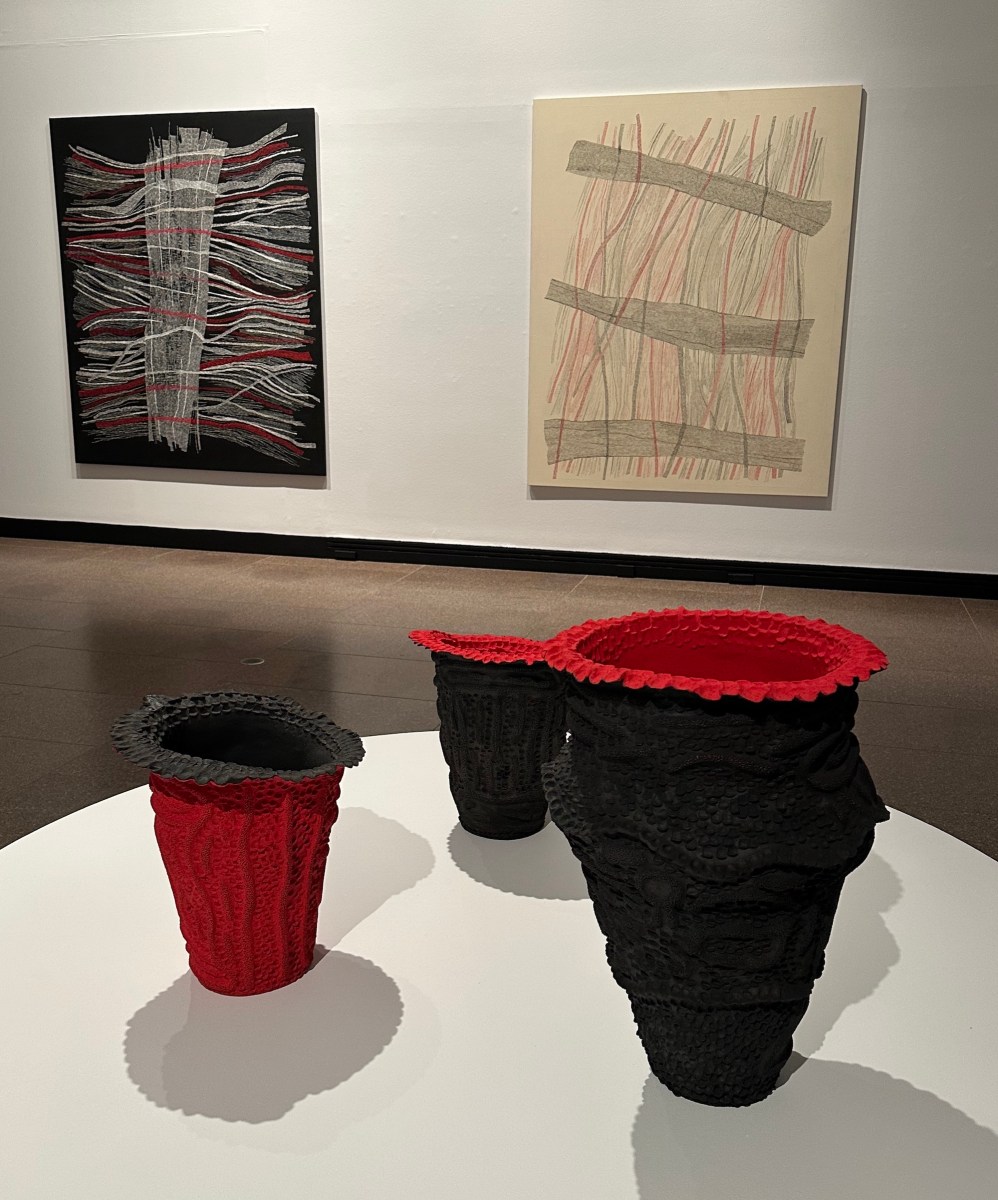
Completing the cluster, Pumani’s ceramics rise like blackened atomic clouds, recalling the nuclear testing at Maralinga between 1956 and 1963. Their blistered skins and red, raw cores speak to scarred land and community. Together, the three artists compress histories of inscription, resistance and survival into a single, potent field.
Read: Khaled Sabsabi: first details of Venice Biennale presentation
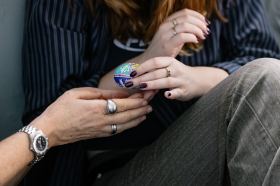
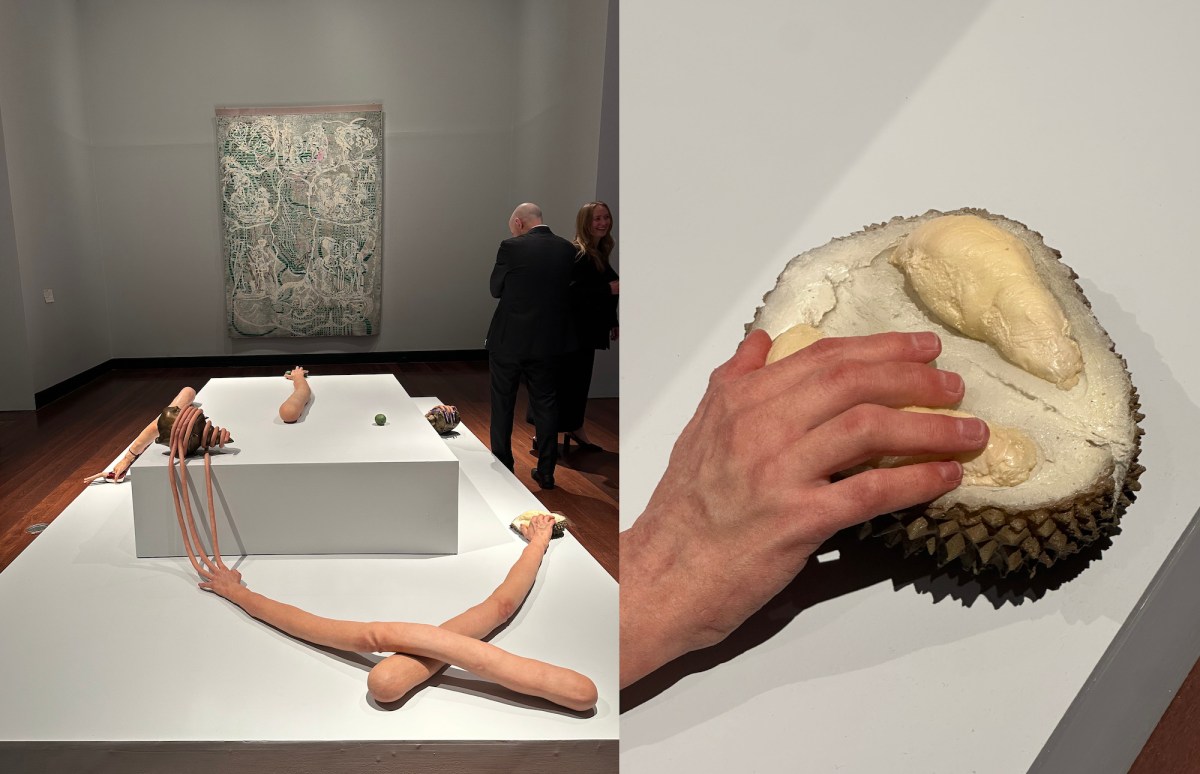
Material, here, is never material for its own sake. Nathan Beard recasts his Thai heritage through hyperreal silicone sculptures of his hands, clasping tropical fruits in elongated, stylised dance positions. They pull viewers into an uneasy proximity, stretching cultural gesture into surreal theatre.
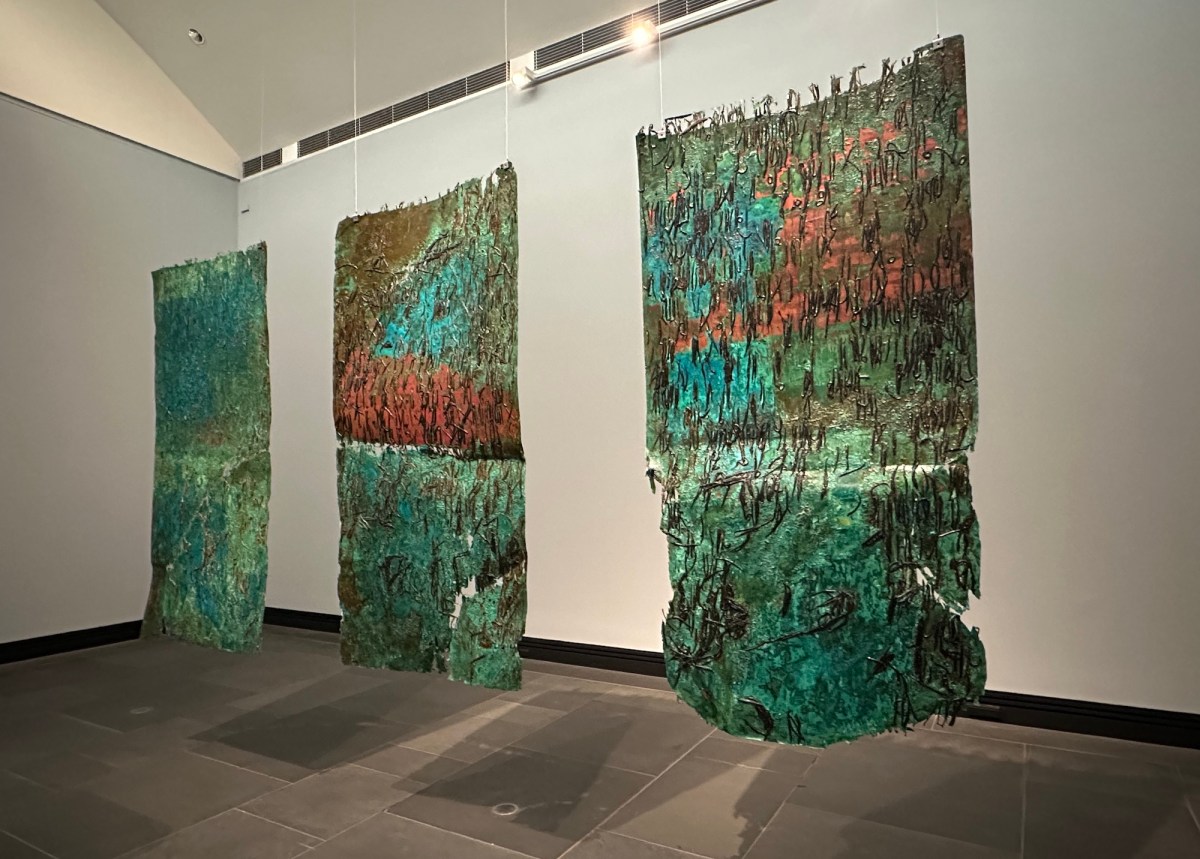
A similarly visceral alchemy animates the work of Kirtika Kain. Working with tar, gold and base metals – materials weighted within the Hindu caste system – Kain transforms substances associated with labour and marginalisation into objects of austere beauty.
At Samstag, a tar-drenched hessian scrim anchors the space with unexpected grandeur. At AGSA, oxidised metal panels hover with the authority of high modernist abstraction. Tar, as Kain notes, speaks to those who build the roads and those who travel them; in her hands, it becomes both monument and indictment.
Gold is threaded through the Biennial, most poignantly in the Museum of Economic Botany at the Gardens, where Archie Moore presents a suite of gilded objects produced in partnership with Pallion: a heart, a tooth, a bucket of liquid gold.
They reference his father’s life as a prospector – his relentless search for the earth’s rewards. It is laced with irony. It was these very mineral deposits absorbed within him that contributed to his death.
At AGSA, a modest lump of fool’s gold converses with one of Kain’s gold scrolls, suggesting the systems are the true foolish acts endorsing erroneous knowledge.
Read: Curator Ellie Buttrose explains theme for her 2026 Adelaide Biennial
Painting, too, is rethought. Mark Maurangi Carrol’s chalky images are like the vapours of colonial memories, created by painting on the verso of raw linen. They are presented as a composite of tiles stitched together using cable ties riffing off traditional quilting.
He describes his practice as ‘cultural hauntologies,’ conjuring the ghosts of colonial memory that continue to shape his Avaiki Nui/Cook Islands heritage.
Equally compelling in their play with ghosting, John Spiteri’s stenciled black figures, emojis and gestures surface and recede beneath veils of washes. Curator Jose Da Silva writes in the catalogue that Spiteri ‘makes looking at paintings feel radical again’. Looking becomes an act of excavation. The pleasure is in duration – slow looking rewards.
Sitting with unsettlement
Yield Strength is not an easy exhibition. It resists the quick read, the swipe, the easy like. Some visitors will bristle at its grunge edges and unresolved tensions. That, perhaps, is the point. Buttrose has calibrated a show that gnaws at the present – at institutional timidity, at inherited systems of value and at material hierarchies. It opens the gates.
While Buttrose satisfies the surface dwellers with signature works of scale, the real rewards are found in the deep dive and by allowing oneself to be slightly unruffled and to sit with unsettlement.
Yield Strength is on display from 27 February to 8 June 2026 as part of the 2026 Adelaide Festival, across venues Art Gallery of South Australia, Samstag Museum of Art and the Adelaide Botanic Gardens.
2026 Adelaide Biennial artists
Robert Andrew, Nathan Beard, Lauren Burrow, Francis Carmody, Mark Maurangi Carrol, Milminyina Dhamarrandji, Matthew Teapot Djipurrtjun, George Egerton-Warburton, Prudence Flint, Brian Fuata, d harding, Matthew Harris, Helen Johnson, Kirtika Kain, Jennifer Mathews, Archie Moore, Josina Pumani, Julie Nangala Robertson, Erika Scott, Joel Sherwood Spring, Charlie Sofo, John Spiteri, Isadora Vaughan and Emmaline Zanelli.