
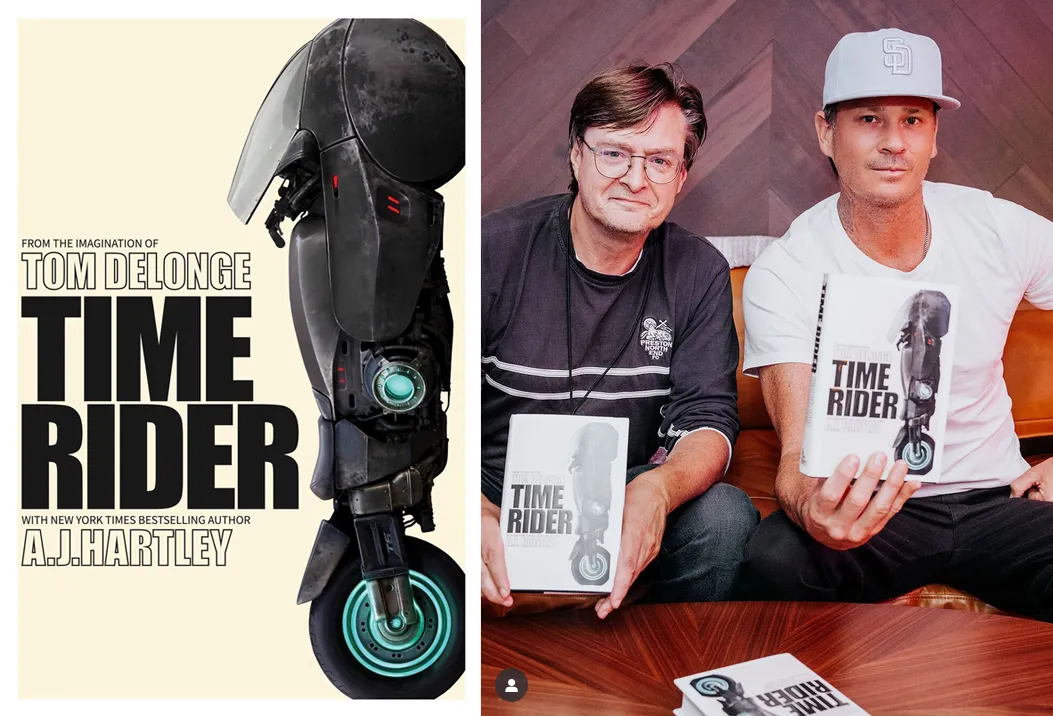
Born from the imagination of Blink-182’s Tom Delonge and the pen of AJ Hartley, Time Rider is a temporal adventure that combines philosophical themes with blockbuster vibes. On the surface, it’s a fast-paced science fiction featuring time-travelling motorbikes, government agents and a slow burn romance. Beneath that, there’s a treasure trove of arcane references and subtle nods to historical events, political conspiracies and unexplained phenomena.
For casual readers then, the story is entertaining escapism, but for a niche readership, it could be interpreted as a fictional cipher through which real-world puzzles might be decoded. Much like the book’s unforgettable bike, the story functions according to the user’s individual leanings.
Heavily informed by Peter Levenda’s non-fiction trilogy Sinister Forces, the plot provides pieces of a wider puzzle, with cryptic clues hinting at links to fringe history and the occult. Strategic negative space dares the reader to interpret how missing pieces could relate to the narrative, all the while posing the question, what does it mean to be human?
Time Rider – quick links
The time-travelling motorbike
In Time Rider, the vividly-painted dystopia of 2157 is ruled by the Design, a totalitarian regime which claims to have saved the world from chaos. In this society, connection is prohibited, both figuratively and literally. Socially acceptable emotional states include amusement-devoid-of-humour and contempt-devoid-of-cause – but not pleasure, joy or love.
The illegality of networked systems means there is nothing resembling the ‘perilous fad’ of the internet. Literature, music, art and history no longer exist in recognisable forms either. The humanities (and by extension, humanity) are devalued and discouraged, and the warmth of human connection is cooled by cultural conditioning, social division and genetic manipulation.
Society is stratified along genetic lines. The Alphas (lab-incubated and government-raised) are described as cerebral and emotionally detached. These pale, hairless, ‘sculpted Aryans’ hold hierarchical power over the Betas, who are integrated into society only so far as they can be utilised, and the despised Gammas, the non-genetically-modified humans who are relegated to labour camps. The book never uses the word eugenics but it’s written very clearly.
The protagonist, Bowie, is a throwback, or non lab-grown human. Alongside his brother, he grew up with storybooks and actual food, as opposed to being state-raised and nourished by tasteless gelatinous cubes. When the world transforms, Bowie aligns himself with the winning side. After the war, he secures status as a Beta, while his rebel brother, Sefton, finds himself trapped in a Gamma work camp alongside other dissidents.
Bowie’s fealty to the Design is rewarded with relative comfort, albeit marred by his innate inferiority. This position of respectable disposability gets him assigned to a dangerous mission: travelling through time on the world’s coolest motorbike to prevent acts of temporal terrorism 200 years in the past.
Bowie is not the Design’s first choice, but his origins enable him to blend in with 20th century humans. The Alphas are content to sacrifice Bowie for their sinister cause, their purpose hidden in the intersecting shadows of esoteric and political fringe theories.
Knowledge of history is key to survival
Upon arriving in 1963, Bowie is tasked with preserving the life of one Alec Heidel – a significant name for savvy readers. Given the Design’s contempt towards history, it’s no surprise that Bowie is provided with little context about the past, leaving him woefully unprepared. Luckily, he meets Sandra Rossi, a reporter investigating Heidel, better known to history as Lee Harvey Oswald.
Naturally, Bowie assumes Rossi is a time traveller, she assumes he isn’t, and hilarity ensues. It’s a transformative dynamic. Rossi’s humanising influence forces Bowie to reconsider his ideology, priorities and identity, while Bowie’s presence irrevocably alters Rossi’s life. Together, they join the dots between constellations of overlapping mysteries.
Multitudinous connections are woven throughout the story, creating a meta-narrative that reinforces the profound importance of preserving and understanding history. By ensuring readers with existing knowledge are privy to deeper narrative layers, Time Rider mirrors its themes. This may frustrate some readers, but many more are likely to appreciate the ways in which this approach heightens suspense, incites curiosity and extends the story beyond the book.
If your literary preferences demand a straightforward plot and neatly-tied threads, proceed with caution. However, if you enjoy high-octane adventure that plagues your mind with lingering questions, well, then you should also proceed with caution because this book will have you falling down at least nine rabbit holes.
This review barely scratches the surface of Delonge’s layered storytelling and Hartley’s action-heavy prose. Suffice to say, this is either an entertaining adventure with a few dense themes, or a complex exploration of humanity disguised as digestible genre fiction.
Whichever lens you view it through, Time Rider is a riveting read that will lodge itself in your brain faster than you can open a portal while speeding down the highway on a time-travelling motorbike.