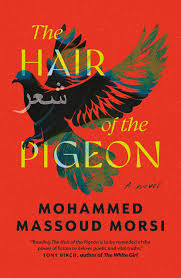
Mohammed Massoud Morsi’s second novel, The Hair of the Pigeon, provides an intense exploration of the meaning of home, the possibility of joy, and understanding that letting go is not the same as giving up.
The Hair of the Pigeon unfolds through the perspective of Ghassan – a Palestinian refugee living in Syria. The book tells the tale of Ghassan’s life, but it isn’t just his story. Through Ghassan’s mind and memory, the reader follows a complex cast of characters as they encounter love, betrayal, war, torture, grief, and eventually (for some of them) home.
Ghassan is a young boy the first time he meets Sama. They form a solid friendship, growing up together in the Yarmouk refugee camp. Life isn’t perfect, but Ghassan and Sama are content with their lives, and – as they get older – with their love for one another.
One traumatic night marks a permanent change in their circumstances. Before long, brutality of another kind boils over on a larger scale. Protests intensify. People disappear. Eventually, Ghassan and Sama find themselves (but not each other) among the missing. Against all odds Ghassan prevails, but Sama is nowhere to be found.
A perilous journey leads to new horizons, and echoes from the past haunt Ghassan’s tumultuous present, even as he embraces a newfound sense of purpose.
A message of love in one pocket and a loaded gun in the other symbolises a pivotal choice between love and vengeance; either option will send Ghassan along a path that can never loop back to where he started.
The Hair of the Pigeon: predicaments
The outward focus of Ghassan’s attention provides the reader with a broad understanding of Yarmouk, its people, and the predicaments imposed upon the present by the past, and on the future by the present. Ghassan’s relationships evolve as the world around him changes and his understanding grows.
This is particularly true in the case of Sama, around whom Ghassan’s unwavering sentiments revolve. Sama – as seen through Ghassan’s eyes – is courageous enough to be outstanding in a world that discourages standing out. She is intelligent, inquisitive and kind. She can also be merciless when the situation calls for it.
Ghassan’s childhood friend Bawadi is mentioned many times before the reader ever meets him. The reader understands from the beginning that Bawadi will eventually do something unforgivable but – when the moment of truth arrives – it’s still a shock to the system.
Ghassan’s mother Salsabeel is beautiful but cold. She dispenses cigarette-scented advice that is either viciously harsh or lovingly practical, depending on one’s perspective. His father, on the other hand, is peaceful, positive and patient. His quiet presence and sage words will live on through his son.
Over the years, Ghassan develops a lasting friendship with Ismaeil; a refugee from Nigeria. This quietly heroic character has a devastating backstory but retains his essential goodness despite the tragedies of his past.
The Hair of the Pigeon: complex characters
The complexity of Morsi’s characters augments the strength of the narrative structure, as the story unfolds across these interconnected lives. Morsi’s avoidance of over-sentimenality does not equate to a lack of emotional depth. It does, however, underline how quickly atrocity can become normalcy.
Morsi consistently communicates through layered subtext, transitioning the reader into darker chapters with impact. A paragraph juxtaposing team sports and a tortured corpse foreshadows danger and raises tension, without the need for watered down exposition.
From the narrow roads of Syria to the grey skies of Copenhagen, Morsi’s writing combines sensory detail with journalistic flair to solidify a living, breathing world. His tonal matter-of-factness doesn’t diminish the moral weight of tragedy, but it does protect the prose against accidental gratuitousness.
Parts of this book can be difficult to read, but – as explored though one of the book’s many themes – it is important to acknowledge the truth. Sometimes, life makes you open your eyes. Other times, it’s easier to keep them closed.
The Hair of the Pigeon: keep your eyes open
There are sections of this novel that might compel you to shut your eyes. Resist that urge, if you can. Such moments include (but are not limited to) Israeli soldiers threatening families at gun point, desperate mothers committing suicide, the murder of innocent children, and the living death that is Sednaya. Sednaya is a filthy, overcrowded prison that exists to inflict torture, starvation and humiliation upon dissidents and innocents alike.
Certain passages are especially disturbing because, despite being a work of fiction, the atrocities described in The Hair of the Pigeon are very real occurrences. Reading this book in the safety of a comfortable home doesn’t mitigate the sickening knowledge that there are countless people in the world who are experiencing the despicable impacts of war, torture, persecution, starvation, rape and genocide right now.
The Hair of the Pigeon might seem like an odd choice for a title, given the seriousness of the subject matter, but towards the end of the book, the title will begin to make sense. By the time you read the final pages, an additional layer of meaning will materialise, and you will appreciate the multifaceted perfection of the title.
The Hair of the Pigeon is an intricately woven story with a lot to reveal about the freedom of truth, the horrors of war and the importance of human connection. It will resonate with people who understand loss, and anyone whose compassion outweighs their complacency.