After premiering at Yirramboi festival in 2021, Soul of Possum returns to Melbourne’s fortyfivedownstairs, directed by Beng Oh. The powerful play by Wamba Wamba playwright Brodie Murray’s presents dual perspectives of the events leading up to a British ship crew’s first contact with the Wamba Wamba people of the area around the Murray River.
The play feels particularly timely as the state of Victoria readies to sign the nation’s first treaty with our First Peoples this week, and as we learn from the final report of the First Peoples-led Yoorrook Truth Telling Commission. Soul of Possum feels like it is its own act of creative truth telling, looking back at the moment that changed everything for the young playwright’s own ancestors.
While the play is clearly grounded in the playwright’s story, Soul of Possum offers all Australians that same opportunity to see the history of this country with fresh eyes.
Soul of Possum review – quick links
Soul of Possum centres Wamba Wamba voices
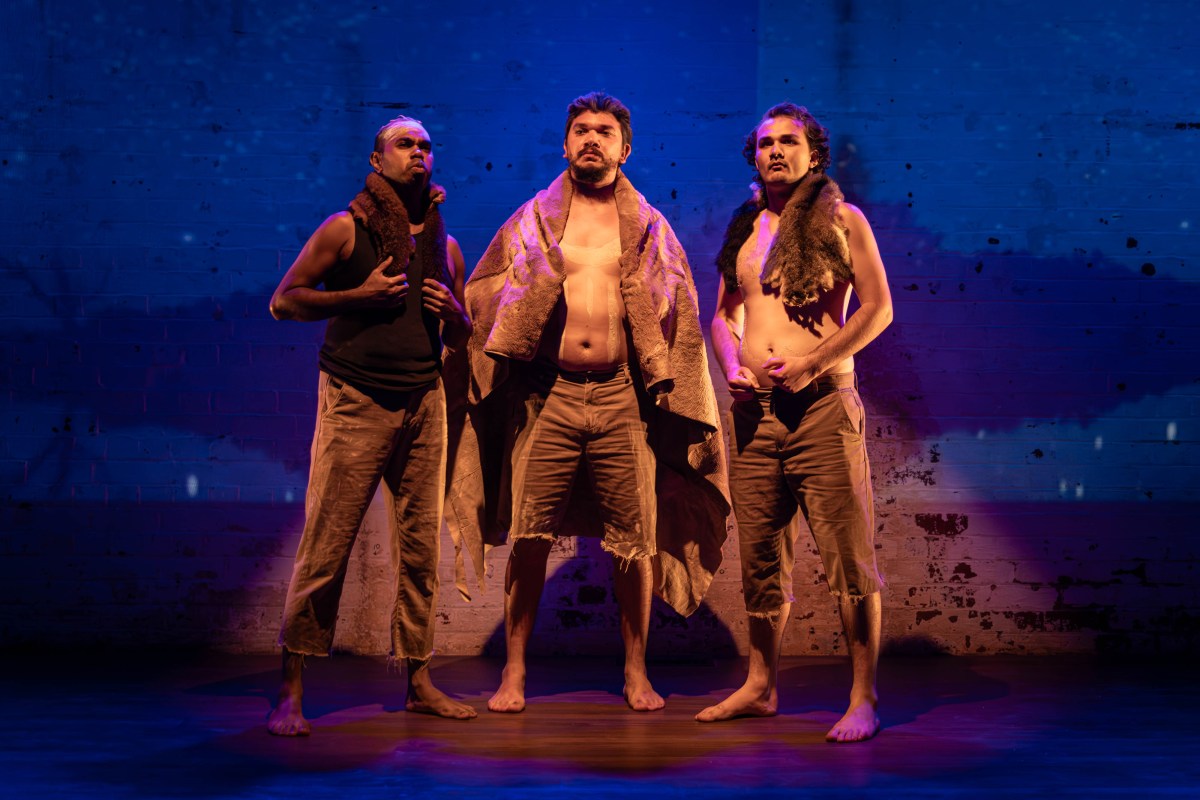
Looking at the point of first contact invites the audience to see the strength of the three First Nations characters, who live their lives in harmony with the land, rich in cultural tradition and with deep localised knowledge of their Country.
The positioning of the narrative at this key historical juncture foreshadows what is to come for these characters and their descendants: the loss of land, and the forcible prevention of speaking language and practising culture. Soul of Possum also presents some of the little told history, showing how many of these early colonisers owed their life to the protection given by Aboriginal people.
The narrative switches between the story of three Wamba Wamba characters – brothers out travelling on men’s business and another Aboriginal stranger who they meet – and that of the British-led crew of a ship travelling down the river.
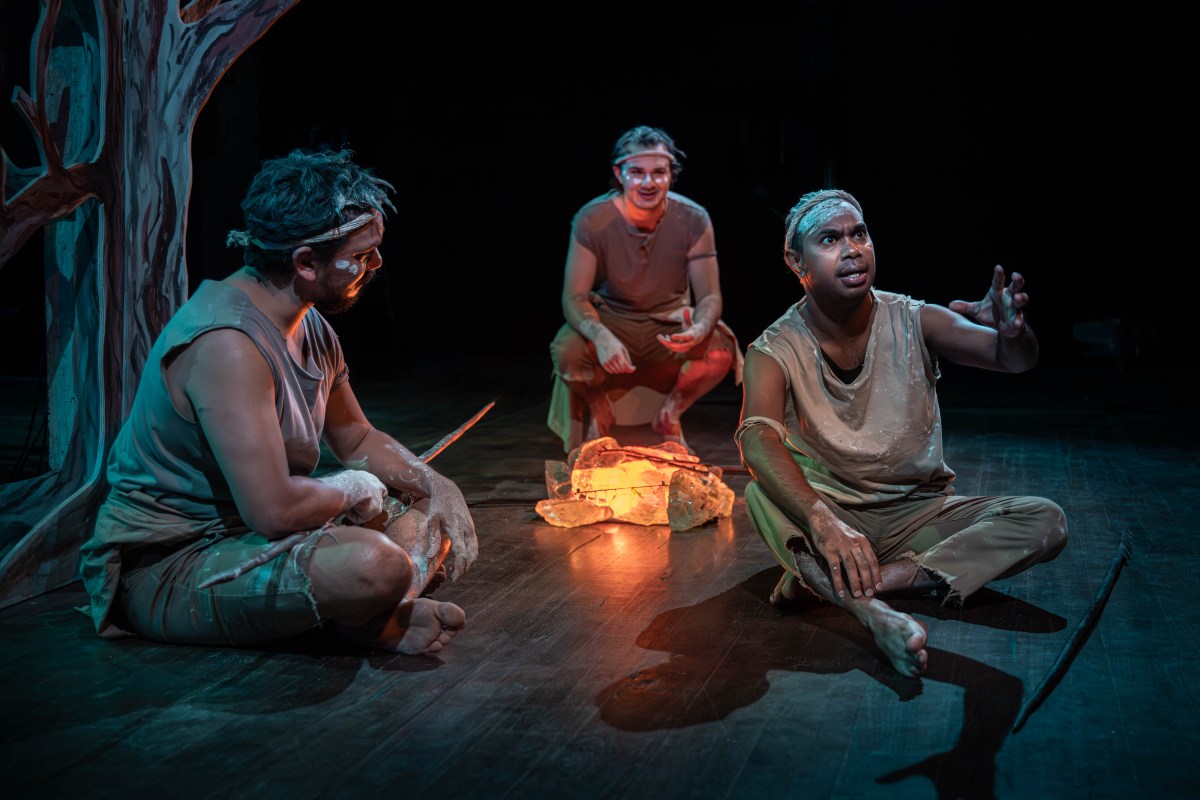
The soul of a possum, his totem animal, speaks to the stranger Wirramanda (actor and choreographer Balla Neba) to warn of impending danger – communicating that there is something wrong with the land and that the problem will arrive by canoe.
Wirramanda shares the warning with the brothers, urging them not to travel further upriver. The younger brother Dindi (performed by Soul of Possum’s playwright Murray) is distrustful and incensed that this stranger should interfere with their important cultural practice. The brothers have been sent on this journey by their father and Dindi believes their traditions, which have always protected them, will continue to do so.
The elder brother Gundi (Wimiya Woodley) is an obvious leader, with the sensitivity to see that the stranger’s words can’t be ignored. He stands in the middle – cautious but sensing that change is coming.
On the boat
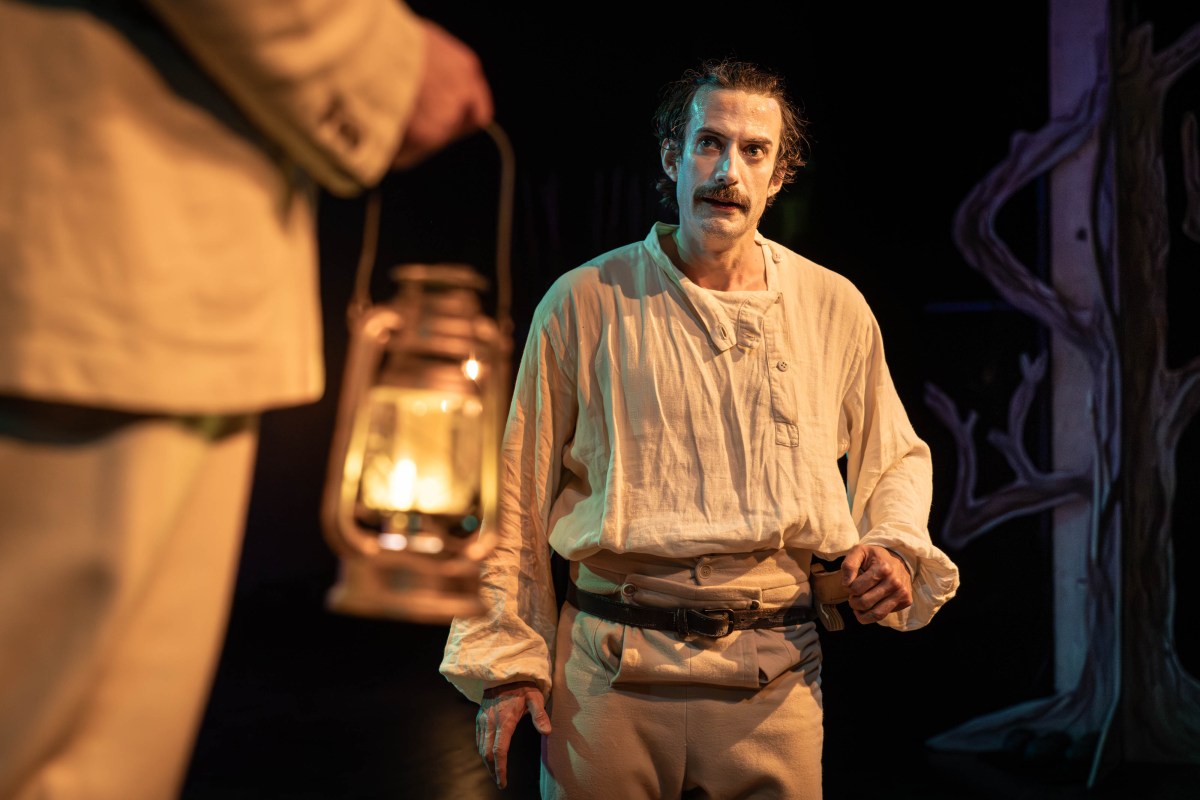
Over on the ship, the young Irish convict deckhand Yates (Luke Mason) is being abused and targeted by the sadistic lieutenant Lachlan Bankes (Gabriel Partington). The ship’s posh-but-kindly boffin botanist Dr Wilkins (Kevin Dee) has taken a shine to the sunny Yates and does his best to protect him where he can but Bankes is relentless.
Meanwhile, the ship’s captain (Leigh Scully) is planning a scouting party to search inland for ‘natives’ – and it’s clear he’s not out to make friends.
The British and Irish characters are defined by class and circumstance. The captain’s accent and gruffness places him as a hard-bitten Northerner, while the lieutenant’s cockney accent and unctuous attitude towards the captain places him as a working class man looking to make his mark in a new land.
Dr Wilkin’s received pronunciation, linen suit and cultivated manner mark him as an intellectual of means, but his friendship with Yates, the lowest-ranked member of the crew, shows him to be a humanitarian as much as a scientist.
Bringing a difficult story to the stage
For a play historically situated, rich in symbolism, with a large cast all speaking various accents, and with such complex themes, the larger intent could easily become buried – but it doesn’t. That’s testament to Murray’s vision as well as a development period that included dramaturgical support from Arrerente writer and theatre-maker Declan Furber Gillick (Jacky) and cultural advisement from Murray’s own father, Uncle Ron Murray.
Having an experienced director like Beng Oh also helps. He’s assembled a very strong cast and brought together all the design elements to anchor the play in time, evoke the landscape and heighten the tension at key moments.
A long seating bank is placed against the window side of the theatre, maximising the width of the stage. The blank white wall is used for projections, which depict the mighty Murray River, the river gums that spread their gnarled branches across the water, and the possum spirit (voiced by Tahlee Fereday) that speaks to Wirramanda.
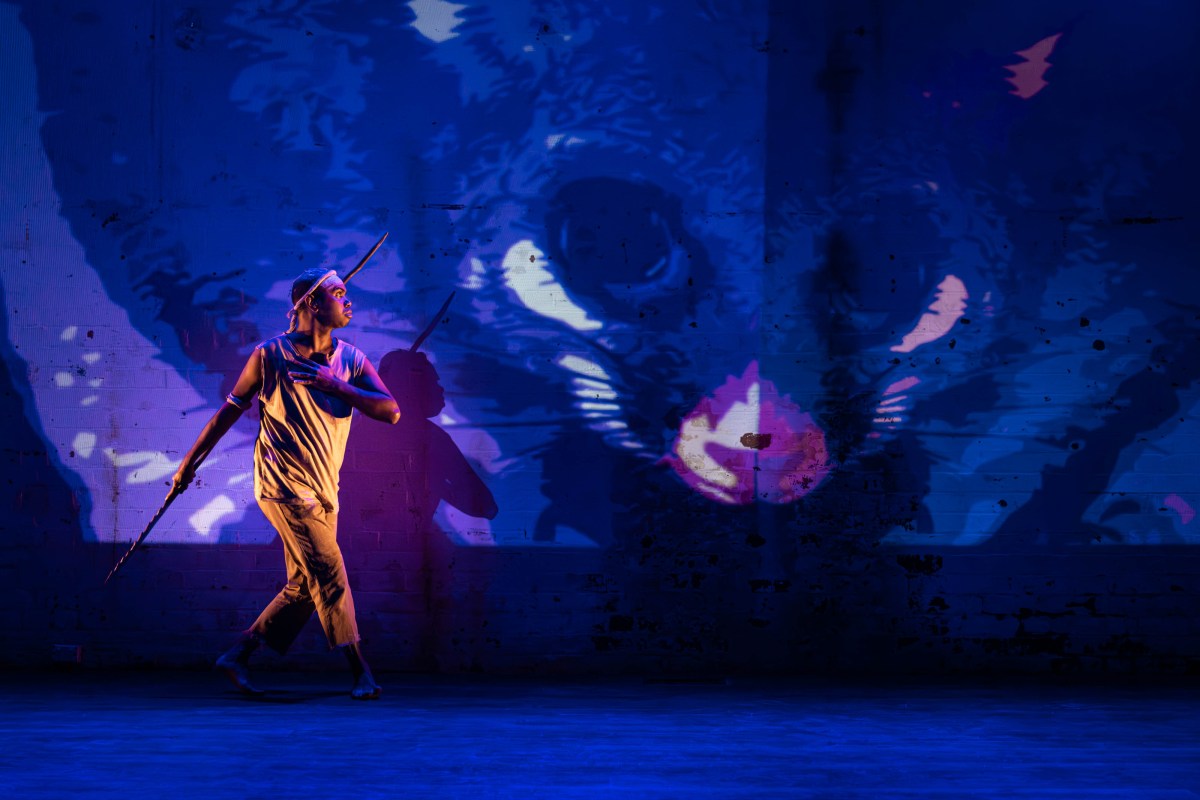
This sparse but flexible set works with the lighting design and projections by Shane Grant and Emma Salmon, turning tables into ship berths and even rocky hills.
The costumes by Adrienne Chisholm speak to character and allude to time without being bound by it, while the layered sound design by BJ Keene evokes both mood and landscape, from the thump of a heartbeat to a chorus of cicadas.
Choreographing first contact
Actor and choreographer Balla Neba has brought a graceful sensitivity to the movements of all the First Nations characters. As Gundi, Dindi and Wirramanda walk light-footed through the landscape – spears in line with their bodies, their feet placed purposefully, and their head and shoulders alert – they appear both hyper-aware of and at ease with their surroundings.
Out on Country that Gundi isn’t familiar with, Wirramanda teaches him the correct way to collect emu eggs – using the end of his spear to separate the ones they will take – so that the father emu will continue to incubate the remaining eggs. The transference of knowledge between the men about how to protect and preserve the environment is a beautiful moment, and a reminder of the sustainable practices First Nations people passed down through thousands of generations.
The inevitable meeting between the two groups is choreographed with precision – the three Wamba Wamba men on one side, with Gundi’s arm protecting his younger brother, and Yates on the other. The two groups circle each other, the tension sharp as Yates readies to signal the rest of the crew.
Yates’ choice – to follow orders or to forge another path – is a metaphor in many ways for his growth as man. His struggle parallels Dindi’s. Living in the shadow of his brother and yearning for the approval of his father, Dindi is yet to learn his own value.
There are a number of clashes in this play: opposing ideas and values, hierarchy versus harmony, tradition versus change, and looking back and looking forward. The opposing choices are to take a leap of faith or to stay, blinkered, believing what you’ve always believed.
Soul of Possum is an accomplished play that grapples with big concepts of national identity. It reckons with and rebalances this country’s history by presenting the stories of First Peoples, told by First Peoples. It is also a play that grapples with the personal, exploring what it means to become a man, and the connection between brothers, fathers and sons. The play doesn’t demonise or diminish but offers catharsis, and looks forward, with hope, for all of us.