
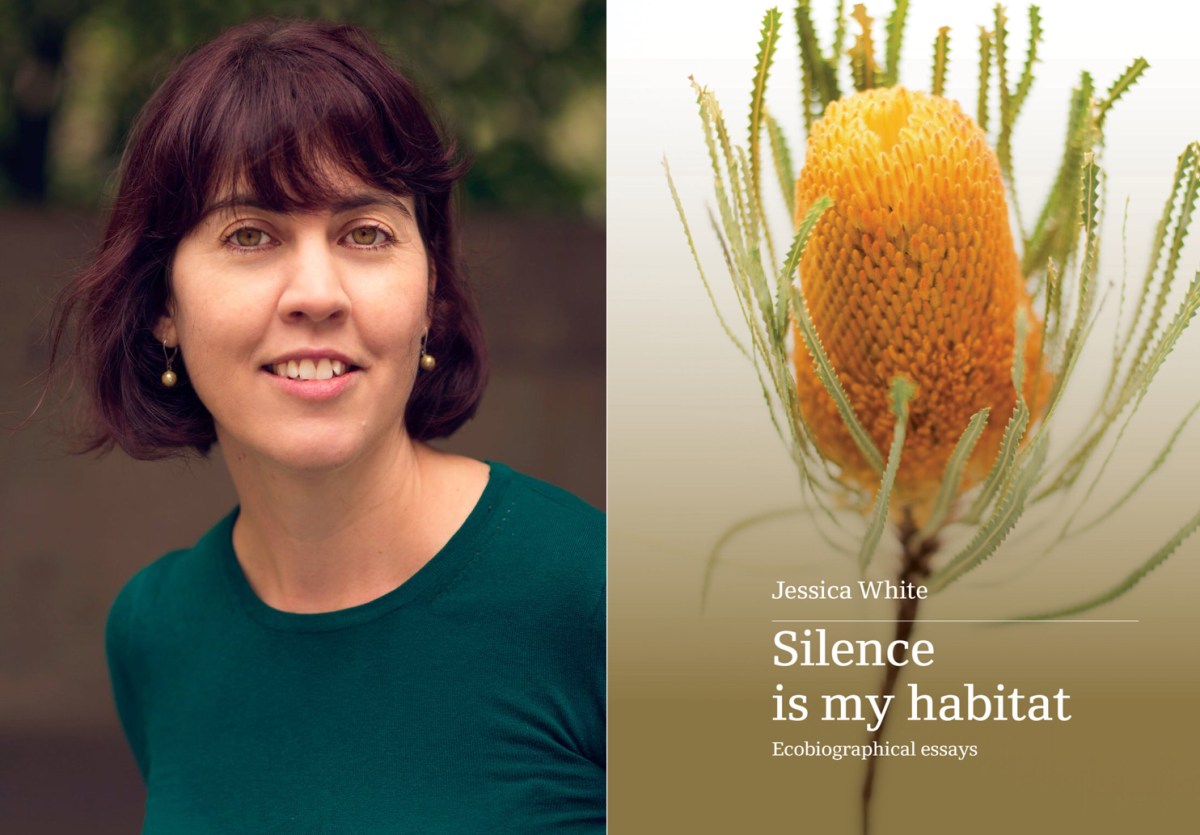
Jessica White, author of A Curious Intimacy and Entitlement, examines the ecosystems of her world, both physical and figurative, in her most recent narrative non-fiction book, Silence is My Habitat: Ecobiographical Essays. Part essay collection, part memoir and part poetry-in-prose, it reads as smoothly as a novel.
While the structure isn’t linear, a strong sense of connected chronology grounds the reader in White’s words (and the world at large) as she explores the dissolution of division, interdependence and the connectedness of all things.
Silence is my Habitat review – quick links
The onset of silence
When White was four years old, a bout of pneumococcal meningitis caused permanent hearing loss. The resulting deafness made her an observant child, perceptive to subtle expressions and nonverbal cues in people (who she often feels isolated from) and animals (who she feels a particular affinity with).
ArtsHub: Why is there so little nature writing by disabled Australian writers?
In Silence is my Habitat, White carefully examines the shards of her existence, detailing how aspects of her embodied experiences are shaped by deafness, interconnectedness and the aftermath of loss.
She writes of the closeness she shares with her family and their mutual support of one another, as well as the devastation of losing her mother, with whom she thought she’d have more time. The 11 essays trace the deconstruction and reconfiguration of a world that has lost its shape through grief.
Dissecting human life through non-human life (or perhaps it’s the other way around), White’s elegant prose alternates between personal experience and scientific fact, with thematically resonant anecdotes connecting her personal history with nature itself.
Deaf time and deaf space: centring accessibility
In the book’s first essay, ‘Grounded’, White’s centres her childhood on Gamilaroi Country in New South Wales, where she and her siblings and cousins grew up having wholesome fun, fully immersed in the natural world.
Sensory and evocative, you can almost feel the creek water, and see the author’s father ploughing paddocks in the sunshine as you read. White explores the ways in which deafness encourages interdependence – as distinct from dependence – and succinctly incorporates recurring elements into the narrative early on.
The second essay, ‘We were all Deaf During the Pandemic’, draws parallels between temporary adjustments made mainstream during the pandemic and the daily adjustments the author has been required to make throughout most of her life.
She acknowledges that during the pandemic many people were exhausted by interacting with a world unaligned with their needs, and in ways that didn’t feel natural. But to the author, pandemic restrictions had the opposite effect.
The change in pace enabled her to exist in a gentler world by increasing her ‘deaf time’ – the author’s term for existing in her own flow without the world speeding her up or slowing her down. The exhaustion of having to alter one’s essential self in order to meet the needs of the external world is explored throughout Silence is my Habitat.
The third essay, ‘Hostile Architecture’, follows on from the concept of ‘deaf time’ to explore ‘deaf space’. In this essay, White expounds on how specific environments impact those within certain spaces, both physically and figuratively.
From spikes on London window ledges to the inaccessibility of academia for people with disabilities, she demonstrates that accessibility still has a long way to go when people must weigh up whether asking for accommodations at work will make their life easier or harder.
Silence is my Habitat builds to a moving conclusion
If the first few essays engage deeply with the author’s interactions with the world, the middle of the book turns inwards. ‘Intertwining’ details White’s longing for a child, the ecosystem of a relationship, and the solace of the natural world, while ‘Swallows and Summers’ frames books as portals, mirrors and friends.
Although some of these essays have been previously published, and were presumably not written with the intent of being published in a long-form collection, they tie together neatly with common threads, from ecosystems to deafness and the life of early settler Georgiana Molloy.
The final six essays elicit a strong cumulative response, beginning with ‘The Breath Goes Now’, which speaks of deforestation, lungs and bronchial illness. From spiders (and care through labour) to ecoacoustics (and charisma), the collection builds to ‘Unseamed’, an essay in which the author outlines lessons learned from her mother, writing, deafness and Georgiana Molly. Be prepared to weep.
Through her essays, White unravels the absence of aural language, and explores how voids can mould the shape of written words and inner worlds. Many astute links are forged in this book, which is – above all – about connection.