

This review references sexual assault.
Strikingly intelligent, emotionally raw and relentlessly enthralling. Prima Facie isn’t just a play, it’s a theatrical juggernaut – imbued with the power to draw audiences onto the edge of their seats and to affect real-world change.
Penned by prolific Australian playwright Suzie Miller and deeply informed by her former career as a lawyer, this explosive one-woman show is a visceral takedown of the nature of the legal system and the way the courts consistently fail to protect victims of sexual assault.
Prima Facie has been seen by more than a million people worldwide, translated into more than 30 languages, and staged on the West End and Broadway in a prestigious, award-winning production starring Jodie Comer (of Killing Eve fame) – a performance also screened in cinemas worldwide, care of the applauded National Theatre Live pro-shot.
Now, seven years since it debuted on the unconventional slice of a stage at Griffin Theatre Company’s home theatre in Sydney’s Kings Cross, and with a major screen adaptation in the works, the original Aussie production is back – opening at Melbourne’s Comedy Theatre for a strictly limited two-week run, to be followed by a three-week residency at Sydney’s Roslyn Packer Theatre.
Prima Facie review – quick links
Earning its return
The enormity of the hype surrounding Prima Facie is perhaps only outweighed by the seriousness of its subject matter. And yet, it soars.
Sheridan Harbridge dives back into the role of Tessa with gusto, steered by original director Lee Lewis, the former Artistic Director of Griffin Theatre Company.
A cool and confident barrister who specialises in defending men accused of sexual assault, Tessa has two priorities that she will not hesitate to mute her own sense of morality to protect: winning cases, and covering up the tracks of her working class upbringing. She trusts that the law can deliver justice, you just need to know how to work it.
But when a romantic evening takes a horrifying turn, she finds herself on the other side of the witness box – and the process she once devoutly trusted turns on her, shattering everything she thought she knew.
Harbridge is captivating, launching into the 90-minute monologue with the magnetism of a beguiling stranger at a party who will start telling you their life story and quickly manage to lure in a small crowd of devoted listeners.
Renée Mulder’s staging is stripped back. An ordinary office chair sits in the middle of a darkened stage. Trent Suidgeest’s predominantly subtle lighting design and Paul Charlier’s sparing sound design don’t lay it on too thick. The measured restraint of these elements serves to hold the true power of Prima Facie in uninterrupted focus: Miller’s exquisite writing, and Harbringer’s generous performance.
Grit, fragility and strength
Just a few months earlier, Harbridge stood on the very same stage, deftly channelling the spirit of her rock’n’roll icon in the return tour of Amplified: The Exquisite Rock and Rage of Chrissy Amphlett. And somehow, she is able to evoke an equally heady combination of rawness, grit, fragility and strength in her portrayal of this Carla-Zampatti, suit-wearing woman of the law.
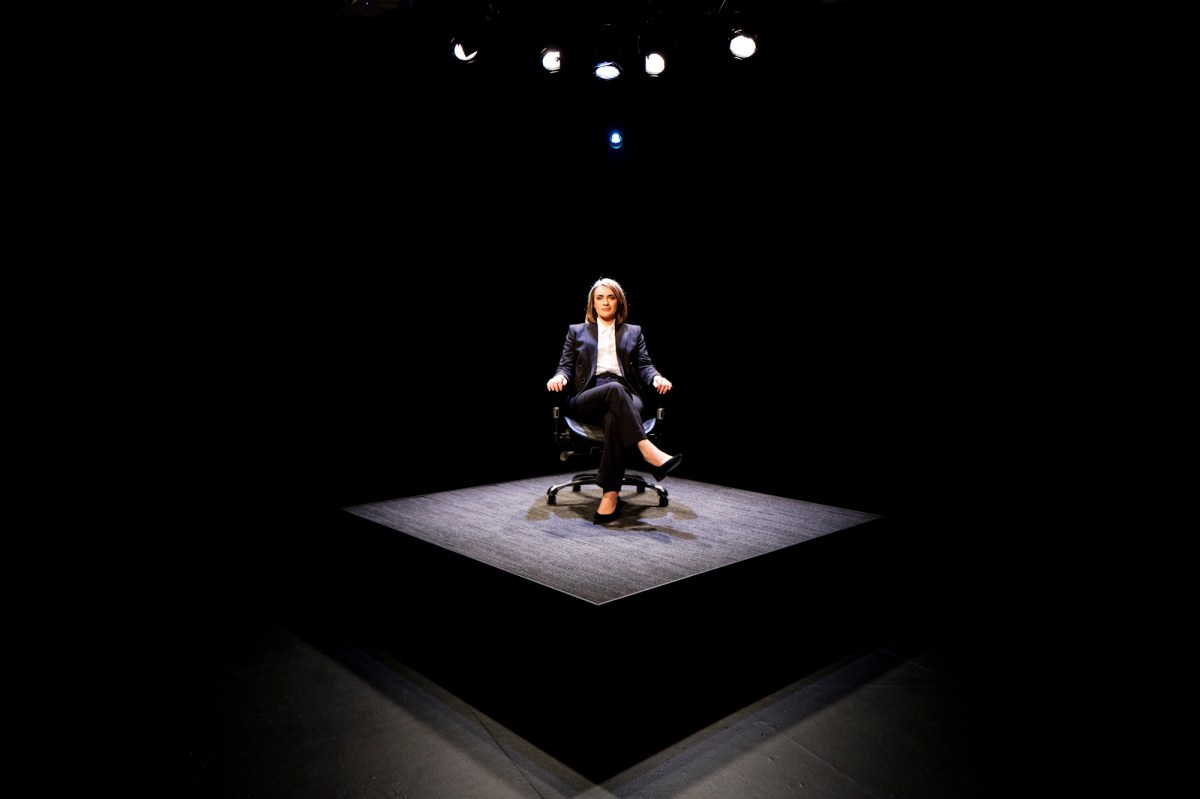
As expected, Prima Facie builds to an emotional gut-punch. But maybe less expected, is how much humour is woven into it. Playing more as a shade to Tessa’s personality than all-out slap-stick, Miller’s dark jokes are as sharp as the critiques she aims at how both the law and society let women down – and yet, the humour never strays into undermining the real problems grappled with here.
Miller’s writing flows organically with both the steadfastness of a playwright who has forged their craft through the writing of more than 40 plays and also of the weary insider, who isn’t afraid to lay the legal system bare.
Reckoning with justice
Interestingly, Prima Facie’s victorious return opened during the final week of Megan Wilding’s sensational Game. Set. Match. at Malthouse Theatre, another original Australian work where a woman must reckon with the aftermath of the violent and careless actions of an entitled, private-school-educated man who doesn’t seem to fear or expect to take any accountability.
Prima Facie’s Tessa faces the dismissiveness and indignity dealt by the police, courts and colleagues in the aftermath of her assault – the systems she was once blindly complicit in. Meanwhile in Game. Set. Match. the trauma inflicted on Wilding’s character – an outspoken young Blak woman – is denied and silenced before there’s even a chance for legal intervention, for better or worse. Ultimately, she takes justice into her own hands, seeking solace in exposing the truth, and in the healing power of Country.
Neither play presents any neat solutions for their character’s treacherous circumstances, but both of these outstanding storytellers speak to a stark truth: that the systems need to do better by women and girls. And in a world backsliding into fascism, where presidents and young boys alike are falling in step with misogyny’s manosphere-enabled rebrand, it is more important than ever to share art capable of calling it out.
The impact of Prima Facie has actually helped to change the way sexual assault trials are handled in the UK. With any hope, those ripples might lead to much-needed reforms in Australia’s own courts too.
Proceed with caution – Prima Facie is a must-see, but the experience has the potential to be re-traumatising for any audiencegoers who are feeling fragile.
This is the kind of play that leaves audiences stunned by the emotional gravity, rageful at the attitudes of perpetrators of sexual assault and their enablers, deeply proud of the calibre of theatre that Australian creators are capable of creating, and deeply protective of the artists, companies and producers who make it possible.
