Long before Baz Luhrmann borrowed the best bits for Moulin Rouge!, Italian opera composer extraordinaire Giacomo Puccini’s Paris-set La Bohème sparkled with soaring joy and swooped down deep into sorrow. The thing about the latter is that it hits so much harder when the happiest peaks are sky-high.
And so it is with Opera Australia’s latest production of Puccini’s crown jewel. As directed by playful polymath director Constantine Costi, La Bohème glimmers with the kooky good humour to be found in his beautiful debut feature documentary, The Golden Spurtle.
Loosely inspired by Henri Murger’s 1851 novel Scènes de la vie de bohème, the show opens on Christmas Eve, as the painter Marcello (the baritone Luke Gabbedy) huddles around a sputtering stove alongside the playwright Rodolfo (tenor Kang Wang) in the stone-cold attic space they share with the philosopher Colline (bass David Parkin) and the musician Schaunard (bass-baritone Shane Lowrencev stood in for Stephen Marsh on opening night).
A rambunctious lot, these players may be skidding along rock bottom, but they’re nevertheless committed to the artistic bit – though not so much that they baulk at burning Rodolfo’s freshly penned pages to stoke the feeble fire.
OA’s La Bohème review – quick links
The bohemian life
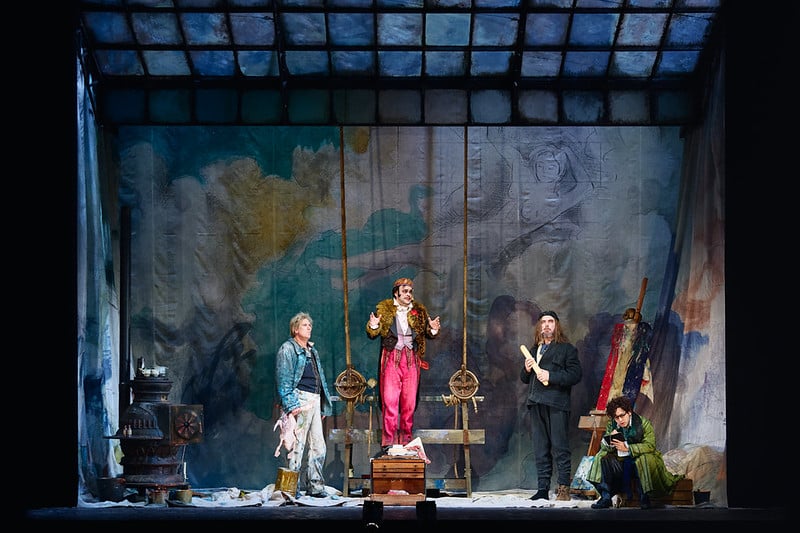
Joined by Colline and Schaunard, the latter comes bearing unimaginable riches: a bottle of wine, tasty morsels and a stack of cigars. This feast is thanks to a recently deceased parrot, whose eccentrically rich owner tasked Schaunard with serenading the spoiled bird off this mortal coil with a violin recital. As you do.
Costi dials up the silliness of their play-fighting and dodgy-landlord-dodging, but as the boys barrel around clowning, the director and his creative crew remind us that, this being the opera, tragedy beckons.
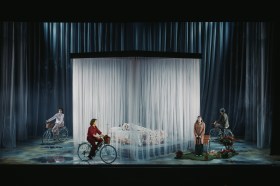
At first glance, the Bohemians’ chilly garret appears to glow below its greasy glass ceiling. A large canvas-like mural depicting a half-painted lady floating in the clouds forms this spartan space’s backdrop, gleaming like a spring morning.
This luminous work is down to spectacular set designer Dann Barber, who’s perfectly teamed with lighting designer Morgan Moroney. Together, they summon the waxing and waning of the moon’s softest kiss.
But a darkness lingers just beyond the frame, literally, with the vast Regent stage constricted to a smaller false proscenium by swooshing black curtains. It’s into this claustrophobic clutter of impoverished ambition that poor Mimi staggers, hoping to relight her spent candle.
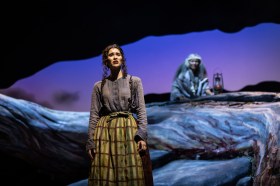
As played by Russian soprano Galina Cheplakova, marking her Australian debut, Mimi’s rainbow-cloaked waif’s frame is nevertheless alive with delight, so much so that you buy it when Rodolfo – hanging back from the lads’ celebratory dinner to finish a spot of writing – instantly falls for this sickly visitor. One who shortly requires a power nap under his ragged green velvet jacket.
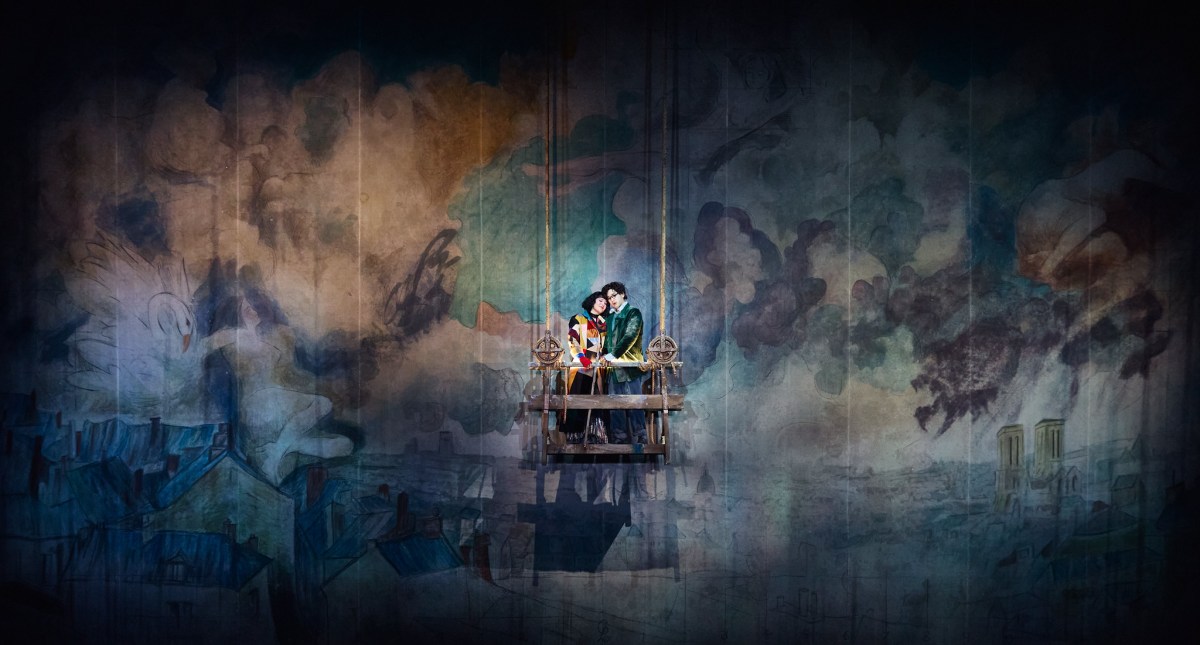
Deliberately prolonging their hunt for her missing keys, Rodolfo swoops Mimi up into the heights of love via the rickety basket Marcello uses to paint his panoramas. And this is when Costi’s La Bohème explodes into abundant life.
A boisterous street party
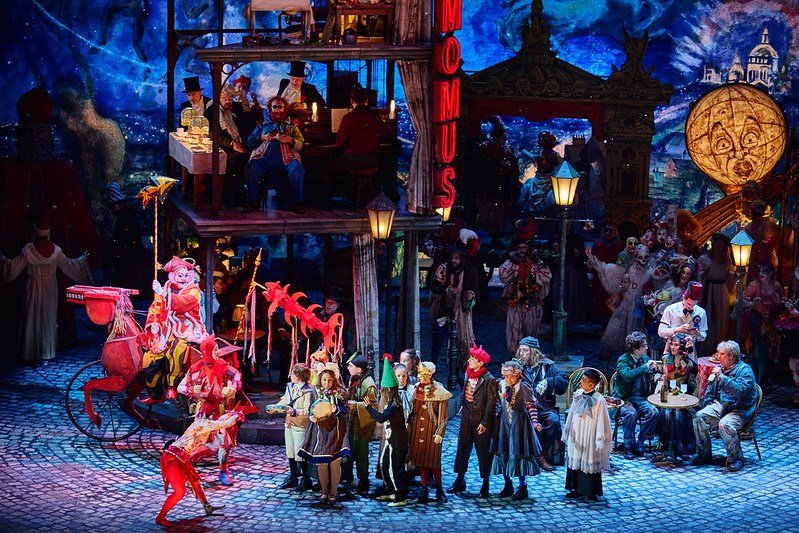
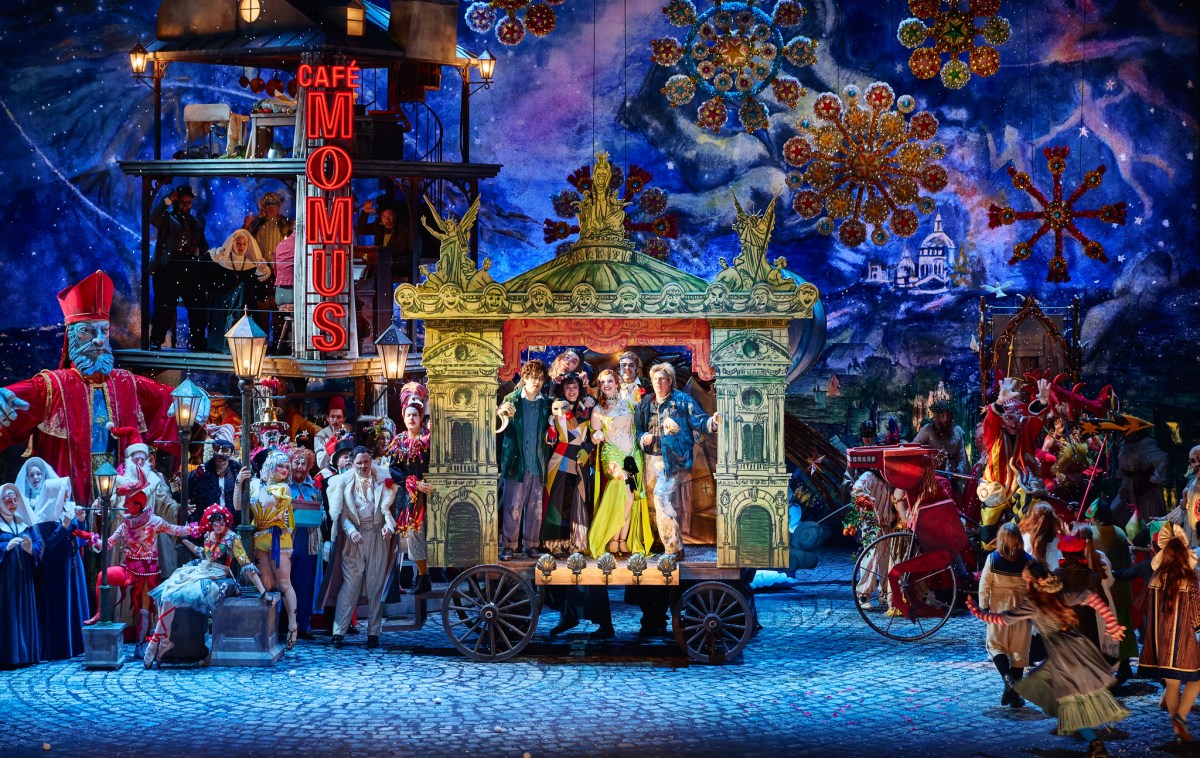
As Mimi and Rodolfo rise up, the full height and width of the Regent stage is revealed as the frame is swept away, revealing three-tiered Café Momus. Looking for all the world like a giant Lego set, it’s set against an abstract rendering of the Parisian skyline that seems to twinkle like stars after a few too many absinthes.
Not content with wowing us with Barber’s towering set, the street outside Café Momus is awash with a carnival of burlesque performers, toy hawkers, giant papier-mâché figures and a crowd teeming with theatrical players of all stripes – overly excited kids, fantastically dressed devils, cops and nuns in their habits – who dwarf our gang as they eat at an outdoor table on the cobblestones.
A constantly shifting festival of kinetic energy, this choreographic marvel – Costi is assisted by movement director Shannon Burns – marks La Bohème’s merriest moment. It’s heightened by the diva energy of cabaret singer Musetta, played with punchy panache by Melbourne soprano Alexandra Flood, depicting Joan of Arc ablaze on her martyr’s pyre in her show-within-a-show. High drama!
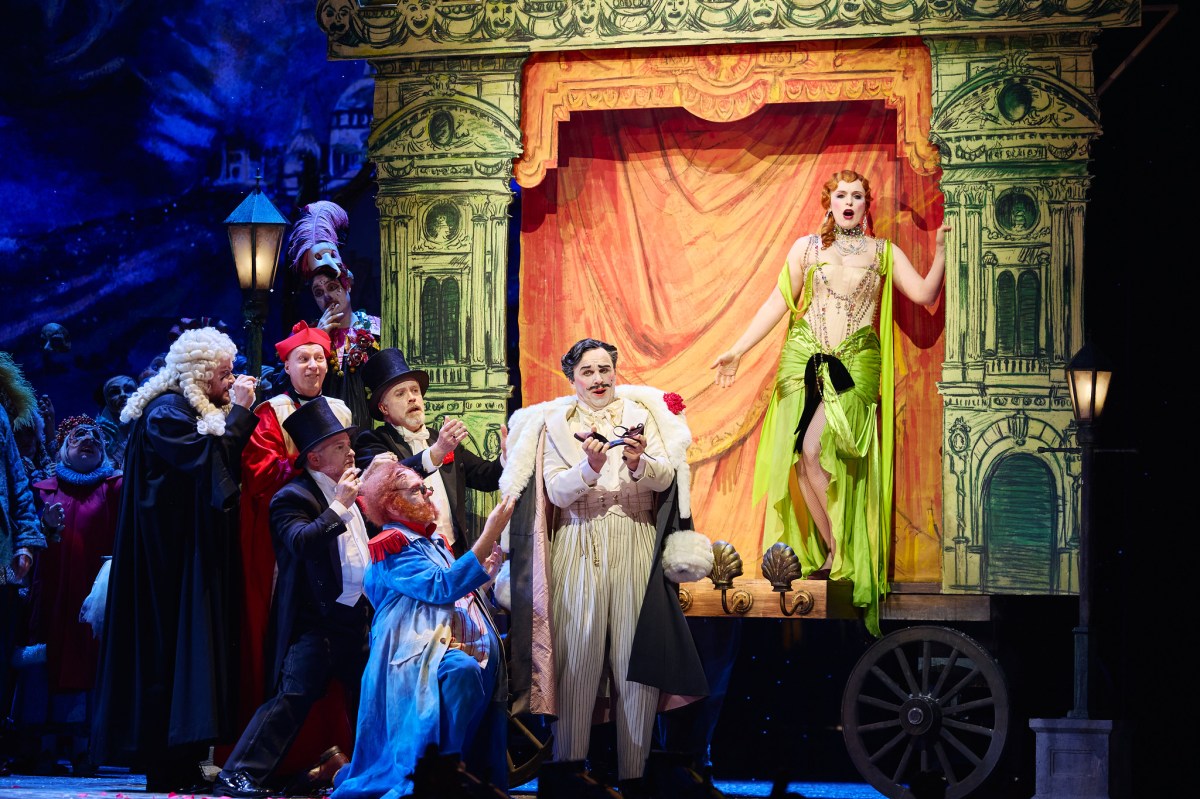
A savvy player, Musetta may be working the wallet of the clueless Alcindoro (hearty baritone Simon Meadows), but her heart truly belongs to Marcello, if only he can stop being a jealous crybaby long enough to realise it. As these friends and lovers regale one another with far-out tales, ushering Act One to a close, hope is swept away with the detritus of Christmas past.
Date with destiny
Act Two opens with the dark swirls of a stormy night, its inky blackness punctuated by feeble lamplight, signalling that all will not end well.
Mimi’s fading fast, as has her love of Rodolfo. Or has it? Like a rom-com in reverse, they fell hard and fast only to freak out and second-guess one another, poisoning the well of their love with doubt in much the same way as dope Marcello. Agreeing to part ways, they almost immediately caveat that until the spring, though their friends wonder if Mimi will make it that far.
This sombre stretch could all too easily be a snoozy downer, but Costi’s deft hand keeps it held aloft on human kindness, as the gang rallies around Mimi. Rushing her back to the garret where it all began, that grand mural now hangs limply by a thread, revealing the abyss beyond as she stumbles towards a date with destiny.
Opera Australia’s newest La Bohème is a lavish triumph, with universally magnificent performances, though Flood steals the show, washing away all comers in harnessing Musetta’s unrestrained majesty. British conductor Finnegan Downie Dear leads the charge at the head of Orchestra Victoria’s heroic wrangling of Pucinni’s verismo masterpiece, with Wang and Cheplakova’s aching rendition of their blissful duet O soave fanciulla a shimmering highlight.
That Costi can uncover new facets of an opera that has been astonishing audiences for 130 years now is a credit to his unbridled talent. There’s magic in his moonlight.