With technology tightening its grip on everyday life, acts of looking and being looked at often slip by unnoticed, absorbed into the background hum of screens, cameras and constant connectivity. On Sydney’s Pyrmont Bridge, where commuters, tourists and weekend wanderers stream steadily across the harbour, these habitual gestures are brought sharply into focus. Here, amid the rhythm of footsteps and the spectacle of Darling Harbour, Julia Phillips’ Observer, Observed, presented as part of the 2026 Sydney Festival, quietly inserts itself into the flow of the city.
Observer, Observed: quick links
Observer, Observed: a Sydney Festival exclusive
Transplanted from the New York High Line to Sydney’s waterfront, this Australian exclusive presentation invites reflection on the ways global systems of power and surveillance are felt locally. In a city celebrated for its openness and expansive harbour views, Philllips’ work gently disrupts the comfort of looking by asking who is watching, who controls the frame, and how public spaces shapes our sense of agency.
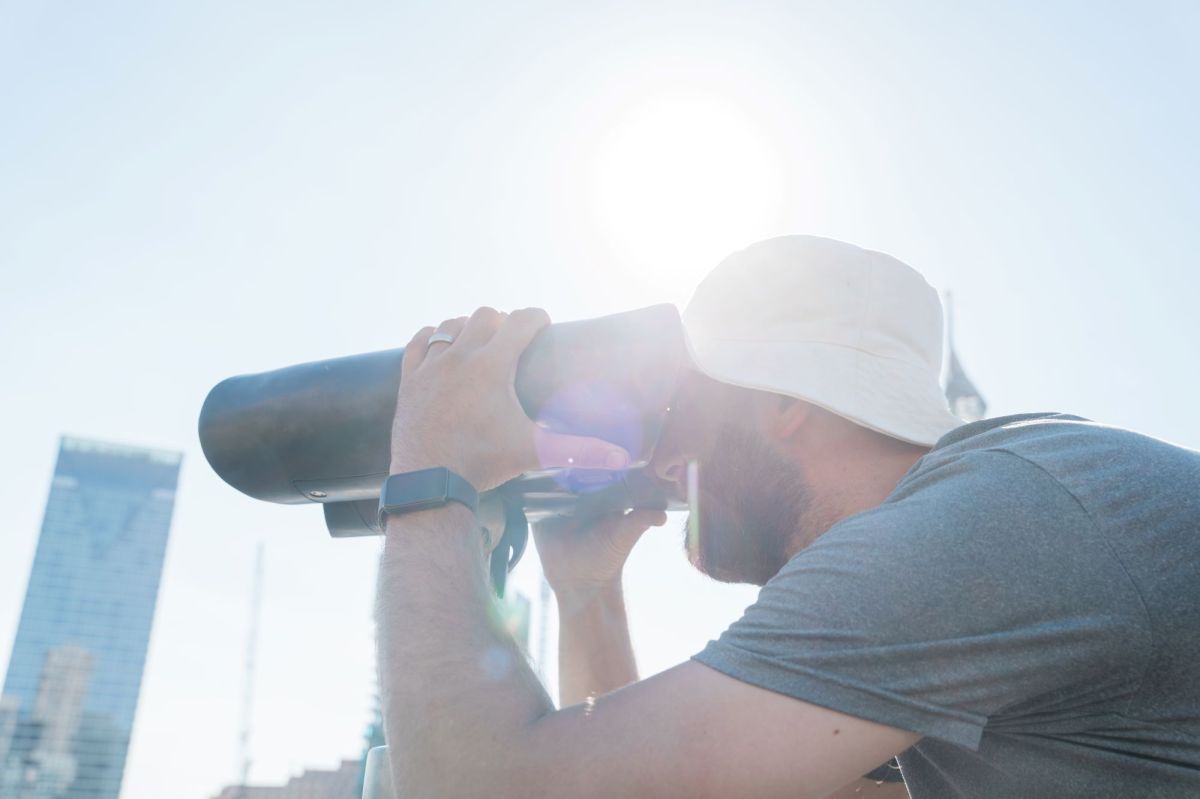
Phillips situates the installation within one of Sydney’s busiest pedestrian crossings, transforming a site of passage into a site of reflection. Custom-made bronze binoculars prompt passers-by to pause and look outward, only to find their gaze – projected below – redirected back at them. This subtle interruption charges the familiar act of seeing with new intensity.
Observer, Observed: exposing invisible power structures
Working primarily in ceramics and metal, Phillips creates objects that stand in for the absent human body. The bronze binoculars, smoothed and gently contoured, seem to cradle the face, small ripples in the metal filling the space where another body might be. Installed on 8 January, one can only imagine the prolonged wear of the bronze from thousands of hands grasping its sides over time, another aspect of the human body slowly recording itself on the artwork.
Phillips’ process is driven by the functionality of objects, transforming them into mechanical extensions of the body. In doing so, she exposes the often-invisible power structures embedded in acts of looking. Observer, Observed raises questions of responsibility inherent in observation, whether within an intimate encounter or an anonymous one, such as the quiet, habitual act of watching from a distance or online. In a recent conversation with the Sydney Festival, Phillips reflected on this exchange being at the heart of the work, noting that, ‘in a way, the price to see up close is to temporarily give up one’s own anonymity’.
The artwork plays with its surroundings in mischievous and unexpected ways, adopting a tongue-in-cheek approach to probing our comfort with being recorded. From the bridge, participants remain largely unaware of the LED screen positioned below that shows their peering eyes, broadcast from cameras built into the binoculars, to a wider, watching audience. Peering through the binoculars, squinting to focus on the streams of people moving beneath, it is only later, when making one’s descent, that the prank is revealed.
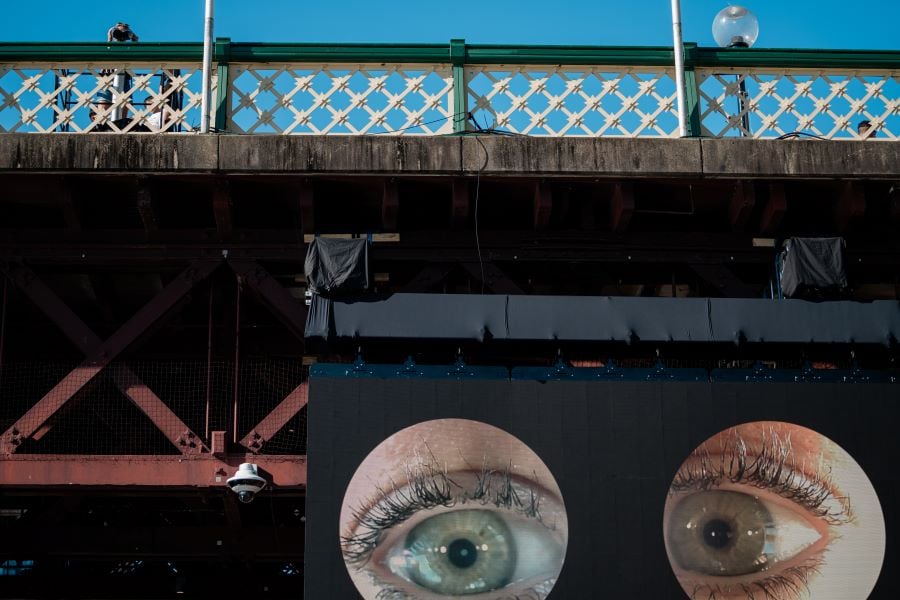
From the reverse perspective, however, the dynamic shifts. In my own encounter with the work, seeing the viewers’ enlarged eyes flicker across the LED screen sparked an immediate urge to perform for the unseen crowds above: a wink held too long, an exaggerated blink, a brief moment to show off one’s eyelashes. I found it difficult to concentrate on the scene below through the binoculars, my attention instead consumed by maintaining this small, self-aware performance. In this playful reversal however, Observer, Observed exposes how quickly self-consciousness turns into spectacle, and how easily surveillance can slip into performance.
Observer, Observed: the setting anchors the artwork
In experiencing Observer, Observed, I was struck by how the openness of Darling Harbour is pulled into the work itself. With water on one side and a dense line of restaurants and bars on the other, the audience is physically and visually enclosed within the site. The steady flow of people becomes caught between these forces, drawn toward the staring eyes on the screen. In this context, the distant gaze takes on a more imposing presence, heightening the sense of being watched within an otherwise familiar and open public space.
While the work is conceptually sharp and well executed, its critique ultimately feels familiar rather than fully transformative. The reversal of the gaze is a well-established strategy in contemporary art, and once the mechanism is revealed, the experience risks becoming repetitive. Phillips’ playful framing encourages performance more than discomfort, softening the work’s critical edge. Though it gestures toward questions of power, surveillance and consent, these themes remain lightly explored rather than being unpacked to their full potential. In a culture already accustomed to self-surveillance and public visibility, the work is engaging and thoughtful, but stops short of delivering a more challenging or unsettling interrogation.
Ultimately, Observer, Observed lingers not as a spectacle but as a subtle shift in perception. Long after stepping off Pyrmont Bridge, the work sharpens an awareness of how easily we move between watcher and watched, participant and performer. By embedding itself within the everyday rhythms of the harbour, Phillips resists didacticism, instead offering a momentary pause that mirrors the quiet negotiations we make with visibility in public space. In doing so, the work reflects the city back to itself, revealing how surveillance is no longer an external force imposed upon us, but a condition we increasingly inhabit, willingly, playfully, and with uneasy familiarity.
Julia Philips’ Observer, Observed is a free public work which is activated every day until 25 January from 8am to 12pm on Pyrmont Bridge, Darling Harbour as part of Sydney Festival 2026.
This article is published as part of ArtsHub’s Creative Journalism Fellowship, an initiative supported by the NSW Government through Create NSW.