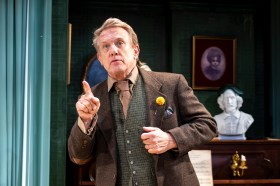
Great Australian musicals are few and far between – though not for want of trying. But for every Fangirls or Keating! there are a dozen duds, which makes the success of Melbourne Theatre Company’s My Brilliant Career all the more significant.
The production was originally developed by Monash University as part of the Jeanne Pratt Artist in Residency program, with subsequent development funded by City of Stonnington and Melbourne Theatre Company’s NEXT STAGE Writers’ Program. First staged in 2024 to near-universal acclaim, My Brilliant Career has now returned to Melbourne’s Southbank Theatre for an encore season, after which it tours to Sydney and Wollongong.
Given its many strengths and enormous heart, one hopes My Brilliant Career will have many successive seasons hereafter, both interstate and overseas.
My Brilliant Career – quick links
My Brilliant Career: from page to stage
Stella Franklin wrote My Brilliant Career when she was still a teenager. The novel’s success – published in 1901 under her masculine-sounding middle name Miles – eventually enabled the creation of the Miles Franklin Literary Award following Franklin’s death in 1954; the latter’s focus on mostly male authors in consequent decades subsequently inspired the now-arguably equally prestigious Stella Prize in 2012.
The protagonist of My Brilliant Career is Sybylla Melvyn, an intelligent, headstrong young woman in rural Australia in the 1890s, who longs for independence and a literary career and chafes against the traditional expectations of a woman’s lot in life. When offered security through marriage, she ultimately rejects it, choosing personal freedom and ambition over romance.
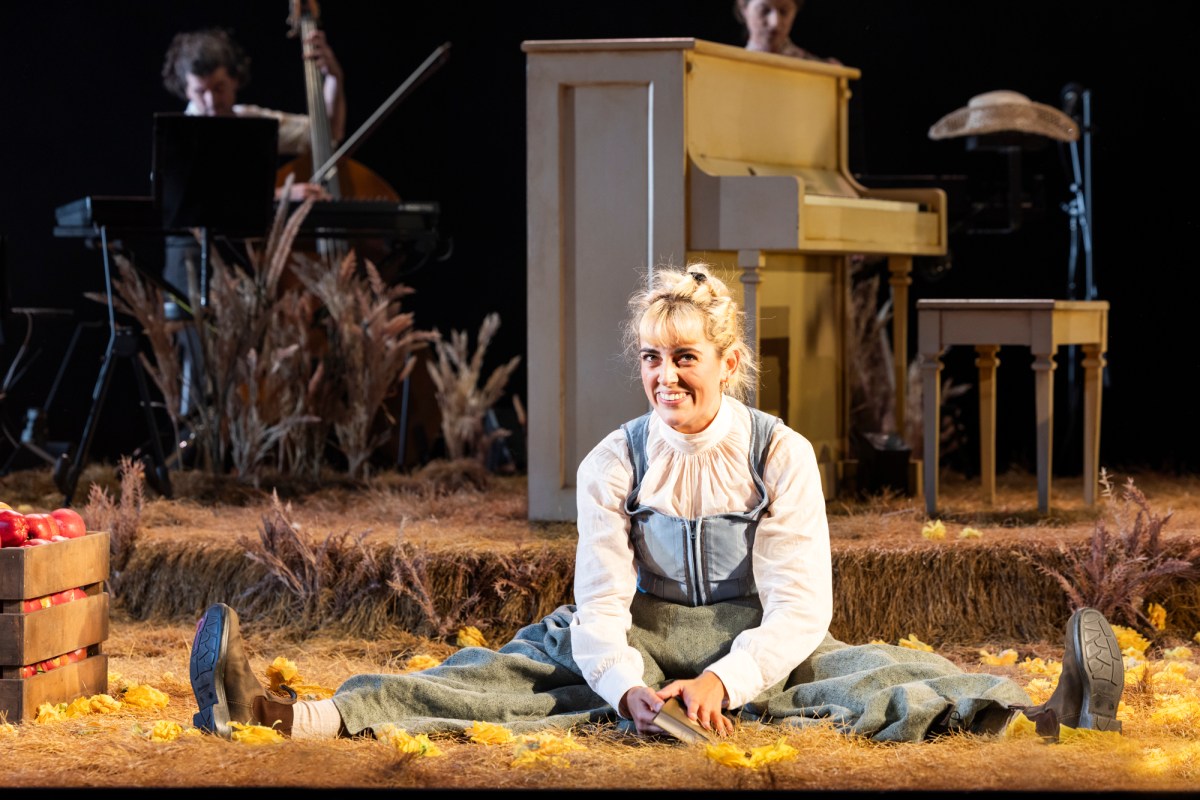
This delightful adaptation of Franklin’s novel features a thrilling central performance by Kala Gare, returning as the teenaged Sybylla – a young woman who makes ‘no apologies for being egotistical,’ as she gleefully breaks the fourth wall to tell us the story of her life, adventures, setbacks and literary dreams.
Gare dazzles, ebullient or brattish when the role demands it, almost winking at the audience when commentating on the lack of culture in her family home (‘Conversation? In this house?!’), tugging our heartstrings in the production’s saddest moments, and inspiring in the musical’s passionate final song, Someone Like Me.
The musical’s book is by Sheridan Harbridge and Dean Bryant, and features songs composed by Mathew Frank with lyrics by Bryant. Collectively, this core creative trio have maintained My Brilliant Career’s late 19th century setting while also allowing us to view it through a contemporary lens.
The end result is – excuse the pun – a stellar adaptation bristling with verve, wit and skill. Colloquial contemporary language melds perfectly with the period setting and the songs embrace a rich array of musical genres. The on-stage band (who begin playing while audience members are still finding their seats, weaving an exuberant air from the get-go) are dynamically led by musical director Victoria Falconer, and double as actors to tremendous effect. In its casting alone, My Brilliant Career sets the bar high – why settle for triple-threat performers when you can cast quadruple-threat actors, singers, dancers and musicians?
Minor flaws balanced out by thrilling highs
Not every moment lands perfectly. Sybylla’s big number midway through the show’s first half, In the Wrong Key, demonstrates Sybylla’s reaction to not only discovering her own voice but being actively encouraged to do so, while also illustrating her joy at being welcomed back to her grandmother’s homestead, Caddagat – a world where art and literature are celebrated instead of ignored. It’s a show-stopping moment, certainly, but it feels slightly contrived – confected rather than earned – and with its piano-clambering, fist-pumping climax, just slightly over the top, though the audience still cheered.
Conversely, it’s My Brilliant Career’s gentler moment – the young Sybylla’s story in song, Prince of a Girl, recounting her memory of her father being supporting and loving in the days before he became an embittered drunkard; little sister Gertie asking Sybylla to write down her stories, ‘For when I need them,’ as Sybylla readies to leave the desolate family farm, demonstrating Sybylla’s writing has meaning to others, not just herself – that land hardest, thanks to the poignancy of simplicity and finely crafted, character-driven dialogue and songs delivered by exceptional performers.
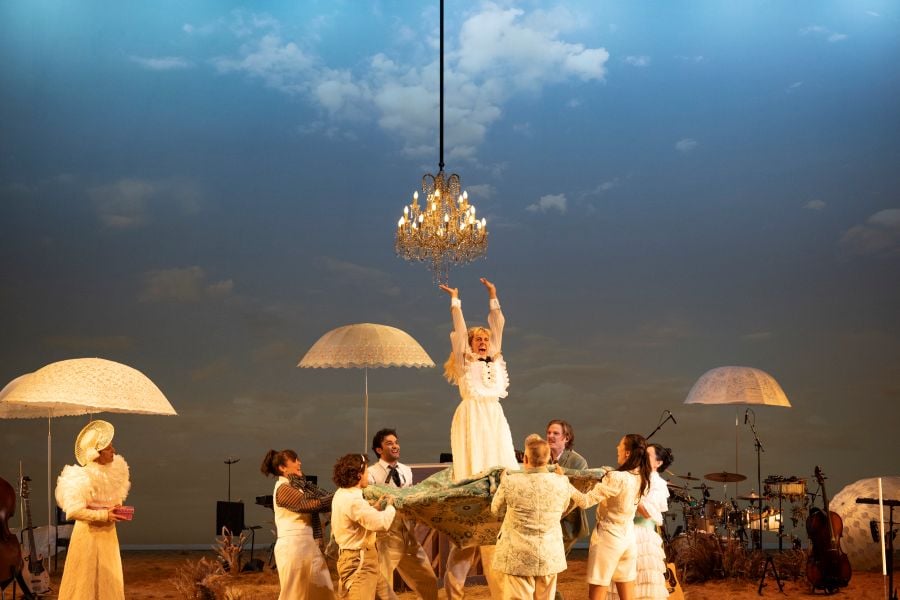
Another superb moment comes after interval, after Sybylla has been ripped away from the happiness she found under her grandmother and aunt’s tutelage at Caddagat to become governess to a swarm of unruly children at the M’Swat family’s farm.
Initially the M’Swats appear to be crude “bogan” caricatures, over-exaggerated grotesques or ‘gargoyles’, as Sybylla unkindly calls them – until the rug is pulled out from under her and our feet, and we realise our perceptions of this supportive, rambunctious family have been distorted by Sybylla’s own snobbery. It’s elegantly done and deliciously played – and also allows for a laugh out-loud moment inspired by the multiple roles perforce played by the talented, 10-strong ensemble.
Sterling performances, choreography and direction
The supporting cast are strong in multiple roles, but Raj Labade especially impresses as handsome young squatter and ‘conceited stallion’ Harry Beecham, deftly conveying the character’s entitlement, charm and deep-rooted Victorian values, as well as his clear passion for Gare’s Sybylla; their chemistry in the boating scene during Harry’s song Wait For You is electric.
Musically, the song also delights, with the instrumentation – assisted by Joy Weng’s sensitive sound design – evoking everything from rippling water to the calls of frogs and froglets.
Similarly, Christina O’Neill excels as Sybylla’s mother, especially with a simple line heartbreakingly delivered late in the piece, but also as Sybylla’s Aunt Helen, who harbours a largely hidden grief all her own.
Gare, as previously mentioned, is the star of the show, but director Anne-Louise Sarks also shines, unifying comedy and drama, politics and pathos, story and songs into a compelling whole. Her blocking segues beautifully into Amy Campbell’s graceful yet lively choreography, the movement vocabulary beautifully matching and amplifying the themes and timbre of the production.
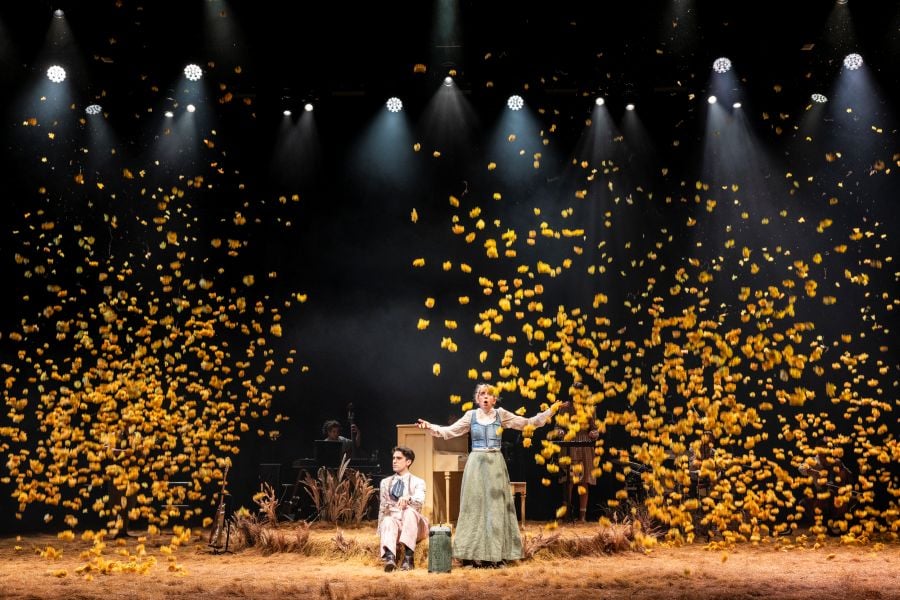
Marg Horwell’s costumes and set designs are exquisite. In one simple yet memorable moment, a scene change is indicated by flowers falling from the sky, transforming previously dry paddocks. Matt Scott’s lighting also strikes just the right note, and the production’s key creative components are knitted seamlessly into a whole by Sarks’ clear eye and steady hand.
Not every moment excels. After Brick, English lordling Frank Hawden’s sung proposal (delivered ably and athletically by Cameron Bajraktarevic-Hayward), Sybylla’s musical retort, the ‘diss track’ Good Enough, falls short as a rousing rebuttal. The very occasional lack of clear enunciation during key two songs also frustrates, though will surely improve as the season continues.
Shining brightly throughout My Brilliant Career, of course, is its rousing feminist message – conveyed through women holding each other up instead of becoming enemies, and the production’s effective and moving exploration of the simple yet achingly difficult challenge of staying true to oneself, no matter the cost.
As Sybylla sings in the final moments of My Brilliant Career:
‘If I write with some care
Of the world that I see
Then I’m free…
And I might free someone like me.’
Great art shows us what it means to be human, and allows us to walk, if only for a few hours, in someone else’s shoes. In years to come, another great Australian musical will be written by someone who was inspired to write – or compose – by My Brilliant Career. It’s that bloody good.
My Brilliant Career plays the Melbourne Theatre Company’s Southbank Theatre until 28 February 2026 before touring to Canberra Theatre Centre from 7-15 March, Sydney Theatre Company’s Roslyn Packer Theatre from 21 March to 3 May and Merrigong Theatre Company’s IPAC | IMB Theatre, Wollongong from 8 to 17 May.
This review was amended after publication, on 11 February at 12:12pm, to include the extended season dates of the STC season.