After a tough year in the arts, Kaylene Whiskey’s survey exhibition is the perfect balm to lighten the soul. You can’t help walking away from this exhibition with a smile.
But it is not all pop music stars and superhero worship in Super Kaylene Whiskey, her survey show at the National Portrait Gallery in Canberra (Kamberri). If one is prepared to dig a little deeper into this expansive collection of works, Whiskey offers an often raw and revealing take on life in a remote Aboriginal community.
Kaylene Whiskey review – quick links
Kaylene Whiskey’s superheroes welcome viewers
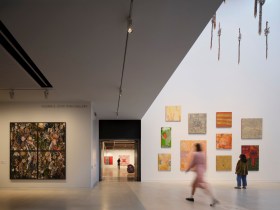
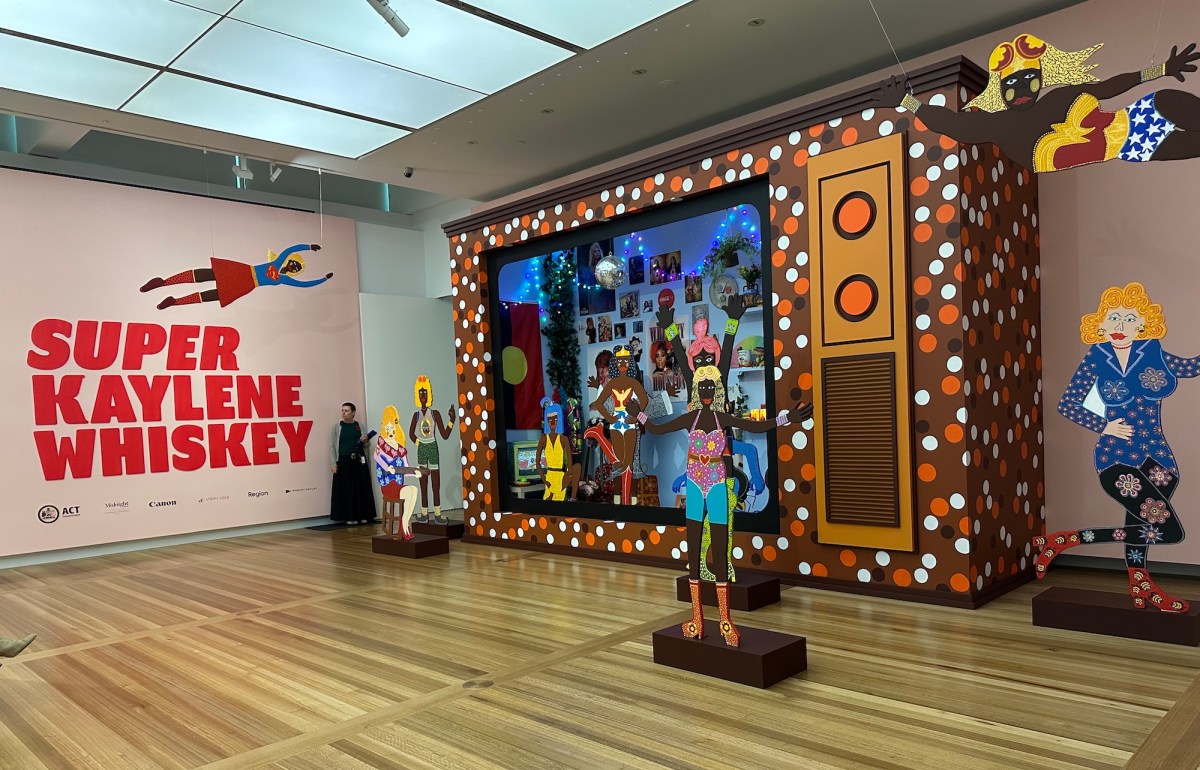
Super Kaylene Whiskey tracks Whiskey’s practice from around 2014 through to her most recent works made for this show. It is huge, with more than 80 paintings, a video work, and her celebrated installation Kaylene TV (2023), which is placed to welcome visitors into the space.
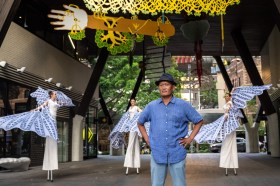
Kaylene TV debuted at the 2024 Biennale of Sydney, just shy of two decades from when she first started painting at the age 30. In this work, Whiskey’s life-sized heroes jump out of the frame of an old-style television set into our world, and here they act as ushers welcoming us to the exhibition.
A cursory walkthrough of the survey exhibition delivers a humour-led, signature sameness. There is a lot of repetition here – but there are also surprises. A small gallery of works within the belly of the exhibition turns to narratives of home for Whiskey, the tiny remote community of Indulkana on the Aṉangu Pitjantjatjara Yankunytjatjara Lands.
Indulkana is about a five-hour drive south of Alice Springs. It’s hot, dusty and, with just 300 residents, is a whole other reality to the life of her adored female heroes. Yet, for Whiskey, these worlds are one.
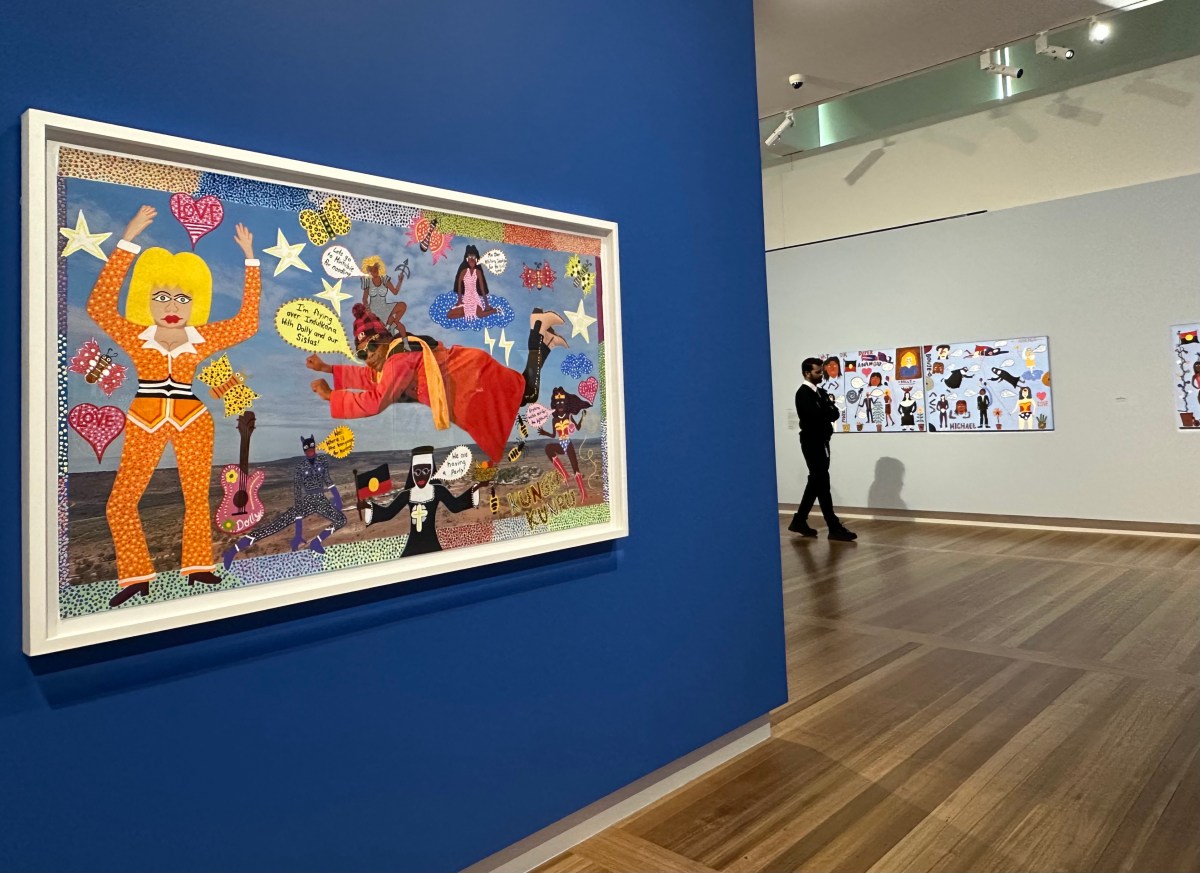
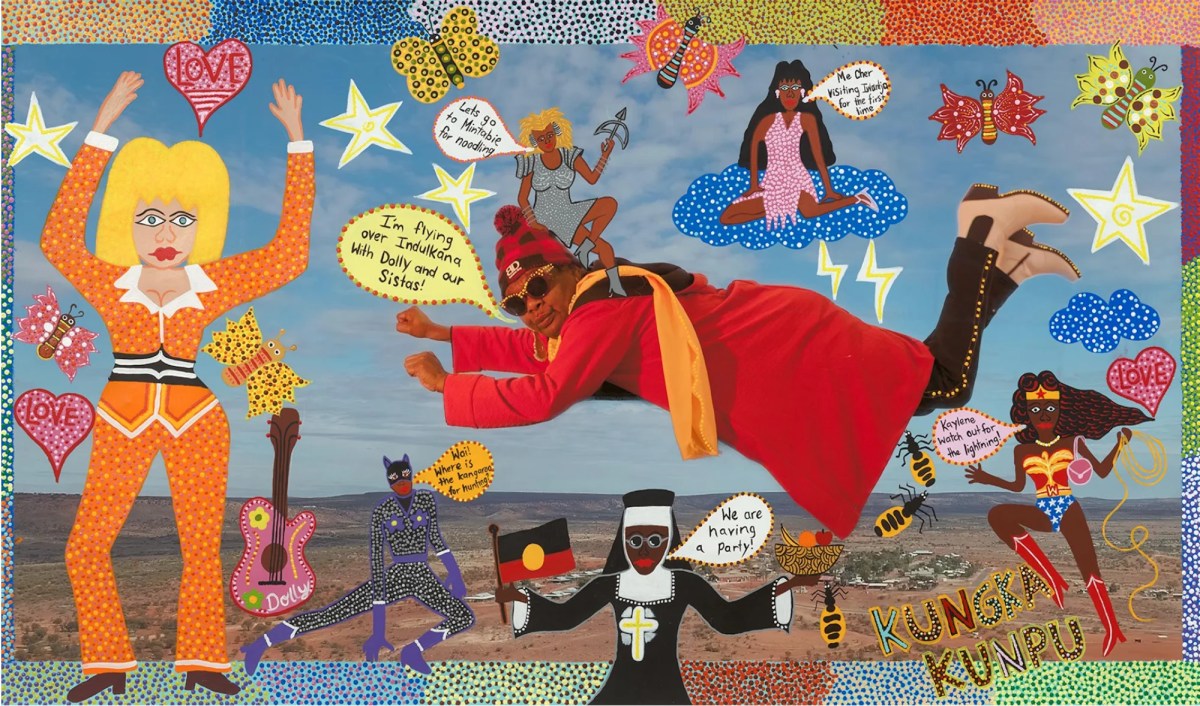
Viewers quickly start to understand that self-determination is the key here. Indeed, the first painting in the exhibition is Flying Over Indulkana (2022). Whiskey is clad in a red, pseudo-superhero outfit. She flies (or flies in the sense of green-screen acting) over Country surrounded by Blak Wonder Woman, Tina Turner, Cat Woman and, of course, her über-hero Dolly Parton, who remains disproportionately larger than all. Whiskey meets our gaze, inviting our engagement.
Survey exposes the darker underside to Kaylene Whiskey’s paintings
While these global pop icons are a kind of religion for Whiskey, her paintings are deceivingly layered, exploring contemporary portraiture, agency, gender, exploitation, cultural resilience and empowerment.
It is not surprising that Cher’s song Believe, with its lyrics about love and the power of independence against adversity, is like the subwoofer foundation of Whiskey’s world. In the exhibition catalogue, Art of Kaylene Whiskey: Do You Believe in Love?, the filmmaker Taika Waititi describes Whiskey’s paintings as ‘like being slapped with a bunch of flowers’.
These are heady topics for a mash-up of emojis, name-brands, love hearts, mingkulpa (native bush tobacco), honey ants and traditional storytelling, including references to the Kungkarangkalpa Tjukurpa, or Seven Sisters story. In the second gallery, this story is approached ‘Kaylene style’ across several paintings made from 2018 to 2021, which draw these worlds together for viewers.
Living culture and ‘Kaylene style’
One aspect I love about this exhibition is that – through its sheer volume of work – audiences can start to draw other connections to traditions of ‘dot painting’. We can see the transition in Whiskey’s oeuvre. The early painting Super Heroes Find Bush Tucker (2015) is segmented into panels that evoke a comic book but also the kinds of structure we witness in bark painting. In later works, ‘dots’ are intermingled with added diamantes and surface bling.
The part of this exhibition that I found most intriguing, was a cluster of works about Iwantja, another town in the APY Lands and the home of the arts centre Iwantja Arts. Iwantja Arts Story part 1 (2015) and Iwantja Arts Story part 2 (2015) are each separated into three panels, progressing the narrative from tent town to lobbying for an art centre, and then its first building. The last shows Whiskey embedded in her studio.
Across from these works is a pair of painted road signs, Visitors to Iwantja Arts (2022) and Seven Sistas (2018), which won her the General Painting Award at the celebrated Telstra National Aboriginal & Torres Strait Islander Art Awards. These two works continue the transition, showing how the art centre matured from tourist trinkets to managing global demand for exhibition quality art. The signs were removed in 2018 and Whiskey is central in this narrative of success.
But choice is always the underbelly of optimism. The works are hung with the paintings Woma Wiya (don’t drink) (2015) and Sniffing Time (2015) as lessons for community – a take on government health warnings but in a local vernacular.
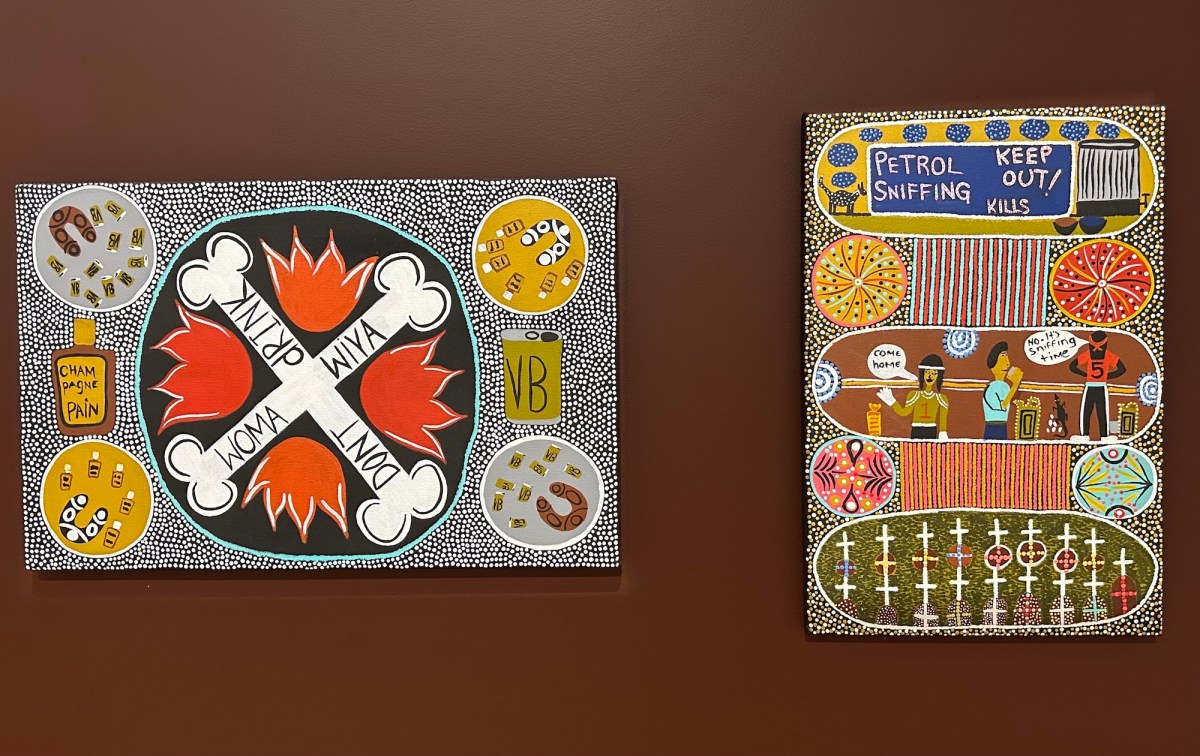
Here, the traditional circular form indicating gathering is overlaid with a more bleak contemporary reality of addition and abuse. They are a rare glimpse to an alternate world that is usually outside of Whiskey’s later sister-heroics.
Similarly, Closing Time at Mintabie (2015) is a general story of an opal mining town on her grandfather’s Country that was leased to the South Australian Government. In 2019 the land was returned to the Aṉangu and the town closed. It was then revealed that stores had illegally held credit from local Aṉangu residents.
Later in the exhibition, another interesting work maintains Whiskey signature style while offering a deeper window into her world. Minyma Kunpu (Strong women) (2024) is painted over a vintage German wall poster that depicts the sacred creation story site in Uluru-Kata Tjuta National Park.
Whiskey leaves the original text visible with its reference to Ayers Rock and overpaints a narrative of the arrival of a new baby on Country, overseen by her community of women. This new life takes back agency of a land usurped by foreign interests and colonisers. Interestingly, Dolly here plays the role of ally and advocate – her speech bubble says ‘My aboriginal flag of colours’ in a riff on her song Coat of many colours.
Read: Australian creatives awarded French Order of Arts and Letters
While growing up on Coca Cola, lollies and TV is hardly an advertisement for a healthy life, it is clear that the role of responsibility is ever-present in Whiskey’s work.
There is little white-cube reverence in this exhibition. Everything about it screams colour and optimism. It is not only accessible storytelling across generations – with its cartoon genre and pop-culture icons – but Whiskey also uproots our understanding of portraiture, where fantasy and reality, present and absent, heroes and non-heroes are sutured together in real time as a coterie of buddies.
The common thread to all this is the sense of agency that Whiskey gives her characters, empowering her chorus of Minyma kunpu, or strong women.
Waititi says it so perfectly in the catalogue: ‘Kaylene Whiskey is an artistic Swiss Army knife in the world of multimedia.’ One would have to agree that Whiskey has cut through the perceived stereotypes of Aboriginal art – and indeed her own making – in this survey exhibition.