
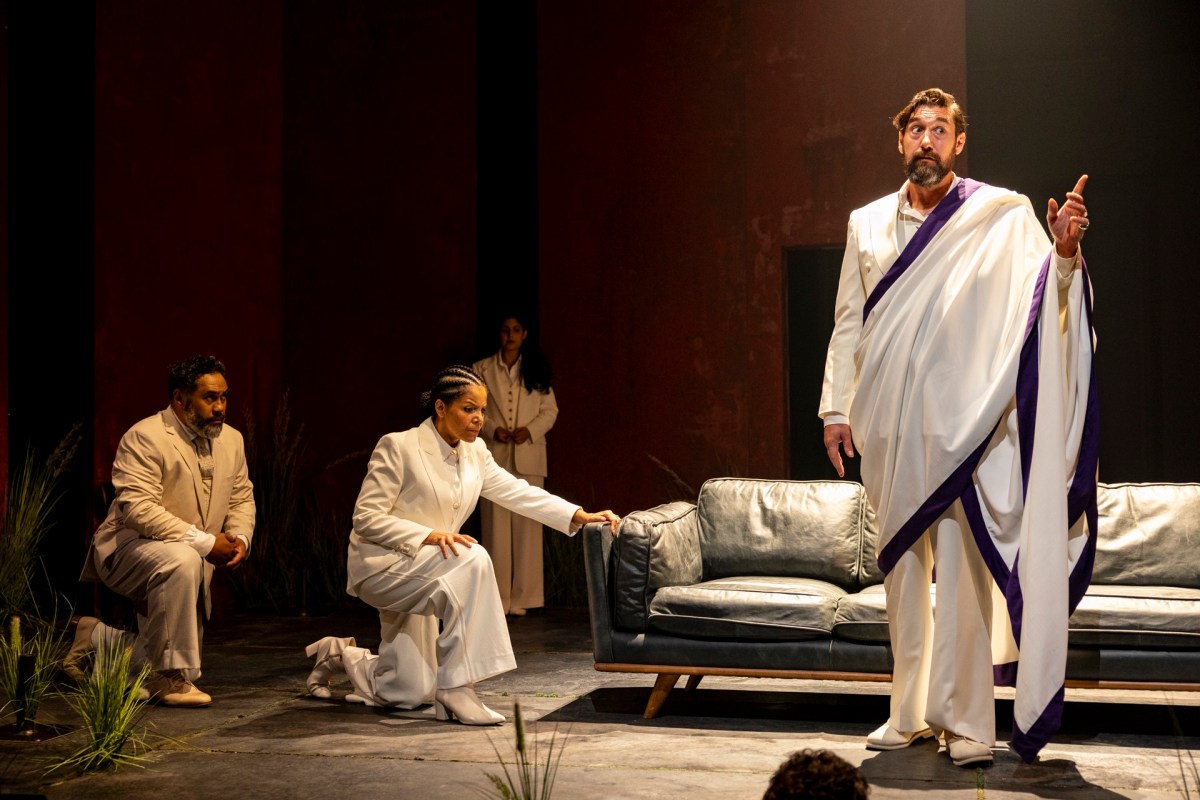
‘No kings,’ says a sea of signs marching on the empire’s seat of power. But this isn’t the Ides of March, nor Julius Caesar’s Rome. Instead, the entire world shudders as a warmongering madman stalks the halls of the White House (those that he hasn’t already bulldozed).
One who swears he’s a peacemaker while raining bombs on innocent civilians and kidnapping heads of state, in a gruesomely Orwellian break with reality. A malignant narcissist who responds to yet another attempt on his own life by redoubling his demands for a ballroom.
Just as there was once a throng of common people all for Caesar – a so-called strongman whose naked power-grab was about returning Rome to a monarchical structure beyond the limitations of politics – a swamp of obsequious enablers cheer on the American president today, as do a storm of MAGA cap-wearers.
It’s hardly surprising, then, that contemporary theatre productions have drawn direct parallels with those sporting these blood-red wreaths. Not so, in the latest, slightly muddled staging of Julius Caesar by Bell Shakespeare Artistic Director Peter Evans, which follows hot on the sandal-wearing heels of the company’s Coriolanus.
Julius Caesar review – quick links
Paving paradise
Instead of mirroring the US, Rome here appears to have been relocated to a suburban outdoor entertaining area somewhere in Melbourne’s outer north, which has seen better days.
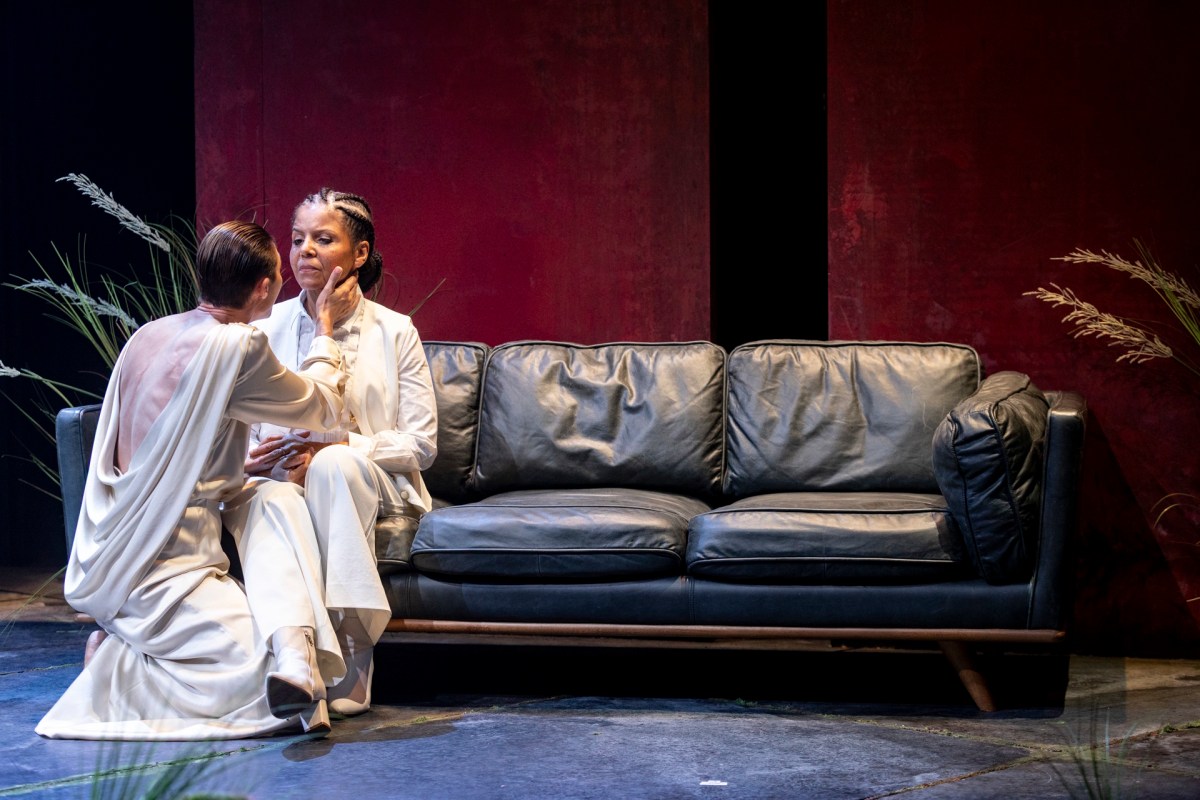
Evans, also on set design duties, delineates Caesar’s court with stark grey paving slabs, mossy from a lack of weeding, a battered leather sofa, mid-collapse, and a faded Cinzano parasol. Don’t judge a papyrus scroll by its cover, sure, but it’s hard to look past the bare bones when seated in the intimate confines of the Fairfax Studio.
By all means, bring the Bard into the now, but what are you saying when you do so? Not much, here, alas. An all too common example of the scourge of generic now-ish plaguing our (admittedly cash-strapped) stages, the look neither embraces the text’s classical import, nor convincingly leans into the trying times in which we find ourselves mired today. It’s a frustrating nothingness that’s not minimal enough to not matter.
Thankfully, costume designer Simone Romaniuk works wonders within this limiting framework, at least for the movers and shakers. She garbs our Caesar, Septimus Caton (an actor surely destined for Roman roles), in a louchely unbuttoned three-piece suit in gleaming white, further adorned with a toga-like wrap, also in white with purple trim. The company’s overused penchant for army fatigues and a generic tweed suit and flat cap for the working classes, not so much.
Portraying power
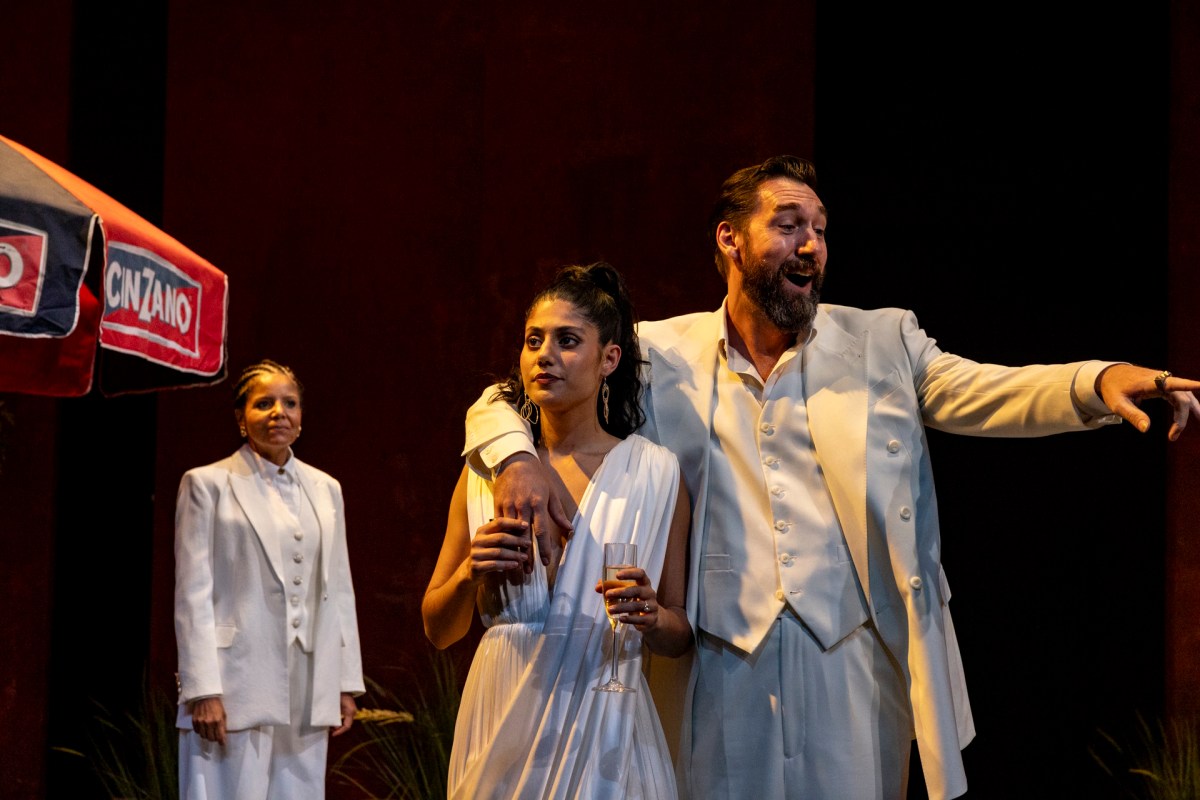
Caton plays the would-be tyrant with an overbearingly jolly, bordering on bellicose, demeanour that, in his performance, at least, more successfully summons both the bizarre appeal and the underlying danger of populists securing their corner.
Shakespeare wisely decentres his titular character, who appears and disappears like fleeting newsflashes, with the audience left to debate, like voters, if his vision for the future includes us all, or just his own ambition – an inherent ambiguity that maintains the text’s relevance today.
You know what comes in the middle, rather than the finale in this telling of Julius Caesar – all the better for us sitting in the consequences when we swoop from Caesar’s ever-confident ‘I am constant as the Northern Star’ to, mere moments later, his betrayed anguish and disbelieving cry of ‘Et tu, Brute?’
Who do you love?
Brigid Zengeni is the strongest player here, her Brutus the betrayer convincing us, if not the people of Rome, that Caesar had to go for their freedom, maintaining, ‘Not that I lov’d Caesar less, but that I lov’d Rome more.’
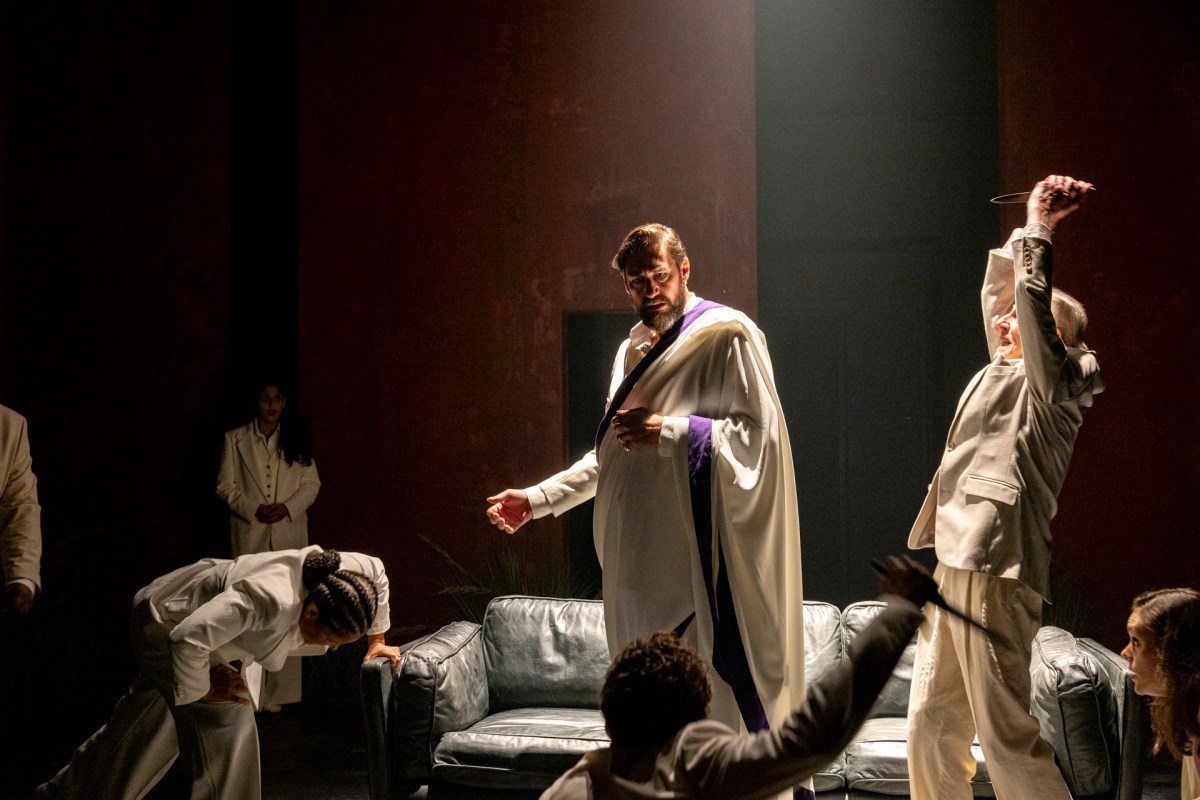
The true tragedy lies in Brutus’ dogged belief that the only way to protect the people is to tear down their leader, and in this determination, Zengeni holds us rapt. While the import of this gender-flipped role isn’t laboured on, it does add an intriguing frisson to the text, as does pairing Zengeni with ace non-binary actor Jules Billington as Brutus’ partner, Portia, and our narrator.
Leon Ford is fun as the slithering Cassius, prodding them towards their doom, with Ruby Maishman’s grinning co-conspirator Cinna and Gareth Reeves’ more overtly pained Casca standing out in the ensemble as their murky manoeuvres invite us to ponder who acts out of their own best interests.
Mark Leonard Winter’s Mark Anthony, a man not above seizing control when it comes to him, is also impressive, particularly in the immediate aftermath of the assassination. Taking to a rusty-wheeled ladder (again with the underwhelming set choices), his manipulative and nimble-footed sway over the shocked crowd, ensuring Brutus’ self-imposed banishment, is a startling moment. This stripped-back stagecraft is impeccably supported by lighting designer Amelia Lever-Davidson.
If Evans’s too-vague staging and occasionally scattershot focus on the ensemble starve some of the play’s strength in the shorter but somehow saggier back half, beyond Mark Anthony’s gambit, it’s a shame. But the shadow Shakespeare’s words cast lingers on.
