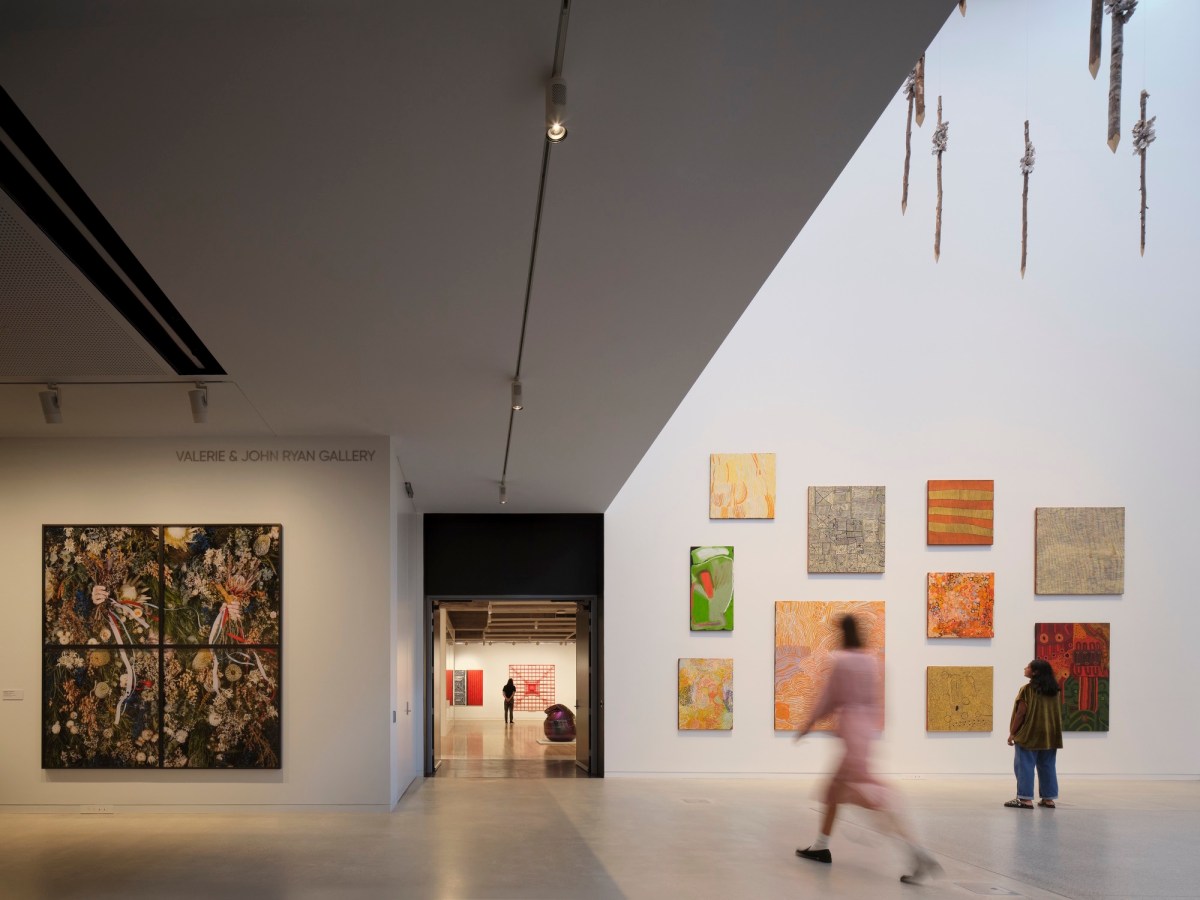
After four years of renovations, Newcastle Art Gallery has reopened its doors with the splashy exhibition Iconic Loved Unexpected. Expanding on and honouring the original architecture, the building is now the largest art gallery in New South Wales outside of Sydney.
Both the exhibition and the gallery are a homerun for Newcastle Art Gallery. Launched with an opening night street party, Iconic Loved Unexpected is an awe-inducing showcase of iconic Australian artists and impressive international pieces, touching on ideas of the body, history and Australiana.
Iconic Loved Unexpected review – quick links
A fitting showcase to reopen the gallery
Iconic Loved Unexpected draws on the gallery’s extensive collection of over 7000 works. Valued at more than $145 million, it was described to me by City of Newcastle CEO Jeremy Bath as ‘the most valuable asset in Newcastle’.
Around 500 of these works are now displayed across 13 gallery spaces in the multi-storey building. Above the main entrance hangs new permanent commission Watawan (Mullet) (2025), a land-inspired chandelier by Awakabal artist Shellie Smith and public sculpturist Julia Squires. Made of 29 woven depictions of local mullet fish, the individual pieces have been cast in aluminium and bent into a whirl, creating an enchanting invitation to connect the gallery to its local environment and culture.
One of the first gallery spaces that visitors encounter is the Margaret Olley Gallery, named after the prolific artist who donated an artwork annually to the collection up to her passing in 2011. While much of the collection on display will rotate, Olley’s art will be permanently showcased here in honour of her extensive history with the gallery and the city.
The works currently on show balance her extraordinary deftness with colour, as seen in pieces like Self-portrait with everlastings (1974), with the vibrant movement she gives static landscapes like State Dockyard, Newcastle (1974).
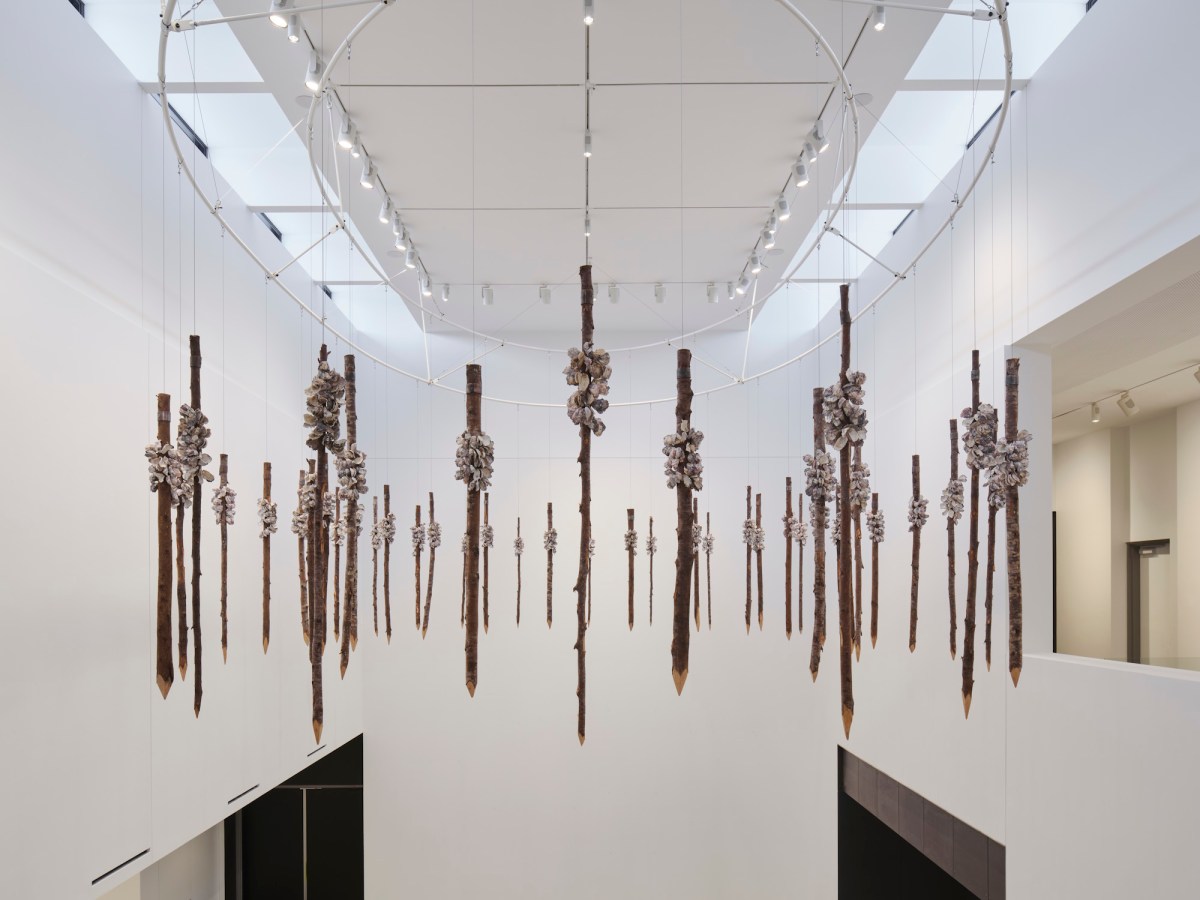
Sweeping into the central atrium, you’ll find Megan Cope’s Kinyingarra Guwimyanba (Off Country) (2022) hanging above you, comprising 44 sharpened pine poles ringed with oyster shells gathered from the natural tideline. Another immediately eye-capturing work is Abdul-Rahman Abdullah’s The men who sold lies (2018), tellingly positioned here alongside Joseph Lycett’s Inner View of Newcastle (1818).
Painted by an English forger who arrived as a coloniser of the land, Inner View of Newcastle is one of the earliest documented landscapes of the region. In a startling and aching response to more than 200 years of colonisation, Abdullah’s The men who sold lies is a frame, made to the same dimensions as Lycett’s work, that appears covered by drapery but, on closer inspection, reveals itself to be a wooden farce.
These first few moments in the gallery leave a profound impression, cementing the ambition of Iconic Loved Unexpected and its respect for the local and Aboriginal communities of the area.
A smart curatorial eye
It would be easy for an exhibition of this size to feel either scattered or curatorially simplistic, but Iconic Loved Unexpected makes the most of its scale, constructing an exploratory history of art that feels alive. Small curatorial touches are married with broader conceptual stories, making every individual gallery feel like a well-stitched square in a quilt.
In the Body Politic section, Interior with water lilies (1992) is Chilean-Australian artist Juan Davila’s boundary-breaking reckoning with colonial invasion in Latin America. Here, the boundary breaking is quite literal: a saw, a smaller painting and other fragments protrude from the domestic scene.
Nearby, Michael Zavros’ The sunbather (2015) is a mesmerising self-portrait that captures the artist wrestling with his own reflection and what it means to seek serenity.
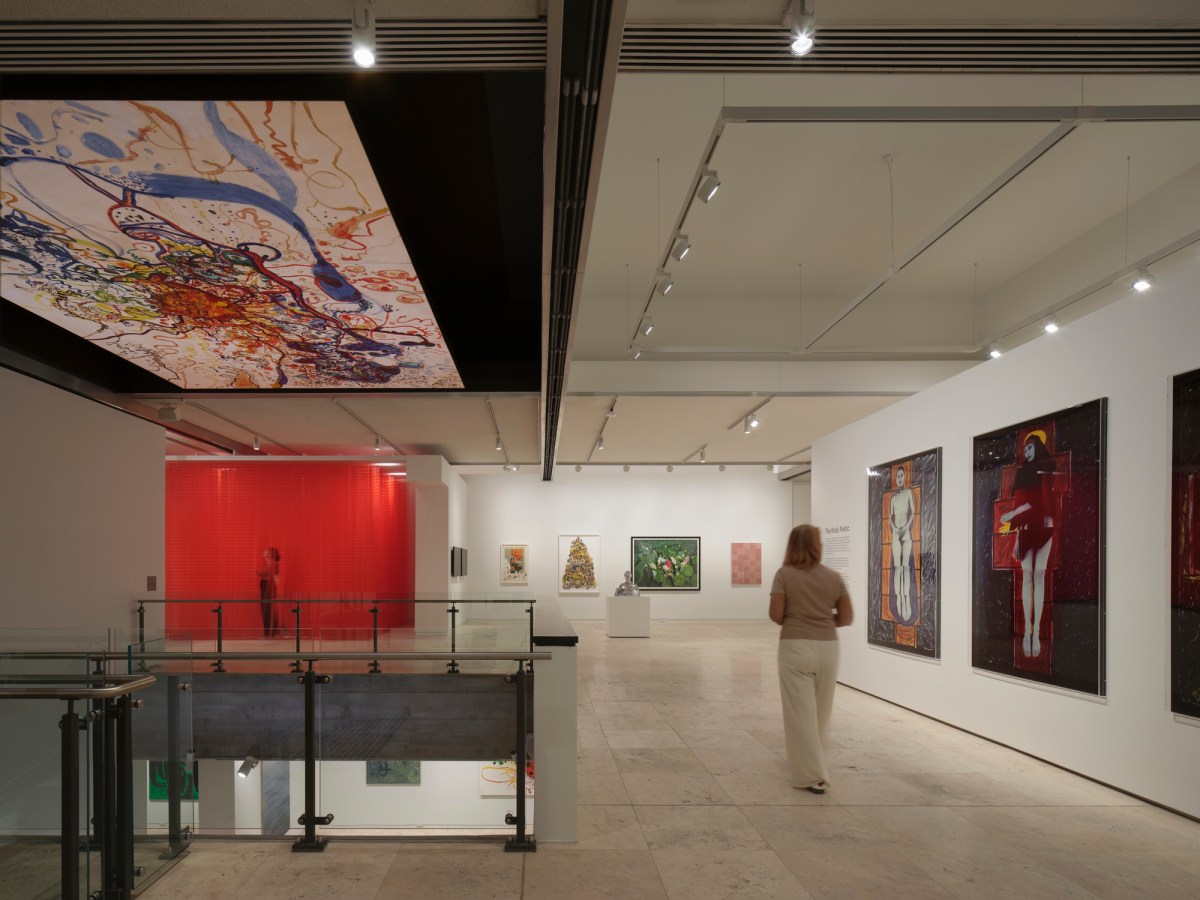
In the next room, John Olsen’s Life burst (1964) is a vibrant and sprawling contribution to the ‘Iconic’ part of the exhibition, a six-metre-long spectacle by one of Australia’s most significant artists, who also happens to be a Novacastrian.
To the left of the Olsen sits Afternoon Yarramalong (1963), a contemplative and muted piece by Valerie Strong, Olsen’s wife, who went unrecognised for her artistic practice until long after her passing. Strong’s painting is mesmerisingly specific, marrying the abstract with the aquatic. The curatorial decision to pair these paintings is a sign of how ‘Loved’ her art is, regardless of the delayed recognition.
On the other side hangs Jeffrey Smart’s striking E.U.R. I (1964). The oil painting is much meeker in scale and scope, and saturated in solitude. I felt a surprising pull to the lone figure swept up in a book on the European staircase, an ‘Unexpected’ feeling which made sense when I discovered Smart’s lifelong interest in depicting queer isolation.
The catalogue provides many such extra tendrils of information. Another work in this room, Philip Wolfhagen’s Surface tension no. 3 (1998), is an overwhelming study of the waters in Tasmania/Lutruwita. Alone, it’s a feat, giving the hulking and wind-swept chaos of the waters a serene shine; the catalogue reveals Wolfhagen mixes his paint with his apiarist brother’s beeswax to obtain this iridescent sheen. While the catalogue is accessible and delightful, Iconic Loved Unexpected is clearly designed for anyone to enjoy, critics and children alike.
A street party designed for the people
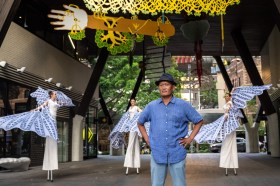
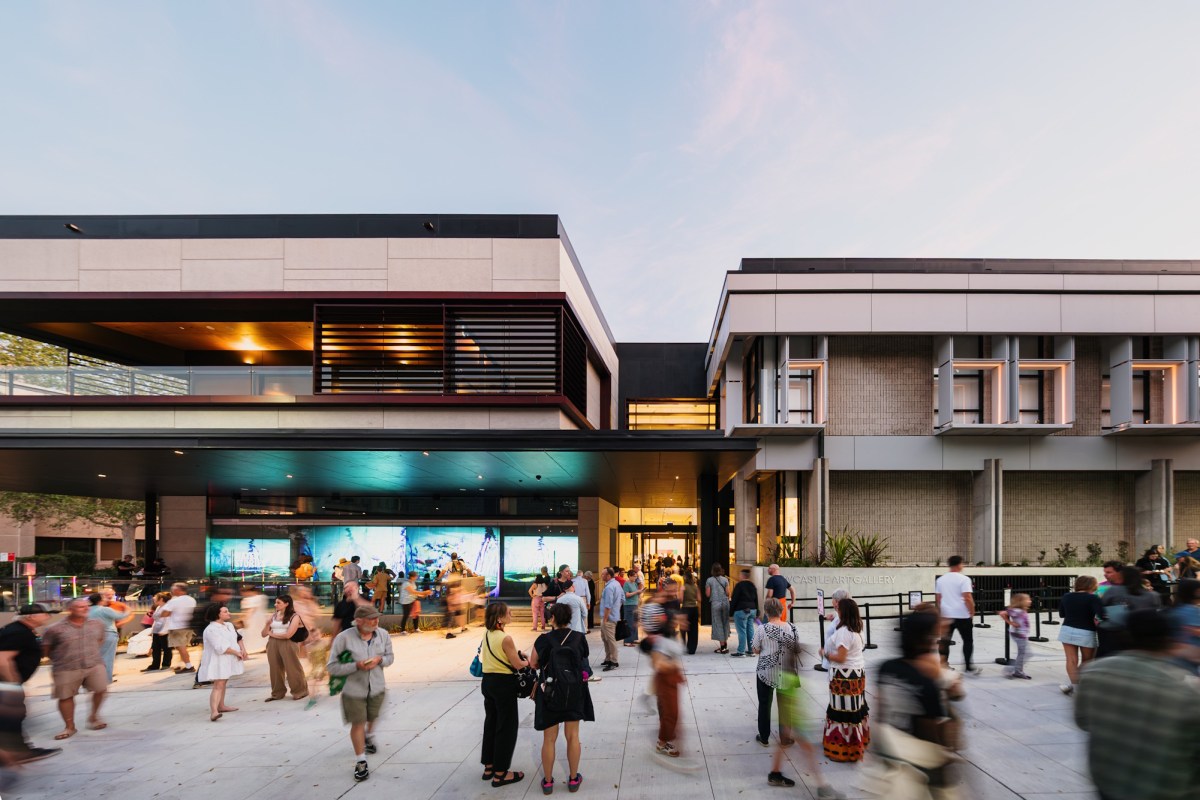
When the gallery held its reopening street party on 27 February, themed ‘Industrial Disco’, there was a line around the block throughout the entire four hours of the event. Newcastle clearly turned out in full force to support its newest attraction.
The street outside, sandwiched between the gallery and Civic Park, was lined with food trucks and so-called ‘donuts’, large circular sculptures commissioned from Newcastle artists Braddon Snape and Dani Marti.
After a Welcome song by Torres Strait artist Toby Cedar, Deborah Kelly’s CREATION choir group emerged, performing several songs in support of what they call their queer insurrectionary climate-change religion, founded as part of a longform collaborative art project.
ArtsHub: Yield Strength Adelaide Biennial review – grunge rupture and eloquent overlays
Other highlights included tattooist Eddy Lou live-inking designs by exhibiting artist Kara Wood, as well as a roaring live rock performance by visual artist James Drinkwater and his band the Pitts. Having collection artists such as Drinkwater and Cedar perform felt like the perfect baptism for a gallery at the centre of Newcastle’s art ecosystem.
The final performance by electronic sister-duo Kinder brought the fledgling DJs into the central atrium and jolted the hordes of people into movement, joyously awakening the space.
It was a fitting and deserved celebration of the gallery reopening, honouring the history and the future of Newcastle’s art scene. Hopefully, Iconic Loved Unexpected also marks the beginning of a vibrant and inclusive curatorial program, but for now it stands as an exciting revitalisation of one of Newcastle’s most essential cultural sites.
Iconic Loved Unexpected continues in full at Newcastle Art Gallery until 23 May, after which some gallery spaces will be turned over to other exhibitions.

This article is published as part of ArtsHub’s Creative Journalism Fellowship, an initiative supported by the NSW Government through Create NSW.