Hamlet Camp: quick links
All the world’s a stage, but hold your horses
As with Shakespeare’s Hamlet, the current Carriageworks production Hamlet Camp isn’t really about indecision. Instead, it explores what happens when certainty is gone and things feel unstable. Performance and identity mix together, art moves beyond the stage, and the famous question, ‘To be, or not to be’ stops being just a thought and becomes more of an occupational hazard.
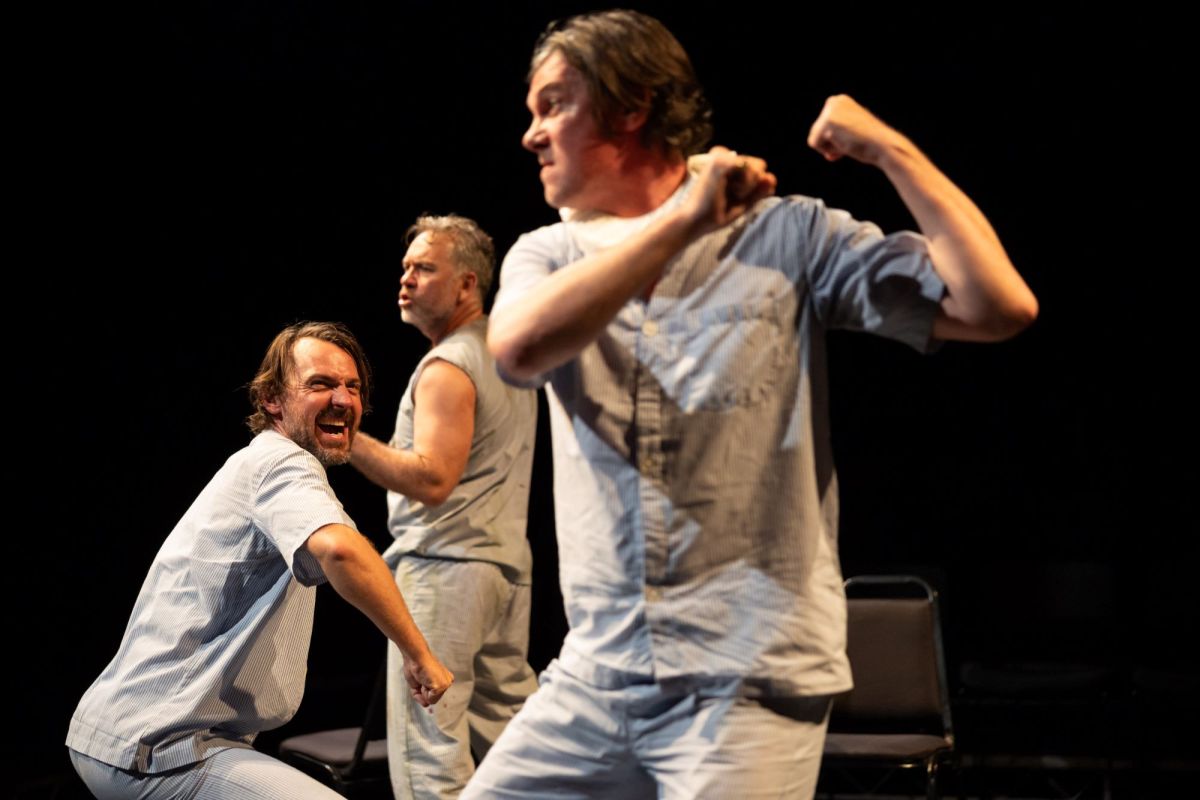
Brendan Cowell, Ewen Leslie, and Toby Schmitz’s combined 25 years of collaboration is deeply felt on stage. Their connection isn’t just comfortable, it’s sharp, precise and sometimes even tense. They interrupt and speak over each other, as if their boundaries have blurred. The show moves quickly but leaves a lasting impression.
The trio’s intertwined history serves as the engine for the piece, but also reveal its cracks. Hamlet Camp’s relentless pace captures the overwhelming lives of artists, but too much intensity flattens feeling. Without appropriate pauses the funny moments blur, the insights fade. The mood rarely shifts, and the audience is left longing for contrast, for breath. More space and silence would not weaken the show: it would let the best moments rise to the surface.
Hamlet Camp: from wit and whimsy to woah
Toby Schmitz begins by talking about his early days working in a bookshop, delivering a wide array of hilarious anecdotes in this opening monologue. He talks directly to the audience, inviting us not just to laugh but to judge customers, art, and even ourselves. Some jokes hit harder than others, but that seems intentional. Not every reference is for everyone, but this sequence aims to leave no one out. Like art itself, meaning slips and slides, becoming personal and unpredictable.
Brendan Cowell’s monologue comes next, driven by movement and a suitcase that is used… creatively. The audience laughs often. His crude humour creates some of the show’s most memorable and uncomfortable moments. However, the energy feels frantic, like someone trying to make sense of chaos by staying busy. What sticks with you isn’t just the jokes but the anxiety beneath them, the sense that the suitcase carries more emotional weight than expected. It’s both funny and quietly unsettling, showing that ownership can comfort us but doesn’t give us the certainty we crave.
Read: Observer, Observed review: public art about public surveillance for Sydney Festival
Ewen Leslie’s monologue changes the mood. His tight, rhythmic speech suggests racing thoughts. He is breathless, conveying a form of madness rooted not in spectacle but in relentless thought. Just as the pot boils over, Leslie pauses, his words slowing and stretching time. It’s the only time the production’s emotional intensity shifts, proving that well-timed changes in pace can help audiences better find their footing and become more grounded amid sustained intensity. It is the most powerful scene, evoking deep emotion – something that sadly was not repeated in Hamlet Camp thereafter.
Collectively, these monologues feel like being welcomed into a group, akin to listening to funny, slightly battered uncles discoursing during the holidays after the younger cousins have gone to bed. Their stories move between confidence and vulnerability. The main idea is clear: these men aren’t just acting as Hamlet; they, like many of us, are living with his questions.
Then the camp begins
Hamlet Camp: rehab, rhetoric and rhythm
A dancer remakes the stage into a kind of psychiatric limbo, where each man, a former Hamlet, is sent to wander. Her movement shapes the air, but she is a fleeting presence – too fleeting. Had she lingered, perhaps more of Shakespeare’s mischief would have seeped in. Like the Bard’s fools who slip between sense and nonsense, her choreography could have broken the spell of words, offering relief from the relentless volley of punchlines. The audience, still catching its breath from one joke is swept too quickly into the next, the emotional current barely surfacing before it is gone.
The premise was simple, however difficult to grasp at times. Maybe that was the point: to let the audience find clarity by experiencing the scenes instead of through direct explanation.
Madness woven in the unweeded garden
Overall, Hamlet Camp makes clear that Cowell, Leslie and Schmitz are not haunted by Hamlet because they failed him, but because the Prince has claimed them. Every attempt, whether faithful, experimental, or modern, falls short. Direction, critique, competition, expectation: the industry devours, misreads, and forgets. Their work feels wasted, their talent invisible. Like Hamlet himself, they are caught in the space between action and paralysis, certainty and doubt. The three have beautifully enveloped themselves in the core themes of the Elsinore court tragedy and retold its fundamental, raw, human facets with agonising wit and physicality.
Madness here is not failure, but the cost of caring too deeply in a world that demands everything but which leaves you with nothing.
Here is where the production’s strength reveals itself. Hamlet is often called a play about indecision, but Hamlet Camp asks a different question: how much are we missing out on by being consumed by our stubborn obsessions?
The work also explores how action itself never promises clarity. Nothing is resolved. The performers move together, but never move on. Hamlet lingers. Madness lingers. Uncertainty, always.
Hamlet Camp is quick, funny, intense, and deeply human. It asks: what happens when art refuses to let you go and whether letting go is ever truly possible.
Hamlet Camp is now playing at Carriageworks, Everleigh until 25 January 2026.

This article is published as part of ArtsHub’s Creative Journalism Fellowship, an initiative supported by the NSW Government through Create NSW.