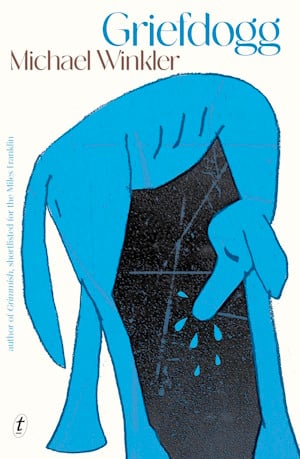
Michael Winkler’s debut novel Grimmish was shortlisted for the 2022 Miles Franklin Award. His second novel, Griefdogg, contains neither grief nor dogs, but it does convey conceptually-adjacent simulacra of each. This sounds confusing (because it is) but the book itself isn’t – as long as you don’t overthink it.
Griefdogg is about emotional catharsis-by-proxy, and the destruction of self as a form of creation. Griefdogg turns humans into animals and endings into beginnings, and then asks if any of it mattered in the first place.
Griefdogg review – quick links
A unique voice
Alternating between (non-chronological) third and first person, the protagonist’s internal monologue is just as rich in unfussy Australianisms – gidday, fair dinkum, carn, yakka – as it is in Greek root words, philosophical quotes, scientific puns, hydrology factoids, academic analogies and shameless dad-jokes.
This stream-of-consciousness prose might be a stylistic choice intended to convey the character’s mental state, or it might just be how the author writes (which you’ll know if you’ve read Grimmish). Either way, Winkler’s approach in Griefdogg is effective, as long as you don’t mind the occasional disorientation of a changing narrative tide.
Jeffrey is a hydrologist, an upstanding citizen, and a family man with a high estimation (which may-or-may-not be accurate) of his own prowess. He is orderly. Reliable. An overachiever (you know the type) who meticulously adheres to a rhythmic routine comprising a respectable job, daily work-outs and an unbroken 18-year-streak of weekly tennis games.
In stark contrast to this portrait of predictability, Jeffrey is also the kind of person who mentally solves equations to prolong his performance whilst cheating on his wife (with his cousin) after the death of his aunt.
Griefdogg: grief and a golden ticket
Perhaps Jeffrey is acting out against the inevitability of finitude, while under the haze of grief? He has, after all, just lost a relative. It’s understandable if he revolts temporarily against his own nature. Everyone grieves differently.
But aside from his racing thoughts, impulsive actions and questionable decision making, there is nothing to suggest Jeffrey is grief stricken. There is no evidence of internal rumination – let alone overt sadness – related to the death of Jeffrey’s recently deceased aunt. There is, however, a sizeable inheritance, which definitely factors into his thinking.
This seven-figure sum frees Jeffrey from the necessity of capitalist monotony, prompting him to realise how much he loathes the cumulative grind of work, family life and social obligation. The intoxicating notion of ‘opting out’ expands to include not only Jeffrey’s job, but his entire identity.
Jeffrey’s carefully cultivated life begins to fracture. He doesn’t want to be Jeffrey anymore. He wants to be the family pet.
ArtsHub: All new Australian book reviews
Griefdogg: dogs and detachment
Jeffrey’s wife, Martine, is understandably resistant to this change in their marital dynamic. Their adolescent child, Bern, is adamantly opposed to losing a father and gaining a pet. But their needs are irrelevant to Jeffrey, who never meaningfully analyses the impact of his choices.
Jeffrey decides to give Martine his entire inheritance and in return, he expects to be taken care of according to his pet directive. Jeffrey’s absence of material greed doesn’t equate to a lack of existential gluttony, as the unconsensual imposition of this arrangement implicitly underlines.
Jeffrey (now called Hubert) embraces his role as the family pet, despite the persistent resistance of his Martine and Bern. Their dismay doesn’t factor into his decision, except as an obstacle to ignore.
Hubert doesn’t identify as an animal per se. He still showers, wears clothes, eats dinner (prepared by Martine) and holds conversations (when he feels like it). But he refuses to drive, work, caretake or participate in anything resembling a human obligation. He benefits from the caregiving labour of his family, while simultaneously abdicating all responsibility for them.
Hubert frames his transformation as a relinquishment of his own free will. He claims to have handed his personal power over to Martine. However, Hubert does as he pleases with no accountability (enacting his free will) while relegating responsibility for his existence to Martine (against her free will). The irony of this reversal is either lost on Hubert, or was part of his plan all along. It’s impossible to tell because despite the multitude of Hubert’s stream-of-consciousness tangents, his thoughts rarely settle on the subject of Martine.
In rejecting the perceived pressures of his former life, Hubert becomes detached from the people and routines Jeffrey once lived for. Hubert refuses to invest in the wellbeing of his family. He has no future plans, aside from avoiding the necessity of planning a future. He casts himself adrift in a sea of inertia, blatantly unbothered by his untethered aimlessness. Nihilistic about his own nihilism, Hubert doesn’t care that he no longer cares about anyone or anything that once meant everything.
Griefdogg’s ambiguous take on self improvement
After a while, Hubert believes he can sense secret sadness in the people he encounters. He cries for them (tearlessly) convinced his act will alleviate the burden of their pain. He never tries to empathise with anyone who loves him. In fact, he spends most of the story oblivious to (or unaffected by) the turmoil he relentlessly imposes upon Martine and Bern, who both shoulder unhappy burdens of their own. And it only gets darker from there.
This semi-surrealist exploration of existence could be interpreted in a multitude of ways, depending on the reader’s own frames of reference. Is Jeffrey/Hubert undertaking an experiment in self actualisation, or experiencing symptoms of an untreated mental illness? Is he railing against anthropocentrism in a capitalist society, or is he pathologically self-indulgent? Is this a story of courageous authenticity, outrageous selfishness, weaponised helplessness, or all of the above?
Book clubs may need to allocate additional discussion time in the service of unpicking these thematic threads, because Griefdogg’s morally-ambiguous premise leaves ample room for interpretation. Winkler doesn’t spoonfeed his readers pre-chewed morsels of food-for-thought, but he serves a meaty meal for those with an appetite for analysis.
Griefdogg might be a eulogy to externally-imposed selfhood, a tribute to nihilism, or an absurdist portrayal of what happens when life drills into a person and they leak. Maybe it’s none of the above. Either way, two types of people will read this book: those who’ll love it, and those who won’t. Both will enjoy deconstructing their respective reasons, and neither will recall the same story.
This book doesn’t concern itself with the usual things, like orienting the reader firmly within the narrative. The reader swims alongside the story – pulled by its currents – floating across pages of watery metaphor. Meandering, fluid and fragmentary, Winkler’s prose defines itself outside the boundaries of conventional storytelling. If tightness in writing denotes a lack of courage, Winkler must be applauded for his literary bravery.
Griefdogg is essential reading for members of book clubs who love lively debate; emotionally repressed dog-men who refuse to reciprocate; capitalists experiencing existential ennui; and anyone who wishes they could opt-out of everything.