While I should have AI write this review, thankfully AI bots still do not have the ability to physically experience an exhibition and critically comment upon it. It is an interesting thought to start with, because this exhibition poses the question: ‘What does it mean to be human in an age of AI?’
Art and AI: quick links
Data Dreams: Art and AI is arguably the exhibition that Australia has been hungry for – taking a deeper, in-person dive into the possibilities and limitations of AI technologies, conversations which have dominated the sector this year.
Showing at the Museum of Contemporary Art Australia (MCA), it is the first of the summer blockbusters to roll out for 2025, and it doesn’t disappoint. The exhibition has been developed by MCA curators Jane Devery, Anna Davis and Tim Riley Walsh – aptly, collective intelligence is another thread running through this exhibition.
What I find fascinating about Data Dreams is the way it both pulls in AI as an active collaborator on the one hand, but then takes an almost ‘autopsy-like’ approach on the other, stripping back and exorcising perceptions for this insanely paced horizon of change.
Breaking down Data Dreams: what visitors will see
Audiences move through immersive installations by ten artists, each of whom presents a totally different approach to working with machine intelligence. While this point of difference makes for a nuanced and intriguing exhibition, it also brings with it a level of optimism – one that breaks down the fear associated with AI-usurped creative futures.
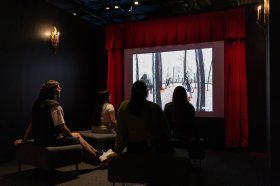
One of the first works that viewers encounter is Hito Steyerl’s (Germany) Mechanical Kurds (2025) – a double-sided video projection surrounded by architectural forms powder-coated in bright colours, which double as seating.
Using an expanded documentary style, Steyerl blends AI-generated imagery with real footage to look at how warfare and surveillance systems recognise and track people and objects. Most interestingly, it looks at the hidden human labour behind these systems. It is set in a refugee camp in Iraq, where people are employed to do the micro-tasks required to teach AI systems. Their movements are framed by ‘boundary boxes’, which track them.
I especially like the way that the custom gallery furniture echos these boundary boxes and pulls you in as active agents and fair game for mechanical learning. Overall there’s this erudite slippage between what is real and what is constructed; between the present action and the future tool.
AI moves beyond the screen in Data Dreams
artist and Museum of Contemporary Art Australia © the artist. Photo: Hamish McIntosh
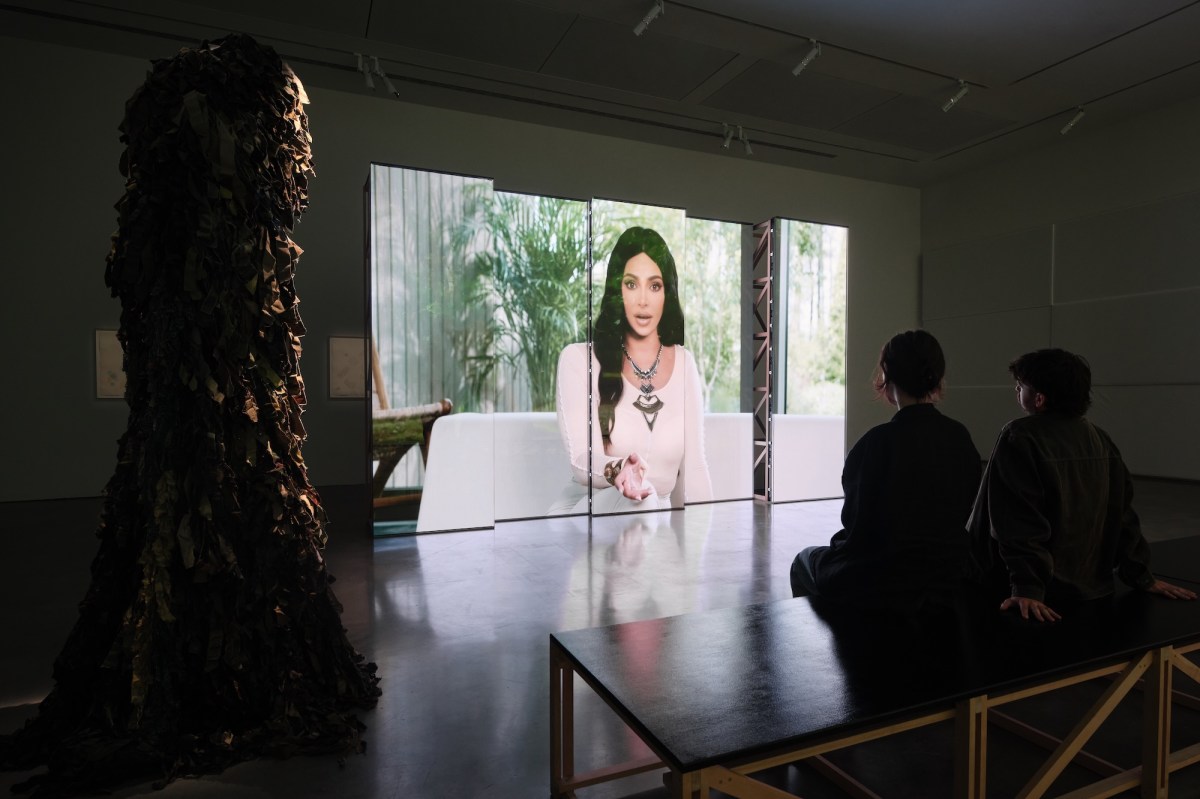
In an adjacent gallery is the monumental work by Christopher Kulendran Thomas (UK), The Finesse (2022), which combines sculpture, archival footage, AI-generated avatars and scraped data to rebuild a narrative for a lost history. It slides from pop culture and the likes of the Kardashians, to Tamil fighters and deep fake messages with political overtones. The work leaves the viewer questioning what is real and what is not, and how we digest our contemporary world fed by our screens.
Dominating the space is an expansive projection of a forest planted by the Tamil liberation movement as a sustainable source of timber, largely inaccessible today due to military boundaries – what the artist describes as an act of ‘weaponising archaeology’. So, it was shot elsewhere, London and South Africa for example.
Opposite this is a five-screen projection looping a data stream – some of it is real footage by the artist, some is scraped from the internet in a continual feed loop. What I like about this work by Thomas is that it uses every kind of tool for storytelling indiscriminately, blurring and morphing our read on history into a kind of pseudo-sci-fi-toned documentary offering an alternative ‘believable’ reality.
AI’s environmental image is at the heart of Data Dreams
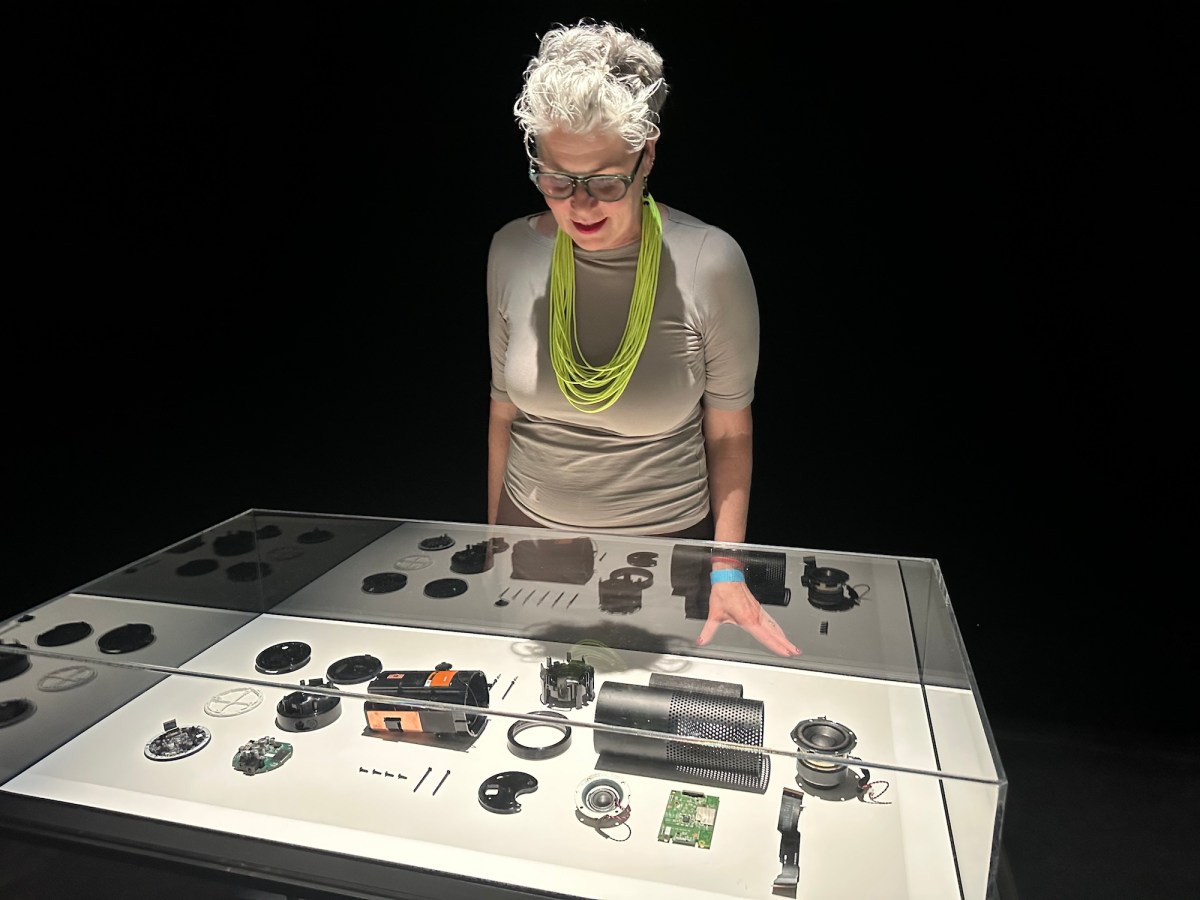
One of the earlier works in the exhibition is by Kate Crawford and Vladan Joler (Australia/Serbia), Anatomy of an AI System (2018) – a visual mapping that looks at an AI device in detail, from mining the raw materials to make devices and the cost of their fabrication, to their use and eventual e-waste. The artists remind us that these systems have a life cycle of two to three years, and compete with our own need for energy and resources.
Crawford explained: ‘We now know that a generative large-scale language model is 10 times more energy intensive for every query, than a traditional search engine. And if you make an image or video, it’s hundreds of times more energy intensive.’
She continued: ‘Generative AI already uses as much energy as the nation of Japan, and it is predicted to use as much energy as India by 2030, so we are now looking at the creation of new systems that are directly competing with humans for the basic resources of life, water, land, energy and so forth.’
The multi-part installation includes two museum cases – one with the actual raw minerals needed in AI devices, and the other a dissected Amazon Echo, an AI system. Between them is a flowchart that maps the carbon footprint and implications of the structures that sustain artificial intelligence. It gives people a different way of seeing AI, beyond the code and invisible layers behind the technology in an easy to grasp way.
Another highlight of the exhibition is the work of Agnieszka Kurant (Poland), which also turns to those raw resources. ‘Essentially, everything in the world is a product of collective intelligence’ she tells ArtsHub. ‘It’s not a product of individuals making a form; it’s always a kind of an accretion, an assembly, an amalgamation of various kinds of elements.’ Kurant’s complex art making, simply, is interested in the digital traces we leave.
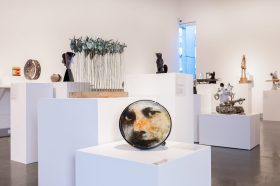
With regard to the brain-popping possibilities of machine intelligence playing a creative role, Kurant’s In Conversions (2019 – ongoing) aces it. These ‘paintings’ hold liquid crystal within a traditional frame, and are constantly changing in real time. The animated data is scraped from the internet and social media using a custom AI system, representing the ways people are expressing emotions about changing the world.
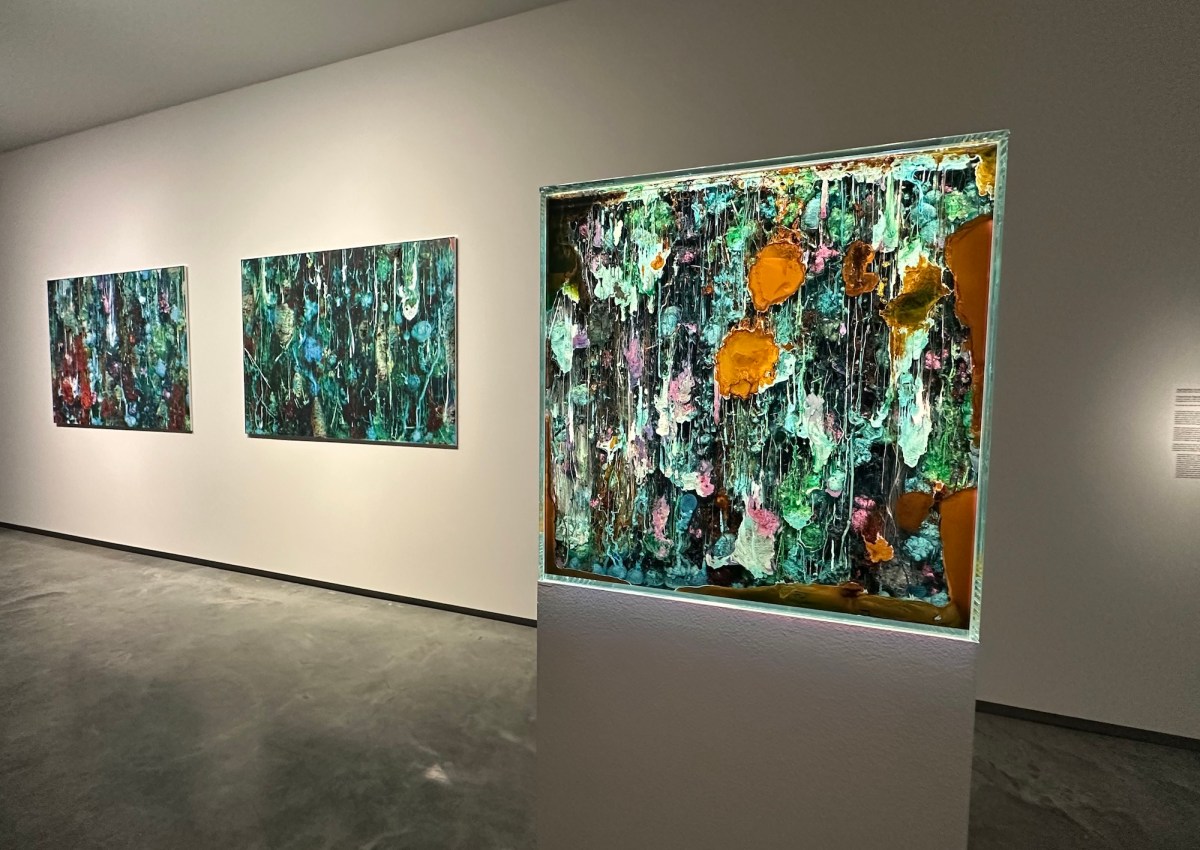
Kurant’s sculptural work Chemical Garden (2021/2025), perhaps best demonstrates how AI can be used as an artistic collaborator. Plant-like crystals – from the same metal salts used to build computers, devices and server farms – actively grow in a glass cube in what looks like an Abstract Expressionist work of art. On the one hand, Kurant is challenging the traditional parameters of painting and sculpture, while on the other she is bringing awareness to these metals that are being extracted at the expense of our ecosystem. The artwork will continue to grow throughout the exhibition period.
Linking land and sea through AI projects
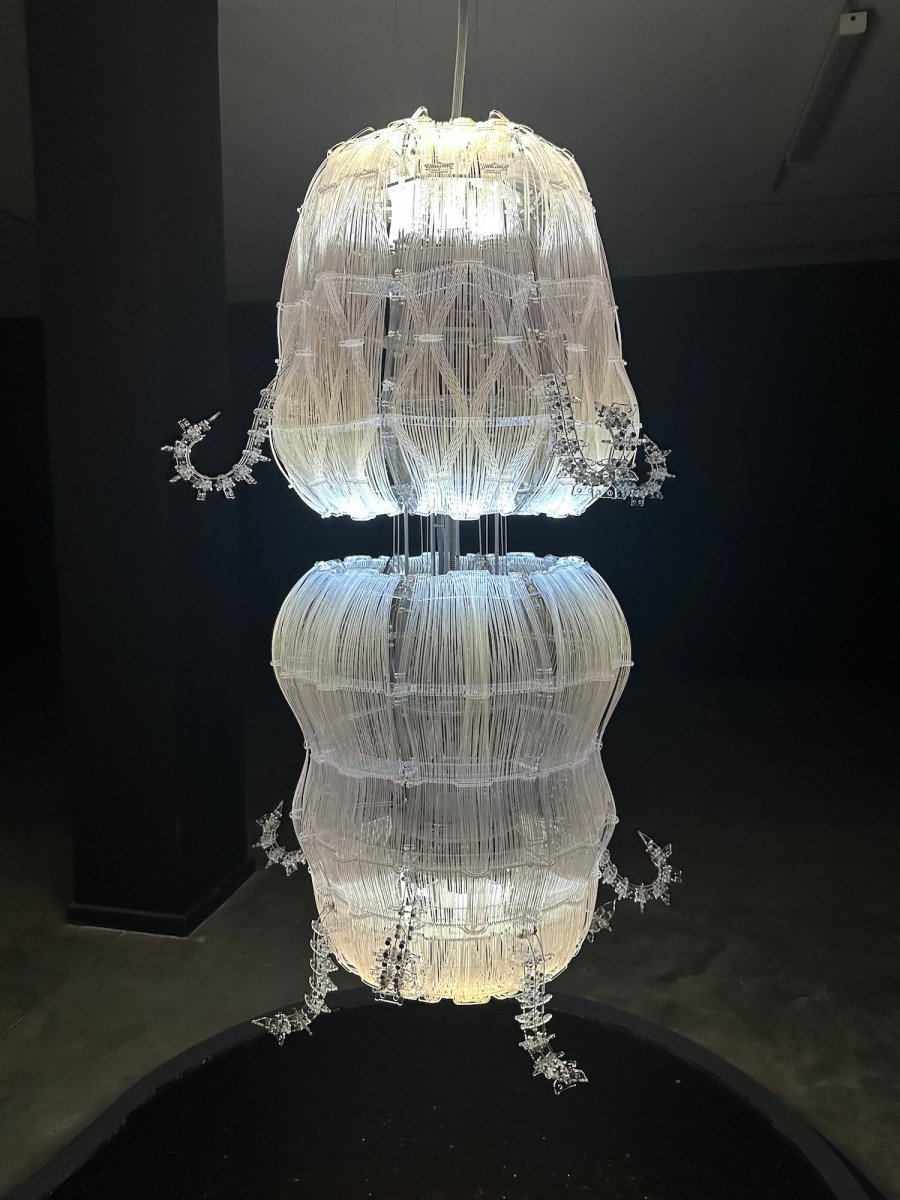
Completing the exhibition is a cluster of works, ushered by a poignant installation, kinetic in another way, featuring the sculptures of Anicka Yi (South Korea/USA). They populate the end gallery and offer a nice transition from Kurant’s colourful kinetic abstractions.
Suspended in a superbly lit darkened gallery, they feel like undulating sea creatures – almost like giant predatory jellyfish. Part of Yi’s Radiolaria (2023–25) series, they have been created using a 3D-animation generated custom AI software designed to carry on her art practice after her death – the ultimate creative extension beyond the human or the organic, and yet a collaboration with both as data sets.
Less successful in their delivery are works by Angie Abdilla (palawa, lutruwita/Tasmania, Australia) and Fabien Giraud (France), artist who, respectfully, turn to deep connections with Country and landscape and place, as their origin to inform AI data sets for future understanding.
Abdilla turns to creation stories in her immersive work, fusing that with evolutionary science to simulate the “Big Bang” in her ceiling-mounted work, Meditation on Country (2024).
Giraud’s ambitious long-form film, The Feral – Epoch 1 (2025), which has been edited by AI, makes its premiere for the exhibition. The project is based in rural France, and is envisaged to last for 1000 years, with each year an artist invited to add a new work for machine learning, fusing physical and digital worlds. The film is the outcome of that first learning data set.

There is a lot to take in with Data Dreams, but it does not feel overwhelming. The work is diverse enough to pace our slow learning or a quick moving medium.
MCA’s mission is to present the most relevant contemporary art ideas of the day, and this exhibition sits squarely within those goal posts. It is also the first time that an ideas-led exhibition has been presented for the Sydney International Art series, which usually favours big name solo artists or major buy-in exhibitions.
Data Dreams is a brave and timely choice, and is the first deep look at AI by an Australian institution. It is really worth visiting to mark this moment – both in terms of Australia’s read on AI at this time, but more broadly as a time piece, as these technologies are moving so very quickly.
Data Dreams: Art and AI is showing at the Museum of Contemporary Art Australia (MCA), Sydney, from 21 November 2025 to 27 April 2026. Presented as part of the 2025–26 Sydney International Art Series. It is a ticketed exhibition.
Discover more arts, games and screen reviews on ArtsHub and ScreenHub.
The article has been adjusted since publishing on the request of artist Angie Abdilla.