To live and to be of a place – Australia – that struggles to accept the violence of its colonial past and present pushes one to ponder their heritage. As First Nations peoples, cultures, and histories are erased from the stories of this land, and as ‘our’ settler-immigration nation struggles to digest its Asian-Australian and African-Australian populations, the need to examine, understand, and explore ‘our’ identity and heritage is becoming more and more pronounced. Omar Musa’s new poetry collection, Killernova, is part and parcel of this struggle to define, understand, and honour one’s heritage and identity.
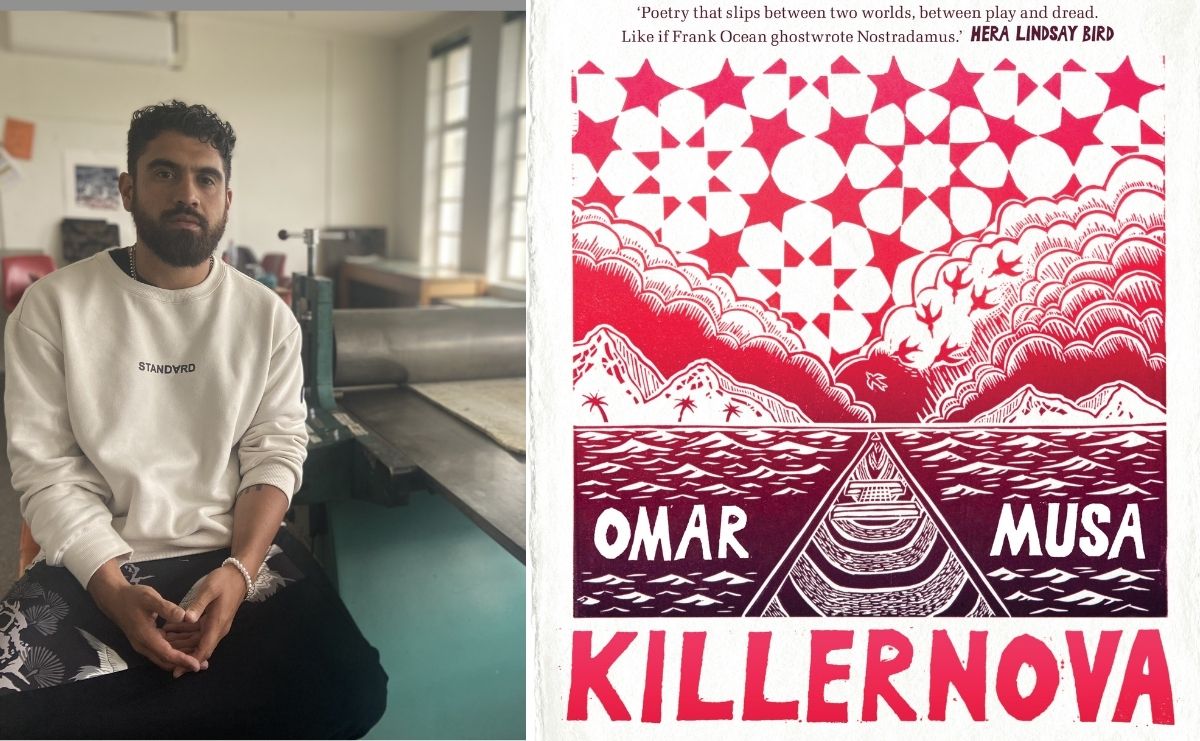
Killernova, is an ode to Musa’s Malaysian heritage and, in particular, the island of Borneo. Through the collection, Musa tends to his soul by excavating the mythos, histories, and memories that have shaped him and his family. Each poem is accompanied by one of his breath-taking wood carved illustrations, a skill he acquired to honour His uncle Bakri, a woodcarver, and his ancestors who ‘sailed in wood’. Etched atop colourful pages, Musa’s words seamlessly carve themselves onto the reader’s mind.
In his poem, Mile 7, Sandakan, Musa asks, ‘how much freight can a soul bear?’ He answers that it can bear more ‘than a poem, surely’, but not ‘nearly as much’. Through his wood carved illustrations and their changing hues, Musa reminds us of the myriad histories and stories that animate life on this continent – Australia. He reminds us to look beyond the colonial narratives that underpin the organisation of life and social relations in so-called Australia. That we need not contort ourselves to fit its form. Rather, we can embrace, revisit, and draw upon other, more difficult histories in developing and building our self-understandings. Difficult because of the impacts of colonisation, imperialism, and migration which have resulted in their historical erasure, neglect, and disavowal.
Read: Book review: Adrift in Melbourne, Robyn Annear
Musa takes us on a seismic, oceanic journey and we feel his anguish as he works to find and rescue those forgotten parts of himself. This is his offering: a story about the ‘last woman in the world who knows how to spin sea silk’. A story about the wereleopard who is ‘marginalia to the ravelling spool of forest’s page’. Musa dreams of Makassar, nutmeg, and the ‘last woman and man in the world’. His mind and memories are as feverish as the ocean waves his ancestors sailed in wood. Water renews and unsettles. It can swallow a person whole. It can bring them home, to the land. Musa is preoccupied with the question of the ‘homeland’, whether it is ‘singular’, ‘ambiguous’, inconsequential, or the ‘truth’. He wonders if his homeland resides within him or if he is the homeland. As he grasps for an answer to his question, Musa wonders if it ‘is possible to smell your way out of a forest on fire?’
In Killernova, Musa’s fire burns bright as the rhythm of his words carries the reader from page to page and line to line. We feast on his mesmerising artwork slowly and with intention – like a flood of children eating fairy bread at a birthday party in ‘unAustralia’. We linger on each page as Musa renders beautifully the fraught colonial histories of South-East Asia. Through this collection, Musa has provided himself – and others – with an ‘invisible map’ through which to find their concealed selves. For Musa, this search is ‘an impossibility – an imperative’.
For those who have ‘wanted to die but now…want to live’, this book is for you and all else who have wondered about their place in this world. Here, you will find love, joy, family, and recovery in abundance. For while the memories it traces are difficult to bear, Killernova smiles at the reader throughout, and as Musa tells us: ‘A smile is charity.’ This and so much more is what makes reading this poetry collection a truly magical experience.
Killernova, Omar Musa
Publisher: Penguin Random House
ISBN: 9781761044632
Pages: 144pp
RRP: $34.99
Publication date: 30 November 2021