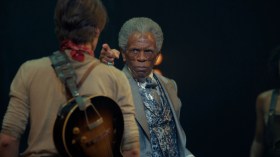
A very handsome young man (The Groom – Kenneth Spiteri) announces his intention to marry. His intended (The Bride – Sophie Ross) is good, modest and hardworking, so why does her name feel like a rock in his mother’s face? Why is she plagued by a feeling of anxiety and foreboding? Was there a past between The Bride and the dashing Leonardo (Yalin Ozucelik) who is now married?
Entrenched tradition and history throb through this tiny community – the Mother (Leah Purcell) is haunted by ghosts from the past and the would-be bride is tempted by a phantom of her own. Hidden wounds, and secrets and regrets from the past are unearthed in this intense tale of thwarted love, desire and heartbreak. We see the explosive results of repressed passion and how society has the power to stifle individuality and love, with an overwhelming emphasis on honour and the family name.
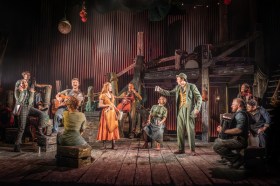
The setting is still very much Lorca’s hot, dusty Andalucía – with stirring Flamenco guitar by Andrew Veivers and terrific singing and dancing by the ensemble – but with some Australianisms creeping in and a hint of the Outback.
Written by Lorca in the 1930’s this is part of a trilogy (the other parts being Yerma and The House of Bernada Alba). At times the new translation by Sinclair is extremely fiery, passionate and earthy; at others it soars lyrically in love passages – in yet others it is weirdly Surrealist, especially in the second half. The raw, hoarse passion of Flamenco echoes throughout.
In Act Two, in the strange woodland scenes, sometimes the text soars to mythical, elevated poetry – but I wondered about the somewhat stilted, refined yet oddly staccato delivery of the ominous, masked woodland creatures, and the tense atmosphere of pre-ordained Greek tragedy.
The cast is outstanding, with fabulous ensemble work and fine performances all round, but Leah Purcell dominates as the embittered, grieving, rigid Mother. As her son, the Groom, Spiteri is tremendous and Ross as the Bride is excellent. We see and feel her embarrassment at her first meeting with her prospective mother-in-law when she is inspected like a horse. Holly Fraser’s double role as an young innocent girl and the vampirish, malevolent Moon is terrific. (In her heavily padded and cloaked costume as the Moon she could be mistaken for a Medieval Madonna ). Zindi Okenyo as Leonardo’s unfortunate wife, now trapped in her marriage with one child born and another on the way, is excellent, as is the terrific Lynnette Curran as the Servant/Neighbour/Woodcutter.
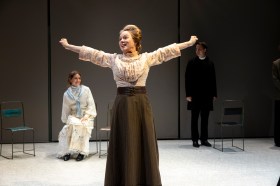
Rufus Didwiszus’ set is stark; basically bare and white with some tables and chairs and an insect repellant. The woodland effect in Act Two was marvellous. You can see the Goya and Surrealist influences throughout the show. There are looming shadows in the villagers’ lives, as Damien Cooper’s lighting eerily illustrates.
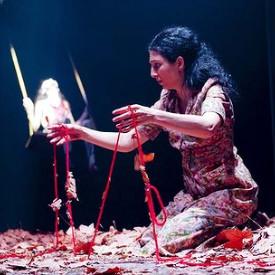
In Act Two it sometimes felt as if there were two plays, one ‘real life’, the other that of the surrealist woodland creatures, but they merged powerfully. The death and destruction are portrayed in a stylized, ritualistic manner, Kabuki- like, with red thread.
All turns on a small knife “that barely fits in your hand”. A haunting, explosively powerful production that ends on a cry of anguish. As The Mother says “I have a madness that comes from not screaming”.
Rating: Four stars
Blood Wedding
By Federico Garcia Lorca
Translated by Iain Sinclair
Director: Ian Sinclair
Set Designer: Rufus Didwiszus
Lighting Designer: Damien Cooper
Costume Designer: Luke Ede
Composer/Guitarist: Andrew Veivers
With: Danny Adcock, Lynnette Curran, Holly Fraser, Julia Ohannessian, Zindi Okenyo, Yalin Ozucelik, Leah Purcell, Sophie Ross, Toni Scanlan, Kenneth Spiteri
Running time: Two hours 20 (approx) including interval
Sydney Theatre Company
August 1 – September 11