Chaos reigns in William Golding’s Lord of the Flies, a deeply pessimistic treatise on the inherent savagery of man (and it is about men, or rather, schoolboys). Many publishers passed when the English author shopped his manuscript around, with one unkindly denouncing it as ‘Rubbish and dull. Pointless.’
Golding’s novel is none of those things. But the fall traced in his story means nothing if there’s no peace to begin with. Therein lies the folly of director Steven Mitchell Wright’s disappointing new production of Nigel Williams’ stage adaptation at Theatre Works.
Theatre Works’ Lord of the Flies review – quick links
War without end
Golding served in the British Royal Navy during the second world war and was involved in the sinking of the Bismarck and the D-Day landings at Normandy. He despaired of the Cold War that followed, worrying that humanity’s fatal flaw would see a destructive force like the Nazis rise again.
How right he was.
Charles Monteith, Golding’s editor at Faber and Faber, trimmed the novel before publishing it in 1954, notably dialling down its religious overtones and entirely excising a prologue in which a nuclear attack necessitates the boys’ evacuation, with their plane subsequently shot down over the uninhabited island where the action takes place.
ArtsHub: Angus Cameron’s slippery new play Luke is full of shifts and surprises
Williams’ 1995 stage adaptation, corralled by Wright, brings a smidge of that starkest stuff back, thrusting us to the midst of this downfall before we’ve even taken our seats.
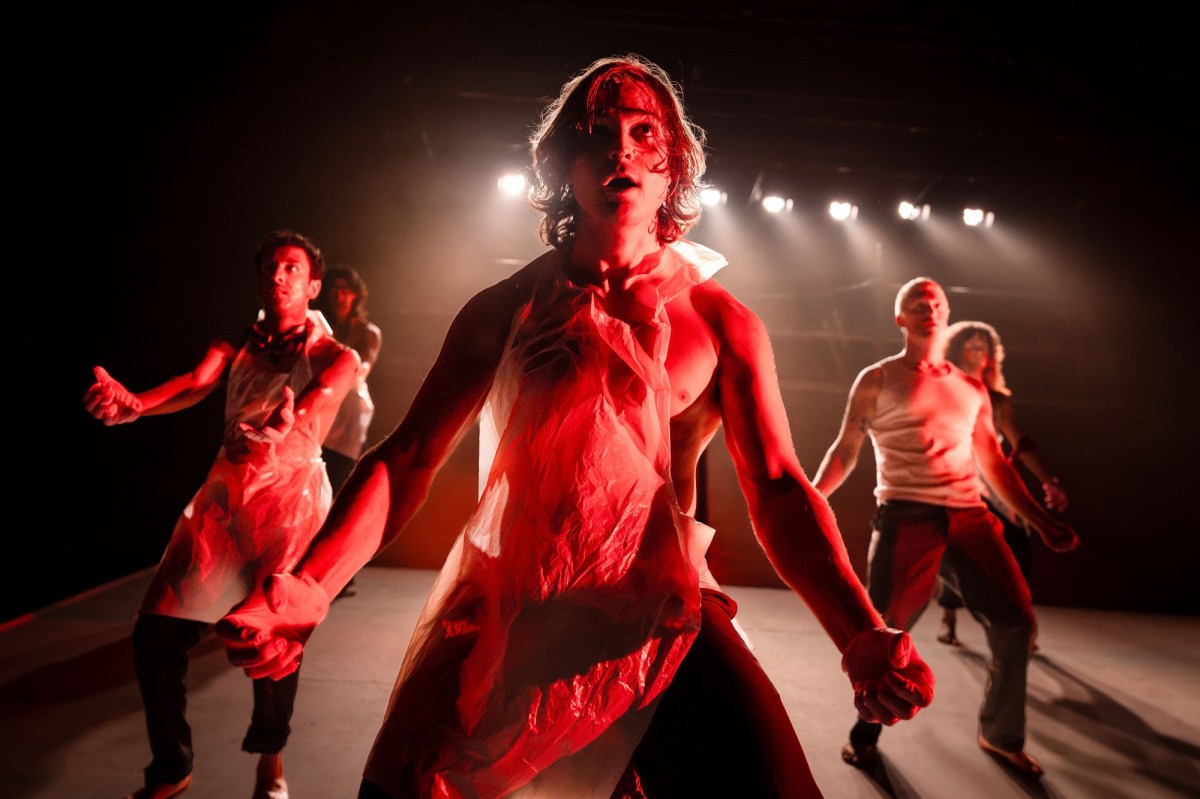
The cast roughhouse around a precipitously sloped stage that had this uncoordinated critic in fear for their collective ankles. Then, once the house lights dim, they grab their luggage and assemble in a row at its peak. A neat bit of slow-mo acting and lighting designer Ben Hughes’ blood-red flashes suggest the downing of the plane.
It’s a striking opener, but things plummet dramatically from there.
Mess and noise
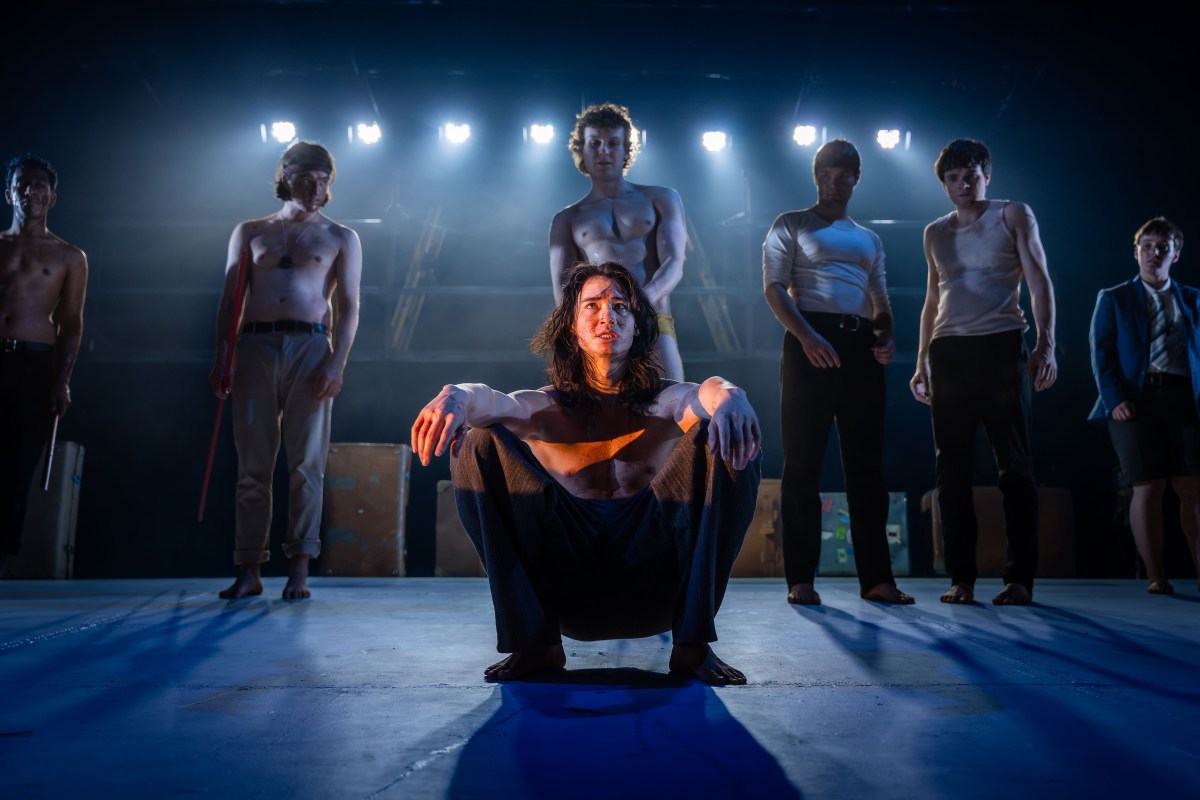
The production is directed by Steven Mitchell Wright. As Artistic Director of The Danger Ensemble, Wright has prided himself on delivering muscularly physical works. That’s a good fit for a story in which a bunch of 12-years-olds left to their own devices run amok, increasingly violently, on an island far from civilisation.
The problem is, as directed by Wright, most of the cast turns it up to 11 immediately, hooting and hollering from start-to-finish, sandblasting subtlety away.
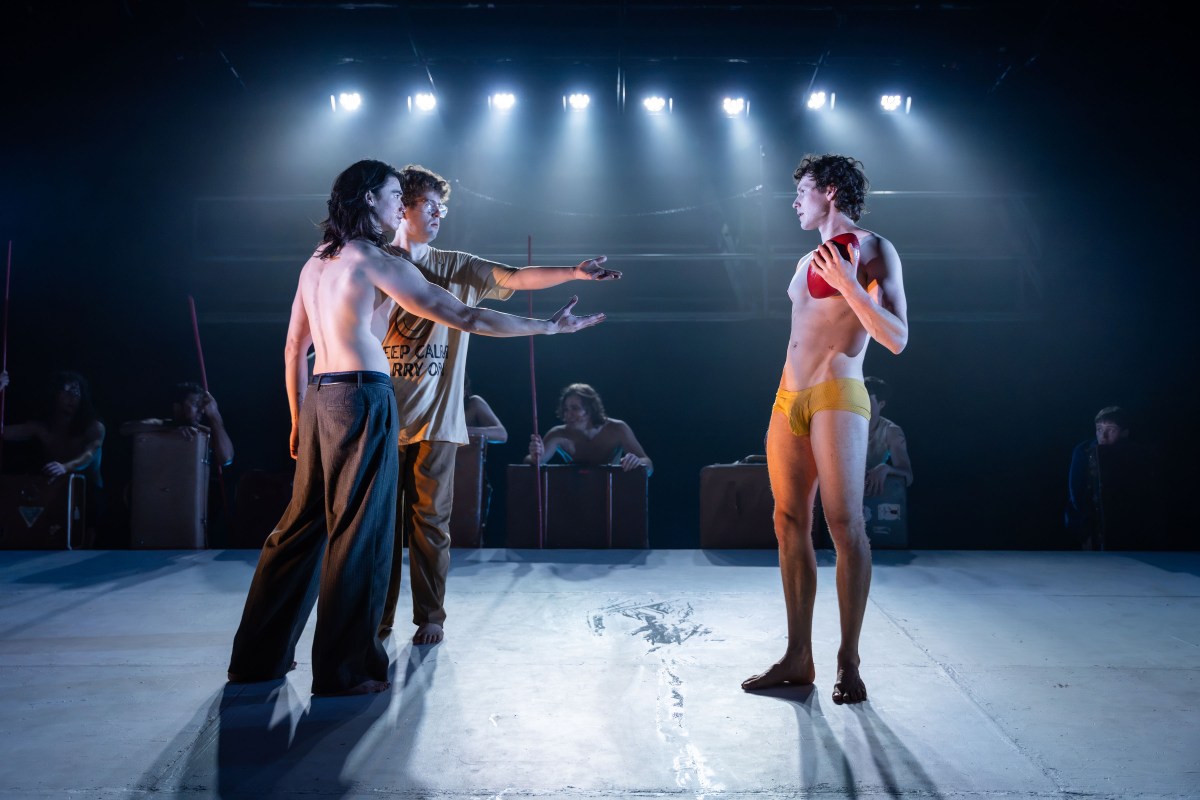
Led by Angus Leighton’s jock-ish Ralph, Oliver Cowen’s bespectacled smart lad ‘Piggy’ and Sean Yuen Halley’s less-than-angelic choir leader Jack, the cast stamp and whoop on the stage’s precarious platform even as we settle in.
Sure, Ralph’s a sporty guy, but Cowen strips to his jocks within seconds, bouncing around like a gurning coke addict. This mania kills stone dead the central tenet that Ralph’s a stabilising force, and Golding’s pillar of order, as the boys’ first-nominated ‘Chief’.
Cowen does decent work as the poor, put-upon Piggy, the real brains behind the operation, but he’s saddled with an all-over-the-place working-class English accent. It’s there to signal he’s ‘beneath’ both Jack and Ralph, but Cowen’s not confident enough, shouting his way through instead.
Conversely, where Jack is supposed to be a bolshily toxic influence – using his status to superciliously bully Piggy, and seizing control from the more measured Ralph at the first opportunity – Halley unfortunately fails to project clearly enough, with some important lines drowned out.
Halley’s limber physicality does bring a sinewy, snake-like charm to his cursed role as splinter Chief, especially as he daubs his boys’ faces with pig blood and dirt as they hunt for food – and, eventually, the weaker survivors.
Calm in the storm
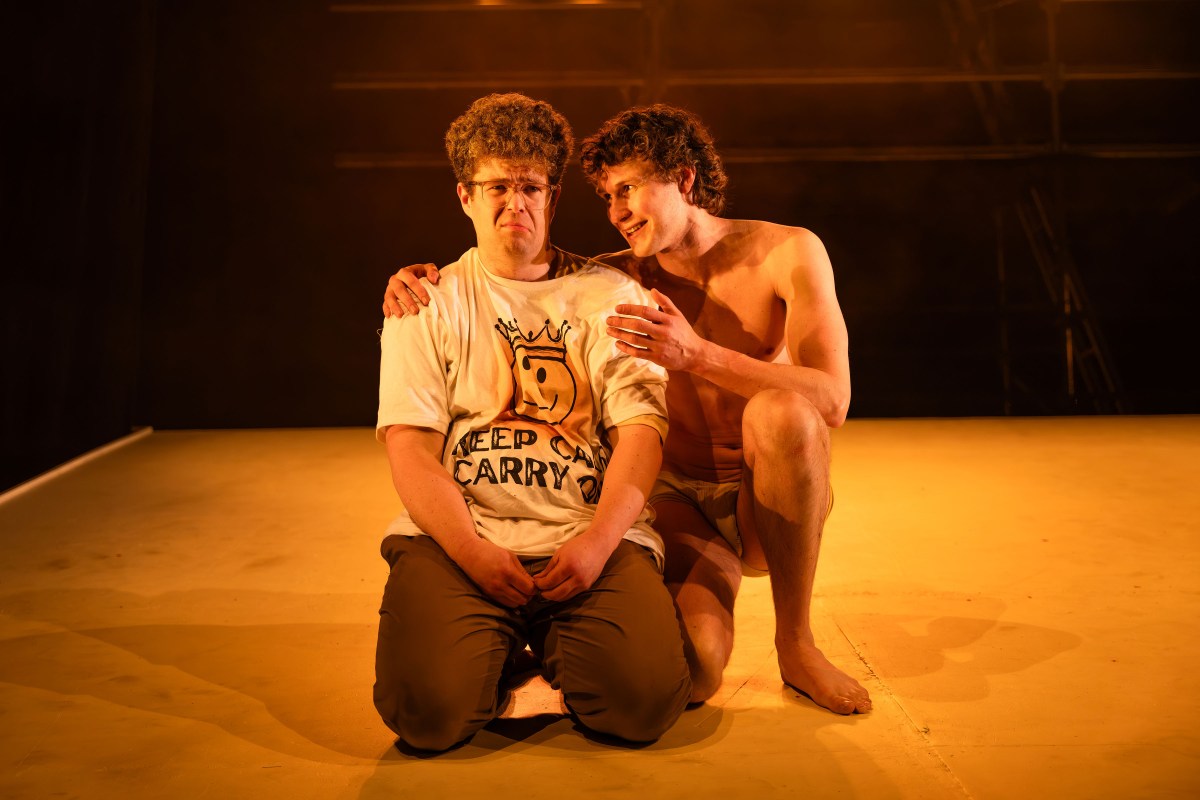
Thankfully, there are more finely tuned performances. Oliver Gorringe and Declan Magee, as twins Sam and Eric, are more gently portrayed, with a rare moment of tenderness in this too-brash Lord of the Flies take coming when they hold hands. It’s a small comfort in the spiralling horror, as order is thrown off and Ralph’s tenuous authority erodes.
Darcy Crawford’s startled facial work is also great, despite having few lines as the only holdover of Golding’s considerably younger littluns to be carried over into this adaptation. That Crawford, a trans actor, strips to breast binders when the warring clans disrobe is a powerful statement, in all this machismo, that Wright doesn’t foreground enough.
Sam Finn Gudgeon is also welcome as the too-sweet-natured-for-this-world Simon, bringing some much-needed calm in this incessant storm. His tender take amplifies the tragedy of his character’s mental health struggles. Gudgeon’s working on a more nuanced level than Wright.
Ankles be damned
Wright’s bulldozing read of Lord of the Flies isn’t helped by him being overstretched creatively, as he also handled most design aspects of the show.
His set works against him. That slope may be an intriguing canvas for later projection work filmed in-show, with the bad boys’ spears doubling as selfie sticks, but it also aches and groans overbearingly – a frustration that’s not helped by much of the exceedingly rickety, squeaking scaffolding to the rear.
My anxiety for the actors’ safety increased exponentially when water came into play, turning that slope into a slip-n-slide hazard. I’ll be amazed if the cast makes it through the run uninjured.
Wright’s design work isn’t always up to scratch either. The appearance of ‘the beast’, a most-likely imagined bogeyman that the opportunistic Jack latches onto to consolidate his control over the scared boys, is naffly realised in a fourth wall-breaking audience cruise-by.
The pig head that we are told is swirling with buzzing insects – the title, Lord of the Flies, refers to the literal translation of Beelzebub – is better. However, the mysterious appearance of an adult corpse, one of the more shocking elements of Golding’s story, is confusingly realised in a rushed sequence, which is head-scratching given this not-short show runs to two hours and forty minutes.
Also odd is the switching back-and-forth between the literal conch shell, which Piggy urges Ralph to use to assemble the lads, and its metaphorical substitution, a Sherrin footy. The latter is a smarter choice, hamstrung by Wright’s indecision.
Lost in the noise
The shrieking roar of Jack Burmeister’s sound design and score too often stands in for dramatic effect that should be carried by performance, of which there is too much here.
With almost no pause for breath, lines roar into one another and are lost in the cacophony, beating us into weary submission.
Yes, the boys’ descent is furious, but with that energy unleashed from the outset, it leaves this Lord of the Flies with nowhere to go but down. As such, Golding’s magnificent text crashes and burns like that fateful plane.