We’ve been fed a lie that success is a linear climb toward higher volume, higher turnover and – by default – greater financial return. What often sits beneath this logic is not growth at all, but making masquerading as mass production.
In an era of global e-commerce, scale has become a predatory term. For the contemporary maker, it often arrives disguised as a compliment: ‘You could sell a heap of these.’ But to treat the studio like a factory floor is to misunderstand the very heart of the craft movement.
Handmade practice is not simply a slower version of industry. It is a fundamentally different proposition – economically, philosophically and culturally. When makers are pressured to adopt industrial metrics of success, the very qualities that make their work compelling are placed at risk.
Makers and mass market pressures – quick links
The two sides of growth
The pressure to grow often leads makers to believe they must become managers of people – to scale up in order to deliver more. With that scale comes increased financial risk, heavier capital investment and a dramatic increase in administration.
Time once spent making is gradually replaced by time managing.
ArtsHub: Should I offer workshops to help the cash flow?
After five years of running a successful sustainable hot glass studio in regional New South Wales, glass artist Scott Chaseling and I were at a familiar crossroads. We could invest in a new five-year plan: doubling production, refining packaging, committing to marketing and trade fairs, and finally hiring an assistant. A perpetual spiral upwards that it hard to stop.
Or we could step back from this pathway toward mass production and pivot instead toward the tactile pleasure of making for a smaller, more devoted group of collectors.
For us, the decision was straightforward. But standing at this threshold, it’s easy to see why the question of which way to go can feel paralysing – especially when growth appears viable, even seductive.
Another way to consider growth is not as acceleration, but as deepening. Instead of producing 500 handmade glass vessels bearing a recognisable creative signature, what if you made 10 pieces that were 10 times more meaningful – and, by extension, more valuable?
In a world saturated with copies, the finite object has become the ultimate luxury. Slowness, care and restraint are not liabilities here; they are assets.
The trap of efficiency
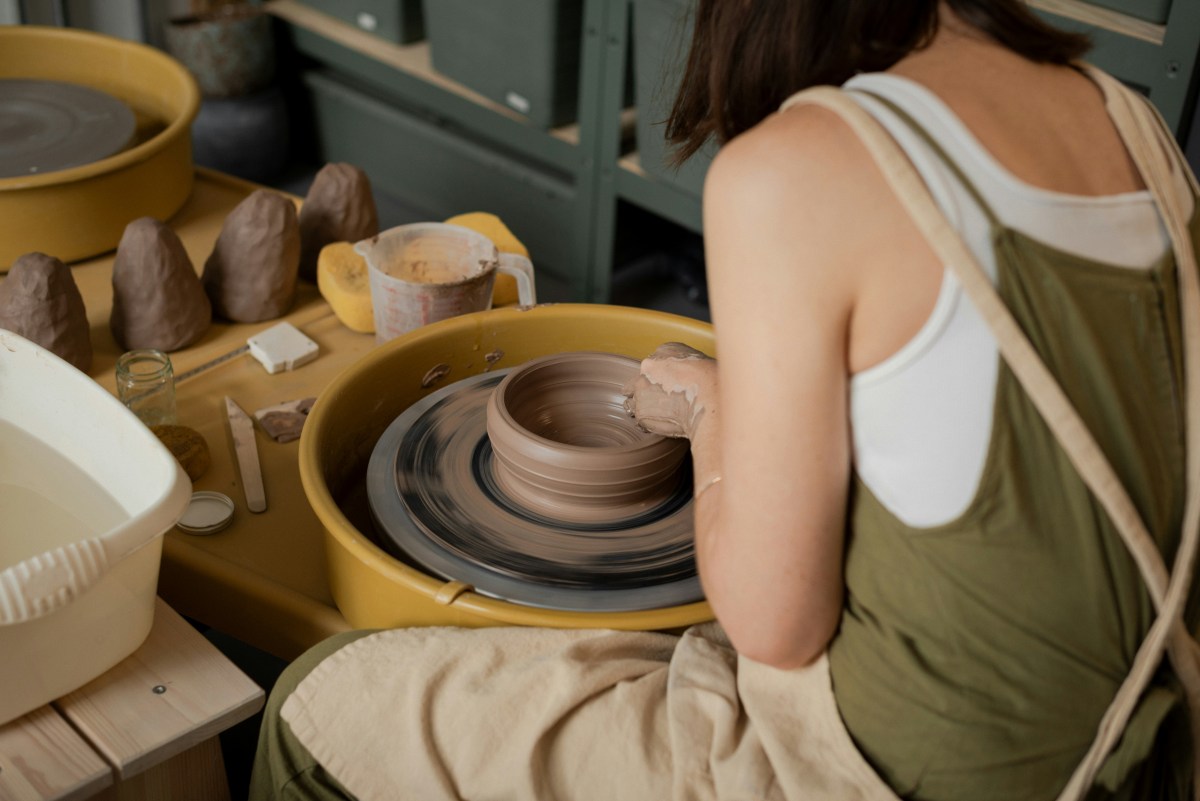
I once heard a saying: ‘Efficiency is the god of the industrialist, but it can be the assassin of the artist.’
The greatest blessings in the studio are the lucky accidents – the organic, experimentation with process and materials that arrive at genuine alchemy. These are not outcomes that can be scheduled or systemised.
Factories, by their very nature, are designed to erase the human hand. They pursue minimal margins of error and a terrifying level of consistency. Yet, in the realm of high-end craft, perfection is often the least interesting aspect.
Most makers understand the pull of efficiency, particularly during peak periods like Christmas, when stockists are hungry for familiar designs in reliable volume. As a jeweller, I’ve experienced how easily one can become trapped in the pump, producing a single design that sells well – a pair of earrings at the perfect price point, endlessly replicated. While I once loved this design, it now feels like an albatross that holds me back.
To pivot away from this factory-style growth – despite its easy financial reward – requires courage. Your business survives because you offer what a factory cannot: intimacy, irregularity and originality.
This also demands honesty about the physical limits of your practice. You can only make so much. The real question becomes not ‘How much can I produce?’ but ‘Where is my time most meaningfully invested?’
Scarcity, in this context, is not a weakness – it is your strength.
Craft and the creative industries
Over the past decade, the umbrella term creative industries has expanded to encompass a wide range of practices that sit outside traditional arts categories. While this framing has helped governments articulate the economic value of culture, it has also blurred crucial distinctions.
Craft and design – once afforded their own autonomy – are now frequently positioned alongside animation studios or game developers, for example, disciplines with entirely different production models and customer relationships, despite sharing the same creative industries niche.
Some makers sit comfortably within this framework. Textile designers, furniture makers and lighting studios, for example, often employ mechanical assistance and practices that are geared toward volume. But even here, the rule remains the same. Stay true to what you are making, why you are making it, and what makes your work collectable rather than merely consumable.
It’s a studio, not a factory floor
We are culturally hardwired to equate success with scale. Yet meaningful growth in a creative practice looks less like expansion and more like refinement: a clearer voice, a braver relationship with materials, and a deeper connection with audience.
Don’t let the pressure to expand turn your sanctuary into a shop floor. A factory can purchase a faster machine but it cannot buy a decade of embodied intuition. Think of investing in yourself instead.
The factory mindset treats mistakes as losses; the maker’s mindset understands that mistakes are often beginnings. When production becomes the priority, play disappears – and without play, the work stops being a practice and starts becoming just another job.
Growth does not have to mean more. Sometimes, it means going deeper, and staying there.