A life-or-death threat. Lockdown. Paranoia and suspicion infecting a community. A reminder that working together is the strongest defence that humanity has.
While a pandemic didn’t inspire the social-deduction game Mafia, which is also known as Werewolf, the Covid era has seen adaptations of it flourish and spread – not only reality-TV sensation The Traitors, which boasts versions in 29 countries so far and at least 12 more to come, but also the immersive theatre experience Werewolf.
‘It’s in the zeitgeist, isn’t it?’ says Joel Baxendale, one of the masterminds behind Werewolf on the stage, and Creative Director of contemporary performance company Binge Culture. The New Zealand outfit’s crowd-favourite show makes its Australian premiere at Brisbane Festival 2026 from 23 to 26 September, fresh from its second season at Edinburgh Fringe.
As fellow Werewolf deviser and performer Stella Reid tells ArtsHub, ‘Part of our fascination with those things is because we live in this post-truth world, in particular after the damaging effects of information post-Covid. And I think we’re pretty interested in how we believe something and our perception of something and our biases.’
She adds, ‘I’m completely addicted to things like The Traitors, and I think part of my fascination with them is watching somebody build a narrative that people believe is true.’
Table of Contents
A timely transformation
In taking cues from the hit party game, Werewolf is part of a pack much larger than just The Traitors. Pre-Covid, online games such as Among Us, Werewolves Within, Town of Salem and Gnosis also drew from it. A film version of Werewolves Within arrived in 2021, a year after Binge Culture’s initial Werewolf development season.
The 2022 movie Bodies Bodies Bodies also gave the premise a spin, with a group of mostly twentysomethings playing the titular Mafia/Werewolf-style game while riding out a hurricane in a mansion, then pointing fingers at each other when their shindig starts accruing a body count.
A level of catharsis comes with this concept, especially in the recognisable traits and relatable behaviours on display since the pandemic, ‘but I think there’s a few things going on simultaneously,’ Baxendale says.
ArtsHub: 10 must-see highlights at Brisbane Festival 2026
Ensuring that Werewolf isn’t a passive experience for audiences, and is more on par with an escape room, is one of Binge Culture’s guiding aims for the production. ‘There’s people wanting to not just see something, they want to feel like they’re part of it,’ says Baxendale.
‘Even in the case of The Traitors, as a viewer you’re enjoying watching the tactics play out and watching people play the game. It’s the gamification of performance in the arts.’
He adds, ‘Games are the biggest medium in the entertainment space, so it’s natural that people are desiring more of that.’
The fact that Werewolf is the type of show that gets audiences engaging with their friends while they’re there is also crucial, as ‘people aren’t getting as much social time with each other, and so they’re wanting to find spaces where they can do that more,’ Baxendale says.
Then there’s the general pop culture resurgence of the horror genre, with Sinners winning four Oscars, and Weapons and Frankenstein also earning the Academy’s love – a response not only to Covid, but to our increasingly fractured and fraught times.
‘There’s so many fears about where the world is at the moment’ says Baxendale, ‘and horror is a way of being able to exorcise those feelings.’
Balancing the familiar and the fanciful
How do you create an experience that is understanding of the fact the globe just went through a traumatic event, but that is also playful, entertaining and interactive?
‘Stell’s got a really nice phrase,’ says Baxendale. ‘You said to me what you like about the show is the rub between the hyperrealism of the situation and then the absurdity of the contagion or the threat.’
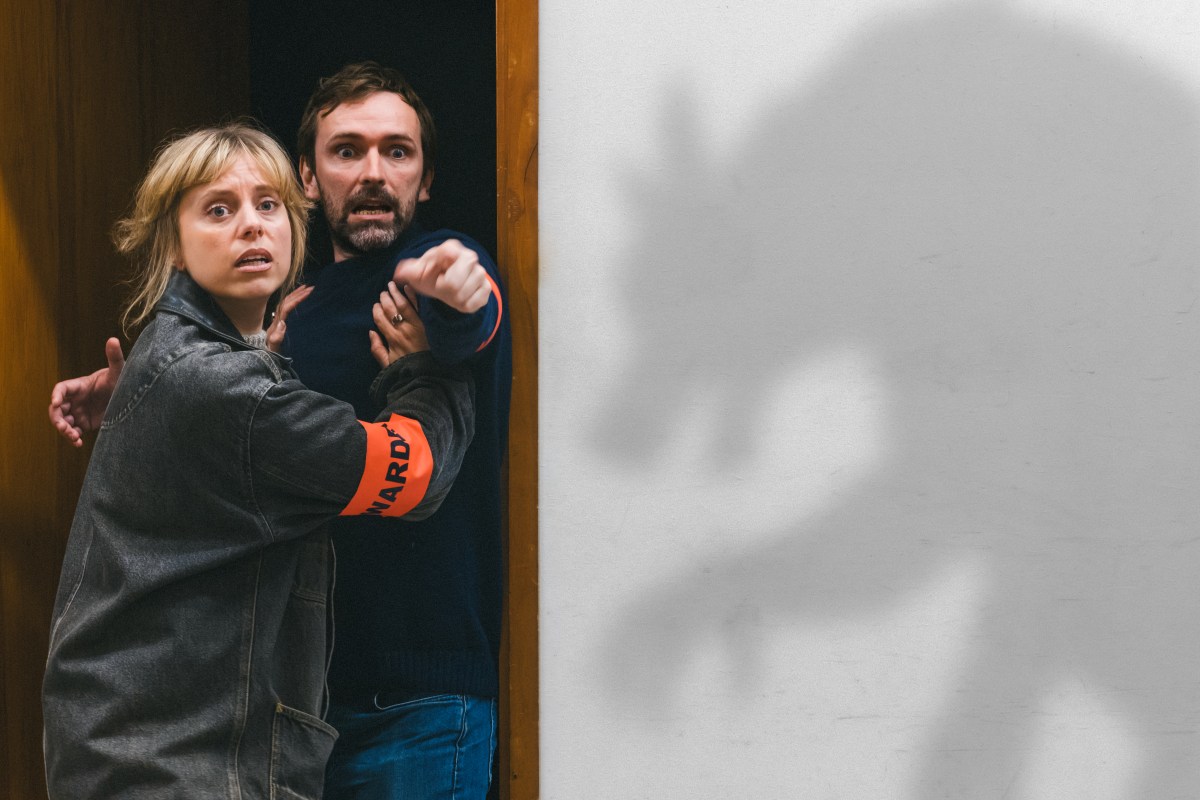
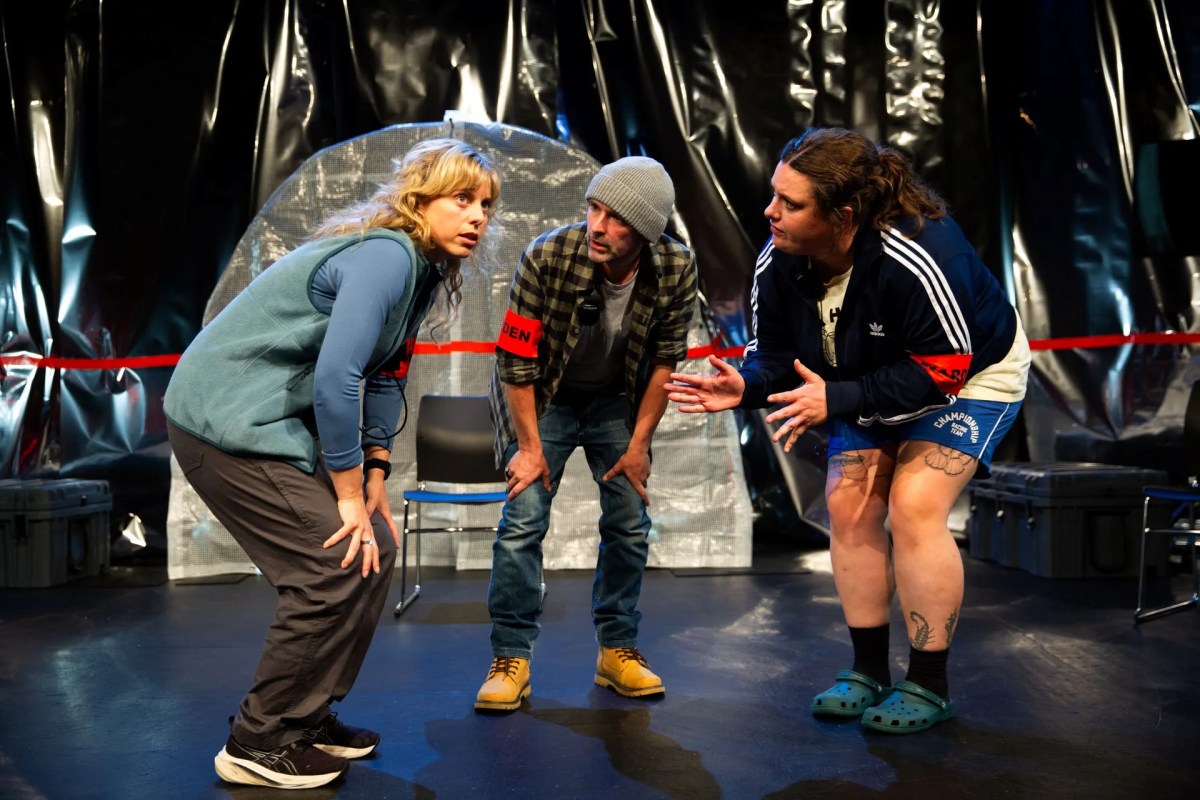
Along with Hannah Kelly, Reid and Baxendale play wardens tasked with keeping the townsfolk-slash-audience calm and safe during a werewolf outbreak. As Reid says, ‘It’s very easy for us to improvise in character because of the real real’ – that is, ‘the idea that we’ve been through a very similar situation.’
Baxendale says Werewolf incorporates ‘a lot of the tropes of the lockdowns and the Covid response,’ even starting with a broadcast telling attendees how to behave. When thinking through the wardens’ behaviour, ‘we were interested in the leadership during that time, and how different leadership led to really different outcomes.’
He adds, ‘What we decided to do is really lean into the characters and explore what the three wardens … in our safe house, where they sit in this leadership spectrum. Is it more leaning into kindness and making sure everyone’s okay? Is it about following the rules? Or is it about following your own instincts and ignoring the rules?’
But for Reid, what makes Werewolf so easy to perform in is that the ‘parable’ around the lockdown scenario is ‘so absurd – werewolfism, or lycanthropy,’ she says.
‘It’s an element that you can distance yourself from. It’s not as scary, it’s not as believable, and so it becomes more fun to play around with.’
As Baxendale flags, ‘that’s where a lot of the comedy in the show comes from as well … approaching that topic, but from a safe and absurd and silly place.’
The complicated art of combining horror and comedy
The likes of Werewolves Within and Bodies Bodies Bodies might make it appear otherwise, but horror and comedy aren’t simple to mix. Werewolf genuinely wants to both scare its audience and get them laughing.
‘I think it is actually the hardest thing to do, to switch tone in a work of art – and in particular in the theatre,’ says Reid. ‘Horror and comedy actually have really different relationships, because one of the ways we laugh is because we don’t have a pull of tension. It’s actually a release. And you need tension in horror.’
The show’s carefully constructed sound design and lighting states help navigate the jump between genres, and set the appropriate moods, but Werewolf still tackles the tricky horror-comedy balance show by show, shaped by each evening’s crowd.
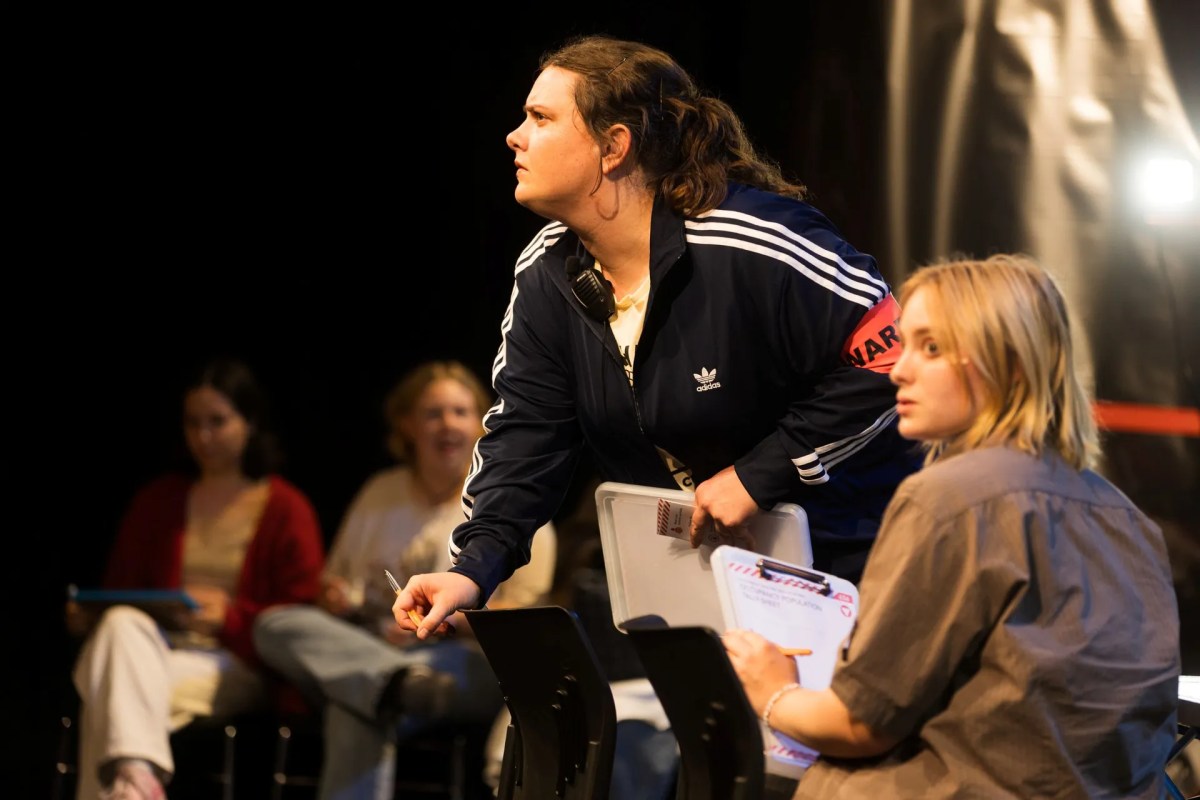
‘We meter it by the audience, because some of our audiences come in and they are already afraid,’ Reid explains, ‘so we work the opposite, to get them to relax … Then sometimes you’ll have an audience who are really ready to laugh and play games, and we actually need to work harder to inject the fear into the space.’
The narrative has an inbuilt mechanism to help guide its tonal shifts. Just like the game it’s based on, the story unfurls in day and night phases, ‘so you always get to reset every 5 to 10 minutes,’ says Baxendale.
‘Even if things have gotten pretty chaotic and silly during the day, the night will bring everybody back down to earth, and then vice versa.’
The type of venue hosting Werewolf is also influential. Reid says she’s been very interested in how the shape of the theatre determines the audience’s response because ‘depending where the doors are, depending where they came in, it determines their feeling of safety – because so much of Werewolf is about an outside threat’.
Brisbane Powerhouse’s Underground Theatre couldn’t be more perfect, then. ‘That’s what excites me a lot about Brisbane, because there is something that happens to an audience when they come down into a windowless space,’ says Reid.
‘In Edinburgh in particular, the temperature would drop as you came in, and something psychologically does happen in a bunker space that sets up a feeling of paranoia, or a feeling of quarantine or containment, already. So much of the world-building is done for us.’
When audiences howl for more
Steering a production where so much can and does change each evening is all in the fun for the Binge Culture team. ‘My favourite thing about performing this show is that every night is so completely different,’ says Reid. ‘Every performance is made by the people in that room.’
Every theatre company wants to create a hit with longevity, but Baxendale didn’t foresee that Werewolf would still going strong after more than half a decade, ‘because originally we made it for such a small group of people, because we were inspired by the game,’ he says.
‘It’s a few people in a living room sort of thing – so when we were thinking, “Oh, we’ll make a theatre show based on that” [and] we only increased the participant size by a little bit. I think we were playing with around 30 or 40 in those first shows.’
This was also Binge Culture’s debut in ‘playing around with this horror genre in the theatre,’ Baxendale says, and ‘sometimes you surprise yourself with what resonates with an audience. Because they were frothing so much from those initial seasons, it just kept dragging us forward with it.’
Still, it was always apparent that this was an idea with stage potential. ‘I had a friend who really loved to embellish the game. He always wanted to make it a big story, and he made everybody create little characters for themselves,’ says Baxendale. ‘So I felt that it was already the most theatrical parlour game-type experience I’ve had.’
He adds, ‘I also thought it was really effective at getting people into that kind of [mindset of] “Oh look, everybody’s an actor, everybody can do this, just a little bit of prompting”.
‘Binge Culture has always been really interested in the audience’s experience and how to get them involved, how to give them stakes in the performance in some way or another. This felt like a really good model or form to draw inspiration from.’
Playing along – if you want to
And audience members do get involved. One key reason is ‘feeling like they’re in a situation that they understand what the parameters are,’ says Baxendale, particularly ‘if it feels like it’s a real emergency situation, because they are in a bunker.’
‘Then suddenly it’s like, “Oh yeah, I know how this rolls. I’ve seen the movie. I’ve been in the Covid quarantine.” And without really thinking about what’s happening, they are preparing themselves to improvise – even if the improvisation isn’t necessarily vocalising a lot. They are being placed in that fiction and they understand what their role is in it.’
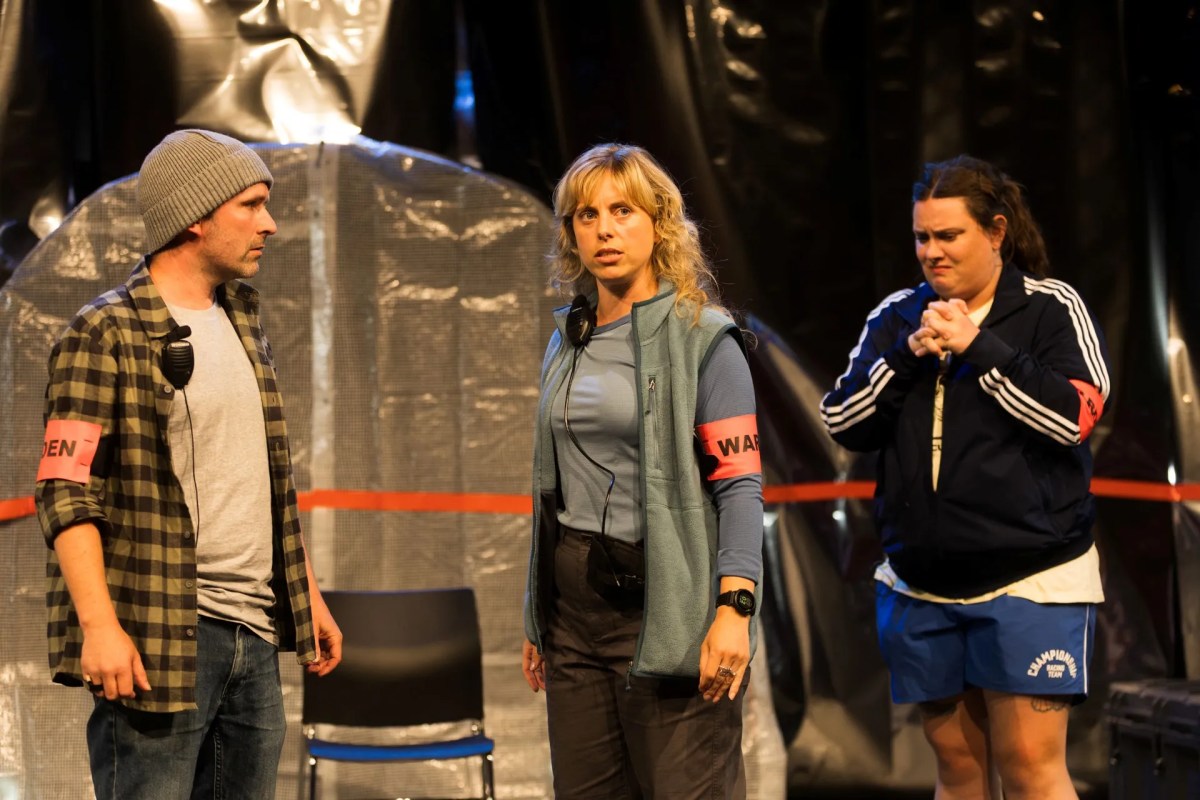
Werewolf still needs to work for patrons less enthused about actively participating, which fine-tuning the stage setup has addressed. Originally, it was staged in the round, with ‘the warden seats, us performers, right next to them,’ says Reid.
The production has since moved to an end-stage configuration, which has ‘helped us let the audience self-select their interest in being a big voice in the community’.
‘When we’re sitting in the circle, the audience, there is no leader. There’s no peak of that space. But in an end-stage [setup], we know once the audience come in that if they sit towards the back, usually they’re not as interested in coming forward, and that has determined our relationship with them,’ Reid continues.
‘It’s been a nice evolution of the show, in that there’s been more variation between what the audience have requested that they want from us, or how much they want to be involved.’
Baxendale adds, ‘We’re still in that space together, and we still use the whole space – in that we will physically travel to the back of the auditorium – but we’re not going to necessarily ask them to say anything, whereas we definitely do that for people at the front.’
Surprises and suspicions
The show’s performers have become so skilled at integrating the crowd’s input that some patrons have openly wondered how. ‘It’s a bit of a trade secret, really,’ says Baxendale. ‘Because we always think, “Oh, this story is on the rails and it’s always going to get to the same place”, but what surprises me from the audience is they are completely convinced that it’s totally organic because of the way that we’ve done it, ducking and weaving with their offers.’
He adds, ‘They’re either convinced that we’ve got plants, either the audience is full of plants, or that the show has infinite and possible endings.’
What the team do have is ‘a manual,’ says Reid. ‘To use an old phrase, like a Rolodex of potential answers, because we’ve experienced so many audience interjections. So often things do appear really off the cuff but there’s a situation in place: if this happens, then this.’
Baxendale is thrilled that audiences are so impressed with that reactivity and layering, to the point of being adamant that their fellow attendees aren’t all just paying patrons – taking the playing with suspicions that’s so pivotal in Werewolf to another level.
‘It’s one of the things that I feel that we’re most proud of, is that we’ve managed to find a way to create a show that does have structure, does have production value and a sense of completeness, and yet it does still feel totally improvised and totally fresh each night.’