For Melbourne-based Larrakia/Darwin artist Jenna Lee, being a finalist in the Telstra National Aboriginal and Torres Strait Islander Art Awards is less about winning than belonging.
‘It’s not one that you enter to win,’ Lee says of the NATSIAAs. ‘It’s one that you enter to just be a part of.’
That distinction matters.
NATSIAAs breaking down divides – quick links
Unsettling the city-remote divide
For First Nations artists living in cities, the NATSIAAs can sometimes be perceived as belonging primarily to artists working remotely and directly on Country. Lee, who has lived and worked away from Darwin, knows that assumption well.
‘I’ve kind of heard mob from the city say, “Oh, that’s the prize for remote artists”,’ she says. ‘But I just don’t think that’s been true the past 10 or 15 years.’ She sees the awards as a place where those perceived divisions can be unsettled.
Louise Palmer, Deputy Director of the Museum and Art Gallery of the Northern Territory, which presents and exhibits the awards, agrees that the geographical mix of the NATSIAAs has shifted over time. There is no fixed ratio of city to remote artists, she says, with the balance changing from year to year and, more interestingly, between categories.
She stresses, the awards are intended to be exactly what their name suggests – a national award. ‘It is absolutely open to everyone,’ Palmer says.
The complicated experience of winning an award
For artists working out of remote art centres, the journey to Darwin offers an encounter with artists and practices shaped by very different experiences of place.
This year, that national conversation included Barayuwa Munuŋgurr, Guruwuy Murrinyina and Napuwarri Marawili – three winning artists from the remote Buku-Larrŋgay Mulka Centre in Yirrkala (Arnhem Land), one of the most consistent forces in the awards.
For Buku centre manager Will Stubbs, the idea of dividing the NATSIAAs into a conversation about ‘city’ and ‘remote’ artists is problematic. ‘These kind of petty divisions are being put upon us externally.’
He continues, ‘The politics we do is the ordinary politics – Yolŋu survival – which is predicated on unity.’
ArtsHub: Ryan Presley lands $100,000 Telstra NATSIAA Art Award
Stubbs says that from a Yolŋu perspective, the Western hierarchy of status and achievement does not map neatly onto cultural understandings of value. ‘Philosophically, everyone is equally sacred and valuable, regardless of whatever their so-called status is in a Western system,’ Stubbs says. That makes accepting an award a complicated experience for Buku artists.
‘One of the hardest jobs I have every year is to bring artists to accept awards,’ he says. ‘They’re basically saying, “It’s ridiculous to suggest that I’m better than everyone else, because I know that I’m not”.’
That does not mean winning is without meaning. Stubbs says the artists experience ‘a thrill of a lifetime’, but it comes with enormous pressure of standing on a stage in front of hundreds of people.
A meeting of mob

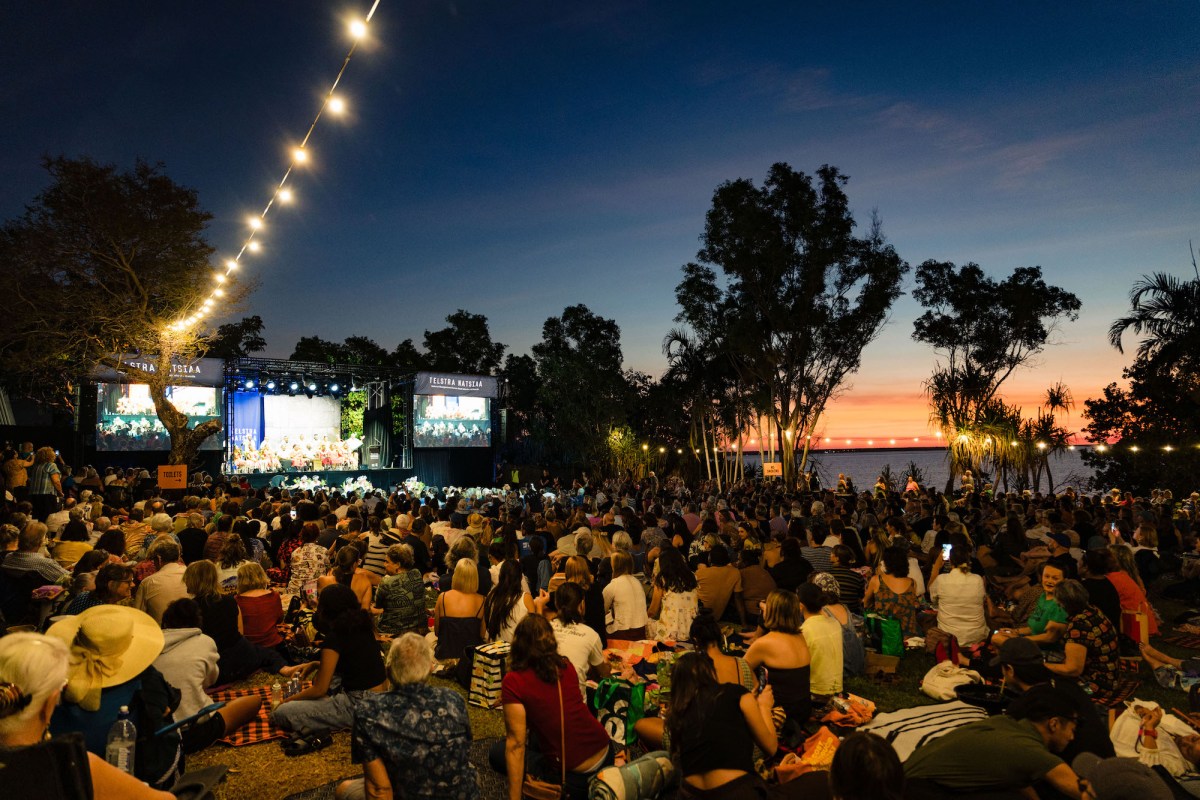
For Lee, that value is felt most strongly during the exhibition’s opening week. ‘I get to go home,’ she says. ‘I try to go most years, regardless of the finalists. It is just me seeing mob from all over Australia.’
The social geography of the awards is significant. The NATSIAAs become something larger than a competition. It is a temporary community, and a chilled space for ideas to move across different experiences of being Aboriginal and Torres Strait Islander artists today.
Palmer sees that exchange as one of the award’s great strengths. ‘There’s a real opportunity for an exchange of ideas that can unfold when works are showcased next to each other,’ she says.
That national remit is increasingly central to how MAGNT is thinking about the award’s future. Dr Shannon Brett has now been appointed as MAGNT’s Senior Curator of Arts and the NATSIAAs Curator. Palmer says having Brett in the role for three years will allow the museum to deepen relationships and advocacy across the country, while retaining the national networks built through the external-curator model.
The ambition is to double the pool of artists entering the awards, particularly from urban centres.
What expanded cultural exchange can look like
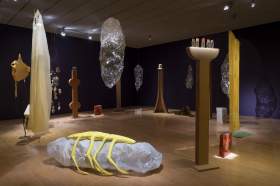
This year, Lee experienced that exchange through a particularly elegant curatorial pairing. Her work, which won the NATSIAAs Works on Paper category, is a Larrakia conical dilly bag made from paper, specifically wayfinding maps from the British Museum. It is installed beside a traditionally woven plant-fibre dilly bag by Rena Ngalinggama Guyula, an artist living on the remote Dhondji homelands.
‘It really showed that the forms I was making are incredibly traditional,’ she says. ‘I enter because you want to be recognised with your peers. But ultimately, I think it comes to that belief, that to be a part of the oldest continuing culture is to be a part of the continuing.’
Lee’s use of paper is an exercise in continuity, not novelty. Growing up, she was taught traditional practices by her father, including string-making and spear-making, but moving away from Larrakia Country meant negotiating cultural knowledge through a different material environment.
‘You take that understanding with you,’ she says. ‘And then, you’re sitting in your apartment in Brisbane or Melbourne and you want to make, but want to be true to that way of living.’
Lee began to consider the material through a cultural and conceptual lens. It didn’t have to be one or the other. ‘If paper comes from a tree,’ she asks, ‘how is that different to bark?’ The question speaks to a broader shift within the NATSIAAs and the increasingly expansive ways that artists are translating cultural knowledge into contemporary materials and forms.
For Lee, the crucial word is ‘why’. Contemporary weaving might employ metal, wire, raffia or other manufactured materials, but experimentation needs to remain grounded in intention. She adds, ‘The “why” is important.’

Stubbs sees a similar process within the Buku artists’ approach to the NATSIAAs. The centre does not simply submit whatever happens to be available. Its annual selection becomes a form of collective curation – a way of presenting the breadth of Yolŋu practice to a national audience.
‘We almost curate the awards like a show,’ he says. ‘It’s like, what are the different notes of the orchestra that we can show, all the different things that we can do?’ He continues, ‘It’s really about the artwork. Is there something about this artwork that needs to be seen? Something special, something new?’
Palmer sees the NATSIAAs as a safe space where artists can take risks. ‘Very good work can win and it doesn’t matter where it comes from,’ she says.
A changing platform rather than an end point
The challenge, then, is not simply a city-remote divide. It is also about ensuring that artists working independently, or outside established art centres and gallery networks, feel that they also have the opportunity to participate.
Palmer says MAGNT is increasingly conscious of the practical barriers that can prevent artists from participating. She explains that art centres provide support with applications, production, freight and travel, while independent artists don’t necessarily have those networks, and have to carry those costs themselves.
‘In that, there is a sort of inequity across the sector,’ Palmer says. ‘I don’t want financial considerations to put people off entering.’ MAGNT now offers freight reimbursement for independent artists selected as finalists.
For Lee, the value of the awards is not simply documenting Indigenous art practice, but providing a place where different practices can encounter one another, and in doing so, reshape the conversation.
Palmer agrees, pointing to watershed wins by Richard Bell (2003), Tony Albert (2014), glass artist Jenni Kemarre Martiniello (2013) and Danie Mellor (2009) as evidence of the range of practices the awards have embraced.
She notes that as artists are increasingly experimenting with ceramics, weaving, multimedia and sound, MAGNT is considering how the awards might evolve with them. ‘Five, maybe six years ago, we were thinking we probably need a separate ceramic award. And now there’s a lot of talk about a separate weaving award.’
She continues, ‘Times change, and we have to have those discussions across the sector.’
The prize is not the only measure
For Stubbs, though, the enduring value of the NATSIAAs is simpler. The prize matters, but it is not the measure of an artist.
He has watched artists return to Yirrkala after winning, with their names forgotten – too hard to pronounce and remember – within days of the awards. ‘It’s so frustrating,’ says Stubbs. ‘It’s naive to think that you’re a prize winner and suddenly a famous artist. It’s not that it doesn’t have an effect. It just doesn’t have the Hollywood effect you might think.’
What remains is the work, and the opportunity to have it seen. And perhaps that is the most significant evolution in the NATSIAAs – not a movement from Country to city, or from tradition to experimentation, but a growing recognition that contemporary Indigenous art can hold all of these positions at once, and that the richest conversations happen when they are placed side by side.
For Lee, that means seeing a paper dilly bag beside one woven from fibre, and recognising both as part of the same continuing conversation. For Stubbs and the artists at the Buku-Larrŋgay Mulka Centre, it means bringing a collective vision of Yolŋu practice into a national exhibition. And for MAGNT, it means ensuring that the door remains open to artists wherever they live and however they make.
‘The joy of it is being part of the ensemble of all of those crazy, wacky arts centres – that’s our family, and this is our Christmas and our grand final wrapped into one,’ says Stubbs. ‘We love it. And, it’s our favorite time of year to be with those other people.’
The 2026 Telstra National Aboriginal and Torres Strait Islander Art Awards continues at the Museum and Art Gallery of the Northern Territory in Darwin until January 2027.
The writer travelled to Darwin as a guest of the Telstra NATSIAAs.