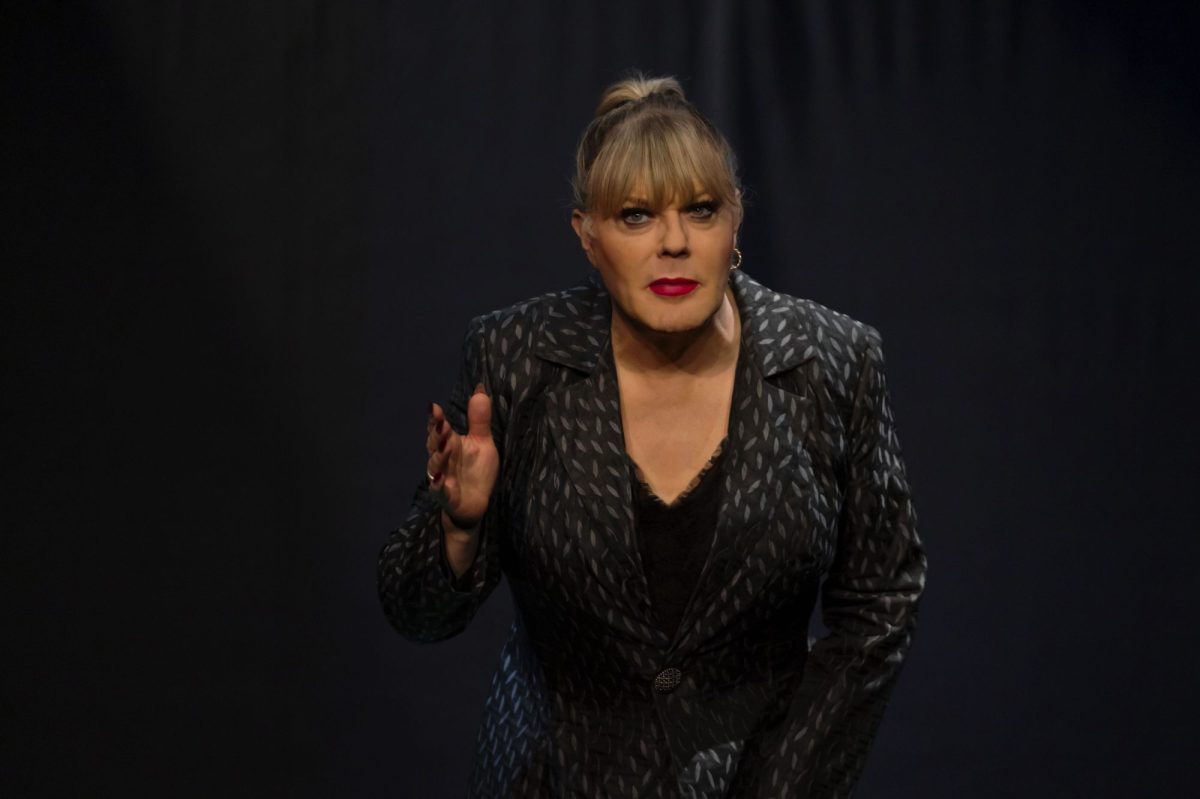
‘I’m constantly ready to go on stage,’ Suzy Izzard says the day we meet in Melbourne.
She’s equal parts punk, power-dressed and put-together: a cropped denim jacket, black slacks, blunt blow-waved fringe, gold hoop earrings, bright pink lippy, blonde hair tied up in a sleek ponytail.
We’re in The Langham hotel, the day before she performs REMIX, something of a greatest hits package of her celebrated stand-up career, to a packed Hamer Hall. Not unlike her comedy persona, she talks quickly, connecting idea to tangential idea, circling, quoting, leapfrogging from this to that.
The 64-year-old Emmy Award-winning comedian, actor, activist, multi-marathon runner and two-time British Labour Party candidate isn’t short of energy or chutzpah.
As someone who came to Shakespeare as a drama student, I’m curious about Izzard’s pre-show preparation for her one-woman version of Hamlet, which opened this week at Sydney’s Opera House, and opens later this month in Brisbane and Melbourne before opening in Canberra in August. An hour or two of meditation? Mantras in front of the dressing room mirror? No – none of that.
‘If someone said, “You have to do it, we need this now,” I could do it,’ she says.
What, right now?
‘Yes. My technique is to always be ready.’
With Izzard, there’s a sense of being in the presence of a gentle juggernaut.
Though famed internationally for her particular brand of Monty Python-inspired surreal, existential, tangential comedy – which she performs not only in English but in French, Spanish and German, with plans to also perform in Russian and Arabic – her Hamlet, she insists, is no joke.
‘This is the tragedy of Hamlet, as opposed to some sort of weird comedy version,’ she says, pouring us a water from a glass decanter. ‘It works beautifully – you know, we’ve done over 250 performances now and I’m very happy with it.’
Izzard: Shakespeare’s footsteps
Izzard’s 44-show run of Hamlet in Australia and New Zealand begins just nine days after finishing her remaining dates for the REMIX tour in Asia at the end of May, which had to be rescheduled due to knee surgery last year.
While that might whip most performers into a frenzy of fear and self-loathing, she seems remarkably unflustered.
‘It’s unusual,’ she says. ‘I know that. But Shakespeare went from comedies to dramas and tragedies … I’m just following in his footsteps.’
From street to stage
Shakespearean parallels abound. Long before selling out stadiums, Izzard slogged it out for years as a street performer in London and Edinburgh, learning her craft and – crucially – how to hold an audience’s attention. ‘The Elizabethan actors would have had a similar experience,’ she says. ‘They’d have picked up their early gifts from performing live to people, using the natural sunlight – just whatever they could bring to that space.’
Of course, nobody was asking Richard Burbage and his ye-olde ilk to play 23 characters in Hamlet.
Does Izzard’s state of constant preparedness mean she lives more in the present than the rest of us?
‘No, my problem has been that I’m not in the present,’ she says. ‘I’m constantly thinking of the future, trying to line things up to make sure my career goes well, bills are paid, that kind of thing. My career took so long to take off that I’ve worked to make sure that I can keep lining things up in a way that I can drive it on until I’ve … Well, I’m just never going to retire.’
She’s no Prince Hamlet, who she quotes as ‘thinking too precisely on th’ event’, but says: ‘I do think intensely on things.’

Izzard’s decision to come out as transgender in 1985, just as she was finally gaining success as a comedian, was one of those things she thought long and hard about. ‘I thought, this could destroy the career that I haven’t even got.
‘I self-analysed. I lay on a bed and thought Why do I feel trans? What do I feel? I said, OK, these feelings are built into me. I’ve felt it since I was five, but I shouldn’t feel shame and guilt – I deny those feelings. That’s for other people to deal with.’
Izzard: a theatrical awakening
Izzard was struck by the audience’s positive response to a performance of Christopher Fry’s The Boy With a Cart she saw aged seven, just a year after the tragedy of losing her mother to cancer.
‘I thought, I want that reaction.’
In the 2009 documentary Believe: The Eddie Izzard Story she speculates that her hunger for the stage is driven by her desire for that type of audience adulation, in part to fill the gap left by the loss of her mother.
Thwarted by her dyslexia at a young age, which made learning lines particularly cumbersome, she decided to focus on comedy.
In the 90s, her comedy career well and truly in the ascendant, she secured an acting agent, which led to roles in films such as Velvet Goldmine (1998), Oceans Twelve (2004) and Oceans Thirteen (2007), as well as in television and theatre. In 2003 she was nominated for a Tony Award for best actor in a leading role for her performance in Peter Nichols’ A Day in the Death of Joe Egg.
‘Gradually, I got more confident that I could do drama, that I wanted to do it,’ she says. ‘And then I thought: I need to do Shakespeare.’
Izzard’s successful New York and London performances of her one-woman version of Charles Dickens’ Great Expectations throughout 2022 and 2023, as well as the success of other internationally touring one-person plays, such as Australian actress Sarah Snook’s Tony Award-winning performance in The Picture of Dorian Gray, gave her the idea that perhaps she could also approach Hamlet – a play she’d been wanting to do for at least ten years – as a one-woman show.
Working again with her brother Mark Izzard (‘the academic of the family’) who adapted Great Expectations for her show, and Selina Cadell who directed it, Izzard’s Hamlet was born.
‘It’s nice, at the age of 64, to be doing this,’ she says. ‘I said to Ian McKellen, “Is there a cut-off age for playing Hamlet?” He said, “No, do what you want”. And then he went on to play his [Hamlet] at 81.
‘I just want to reach out and do things which are difficult to do.’
Izzard: doing difficult things
Did grieving her father’s death in 2018 bring her closer to wanting to perform Hamlet given so much of the play revolves around Hamlet’s grieving?
‘No, I don’t feel so, because my dad had a good life and died in his ninetieth year, and he wanted out at the end.
‘What mum and dad gave me and my brother was a chance to do things a little differently, and I said, I’m going to take all the risks I can.
‘Not just any challenge, like how many students can you get in a mini … It’s about taking on the things I want to do. This is a play I just wanted to do. And when I started rehearsing this Hamlet, I just felt very at home.’
‘I think Dad would just wish me well.’

‘What I know for certain,’ she says, ‘is that Shakespeare wrote for people to experience his plays in a visceral way. I do not believe for one second Shakespeare wanted people to think Oh, what does that mean? What’s he talking about?’
Izzard knows she’s on the right track on stage when she feels what she refers to as ‘the thickness of the silence’.
‘Something I really push for is to control the space so that the audience can really feel the silence and I earn any pauses that I’m using in the play, so that you can really hear a pin drop. And then the laughter is a great release as well.
‘What I love about that is I know it’s very hard to get. You’re bringing the audience into that reality – not the reality of them sitting in their seats, but that other place, out there. That is, the world of the play.
‘That’s a kind of beautiful thing.’
Does time slow down for her when she’s on stage?
‘I don’t know if I’d define it like that,’ she says. ‘I’d say it burns brightly. It is like living on pure oxygen.’
Izzard: a glass two-thirds full
Izzard’s determined positivity – she describes herself at one point as a ‘glass two-thirds-full person’ – extends to Hamlet who, despite dithering for a very long time about killing his uncle before having a hand, eventually, in the deaths of not just his uncle but Laertes, Claudius, his mother and himself, Izzard describes as ‘an accidental hero’.
‘I’m not so depressed on the world, because the world’s always been like this,’ she says. ‘There’s always been the right wing. Once World War II was finished, the Nazis and fascists weren’t gone, they just went quiet.
‘So, this unfortunately is out there, these people who want to put other people down, want to use hatred in the world. And unfortunately, hatred is much easier in politics to get action on.
‘But we do progress, and if you take human rights from the ancient Egyptians to now, the graph does slowly go up – and I’m a trans person touring around the world, so that’s a nice little soft-power, positive thing.
‘There are lots of people doing good stuff out in the world. It just doesn’t get much traction. But we need to see that and be positive.’
So far, Izzard has run twice, unsuccessfully, as a candidate for the UK’s Labour Party, once for Sheffield and once for Brighton Pavilion, and is adamant that eventually – like everything else she’s put her mind to – it will happen.
‘Everyone in the world has the right to a fair chance in life,’ she says. ‘That is my world vision. And I think 99.9% of the world are happy to fight for that. And when I say fight, I mean, put action into it and give a fair chance in life for everyone.’
The sun shining into the room reminds Izzard that she plans to ride a bike around Melbourne – ‘getting that vitamin D, living life in this world’ – shortly after our interview.
I ask what she’s learned on a personal level from performing Hamlet.
‘What have I learned?’ she says, eyes to the ceiling, pausing to consider. ‘I’ve learned … I’ve probably learned something …’
She starts talking about the hellishness of life – stops; mentions the great tragedy she faced in the early part of her life – stops again …
‘I’ve learned,’ she says eventually, eyes twinkling, a slightly bemused but optimistic smile on her lips, ‘to dream big.’
Eddie Izzard performs Shakespeare’s Hamlet at the Sydney Opera House from 9 to 21 June, the Brisbane Powerhouse from 24 to 27 June, the Fairfax Theatre at Arts Centre Melbourne from 30 June to 12 July and Canberra Theatre Centre from 31 July to 1 August.