Think writing comedy is hard? How about making it up on the spot? That’s the premise of improv comedy, a highly skilled branch of comedy that can offer audiences unpredictable thrills; an experience that may be totally different at the next night’s show.
While improv can seem niche and is often misunderstood, its imprint is all over modern comedy of all genres. From Steve Carell to Stephen Colbert and Amy Poehler to Aubrey Plaza, many famous names began developing their comic chops in the world of improv.
At this year’s Melbourne International Comedy Festival, there is again a smorgasbord of spontaneously-created comedy, with everything from stand-up shows featuring snippets of improvisation to full solo and group shows that are made up from scratch, riffing on everything from Shakespeare to The White Lotus.
ArtsHub talked to four comics at MICF about the art of improv.
Improv comedians at MICF – quick links
Casey Filips
The audience is sort of a live director.
For comedian Casey Filips, the audience isn’t a passive group there to simply watch his shows. Instead, they’re a collaborator, helping shape his work as it unfolds before them.
He built his celebrated debut solo show Virtuoso in small rooms at late-night Edinburgh Fringe slots, and is following a similar process with his new hour, What a Character, which introduces a whole new cast of comic creations. It’s already picked up a Best of Comedy Weekly Award at Adelaide Fringe Festival this year.
ArtsHub: 12 shows to see at Melbourne International Comedy Festival
‘The whole idea was just to get in front of the audience and see how far we could stretch the characters and what directions that the audience wanted them to go in,’ he says of the early shows for this new work.
‘The audience is sort of a live director. We record all the shows and any lines that come out naturally, we can go back and say, “That was a great moment, let’s see if we can reconstruct that moment in an organic way.” That’s how you learn what the show is about and the patterns of the show.’
‘Usually, I think I’ve got a good idea, but it’s never as good as what it is when the audience is giving you feedback. What you thought was going to get a big laugh could get a giggle, and it turns into a flop, but then you save it with a joke, and that turns into the actual joke that you use for the whole season. That element of discovering is what excites me the most.’

Filips says that having improvised elements in a show also keeps things fresh for the performer, a godsend when each show can tour for a year or more.
‘It’s really important to hold the passion and the interest, because if the lights go out from the inside, you’ll know about it very quickly.’
He describes the best improv as achieving something like a flow state. ‘If I’m a bit tired or not on top of my game, I start to lead the audience in a certain direction. But when I’m well rested and feeling good, you’re so open. That’s the sort of improv I’ve always liked watching; it’s genuinely spontaneous and can go any direction.’
Casey Filips: What a Character is at Trades Hall, Melbourne from 6 to 19 April as part of the Melbourne International Comedy Festival.
Isabella Valette
Every ball that has been put in the air at some point has to be caught.
If you attend Isabella Valette’s improvised cabaret comedy show at MICF this year, it’s just as likely to be set in the Summer of Love as it is to take place in Elizabethan England. On another night, the backdrop may be Ancient Rome or the 1980s.
‘Audience members vote by a QR code from a menu of different historic eras, and whichever one wins the popular vote will then become the era that is performed that night,’ she explains.
From there, Valette will improvise characters and songs around key historical events based on audience suggestions. As if this wasn’t enough off-the-cuff creativity, her live band also improvises a score on era-appropriate instruments.
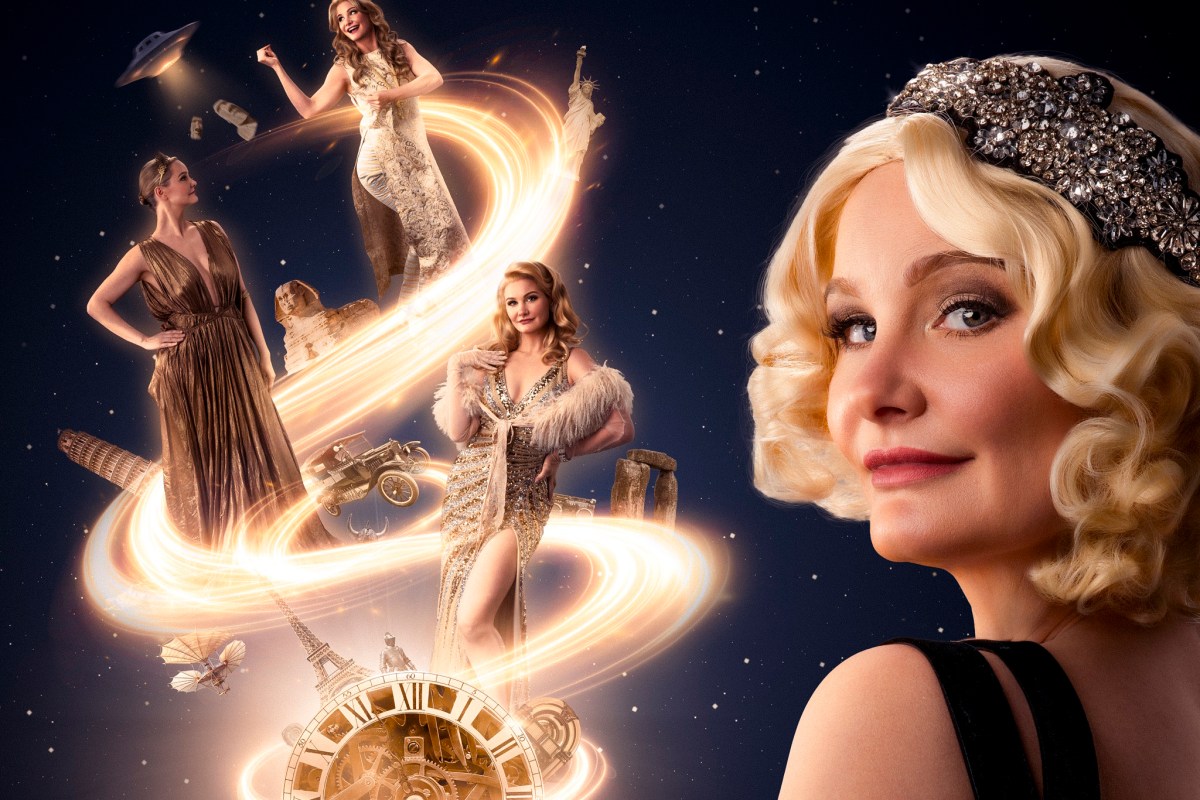
Having honed her musical improv skills with the long-running Impromptunes group and the Cabaret Unscripted duo with Greg Lavell, Valette was looking for a new challenge.
‘I realised that I was most inspired by genre and history. Those types of [audience] suggestions opened up a really exciting world for me as someone who’s always been a huge fan of history and mythology. I wondered how I could kind of incorporate that more into the show, and that’s where the idea of Cabaret Time Machine was born.’
Valette says that in Australia, the improv format most people are familiar with is the short-form improv seen in TV shows like Thank God You’re Here. This style of improv uses games with ‘handles’ (which set the rules or parameters) and at the end of the scene, the action is ‘wiped’, and another scene begins, which may feature all-new characters or a completely different premise.
In longform improv shows like Valette’s, however, nothing is wiped. ‘That is a huge challenge, tying it up at the end,’ Valette explains.
‘Every ball that has been put in the air at some point has to be caught. There are no restarts or refreshes; it’s about and finding moments of spontaneous humour within the show and with the audience in that narrative continuity.
While it might seem that the audience suggestions which improvisers take on are all-important, Valette says experienced improvisers can work with almost anything. ‘Unless it’s totally inappropriate – which doesn’t happen very often – there is always an interesting way to spin, work with it and ask for clarification from the person who said it. The more interesting it is or unique it is, the more you can spin out of it, but every suggestion has its own inherent value.’
Isabella Valette: Cabaret Time Machine is at the Trades Hall, Melbourne from 26 March to 5 April as part of the Melbourne International Comedy Festival.
Ben Russell
It’s about being comfortable being an idiot, which goes against everything we do in the real world.
Learning improv comedy is often described as an exercise in becoming uncomfortable with uncertainty. Melbournian Ben Russell has a slightly different take.
‘It’s about being comfortable being an idiot, which goes against everything we do in the real world,’ he says. ‘The average person thinks about what they say and doesn’t want to make a fool of themselves; that’s not what improv is about!’

After training with Second City Conservatory Chicago and iO Chicago – both uber-influential schools in the world of improv – Russell has drawn on these skills across his work spanning (and often blending) stand-up, sketch, improv and acting.
‘At iO, doing longform improv, it was about creating characters and taking people on a journey and finding the buttons (the line or action that concludes a scene) and the laughs,’ he explains.
‘At Second City, I got to learn all about the structure of sketch, which is very similar to the structure of jokes. Second City is more improv for writing. Through play, you can find things that you can use. If you come up with a great idea in an [improv] show, there is no reason why you can’t develop that.
‘What I learned there, and what I still preach today when I [teach] classes, is the use of repetition and finding patterns. This is oversimplifying, but you could argue that comedy is effectively just rhythm and pattern.’
While Russell says that longform improv has a lower profile in Australia than in other scenes, he’s seen its appeal grow broader. ‘I like that it is sort of the ugly step-son to stand-up. I love improv because it is so low-stakes. If you do a good show, nobody remembers it, and if you do a bad show, nobody remembers it. It’s just kind of ephemeral.’
As well as performing in the group improv show Something Good, Russell is bringing two solo shows to the Melbourne International Comedy Festival this year: an encore of his acclaimed 2024 hour, which incorporates some crowd work into its narrative, and a new one, titled Bon. The latter sees him adding yet another skill set to his box of tricks: the synth skills he picked up during the lockdown era.
‘I’m a big synthesiser guy now, which is embarrassing because it’s very elder millennial-coded,’ he says with a laugh.
‘I’ve made a bunch of music scoring the entire show, and there are stupid bits, riffs and sketches. It’s lo-fi beats to watch a short man to.’
Ben Russell’s 2024 encore performance is at The Greek, Melbourne from 26 to 29 March, while his new work Bon, also at The Greek, runs from 26 March to 12 April. Both shows are part of the Melbourne International Comedy Festival.
Hannah Camilleri
I started engineering parts of the show to include wiggle room, extra time to explore and play.
For many performers, there is comfort in knowing every last line and nuance in a script. But for Hannah Camilleri, the opposite is true.
One day at the Edinburgh Fringe Festival, she decided not to look at her script at all, instead detouring to Glasgow to hang out with a friend, swim in a loch and watch soccer. Her show that night was a success, and she realised her apparent lack of preparation had been freeing.
‘I started engineering parts of the show to include wiggle room, extra time to explore and play,’ she explains.
‘Instead of writing a 50-minute show I would write, say, a 40-minute show so I could follow my nose, much like the training had taught me.’
In last year’s What I’m Going For, Camilleri would invite an audience member on stage for up to 30 minutes. At a show at Brisbane Powerhouse, a familiar face volunteered to jump into the fray with her. ‘Susie O’Neill came onstage … I was reminded that theatre is live. Yes, we’re sitting in our seats watching but anything could happen in that space and time. After a show-stopping performance, I asked her to sit down. Susie!’
While her ‘frivolous, fun and loose’ new work Dinner Hannah Show features less audience interaction (and presumably fewer Olympic legends), it will again draw on Camilleri’s training both in improv and clowning. She has studied the latter extensively – including at École Philippe Gaulie, the school founded by the genre’s most famous teacher – and was ‘shocked’ to find how many principles the two disciplines share.
She says both clowning and improv celebrate individuality and impulsiveness, and each is built around acute sensitivity and a complete commitment to being present in the moment.
‘Both forms are essentially calling you to remove the filter that lays the unhelpful foundation for children to become polite adults,’ she says.
‘They want you to get in touch with your personality because when your spirit is free, it’s engaging to watch and no one else can replicate that.’
Camilleri agrees that improv training can be beneficial for any performer, not just those eyeing a career in improv, as it can help break down the ‘thick skin’ many people cultivate as a defensive mechanism.
‘In these spaces you can relearn how to trust yourself and chip away at that pesky encrusted layer. These modes affirm our choices. It’s a bit mind boggling isn’t it?
‘Improv taught me that everything I need I already have – sappy but true! You can arrive onstage without preparation, and you are enough.’
Hannah Camilleri: Dinner Hannah Show is at The Malthouse, Melbourne from 26 March to 19 April as part of the Melbourne International Comedy Festival.