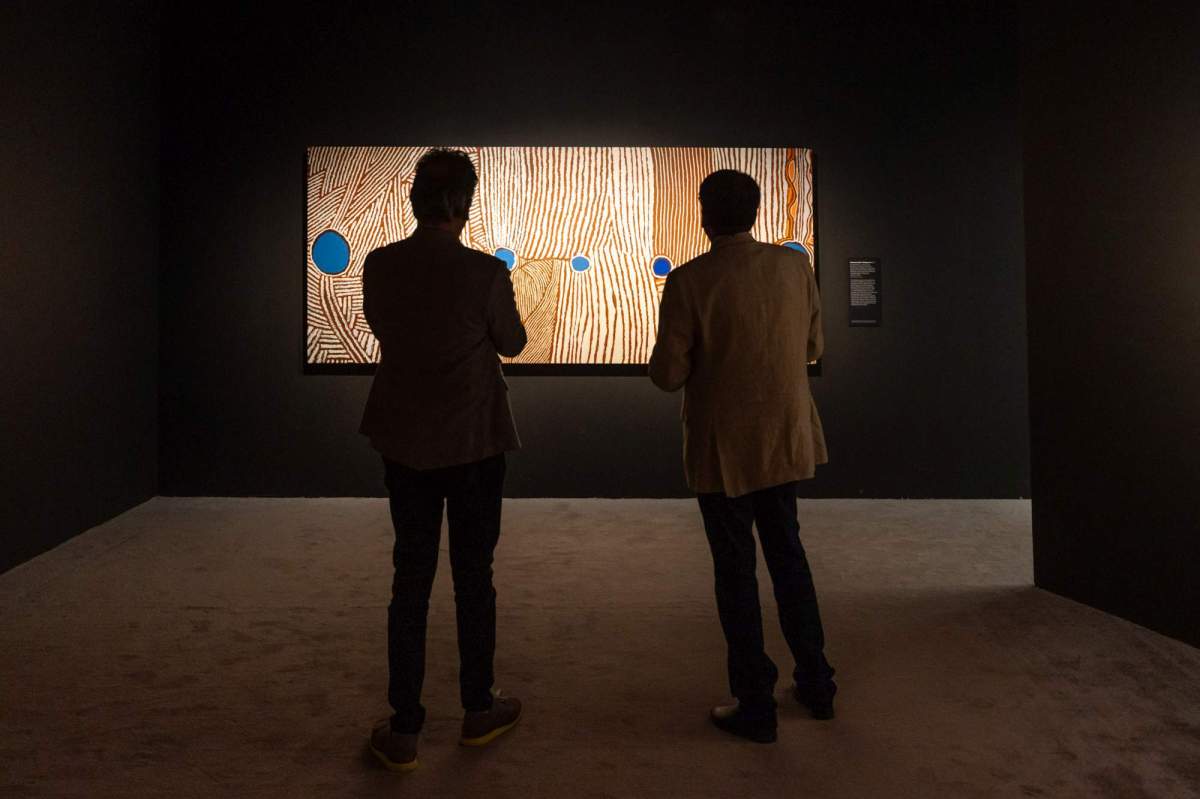
When the National Museum of Australia debuted its blockbuster exhibition Songlines: Tracking the Seven Sisters in Canberra eight years ago, it was to overwhelmingly positive acclaim.
But back then, it’s a safe to say no one was thinking much about the show’s potential to be just as popular (if not more popular) with audiences on another continent as it has been with local crowds. Nor was anyone predicting the exhibition would reveal some stunning cultural and spiritual connections between ancient Indian mythology and Australian First Nations lore specific to the Seven Sisters (Pleiades star cluster) constellation.
Yet this is the reality now playing out as Songlines: Tracking the Seven Sisters makes its debut at Humayun’s Tomb World Heritage Site Museum in Delhi, thanks to a touring partnership between National Museum Australia and Delhi’s Kiran Nadar Museum of Art.
Since 2021, Songlines has travelled to various museums across Europe and the UK, including the Humboldt Forum in Berlin and the Musée du quai Branly in Paris. Now, Songlines is making perhaps its strongest impressions yet with audiences in Delhi, who are flocking to learn more about Indigenous Australian creation stories that have fascinating ties to their own country’s Hindu origin tales.
Songlines international journey – quick links
A landmark exhibition
Songlines is dedicated to tracking the geography, law and stories of five First Nations songlines from three different Indigenous groups from across Western and Central Desert regions (the communities on the APY Lands; the Ngaanyatjarra people of the desert border area between Western Australia, the Northern Territory and South Austrlaia; and the Martu people of the Pilbara desert).
The exhibition features nearly 300 paintings and objects that highlight the significance of the Seven Sisters creation story to these Indigenous groups.
Long before the show began making waves internationally, it was already an important moment of recognition by a major Australian cultural institution of some important Indigenous songlines that Traditional Custodians of the APY Lands were warning were at great risk of being lost.
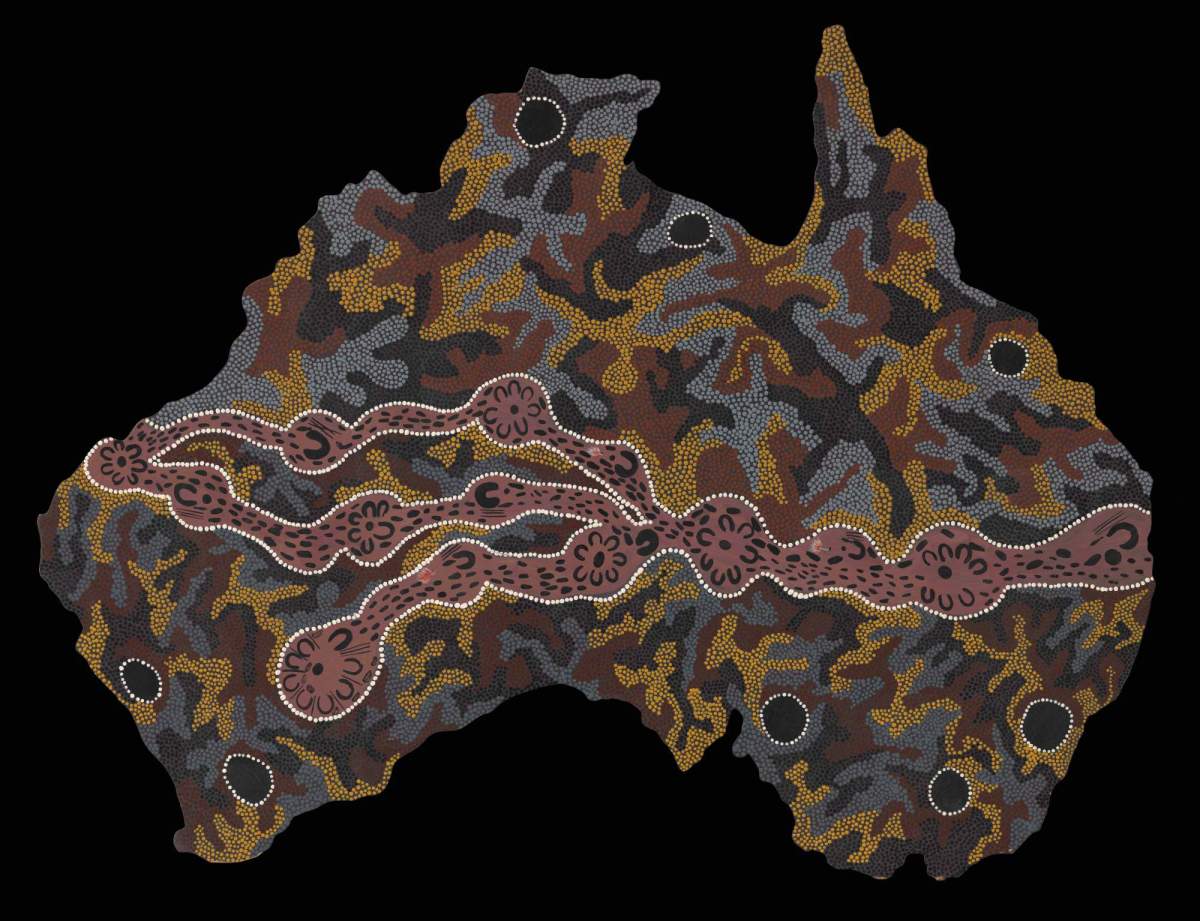
For these Aṉangu Elders, the traditional means of handing-down these stories – via the oral traditions of storytelling, dance and song, and visual mediums like painting – is under increasing threat, especially with the loss of Indigenous Elder story-holders who have not been able to share these stories (their Tjukurrpa) and ensure their songline maps remain adequately intact.
As described by NMA, the Songlines project was conceived in response to these Aṉangu Elders’ urgent plea ‘to help put the songlines back together’ at a time when ‘they were getting all broken up’.
The Seven Sisters songline
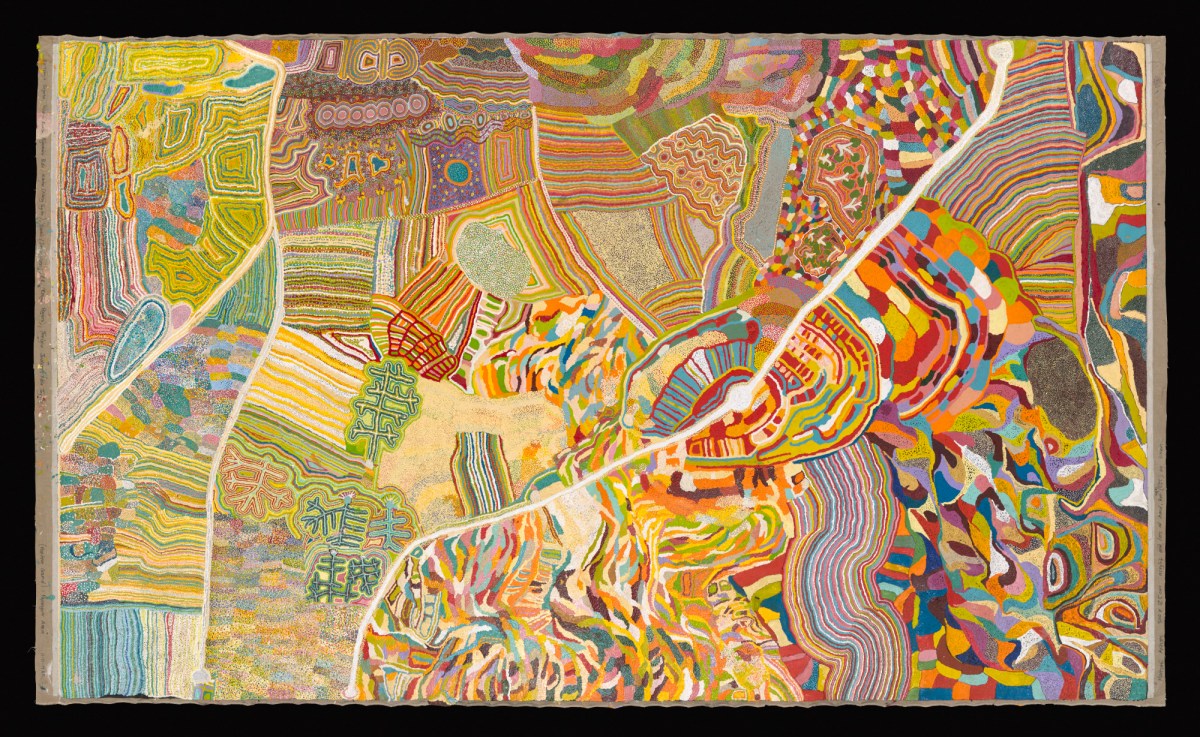
The songlines story chosen for sharing in the museum’s landmark show was that of the seven ancestral Indigenous women (the Seven Sisters) who travel across vast desert plains while being relentlessly pursued by a powerful spirit sorcerer known as Wati Nyiru (or Yurla).
As these women traverse the desert they must hide, scheme and outwit the Wati Nyiru/Yurla sorcerer and foil his attempts to capture them. As they do so, they chart paths across the desert that mark out essential food sources, waterholes and sacred sites.
These songlines are therefore vitally important spiritual guides and practical survival maps for these Western and Central Desert Indigenous groups.
Why Indian audiences are taking strong interest
Somewhat surprisingly, as the Songlines exhibition makes its first appearance in India, it seems this particular ancient Tjukurrpa is striking strong chords with audiences in that country.
According to KNMA Curator Premjish Achari, the first potential reason for the excited interest from Indian audiences in Songlines is the connections that the exhibition reveals between Indigenous Australian groups’ approach to cultural knowledge holding and some of India’s own indigenous communities’ lore.
As he writes in the exhibition’s catalogue, Indigenous Australian ‘knowledge does not have to be confined alone in textual form to survive; the Country itself is an archive; the body is a medium; the song is a map’.
Achari argues that this concept is highly relevant for Indian audiences, ‘in the context of [India’s] own indigenous communities, who narrate similar cosmologies where land and knowledge are indistinct, where origin myths are expressed in lines, dots and circles, where remembrance rises against colonial erasures’.
But the fascinating links between the two cultures go even further.
As Achari tells ArtsHub, he would not draw any direct connections between Indigenous Australian and Indian Hindu cultures, but he does see certain crossovers specific to significance of the Pleiades star constellation.
As he explains: ‘Both Hindu and Aboriginal Australian traditions associate the Pleiades star cluster with seven sisters. In Hindu mythology, the Pleiades represent the Krittikas – who are seven celestial women central to Vedic and Puranic [Hindu] cosmology.
‘According to one Hindu narrative, the seven Krittikas women were the wives of seven male sages (the Saptarshis). But the women became separated from their husbands due to misunderstandings and jealousy.
‘Upon separation from their husbands, they were adopted as mothers by the Hindu god of war, Kartikeya.’
Essentially, Achari observes that this Hindu story, which encodes themes of separation, survival, refuge-seeking and transformation, is not dissimilar from the Indigenous Australian narrative of the Seven Sisters fleeing across the desert pursued by a powerful male sorcerer.
Read: Glimmer review: artist Lynda Draper’s unrelenting and unique journey in ceramics
The curator goes further in observing certain thematic threads that are apparent in both stories, adding: ‘In both cosmologies, the seven sisters carry knowledge, agency, and survival, and both cultures understood that these celestial sisters carry civilisation-sustaining wisdom, embody cosmic knowledge and hold protective maternal power’.
Achari also sees resonance in the way both ancient stories foreground strong female figures, which he sees as having particular potency to contemporary Indian audiences.
‘What I find most compelling is that both traditions foreground female lineage and female agency in culture-making,’ he tells ArtsHub.
‘Both are journeys of women and I think this resonates deeply with Indian audiences, particularly those engaged with contemporary feminist re-readings of mythology.’
Which Songlines’ artworks are commanding most attention?
Aside from the fascinating links between origin stories in both Indigenous Australian and Hindu cultures, the KNMA curator has noticed certain other visitor engagement patterns pointing to additional reasons for the show’s popularity with audiences in India.
As he tells ArtsHub: ‘From my observations, audiences have been most profoundly moved by the exhibition’s immersive DomeLab [multimedia] experience.
‘When visitors stand beneath the seven-metre-wide domed ceiling and encounter the animated rock art, constellations and the transit of the Pleiades star cluster – this isn’t simply a technical feat, it’s a phenomenological shift,’ he says.
He says visitors have described it as being transported into the songlines, rather than observing them from a distance.
‘That embodied encounter – where sound, light, and visual storytelling converge – appears to dissolve the barrier between observer and participant,’ he says.
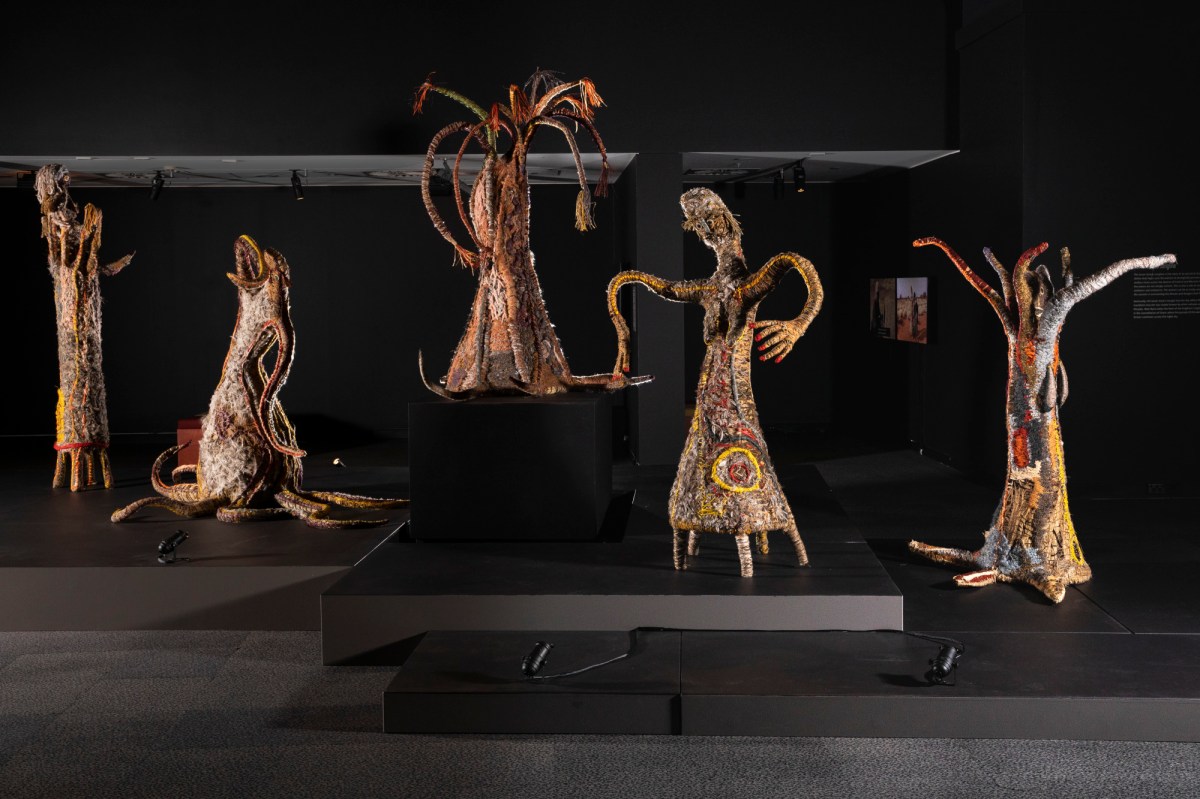
He has also noticed sustained engagement with the tjanpi (grass) weavings and the multi-channel film installations that depict the Seven Sisters’ journey across the desert.
‘Indian audiences seem particularly arrested by these intimate, tactile artworks – perhaps because they recognise in the materiality and craftsmanship something that resonates with our own traditions of handwoven textiles and sacred objects.’
While there are clearly manifold factors drawing Indian audiences to this show, for Achari, one of its most powerful elements centres on Indian audiences’ recognition of kinship connections.
‘Songlines is activating a deep resonance between two ancient knowledge systems,’ he says.
‘This exhibition is not a museum display of “artefacts”. Rather, it’s a living cultural system that has been developed collaboratively with Aboriginal custodians, and which continues to evolve as it encounters new audiences.
‘Ultimately, I think audiences in India are responding to the urgency and living vitality of these traditions,’ he concludes.