Sydney has one of the largest natural harbours in the world, but it can be easy to forget it when spending time in the urban jungle that makes up Australia’s largest city.
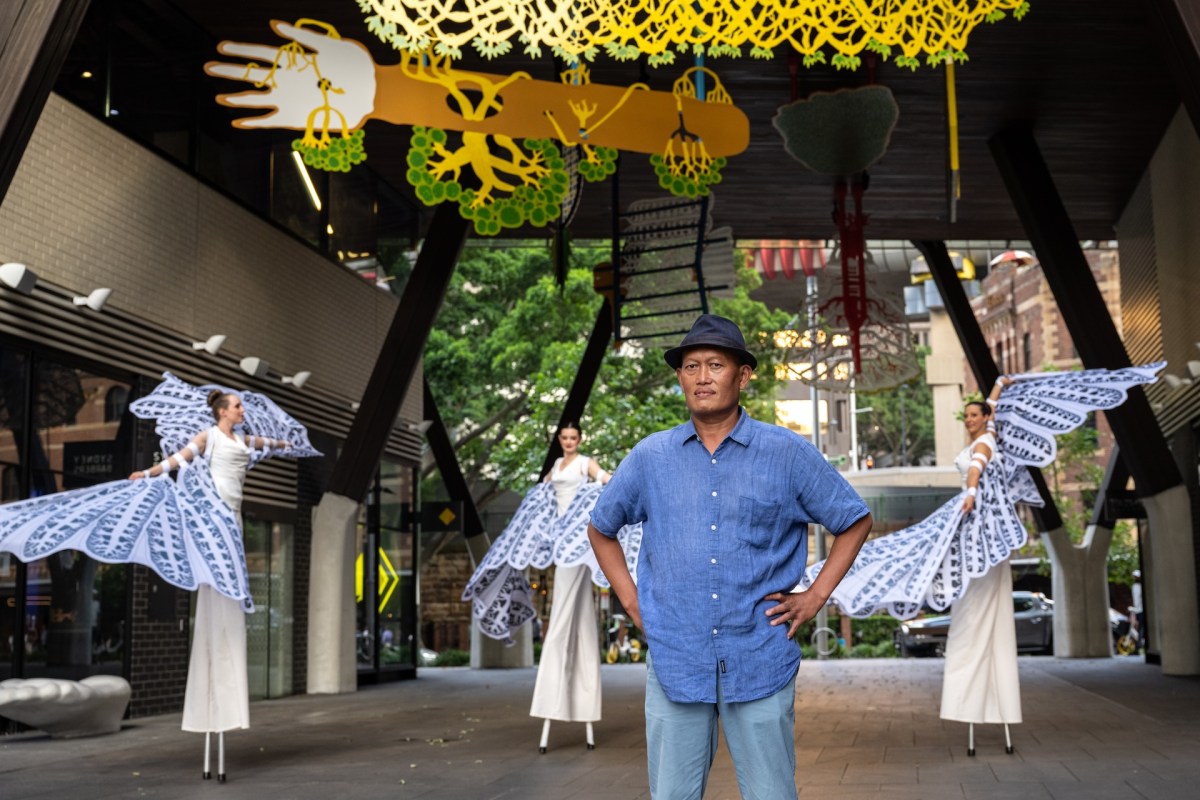
This body of water has shaped the culture and economy of the area for tens of thousands of years, with its history being excavated as part of one of the city’s newest public artworks. Upside-Down Garden is the first large-scale public artwork from Indonesian-Australian artist Jumaadi, located at Barangaroo in Sydney’s CBD.
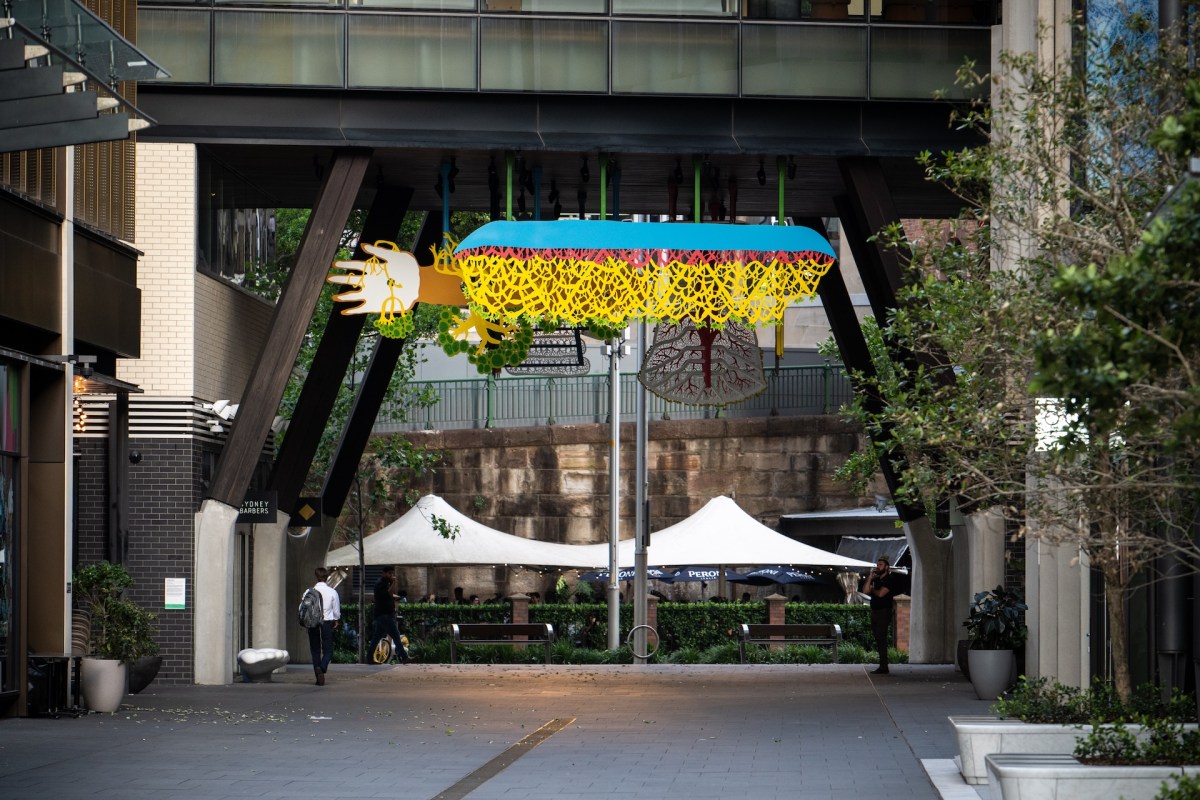
The skyscrapers of this corporate hub form a barrier between the water and the city, navigable through a patchwork of pathways populated by suited businesspeople and visor-wearing tourists. In a thoroughfare beneath towers at Mercantile Walk, Jumaadi’s colourful scenes both natural and manmade hang suspended and bring the life of water to the fore.
A red footprint glows ethereally, as if a giant had stepped across the ceiling. Brightly coloured figures intertwine with natural elements. A hand is wrapped and overcome with tree roots, a winged figure takes flight.
Public art and Barangaroo
The work was curated for the space by Glenn Barkley and Holly Williams as part of a $40 million contribution from developer Lendlease into public art around Barangaroo, delivered in partnership with the state government.
October last year marked the end of a 15-year multi-billion dollar redevelopment of the precinct with former lives as a precolonial fishing and hunting region before being built out as wharfs and now as a mixed-use commercial space.
The work by Jumaadi sits in proximity to other public artwork in the region, including Esme Timbery and Jonathan Jones’s large-scale Shellwall (2015), German artist Sabine Horning’s Shadows (2019) and Mermer Waiskeder: Stories of the Moving Tide by Ghost Net Collective (2023).
Jumaadi’s human and natural histories
Jumaadi told ArtsHub he drew on the area’s ‘complex history’ in developing Upside-Down Garden, infused with his own thematic concerns of migration and hybrids between human and nature.
‘(Barangaroo) has a precolonial history with natural history and also a lot of social history taking place, including the current function of the harbour as an economic hub for Australia,’ he said.
‘As a starting point, we were thinking of the natural history and imagined that if we tipped the harbor upside-down we would have found the shape without the water. If you imagine the sea bed was above us, then those things that are hanging are either natural or archeological remains.’
Upside-Down Garden bridges these human and natural worlds in its placement and its themes, inviting viewers to look up and reimagine the space from a different angle.
The artwork responds to the different timings of the city, with various elements coming into focus as they’re silhouetted against skies during the day or lit at night against the darkness.
Approaching the work from the direction of the city at night, the glow of each scene allows them to be seen through each other’s gaps, feeling connected and alive. Their finer details come into sharper relief when lit up in the darkness, fractal forms alternately recalling tree branches, roots and lungs.
A shifting perspective
A soundscape by composer Michael Toisuta was created in collaboration with Jumaadi, changing throughout the day and in relation to sun and moon cycles. The work changes in four cycles at dawn, midday, dusk and near midnight, with sounds including insects and birds.
While the audio elements can struggle to be heard above the footfall of passersby or music from nearby cafes, co-curator Glenn Barkley said public art must take into account the space around it.
‘You have to find a way to either compete with it or sit alongside it,’ he said.
‘What Jumaadi is doing is an insertion into that space.’
Given its location in such an exposed site of tourism and commerce, Barkley said the region’s architecture and ‘transitory’ audience were central considerations in the work’s development.
‘People might only go there once and encounter it as quite a static thing, they might see it in the early evening where it’s changing in this sound element,’ he said.
‘But it’s also thinking about the people that live and work at Barangaroo who might see it in all of its different complexities and all of its different moods.’
‘The great thing about public art is it’s something you can sit there and engage with, you can walk past it, you can come back to it.’
Barkley, Williams and Jumaadi worked alongside experts in sound, architecture and design since its conception during pandemic lockdowns to develop the work, including architect Caroline Comino.
The architectural spaces around the work have the potential to be overpowering, with imposing walls and sleek surfaces contrasting against the playfulness of Jumaadi’s artistic sanctuary.
Barkley told ArtsHub he sees ‘a type of informality in Jumaadi’s work that plays off well against the formality of the buildings’.
‘He quite often uses sort of magic and ceremony and those types of things which you may think aren’t included in sort of corporate sites,’ Barkley said.
‘The work we imagine like a garden, a chapel or a refuge in contrast to the dynamic of the area.’
The toughest challenge for Upside-Down Garden is that Barangaroo is an area of the city largely stripped of personality. Black, white and grey dominate the corporate landscape that feels like it could be a commercial hub anywhere in the world.
This contrast forms its greatest power, the colourful and lively figures drawing on local history to bring a sense of place back to the landscape. Looking up at the scenes of natural life, viewing the work does transport you into an upside-down garden.
Upside-Down Garden is on permanent public display at Barangaroo South in Sydney.
This article is published as part of ArtsHub’s Creative Journalism Fellowship, an initiative supported by the NSW Government through Create NSW.