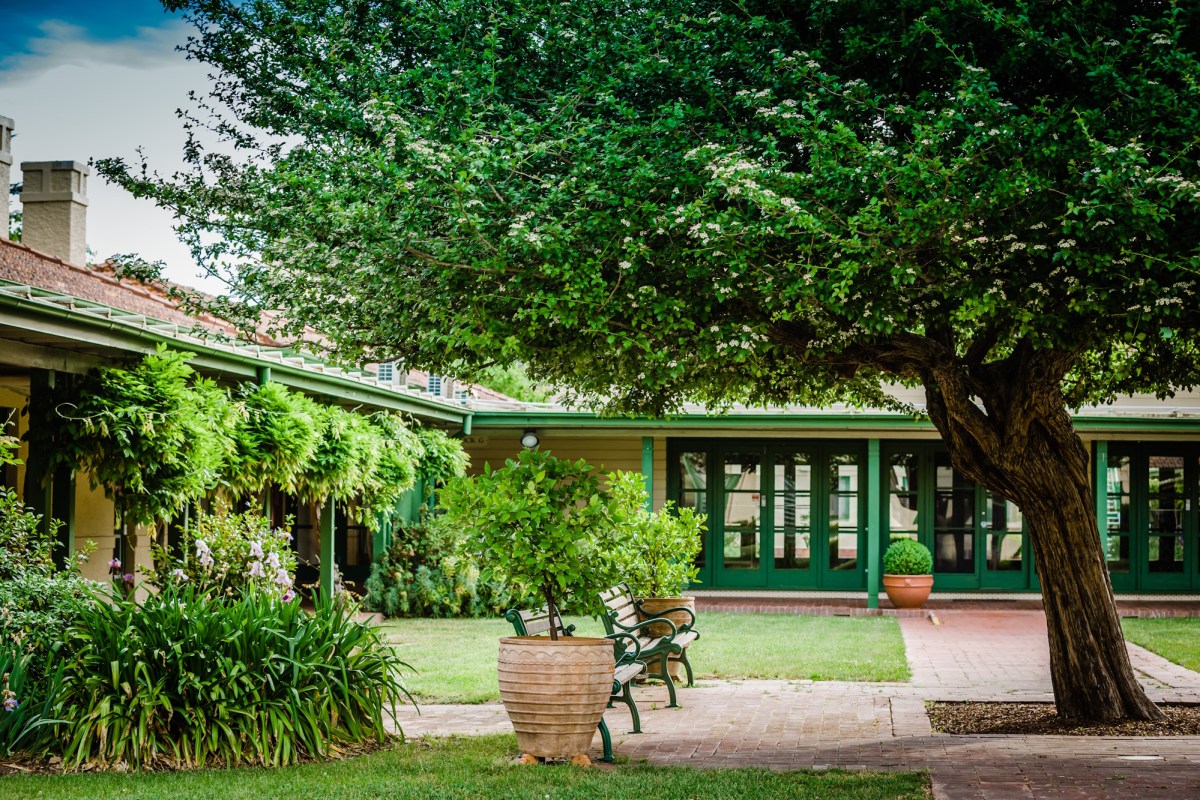
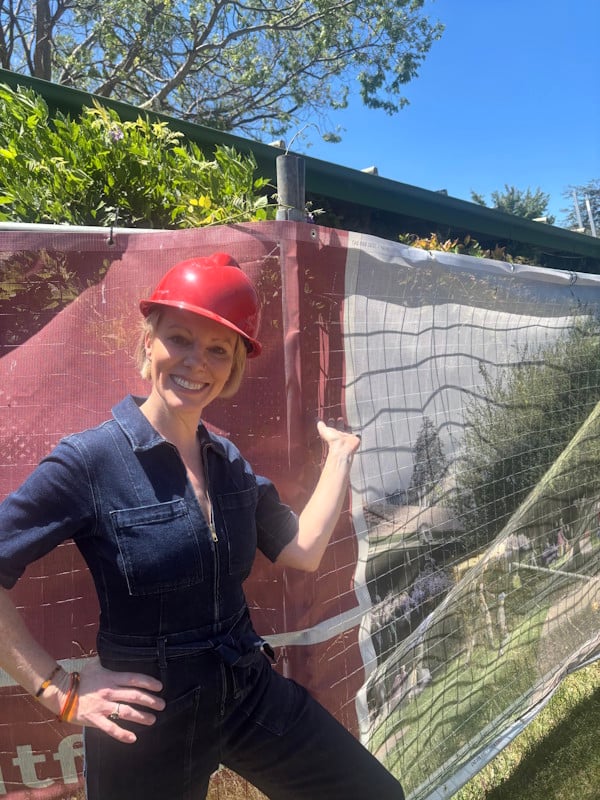
At Canberra’s Gorman Arts Centre, scaffolding has become almost as familiar as the precinct’s heritage wisteria. Since redevelopment began in July 2024, the site has existed in a state of partial closure: rather than opting for a swift, doors-shut transformation and a triumphant reopening, Gorman has had to tread a slower, more complex path – a staged redevelopment that keeps artists and organisations on site while construction unfolds around them.
It’s a high-wire act, and one that Arts Capital CEO Nancy Bennison readily concedes has tested patience. ‘It’s a long building project,’ she tells ArtsHub. ‘As CEO of a not-for-profit you have one hand on the strategic plan and the other holding a mop.’ It’s an apt image.
The $12.9 million redevelopment has meant years of construction fencing, reduced visibility and careful messaging. With completion projected for early 2028, the promise remains optimistic: a revitalised, artist-centred precinct that honours the centre’s heritage while meeting contemporary needs.
However, a question lingers in the sector: will the wait be worth it, or is the redevelopment out of sync with changing needs and a new demanding demographic?
Gorman Arts Centre redevelopment – quick links
Stability over spectacle: the case for slow redevelopment
Redeveloping a heritage precinct is never straightforward. Compliance upgrades, accessibility improvements and climate control retrofits are complex in buildings approaching a century old. The decision to stage works over multiple years, however, was not merely reactive – it was strategic.
The advantage has been continuity. Resident artists and organisations retained a home during a period of upheaval, even as they endured the disruption of ‘musical chairs’ between studios. The cost has been diminished activation and the lingering perception that Gorman is in limbo.
Bennison acknowledges the communication challenge: how to share progress without overpromising. ‘It is a tricky balance – keeping interest in the spaces alive while also managing expectations of what is available to people in the short term.’
Recent activations, including markets and festival partnerships, signal a renewed effort to animate the site ahead of completion. ArtsHub caught up with Bennison at last year’s Undercurrent Market, the first significant commercial activity since mid-2024, and there was a palpable sense of return. Not quite the old Gorman, but something stirring. She described with optimism, ‘It’s like watching a black-and-white picture be coloured in.’
The precinct carries weight in Canberra’s cultural memory. Designed by John Smith Murdoch, the architect of Old Parliament House, the buildings opened in 1924 as accommodation for public servants. By the 1980s, they had become an arts centre and, over time, a cornerstone of the city’s independent arts ecology.
Modernising such a site is a legal and architectural minefield. Critics have argued that heritage preservation too often trumped active maintenance, leaving accessibility, climate control and other essential upgrades deferred. The redevelopment seeks to correct that drift – but the slow pace has fuelled questions about momentum, particularly as the surrounding neighbourhood booms.
A further blow came in 2023, in the way of significant staff cuts (from 18 to 11) due to financial pressures and a funding grant that fell short of expectations. However, Bennison confirms that the protracted redevelopment timeline has been a strategic commitment to stability for resident artists and arts organisations.
The trick, of course, is managing perceptions. Canberra’s demand for creative space has not paused. With nearby developments reshaping the neighbourhood, the question lingers: could a more decisive construction period have delivered renewed capacity sooner? It is impossible to know definitively.
And, with a partner Arts Capital organisation, Ainslie Arts Centre, largely carrying operational finances during building works, that burden is felt more deeply over time – which counters the sound model of shared administration and maintenance expenses.
Bennison is frank about the balancing act. ‘Sustainability is not an abstract goal; it’s daily arithmetic,’ she tells ArtsHub. ‘The model works only if both centres are really, really busy.’
What does $12.9 million buy?
The bulk of the $12.9 million spend is functional: heating, cooling, security, compliance. Necessary, certainly, but hardly sexy. It’s not a flashy rebrand. It’s infrastructure – both physical and cultural.
Delivered in two phases, the project will see half the artist studios and several shared spaces reopen by October 2027, with full completion expected in late 2027 and a formal unveiling in early 2028. Rolling reveals from early 2027 aim to reintroduce the precinct gradually.
Post-renovation, Gorman will house approximately 40 individual artist studios, four multipurpose workspaces, a main hall, two theatres and a newly fitted multipurpose gallery. A new entrance on Batman Street will reorient the site toward the city and a new UNSW campus, accompanied by a café and bar designed to activate the precinct and generate income.
This commercialisation – a now-familiar strategy in arts infrastructure – will subsidise studios and community access. With the centre located in a corridor increasingly defined by apartment developments and a changing demographic profile, the approach is pragmatic. The question is whether the protracted timeline has limited the precinct’s ability to capitalise on that growth sooner.
The ‘everything but the art’ model
At the core of the redevelopment is Bennison’s economic model: ‘Everything but the art’. Subsidised, resident artists and not-for-profit organisations rent studios at up to 50% below market rates. As she explains, ‘When you pay for a space at Gorman or a desk at Ainslie, it is the security of the centre, it’s the maintenance, the grounds, the Internet, it’s support with marketing and promotion, it’s access to professional development, connectivity.
The aim is to remove administrative burdens so artists can focus on practice. ‘Artists should be able to come in the door and focus on their craft and not worry about anything else,’ she adds.
At present, residents include artists, photographers, composers, jewellers, a violin maker and multidisciplinary practitioners.
Who gets a studio? Stability versus transparency
Gorman has long been regarded, fairly or not, as a closed shop. Studios have historically been held for extended periods, sometimes decades. In a national climate where artists struggle to secure affordable, fit-for-purpose space, especially within CBD areas, the promise of a five-year tenure is gold.
Currently, 21 studios are occupied, just under half capacity. Post-renovation, 40 individual studios – alongside shared wet areas, a darkroom and multipurpose spaces – will be licensed for up to five years.
Additionally, a minimum of four studios will also be reserved for emerging artists at subsidised rates, for terms of between 12 and 24 months.
Bennison says it won’t be a clean flush of residents. Precedence will be given to current active residents, but underutilised spaces will return to the pool. For a government-owned site with deep public attachment, transparency around decision making will be critical – not only to ensure fairness, but to rebuild trust among artists who have felt excluded.
Bennison acknowledges the trust gap, and intends to introduce a new Expression of Interest process. She tells ArtsHub that renewal must be structural, not symbolic. ‘A new artist brings new networks and new energy. That’s really important.’
‘It’s important for artists to know they have a space for their practice as they become more established and seek to grow,’ she continues. ‘That’s where you have to be careful, because it’s just not a warehouse that people lease; these are ACT Government owned facilities. Fairness is a really big deal.’
Resident organisations: reach or entrenchment?
Alongside individual artists, five resident organisations curently anchor the precinct, including Canberra Youth Theatre, Rebus Theatre and Australian Dance Party. These groups occupy dedicated spaces while sharing facilities with independent artists in their sectors.
In theory, this strengthens sector development across dance, theatre and youth arts, extending reach beyond what Arts Capital could deliver alone. It’s an elegant solution and arguably an innovative response to the ACT’s compact arts ecology and constrained funding environment.
In practice, its continued success will depend on clarity around how shared access is communicated, how opportunities are advertised, and how reciprocity is maintained. In a small arts ecology like the ACT, proximity can blur the lines between collaboration and gatekeeping.
Memory, ownership and optimism
There is genuine cause for optimism. The infrastructure upgrades will secure the site’s viability for decades. Longer tenures could provide rare stability for artists in an increasingly precarious creative economy. Shared facilities and sector partnerships may deepen collaboration. The precinct’s growing residential population and proximity to the city also position it well for renewal.
Yet by 2028, expectations will be high. The true test will not only be whether the buildings function efficiently, but whether the systems within them operate openly and equitably. Can Gorman pair stability with access, sustainability with fairness? Can it honour its past without calcifying it?
Bennison insists that openness is central to the next chapter – that those who want to be part of Gorman’s future should be able to see themselves in it. For now, the fences remain, and patience may be in shorter supply than studio space. But if the slow burn succeeds, Canberra may yet inherit a precinct that feels both deeply familiar and genuinely renewed.