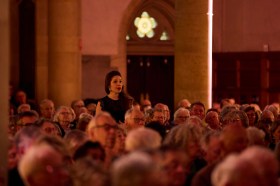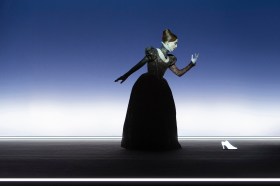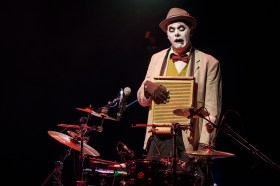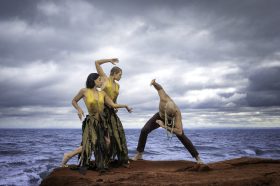
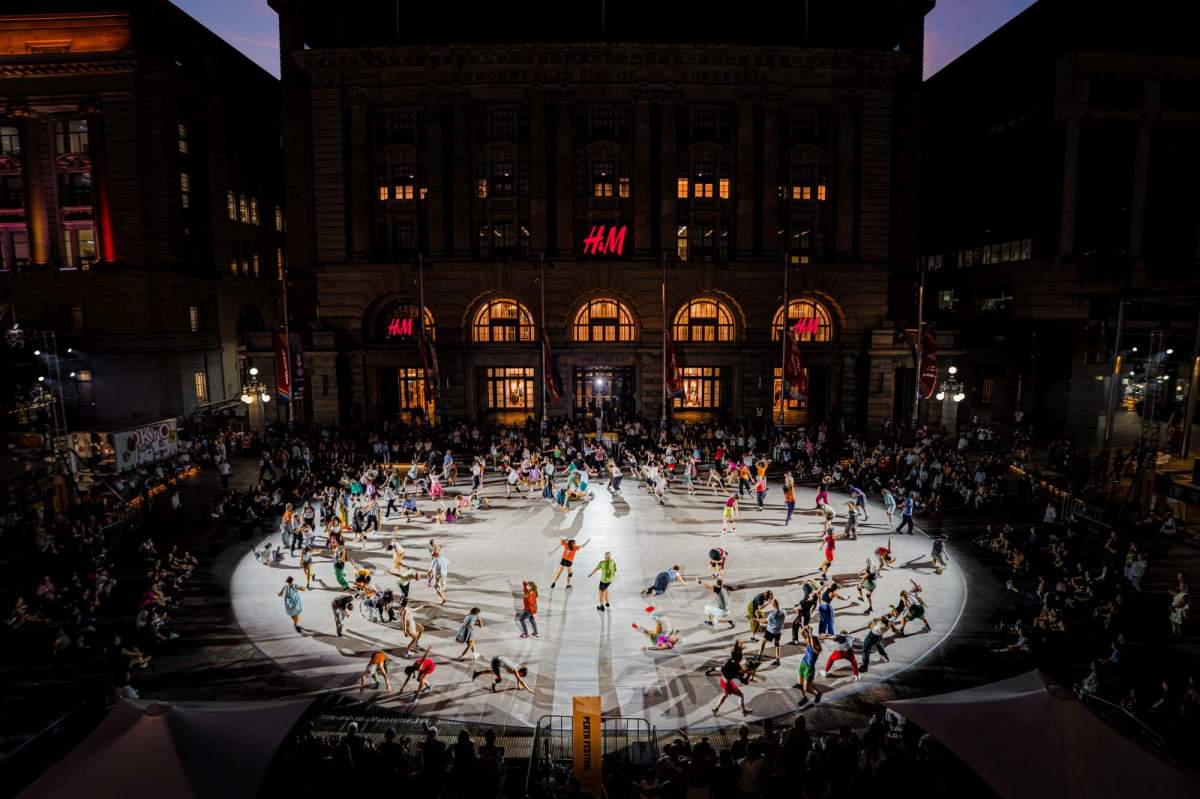
The urge to come together and dance is surely one of humanity’s most enduring forces. From the ancient Greeks linking together in circles of dancing festivities to the town square dance traditions of Renaissance Europe – not to mention the infamous dancing plague of 1518 – there is abundant archival proof of our collective thirst to dance in open air.
For French choreographer Boris Charmatz – who most recently served as Artistic Director of German dance company Tanztheater Wuppertal: Pina Bausch (until mid-2025), and who is now leading his own company Terrain – the idea of bringing people together in any place, at any time to experience dance together is a key theme in his creative practice.
But Charmatz is not alone in this pursuit, as Perth-based contemporary dance organisation STRUT Dance and its Co-Directors – Sofie Burgoyne and James O’Hara – showed this year with their Perth Festival project that championed the idea that dance can and should be an artform accessible to anyone who feels compelled to move.
CERCLES of dance in public space – quick links
Inviting the general public
Boris Charmatz’s work CERCLES was first presented in France at the 2024 Festival D’Avignon. It sees around 150 members of the public invited to attend six half-day workshops, led by Charmatz and his company, where participants learn a 40-minute set of Charmatz’s CERCLES repertoire, which they then perform together for general public audiences in an open air setting.
For its Perth Festival season, the work was shown in the city’s CBD Forest Place square over three nights during late February. It marked the fourth-ever time the work has been staged and the first time it’s been seen outside Europe.
Its Perth/Boorloo season also involved 12 Australian dance artists who were chosen as CERCLES’ workshop leaders. These local artists worked alongside Charmatz and his rehearsal director to teach the work’s repertoire to the general public participants who had signed up to take part.
As STRUT Dance Co-Director Sofie Burgoyne explains, the decision to present CERCLES this year was an important way for the organisation to continue developing its burgeoning annual Perth Moves initiative, which launched in 2023.
As Burgoyne tells ArtsHub, ‘In early conversations with Boris [Charmatz] about doing CERCLES this year, he actually suggested doing it next year [2027] because his schedule this year was already so busy.
‘But we really pushed for it to happen this year because despite it being a potentially bigger financial risk for us to do it now, we knew the benefits in terms of access and momentum around our Perth Moves program outweigh those challenges.’
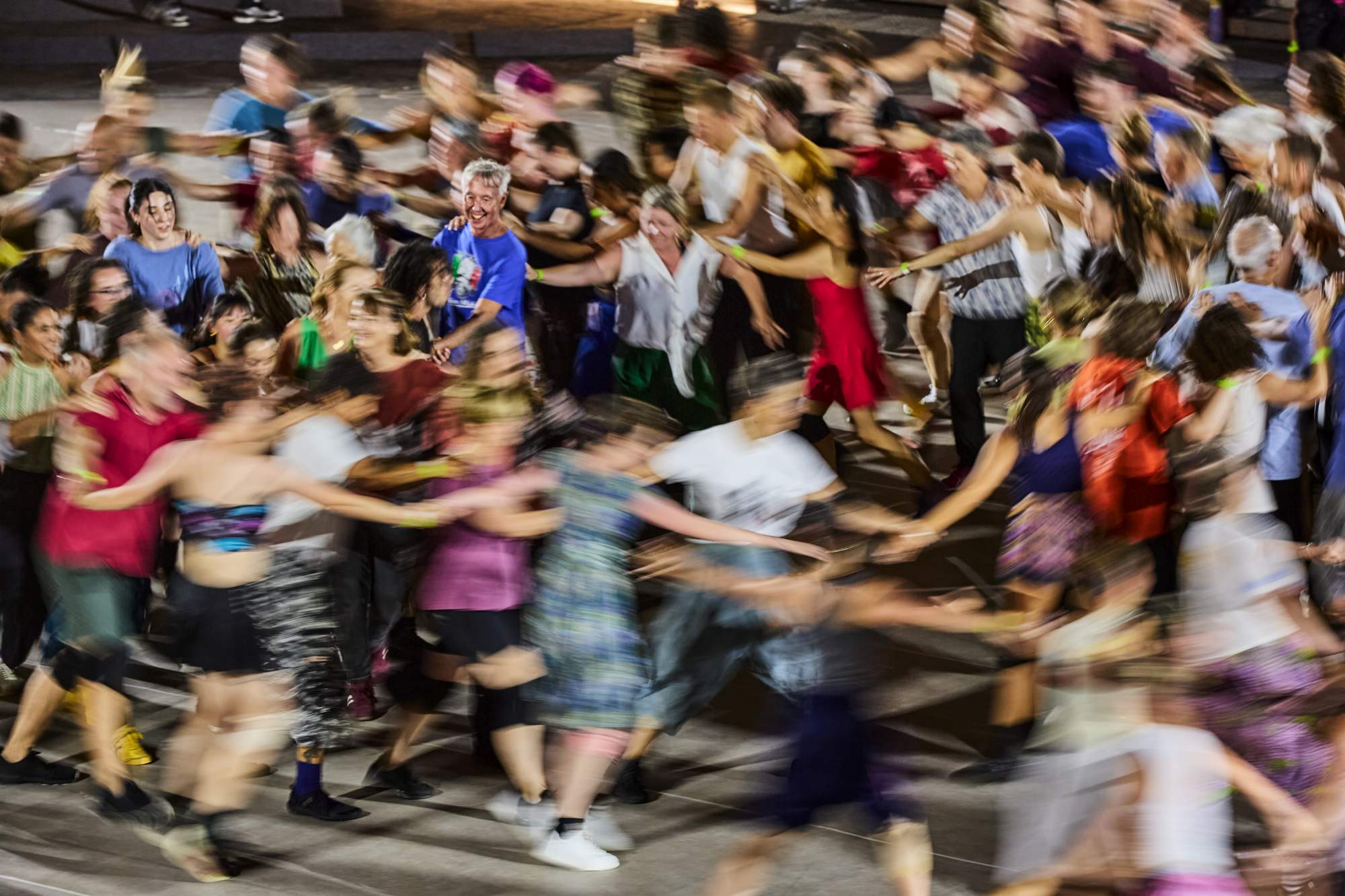
CERCLES participants in Perth/Boorloo during the work’s Perth Festival season. Photo: Thomas Earnshaw. 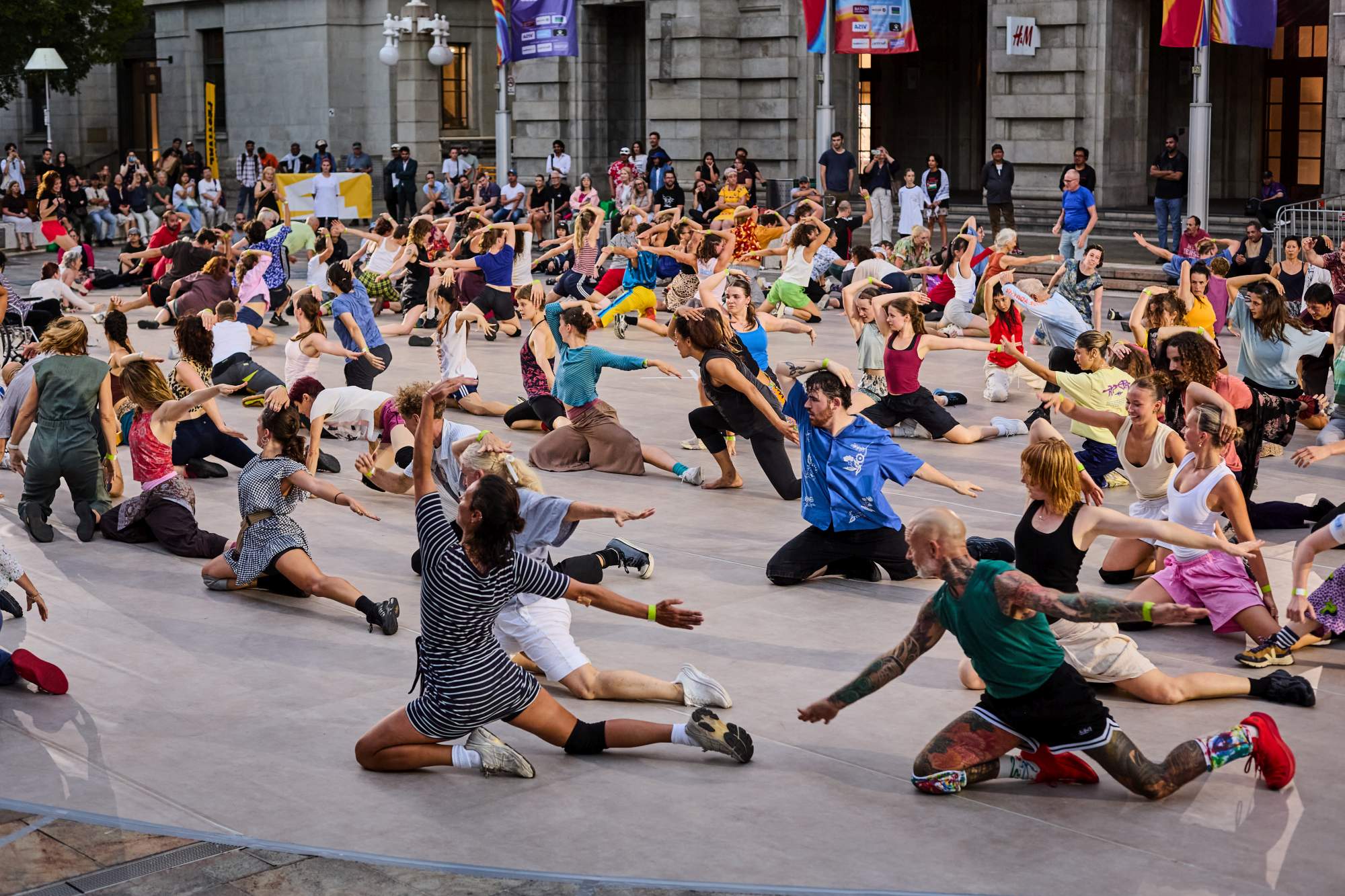
CERCLES participants in Perth/Boorloo during the work’s Perth Festival season. Photo: Thomas Earnshaw. 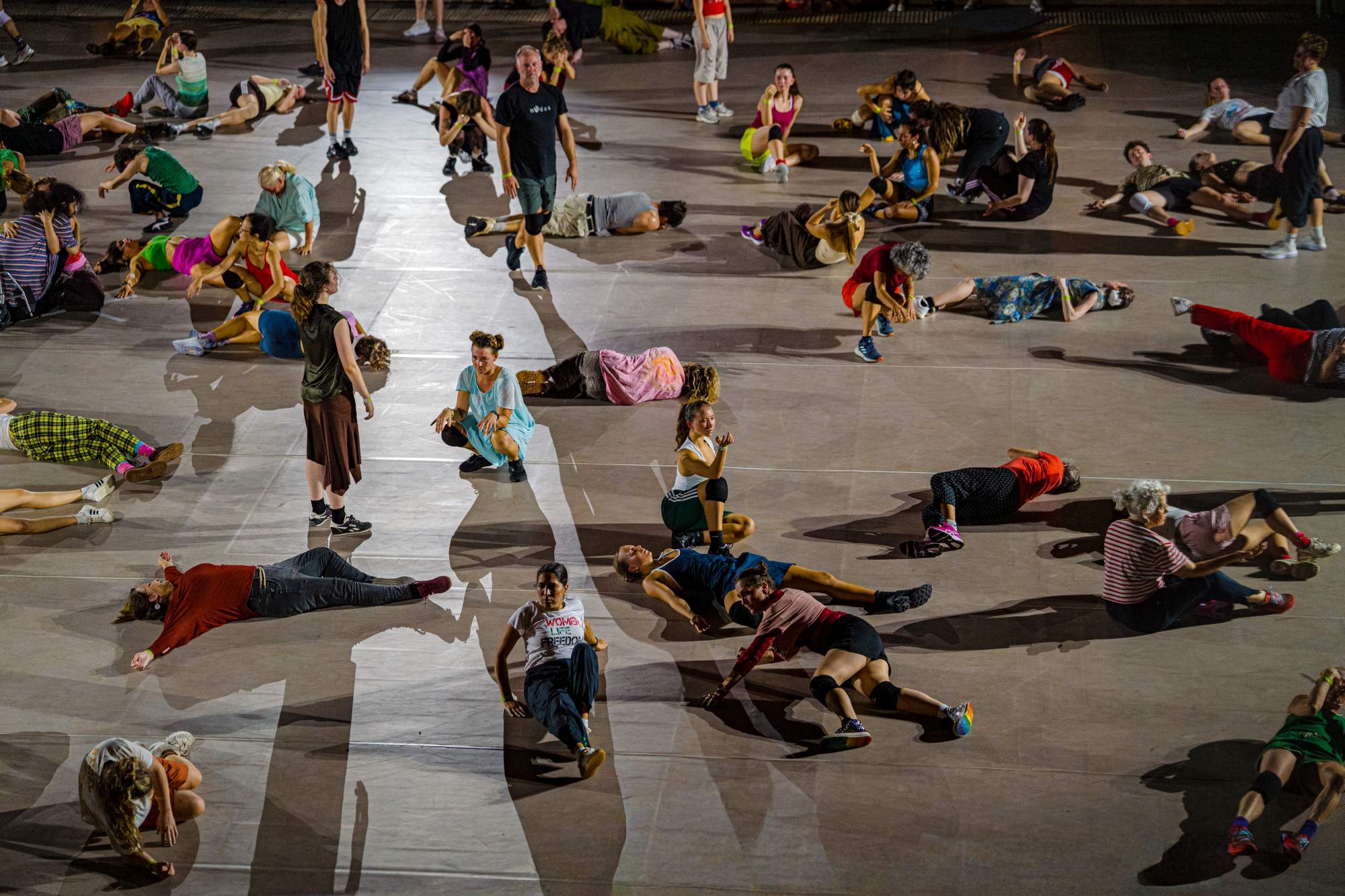
CERCLES participants in Perth/Boorloo during the work’s Perth Festival season. Photo: Andrew Clarke / Edify Media.
A central pillar of STRUT’s annual Perth Moves program is that it includes a number of free viewing and free participation contemporary dance events.
As Burgoyne explains, this commitment to free dance events is important to the STRUT directors’ belief that dance, as a form of social connection, should be open to all and not only to those who can afford to buy a ticket to see it.
‘Not that there’s anything wrong with paid in-theatre performances, of course,’ Burgoyne comments.
‘But for us, we really want to make sure people like the 16-year-old kid who wouldn’t normally be going along to the theatre can come with their grandparent, or with their family.’
Democratising the stage
This public access principle is also close to the heart of CERCLES choreographer Boris Charmatz. However, as he tells ArtsHub, his intentions to democratise the stage are not at all about compromising his work’s artistic rigour.
‘It’s very important to say that these projects – where I‘m bringing amateurs and professionals together – are not projects I do on the side of my other work,’ Charmatz tells ArtsHub.
‘No – this is my art. I think it’s in my DNA to make these kinds of works that include many people and make dance in public space,’ he continues.
However, Charmatz says CERCLES is more than an experience ‘where we all come together to make something nice and feel good together’. As he explains, ‘It has to be more than that, because I want to create high art’.
CERCLES requires its participants – both amateur and professional – to give a lot of themselves throughout the six-day process. ‘It’s quite tough for them in terms of the demands of the choreography,’ Charmatz says.
‘But it’s also a work where they can give as much as suits their capacities and levels of [dance] experience. And I think this is part of what keeps drawing me to dance as an artform,’ he adds. ‘It’s so wide in its possibilities and the way people can connect with it.’
Trying, failing and making art together
For the thousands of people who gathered in Perth’s Forest Place to witness CERCLES over the three nights it was performed, what they saw was a mix of euphoric communal exertion and liberated individual expression through dance.
At times the work’s 162 performers moved together to a pulsing sound score by German techno brass band Meute, forming a swirled mass of united bodies; at other times they dispersed and did their own thing in improvised scenes that launched them in different directions at varying speeds.
As Charmatz explains, the repertoire is a carefully constructed cycle of movement that is as much an ode to the history of modern dance as it is to present-day energies.
‘The repertoire includes a work by Isadora Duncan, which is a political dance she created in 1922 when she joined the revolution in Russia. But we do a rough, brutal punk version,’ he says.
‘I think it’s important that participants can take this dance with them – that they have the knowledge of this dance inside them now, and they can dance it wherever and whenever they want, and go on inventing for themselves.’
Participants ranged in age from 17 to 76, and included at least one participant with a disability who performed in their wheelchair. By the work’s end – which on its final night lasted three hours – audience members walked away with a strong sense of the exhilarating collective energies that can arise through the power of dance.
‘What I’m really interested in with this project is how we can create art together,’ Charmatz tells ArtsHub.
‘With CERCLES, we are really working on it together until the end – even in front of the audience,’ he adds.
‘We are trying together, we are failing together. It’s not like we are showing a “final” work to the audience at the end of a workshop and rehearsal period. The connections between participants and the audience are alive until the very end.’
How do you fund a free performance season like this?
After delivering this epic project to such positive acclaim, one could imagine the STRUT team is now enjoying some downtime and taking a moment to relish its success.
But as Burgoyne explains, CERCLES is the result of the small arts organisation’s tireless fundraising efforts, and that work – raising philanthropic dollars for upcoming projects – will continue without a break.
‘The majority of CERCLES was funded via philanthropy,’ Burgoyne tells ArtsHub. ‘And raising philanthropic support for these projects is something we continue to work on to make sure we can deliver these Perth Moves events in future.’
Burgoyne adds that as well as needing significant philanthropic support to deliver CERCLES, STRUT used small amounts of its four-year organisational funding from both Creative Australia and Western Australia’s Department of Creative Industries to make it happen, and also received a small amount from its presenting partner, Perth Festival.
‘Perth Festival contributes to our [Perth Moves] choreographic commission, dance battle and the production side of doing the outdoor event – so it’s largely been philanthropic support that has allowed us to bring CERCLES to Perth as part of Perth Moves this year,’ Burgoyne says.
She adds that STRUT’s pitch to donors to help support CERCLES was not especially easy, given the unconventional nature of the work.
‘We had to work really hard to tell the full story of the potential and impact we believed CERCLES would have,’ Burgoyne says.
‘This project is very different to what many people associate with high quality contemporary dance performance, so it felt like a bigger risk for our donors to commit to.’
Despite their reservations, Burgoyne says that when donors ultimately saw CERCLES unfolding in Forest Place for themselves, any uncertainties about its impact were quelled.
‘When they saw it, they were thrilled by it,’ Burgoyne says.
‘In fact, it blew them away. And that is really pleasing for us because it means we feel we’re now in a position to garner more interest in these project for future.’
Boris Charmatz’s CERCLES was presented from 26 to 28 February in Forrest Place, Perth by Terrain and STRUT Dance as part of Perth Moves at Perth Festival. Browse all Perth Festival reviews.
The writer is a past employee of STRUT Dance (2011-2012 and 2014-2015).