Brisbane’s new Glasshouse Theatre set to open in March

After long delays, the 1500-seat Glasshouse Theatre will soon open in Brisbane.
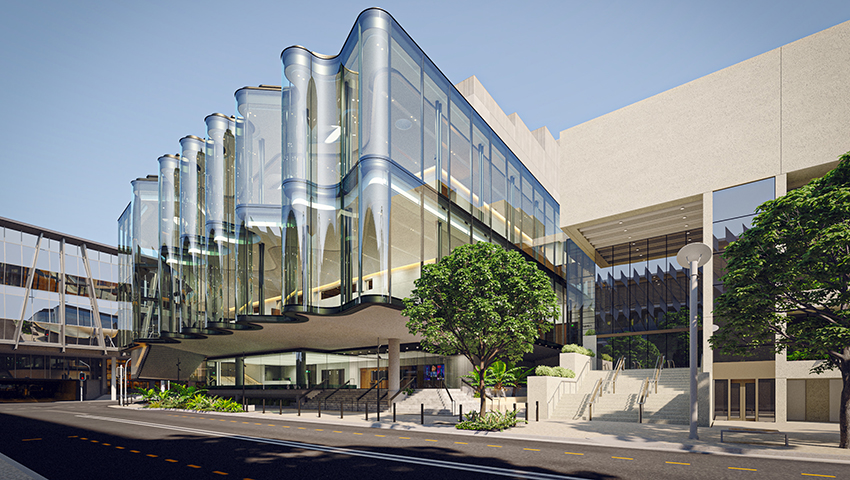
Artist's render of the new Glasshouse Theatre at QPAC, Brisbane. Image: Supplied.

When the new Glasshouse Theatre opens its doors at Queensland Performing Arts Centre in March, almost two years will have elapsed from its originally scheduled opening. The Covid pandemic and floods across Brisbane’s Southbank triggered substantial delays.

ArtsHub was recently given an advance tour of the new venue. The wait has been worthwhile, as the Glasshouse promises to enhance Brisbane’s performing arts scene and assist with positioning Queensland as an important cultural destination in the lead up to the 2032 Olympics.

The long journey to creating a new theatre

QPAC identified the need for a second major stage some 10 years ago, given that larger touring shows were over-subscribed in the Lyric Theatre. Consulting widely to determine interest and need, QPAC prepared a concept design in 2018, which was supported by the QLD Government (though some in the sector argued a smaller, 500-seat theatre was more urgently needed in Brisbane; others suggested a First Nations cultural centre should be prioritised instead of a new lyric theatre).

Read: New performance venues in Melbourne and Brisbane

An international architectural competition saw Brisbane-based Blight Rayner Architecture partnering with Norwegian-based Snøhetta, the architects responsible for the award-winning Norwegian National Opera and Ballet building in Oslo.

In 2025, after a 5000-person consultation, the title ‘Glasshouse’ was unanimously voted the favourite name for the new theatre. The Glasshouse Theatre adds a fifth venue to QPAC – joining the Lyric Theatre, Concert Hall, Playhouse and Cremorne Theatre – to make QPAC the largest performing arts centre in Australia under one roof.

Inside the Glasshouse Theatre

The new theatre is a handsome building featuring a high atrium that rises above a sweeping entrance staircase. Curved glass windows offer river and street views, with skylights adding a sense of light and space.

Rippled concrete wall panels sit alongside dark bronzed wall and bar surfaces, while much of the interior and the auditorium boasts wooden slats of Queensland grey ironbark. The colour palette is mostly cool and light, though the green and gold of Australia is proudly on display, with the welcoming foyers carpeted in gold patterned wool.

The deep green of the auditorium has matching, comfortable seating and a single balcony. It also features a fully automated orchestra pit with reflective and absorbent acoustic panels. The stage has a fully electric 100-line flying system, one of only a few in the country.

Considerable consultation with industry, audiences and the community has gone into creating the Glasshouse Theatre. Bill Jessop, in charge of QPAC’s Production Services, liaised with the architects, and together, the design team has created a practical, user-friendly venue, with meticulous attention to detail paid to issues from female toilet ratios to mobile device charging sockets.

The venue also celebrates Aboriginal and Torres Strait Islander arts and culture, with a number of sculptures and art pieces decorating its public spaces.

Streaming technology and flexible spaces

Rachel Healy. Photo: Supplied. Glasshouse theatre
Rachel Healy. Photo: Supplied.

Rachel Healy, Chief Executive of QPAC (and a former Co-Artistic Director of Adelaide Festival, among other career highlights), believes there is ‘a certain magic about the new theatre’, telling ArtsHub the Glasshouse sets a new standard for the overall audience experience for QPAC’s venues.

‘I do hope [its] quality of “specialness” will infuse all of our venues as our capital improvement plan pans out over the next few years,’ she says.

Healy is especially thrilled that the Glasshouse will be able to present a new level of performance experience using the latest technologies.

‘The inclusion of a digital recording studio to stream shows regionally, and in real time, will assist in reaching a wider audience across the state,’ she says. ‘It will also be crucial for our regional educational and schools’ programs that are being rolled out in the near future.’

Healy continues: ‘In addition to the auditorium, we will have two flexible performance spaces with retractable seating that can be used for rehearsals, studio performances, recitals and schools’ programs. These spaces can be collapsed into a single large space, the size of both the Glasshouse and Lyric stages, for rehearsals.

‘This makes it very desirable for touring companies. To have that as part of QPAC’s arsenal when pitching for national or international touring shows is a real bonus for QPAC.’

She cites the backstage central hub, with one dock through which all five theatres are serviced, as being crucial to managing the building. As part of the integration of the new theatre into the complex, a walkway links the Glasshouse and Playhouse.

Healy’s long-term artistic vision for the Glasshouse is not as a distinct stand-alone space: ‘While the Glasshouse was built initially to take the pressure off other venues, my vision is a whole-of-QPAC vision,’ she says.

‘QPAC has a distinct model in Australia in that only 14% of our income comes from government subsidy, so we need to have more commercial programming, which has usually been in the form of musicals.

‘At the same time, QPAC has a unique responsibility to optimise the range and diversity of performing arts for the community we serve. We can only do that if we have the venues and spaces to accommodate more works. The Glasshouse will help us to achieve that goal.’

The 2026 Glasshouse program

In programming her first Glasshouse season, Healy has strived for a mix of local, national and international elements. ‘We should not have to get on a plane to see the best in the world. We should be encouraged to bring the best in the world to come to us,’ she says.

Officially, the Glasshouse Theatre opens on 23 March with a production from Zurich of Verdi’s monumental requiem, Messa da Requiem.

‘I know this production well as it was the centrepiece of our 2023 Adelaide Festival … It combines a huge scale work of international standing with the best of our local companies working together in a symbiotic relationship,’ Healy says.

The Glasshouse season of Messa da Requiem will see Queensland Youth Orchestra’s Artistic Director Simon Hewett conduct the Queensland Symphony Orchestra alongside 90 choristers from the Brisbane Chorale and Canticum Chamber Choir, four operatic soloists, and choreographer Christian Spuck directing members of the Queensland Ballet.

It will be followed by The Last Ship, which Healy describes as, ‘a major international work offering the requisite sparkle to open a new theatre, and a once-in-a-generation event’.

Written and composed by international singer and artist Sting, who will also play the lead role in the production, The Last Ship is a new musical about the closure of a shipbuilding yard.

Brought up in North-East England in the shadow of the Wallsend shipyard, Sting describes this work as: ‘My tribute to the people and the place that shaped me.’ While Wallsend closed in 2006, there is a distinct resonance to Brisbane’s history, in that the Evans Deakin shipyards closed similarly in 1976.

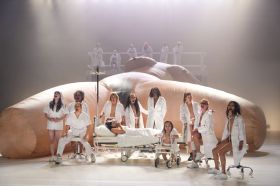
Nina Korbe during development of The Drover's Wife – The Opera for Glasshouse Theatre, Brisbane. Image: Supplied.
Nina Korbe during development of The Drover’s Wife – The Opera for Glasshouse Theatre, Brisbane. Image: Supplied.

The third major work opening at the Glasshouse this year is The Drover’s Wife – The Opera, a world premiere production produced by QPAC in association with Opera Australia and Oombarra Productions.

Read: The Drover’s Wife – The Opera to have 2026 world premiere at QPAC’s new Glasshouse Theatre

Based on the play, novel and film by Leah Purcell AM, The Drover’s Wife – The Opera has had a long gestation period. Purcell wrote the libretto with George Palmer AM, who is also the composer and director.

Performed live by the QSO and conducted by Tahu Matheson, it will star Queenslanders Nina Korbe as Molly (the titular drover’s wife, reimagined and given greater agency than the character in Henry Lawson’s original 1892 short story) and Marcus Corowa as Yadaka, an Aboriginal man evading colonial authorities who disrupts Molly’s hard-won sanctuary. The production will also feature six dancers from Bangarra Dance Theatre.

After its premiere season at the Glasshouse in May, The Drover’s Wife – The Opera will tour to both Sydney and Melbourne. ‘This work is a nod to our long-term commitment to Indigenous voices and to co-commissioning,’ Healy says. ‘It is of national significance that it will have a life beyond Brisbane.’

QPAC’s new Glasshouse Theatre opens on 23 March.

Discover more screen, games & arts news and reviews on ScreenHub and ArtsHub. Sign up for our free ArtsHub and ScreenHub newsletters.

Suzannah Conway is an experienced arts administrator, having been CEO of Opera Queensland, the Brisbane Riverfestival and the Centenary of Federation celebrations for Queensland. She is a freelance arts writer and has been writing reviews and articles for over 20 years, regularly reviewing classical music, opera and musical theatre in particular for The Australian and Limelight magazine as well as other journals. Most recently she was Arts Hub's Brisbane-based Arts Feature Writer.