Tapestry is enjoying a renewed moment in contemporary art. Once seen as a niche or decorative medium relegated to the margins of art history, its emphasis on collaboration, craftsmanship, materiality and slow craft feels increasingly relevant.
The timing of the Arthur Boyd: Tapestries exhibition at the National Gallery of Australia is therefore apt, revealing one of Australia’s most ambitious tapestry commissions and the extraordinary relationships that made it possible.
Arthur Boyd: Tapestries – quick links
Arthur Boyd: the genesis of a career-changing commission
‘This story has a long genesis,’ says Elspeth Pitt, co-curator of the exhibition. It began in 1965 when Melbourne gallerist Frank McDonald encouraged Boyd, then living in London, to visit fellow Australian artist John Olsen in Portugal, suggesting it would provide ‘a lovely break from the London winter’.
Olsen had begun working with the renowned tapestry workshop, Manufactura de Tapeçarias de Portalegre. The trip changed everything for Boyd.
PULL QUOTE: ‘Art is a journey to unknown destinations. The more you embrace the unknown, the richer the journey becomes.’ – Arthur Boyd
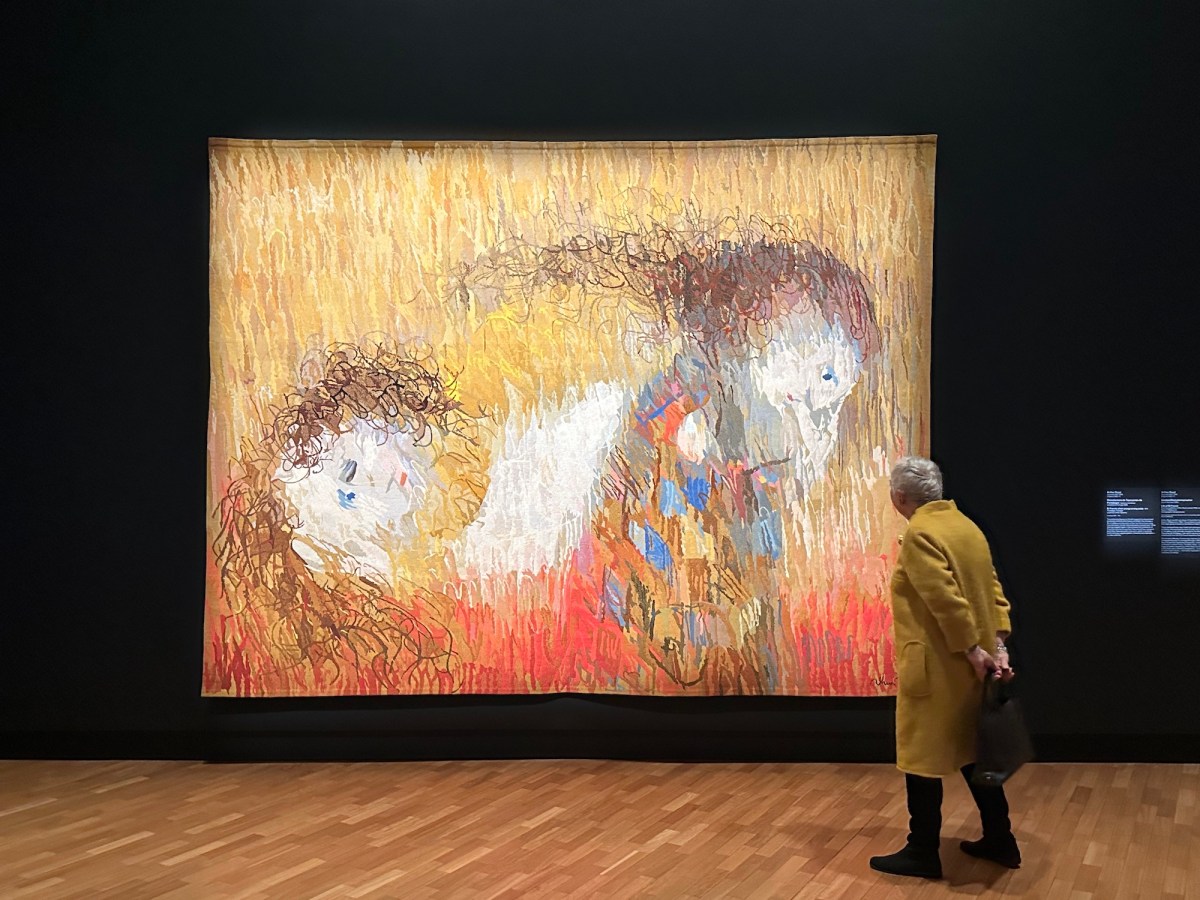
The exhibition at the National Gallery of Australia reveals not only Boyd’s tapestries but a remarkable story of trust, ambition and collaboration that transformed fragile pastel drawings into 20 woven masterpieces, each measuring 2.5 by 3.4 metres.
They remain among the most extraordinary tapestry commissions ever undertaken by an Australian artist.
Arthur Boyd: the role of trust in commissioning
Visitors face Boyd’s first woven work, Nebuchadnezzar’s Dream, on entering the exhibition. It has a different feel to the St. Francis tapestries, despite the ‘crossover’ between works that Pitt describes. She says that it is ‘indicative of his practice at large – that he wouldn’t ever generate a series in isolation’.
In a similar way, Boyd returned to a body of pastel drawings he had begun after travelling to Assisi in the early 1960s, as the foundation for the series named after the saint. St Francis had become a lifelong companion in Boyd’s imagination, occupying his practice between 1965 and 1975 through paintings, pastels, lithographs and eventually tapestry.
ArtsHub: Man on Fire review: Shaun Gladwell and Arthur Boyd in searing dialogue
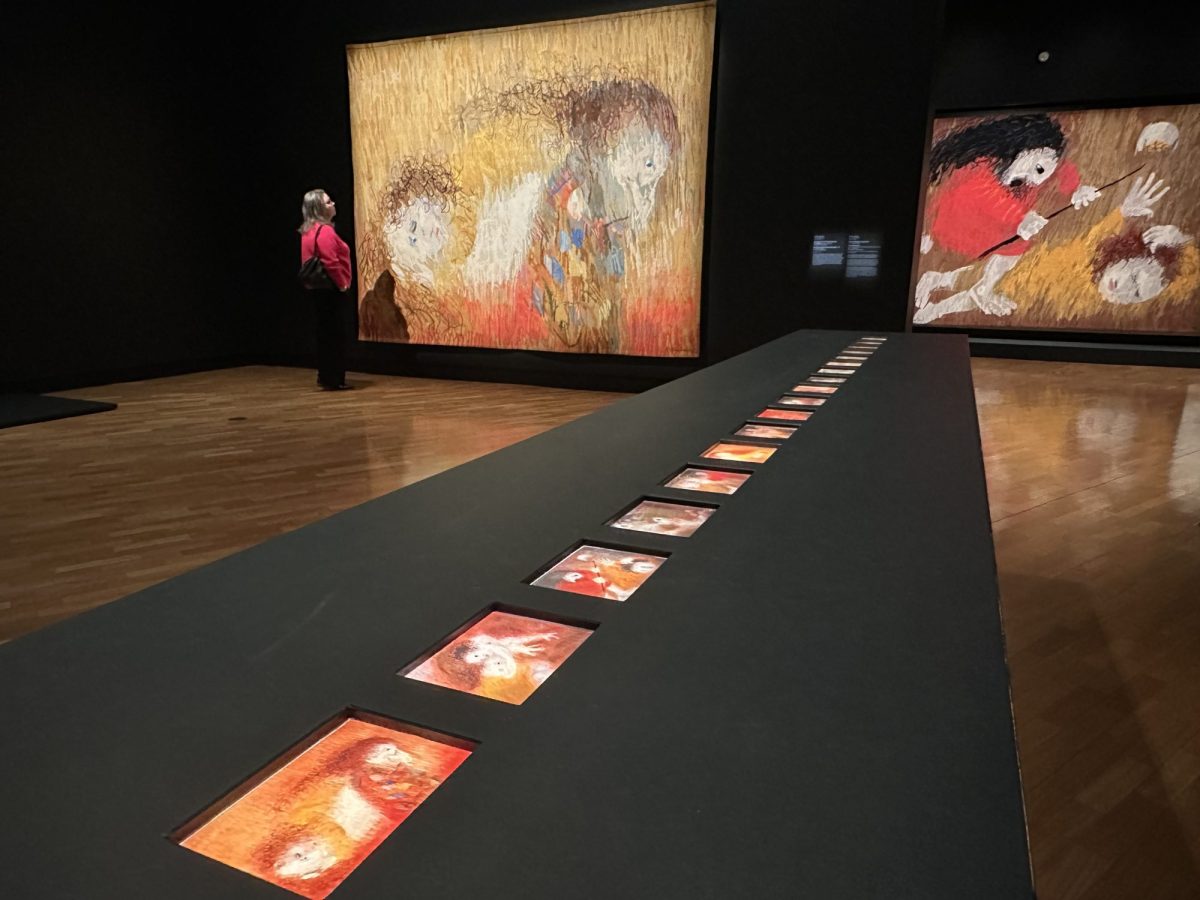
What makes the woven versions extraordinary is that the Portuguese weavers never saw the original artworks. ‘They were working from small photographic transparencies,’ explains Pitt. It was a near impossible task.
Australian Galleries had the foresight to photograph Boyd’s pastels in 1975 – the first exhibition they had documented. Those transparencies, now displayed in the exhibition alongside the tapestries, became the only visual reference for the weavers translate Boyd’s extraordinarily colours and gestures into wool.
Arthur Boyd: changing times
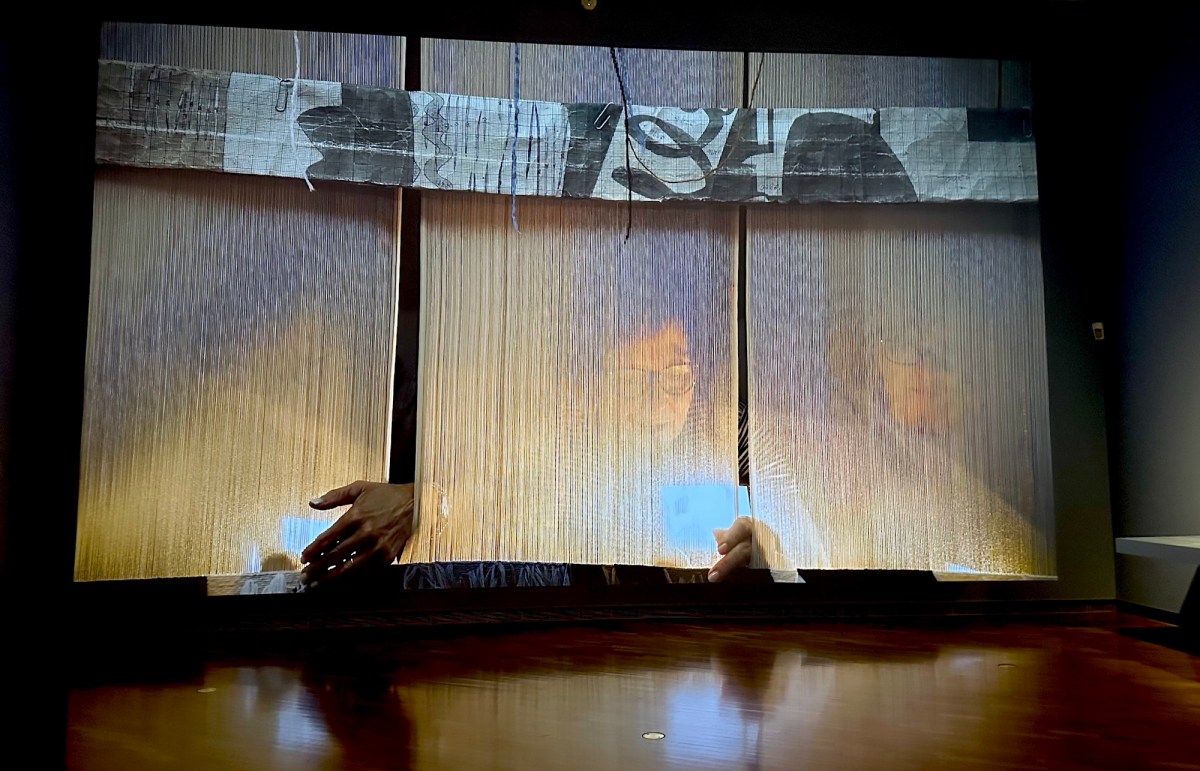
First step was creating enormous cartoons – or weaving drawings – of the pastels, at a scale more than 20 times larger than Boyd’s original source images. Every stitch was mapped: some 4.5 million handwoven stitches.
Teams of weavers worked around the clock to complete the commission over two years, sending it home over multiple shipments and amid political upheaval, production delays and Portugal’s Carnation Revolution. Yet what resonates most strongly today is not the logistics but the relationships.
‘When the Gallery acquired the tapestries in 1975, they were simply catalogued as works by Arthur Boyd,’ Pitt explains. ‘The weavers weren’t named.’ Research for the exhibition sought to change that.
While many of the women who worked on the tapestries remain unidentified, Pitt and her team traced lead weavers, cartoon makers and former production manager for Boyd’s tapestries, Fernanda Fortunato, now in her nineties, who vividly recalled the commission. ‘I can’t choose a favourite tapestry,’ she tells Pitt. ‘They’re like my children.’
Pitt recounts her words: ‘She said, “We had to become Arthur Boyd to understand the work”.’ Fortunato captures the intimacy of the collaboration. It is perhaps the most revealing sentence in understanding the exhibition.
Tapestry is never simply reproduction; every colour, texture and transition requires interpretation, and Boyd had to place enormous trust in craftspeople working thousands of kilometres away. The first gallery space presents a beautiful, almost veiled moving image of those worker’s today – a metaphor for that layered history of authorship.
Arthur Boyd: trust comes with tensions
The archive reveals that trust was not without anxiety.
Boyd paid for the commission himself — an investment worth around three-quarters of a million dollars in today’s terms — and production was repeatedly challenged by rising costs, political upheaval and delays during Portugal’s Carnation Revolution (1961–74).
At one point. a commission by Nolan even jumped ahead in the workshop’s queue. ‘There was definitely anxiety,’ Pitt says. ‘You can see it in the letters.’
ArtsHub: Craft is in crisis – but it seems only in Australia
There were technical mishaps too. Some transparencies were projected in reverse, requiring lengthy exchanges of letters to correct orientation. Visits can witness that in the cartoon and tapestry for St Francis when young turning aside (1972).
Boyd, however, only expressed dissatisfaction with one completed tapestry, St Francis turning Brother Masseo (1973), writing in a letter it had ‘no nuance, not fine enough, too crude, too coarse’. The comment reveals the sensitivity and detail he wished to achieve in the tapestries.
Looking closely, the tapestries seem almost painted rather than woven. That may be their greatest power.
Research uncovered evidence that Boyd had approached other tapestry makers, asking whether they could weave directly from photographic transparencies. Their answer was unequivocal: it was too complicated. Portalegre said yes. That confidence resulted in what remains the workshop’s most ambitious commission.
Arthur Boyd: tapestry is a living craft
What this exhibition does is demonstrate a public interest for tapestry, something Pitt sees reflected in audiences today. In partnership with the Australian Tapestry Workshop (ATW), the gallery has presented demonstrations, talks and sold-out workshops. Contemporary weaver Karen Black is also creating a new tapestry throughout the exhibition’s run.
It speaks to tapestry’s renewed cultural relevance, and contemporary audiences increasingly value for slow making, collective authorship and the visible labour behind artworks.
Arthur Boyd: Tapestries is showing at the National Gallery of Australia, Canberra, until 18 October 2026. Free entry. The exhibition was curated by Adam Lindsay, Former Deputy Director NGA, and Elspeth Pitt, Senior Curator, Australian Art.