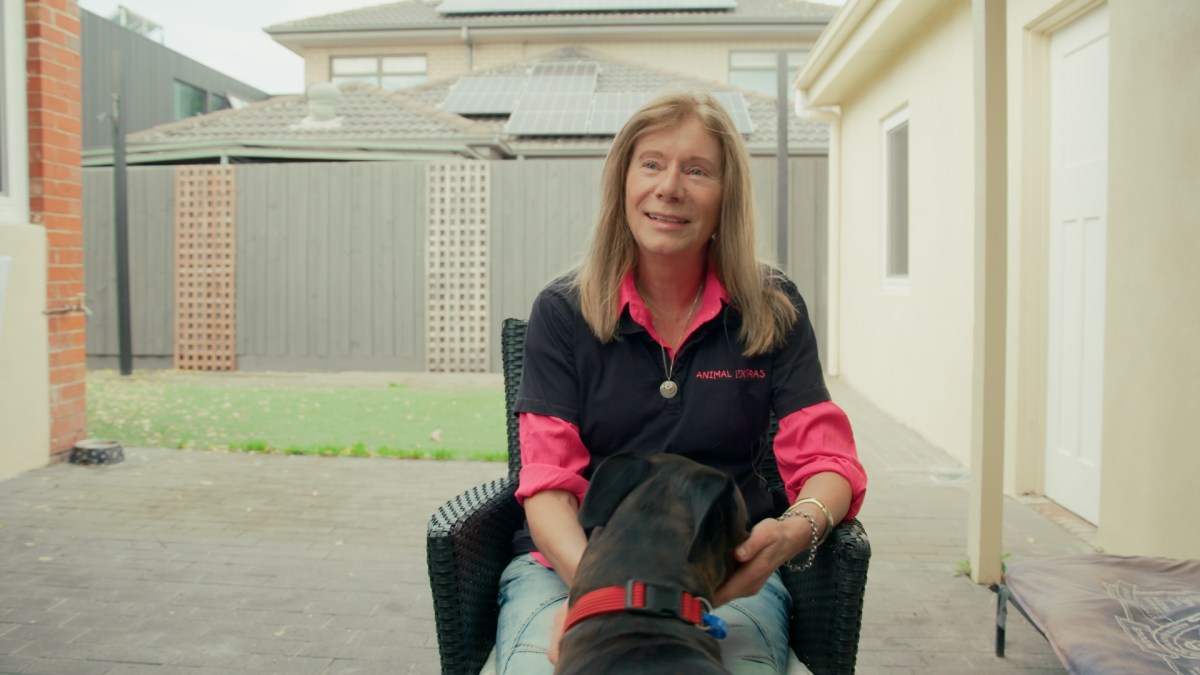
Merran Hamilton has more than 12 years’ experience working with animals in film and TV production. She explains what she does, and how she got started in this line of work, to ArtsHub.
Connect with Merran Hamilton on Facebook and Instagram.
Would you like to be profiled for ArtsHub‘s What I’ve Learned series? Email us with ‘What I’ve Learned’ in the subject line.
Merran Hamilton: video transcript
No touch, no speak, no look.
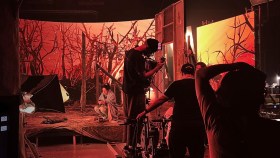
A set is a strange place for a dog to find itself, no matter what people say about calm temperaments. There’s lights, there’s lots of strange people moving around.
So most dogs have a little bit of a response to it. And it’s my responsibility to have them, when they’re called for their scene, to be as calm as possible.
What I’ve Learned: Anita Lester, courtroom artist
So if they’ve made a friend with someone that’s behind the cameras, and they think, ‘Ooh, I don’t want to hold this position – I’m going to speak to that person that’s just been friendly to me,’ I can’t have that.
I often get a reputation of being quite mean in a joking way. But at the end I just say, ‘Look, at the wrap, you can party’. And they do. That’s what happens.
What I’ve Learned: Amy Hume, voice & dialect coach
I’ve just got to make sure that everyone’s safe, the animal’s comfortable, the animal does what’s required. And when you put those three things together, it’s quite a big role. With my own dog, he was highly obedience trained. I didn’t have to work with him with treats – just a command or a hand signal.
And the hand signals are very worthwhile, particularly when you can’t speak to them, when there’s dialogue.

Merran Hamilton: other people’s dogs
With other people’s dogs, often I don’t meet them until the day of the shoot. I ring the owners prior to, and have a chat to them about what motivates their dog.
Look, honestly, basically it’s normally food. There’s very few dogs that don’t work for food. But some of it might be you showing them a toy. They’ve got to be well enough trained to know that, at the end of what they’re required to do, then they get the reward.
And you are working with an animal. Like, you set it up, and sometimes I’ve walked away with my fingers crossed thinking, ‘I hope this works’.
Merran Hamilton: getting started
The first thing you have to do, you have to be able to establish some sort of professional behaviour in that you’ve trained up an animal. You’ve got to be able to prove that.
And that can be a horse. That can be anything. And then after that, some scientific study or study in animal studies to add on to that – and then follow the road.
Just put yourself out there, even on Facebook, follow directors.
Put yourself out there on extras pages. I got a job for my black German Shepherd that I’ve got now when I saw a script for a horror film. And I just jumped in and said, ‘I’ve got a beautiful black pack of German Shepherds that I can get if you want to write them in’.
They wrote them in.
So it was thinking out of the box.
I was once a teacher – now I’m on a US movie set being shot in Melbourne.
It wasn’t something that I ever set out to do.
Just go with it.