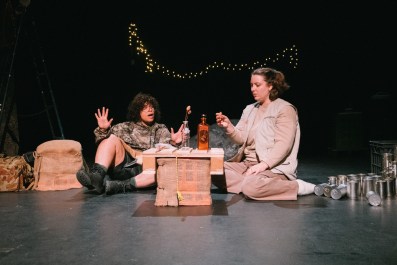



‘Lacrima’ means ‘tear’ or ‘teardrop’ in both Italian and Latin. The play of the same name straddles four languages: French, English, Tamil and langue des signes française (French sign language). It’s set in multiple places around the world: Paris, London, Normandy (Alençon, to be precise), Mumbai and Sydney.
Are you getting the idea? This is an expansive tale. It’s international in scope. It’s a theatrical event.
Written and directed by Caroline Guiela Nguyen and a centrepiece of this year’s Sydney Festival, Lacrima comes via the esteemed National Theatre of Strasbourg – France’s only designated national theatre outside Paris.
Lacrima review – quick links
A world story
So far, so impressive. But what it’s all about? Lacrima revolves around the nuptials of an English princess. Paris haute couture house Maison Beliana wins the bid to make the wedding outfit. It is to be made in three parts: the veil in Alençon, the dress itself in Paris and its train in Mumbai.
London is, of course, where the princess lives, while Sydney plays host to a small but compelling subplot.
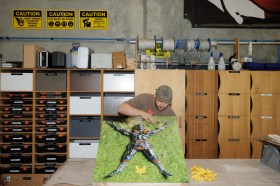
Despite the tale spanning multiple locations, it’s a tight, coherent story, rooted in the machinations of high fashion. From this base, Guiela Nguyen and 12 talented actors explore the costs of haute couture. Not just financial costs (although they’re steep, to be sure) but the personal toll on the workers.

While this aspect of the story revolves around the atelier’s workroom in Paris, overseen by costume professional Marion (Maud Le Grevellec), Lacrima also has much to say about fashion’s dependence on ‘Third World’ workers.
Not only does the play portray the exploitation of the workers in the Mumbai workroom, it highlights their talents – and the fact that without the expertise of professionals in the developing world, the whole edifice of European high fashion would collapse.
In this way, Lacrima gets above the usual ‘poor exploited brown people’ tropes. Characters such as masterful embroiderer Abdul (Charles Vinoth Irudhayaraj) are fully fleshed out as real people with real problems – and real talent. It’s clear they’re not just being used because they’re ‘cheap labour’ but because fashion houses need their skills.
Clever staging makes the most of screens
The scope of the play, the various settings and multiple languages could make for an unwieldy story that’s hard to follow. But, like embroidery on an elaborate dress, the narrative is expertly stitched, bringing the disparate elements together.
The staging also helps enormously. Various scenes are fashioned as Zoom calls and the use of onstage webcams and screens works brilliantly. The video design by Jérémie Scheidler means we can jump between scenes and locations with ease.
The close-ups on the screens also brings the audience closer to the action. Despite the size of Sydney’s Roslyn Packer Theatre, we can see the actors’ faces in a way that’s usually only possible in small, intimate settings.
The screens also surmount the language barriers, with translations projected onto them clearly visible at all times.
Read: WAKE review: queer cabaret from the Emerald Isle
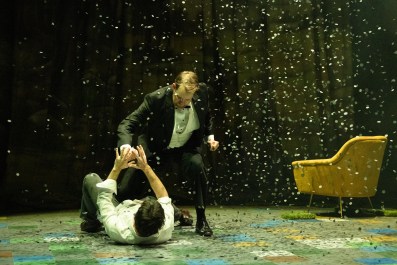
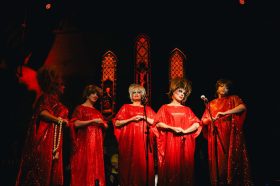
The excellence in staging extended to the costumes and physical sets, with the story giving ample opportunity for impressive high-fashion pieces (Benjamin Moreau). The opportunity was certainly taken, leaving one pining for more productions with healthy budgets, from countries that fund their arts sectors more generously than we do.
The interval that wasn’t
If there’s somewhere Lacrima misfired it was in eschewing the traditional interval one expects in a play of this length. This is a three-hour play. It is simply not practical to run this long with no interval – the lack of which led to inevitable disruptions when patrons left their seats for toilet breaks.
Mystifyingly, there was actually a three-minute break about halfway through the play – accompanied by strict instructions not to leave the room. This point would be the perfect place to insert a traditional interval. Why one wasn’t factored in is mystifying. Ideally, this issue will be addressed before Lacrima continues in Perth next month.
This one complaint aside, Lacrima deserved to be seen as a glittering jewel among the rich cultural offerings of the 2026 Sydney Festival. West coast theatre lovers are advised to get tickets while they still can.