Aboriginal and Torres Strait Islander readers are advised that this article contains the names and images of, and references to, deceased persons.
Tarnanthi (pronounced TAR-nan-dee) is a Kaurna word meaning ‘to spring forth or appear’. Over the past 10 years, the Art Gallery of South Australia’s festival of contemporary Aboriginal and Torres Strait Islander art has certainly done that. More than 2.2 million people have engaged with Tarnanthi exhibitions and events since its first edition in 2015, shifting perceptions of Aboriginal art and ushering in a next generation of innovation and expansive practice.
Too Deadly review – quick links
Tarnanthi’s Artistic Director, the Barkandji woman Nici Cumpston OAM, uses this anniversary moment to reflect on what’s changed and highlight the collection of over 200 artworks accrued over that time. Whether seeing these pieces for a first or revisiting as familiar favourites, the collection is staggeringly good and continues to have a visceral impact on audiences.
Simply, this exhibition is jaw-droppingly beautiful, but Too Deadly does feel like it stands at a pivotal juncture. Cumpston has left to take up a new role at the Kluge-Ruhe Aboriginal Art Collection in the United States, future sponsorship is still being negotiated, and many of the artists from those first formative editions of Tarnanthi are no longer with us.
A decade of innovation and legacy
Too Deadly is both survey and story – an exhibition that demonstrates how sustained support can lead to profound creative outcomes. From bold early commissions to intimate moments of cultural maintenance, the exhibition reveals what can be achieved through long-term relationships between artists, communities and institutions.
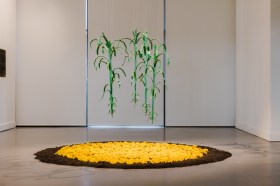
A breathtaking entry point is Yhonnie Scarce’s monumental installation Thunder Raining Poison (2015), a cloud of hand-blown glass yams suspended in space, and a haunting reflection on the atomic testing at Maralinga. Nearby, Teho Ropeyarn’s Ayarra (Rainy Season) (2021), with its delicate vinyl-cut strokes, quietly mirrors Scarce’s falling forms. Together, they embody the festival’s ability to create poetic dialogues across mediums and generations.
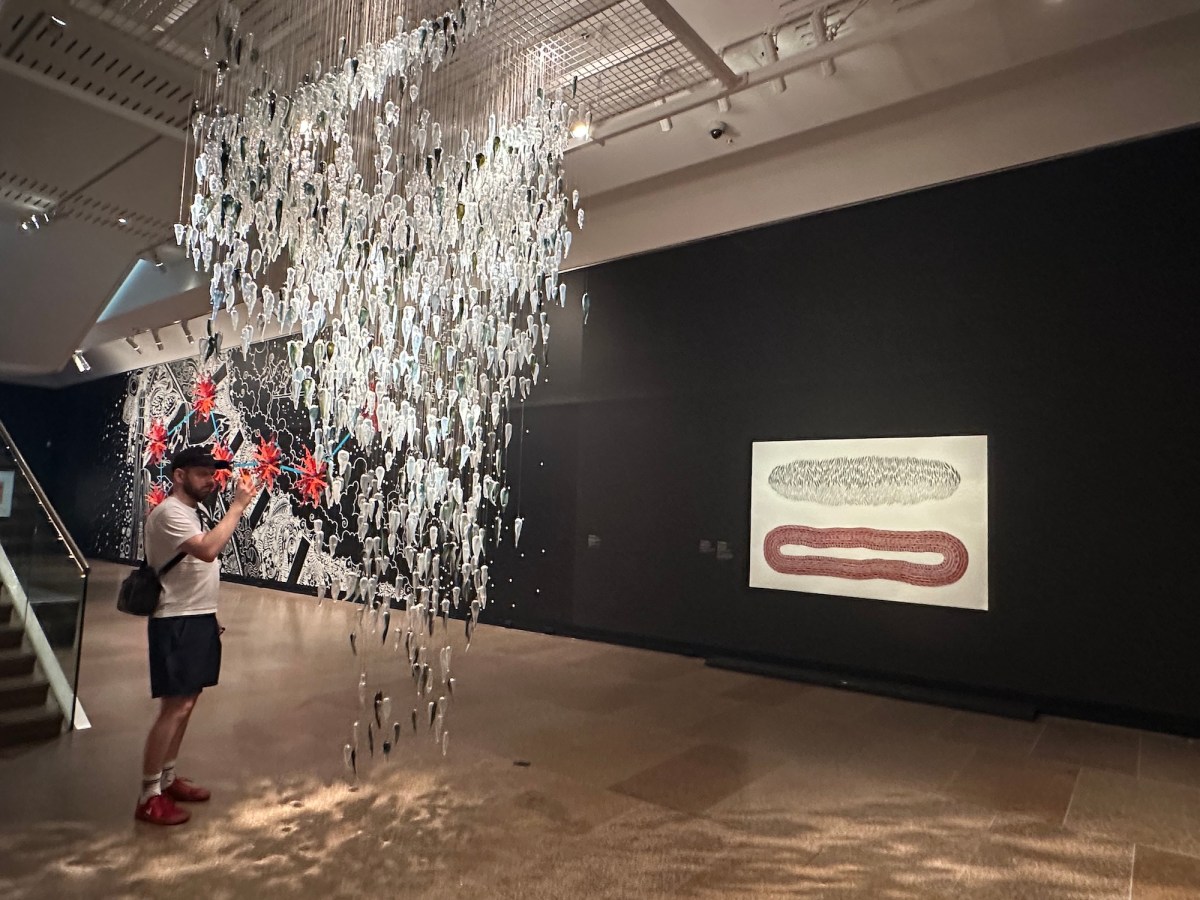
While the exhibition has its dramatic moments, it is also subtle in the stories it tells. Entering the lower galleries, Maree Clarke’s necklace (2019) is a large-scale version of a traditional river reed necklace once given to visitors as a sign of friendship and safe passage. Here, it is positioned so that visitors flow around it, poetically capturing the ethos of Tarnanthi.
Nearby hang works on paper by Tjilpi Kunmanara Kankapankatja, completed shortly before his passing in 2012 and presented in Tarnanthi’s inaugural edition. They anchor the show and give it a sense of continuity. Artists who were there at the beginning now have an enduring presence through their art.
Tarnanthi returns agency and shapes careers
A hallmark of Tarnanthi has always been its commitment to artist agency. While AGSA supports the development of new work, artists are never obligated to sell their creations to the gallery. Cumpston notes that this independence has been crucial to the festival’s integrity and impact.
Scarce’s Thunder Raining Poison is a prime example. Though supported by AGSA for the first edition, it entered the collection of the National Gallery of Australia. Its return to Adelaide for Too Deadly feels deeply symbolic – a homecoming for a work that embodies Tarnanthi’s ambition and reach.
Other pairings tell similar stories. Iluwanti Ken and Betty Muffler’s powerful drawings from 2020 were made before they began painting on canvas, and show how the festival has captured key turning points in artists’ practices.
Across the room, Mavis Ngallametta’s vast The Mouth of Kendall River (2015), painted for the first edition, sits alongside Bugai Whyoulter’s luminous Wantili (Warntili, Canning Stock Route Well 25) (2023), which was presented in the last edition. The two works form bookends across the festival’s history. Time is both circular and endless.
A catalyst for innovation
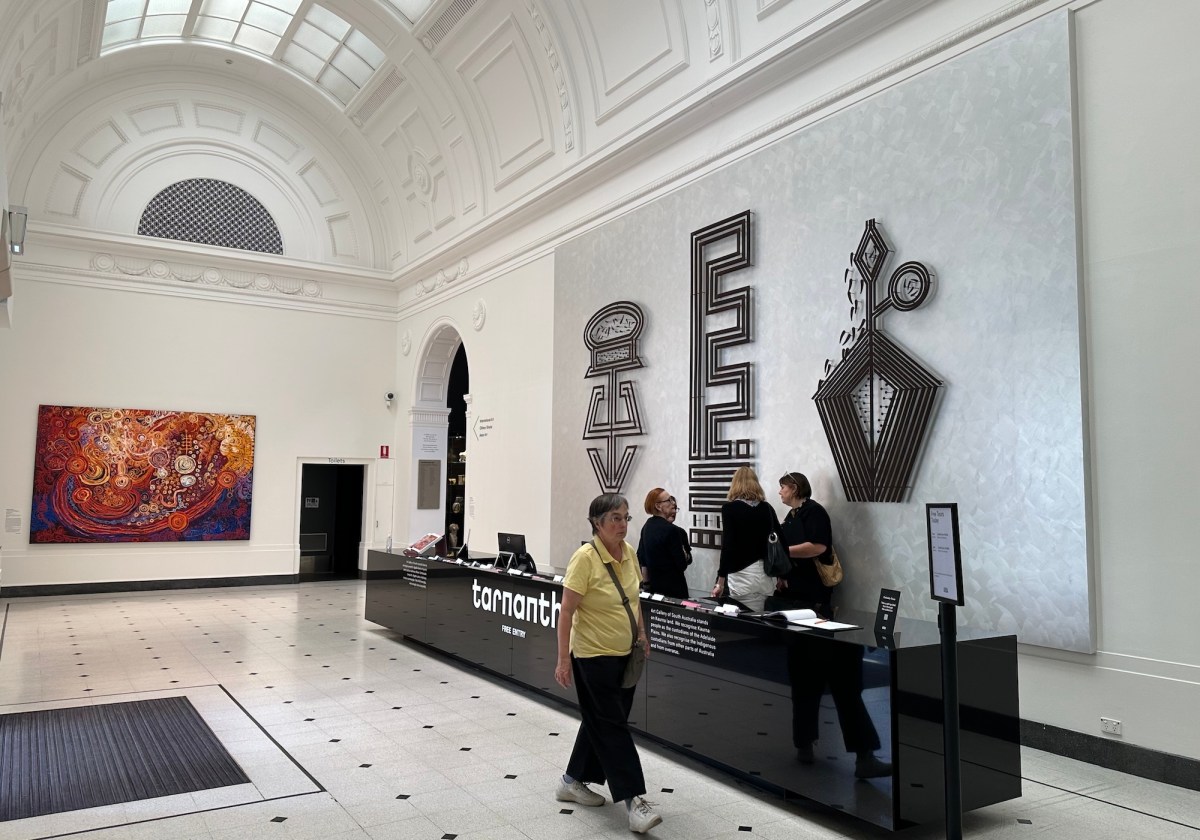
The exhibition’s strength lies in its balance between reverence for tradition and encouragement of experimentation. This is so eloquently captured at the entrance to the older wing of the gallery, where visitors are greeted by Darrell Sibosado’s work Aalingoon (Rainbow Serpent) (2019), with its carved shell designs recreated in metal.
Deeper into the Elder Wing, Garry Sibosado’s carved pearl shells demonstrate how Tarnanthi has emboldened artists to push their practice, to innovate and dream big.
Equally compelling is the collective work Kuḻaṯa Tjuṯa (Many Spears), a striking installation of 551 hand-carved spears suspended in a dramatically lit, darkened space so that their shadows form an ominous, beautiful constellation. Completing the installation are hand-carved piti (wooden bowls) made by Aṉangu women.
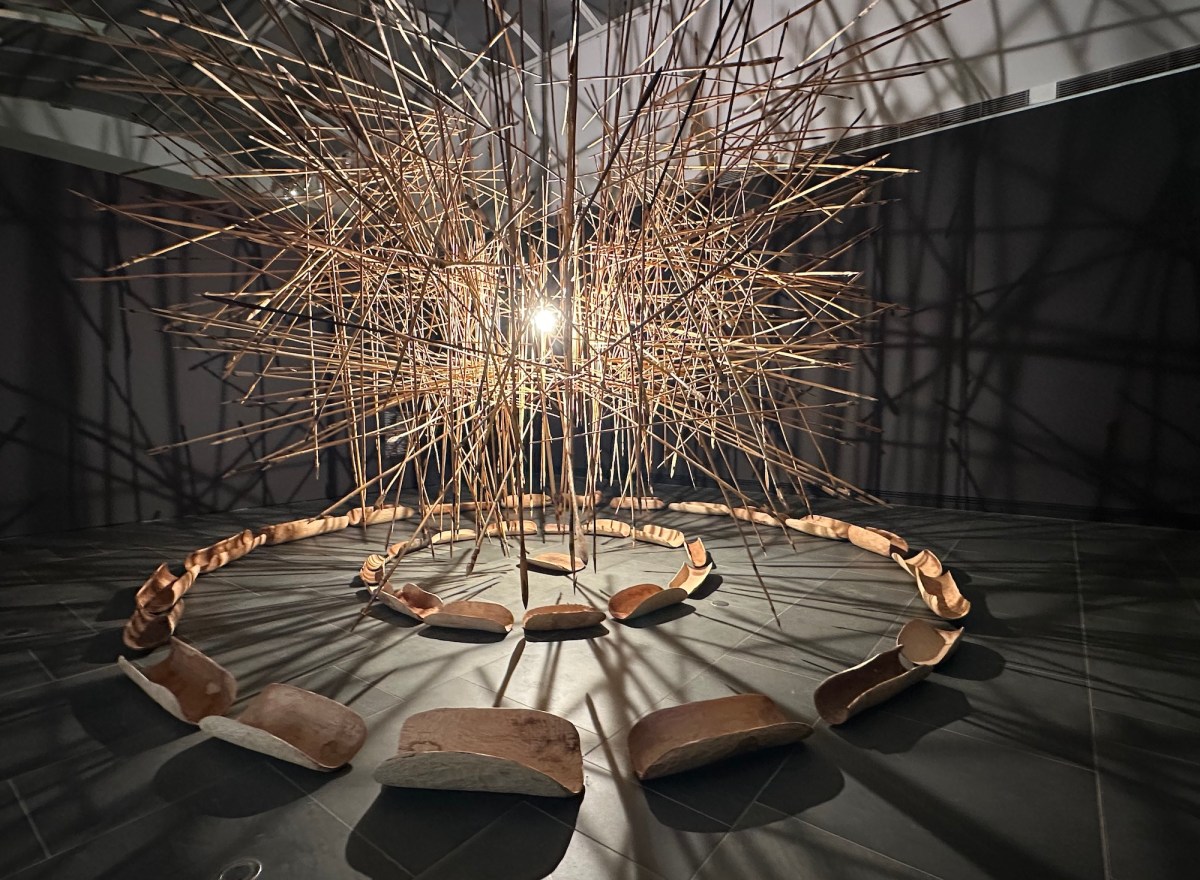
First shown in 2017, it has become a bit of a signature work for the festival. The project was both an act of cultural revival and a response to the atomic bomb tests on Pitjantjatjara and Yankunytjatjara Country between 1953 and 1963. Its international acclaim, including touring the US and upcoming reworking for the 25th Biennale of Sydney, underscores Tarnanthi’s global resonance.
That continuum is demonstrated in the next gallery, where a six-channel video cuts together deeply personal interviews with footage of Aṉangu lands impacted by nuclear testing, pulling that lived knowledge into our time.
Alongside it hangs Australian Post mail bags painted by Mumu Mike Williams and Sammy Dodd, stamped with the government warning ‘Theft or misuse of this bag is a criminal offence’ – except the artists have replaced ‘bag’ with manta (land) in a quirky potent statement on land rights.
Deeper into the exhibition, and a generation later, Marri Ngarr artist Ryan Presley’s Blood Money (2019, reworks Australia’s currency by replacing colonial portraits with Indigenous leaders, giving visibility to Aboriginal achievements. It’s another act of reclamation, equally elegant and political.
There is just so much history on these walls and yet it does not feel heavy or ostracizing. Rather, Too Deadly offers a moment to revisit and recontextualise these works today, especially after the Voice Referendum (the last festival was delivered just days after the outcome). This edition is almost like an effort to take stock, and an affirmation to still find strength in Aboriginal voices.
Clusters and collaborations deepen the story
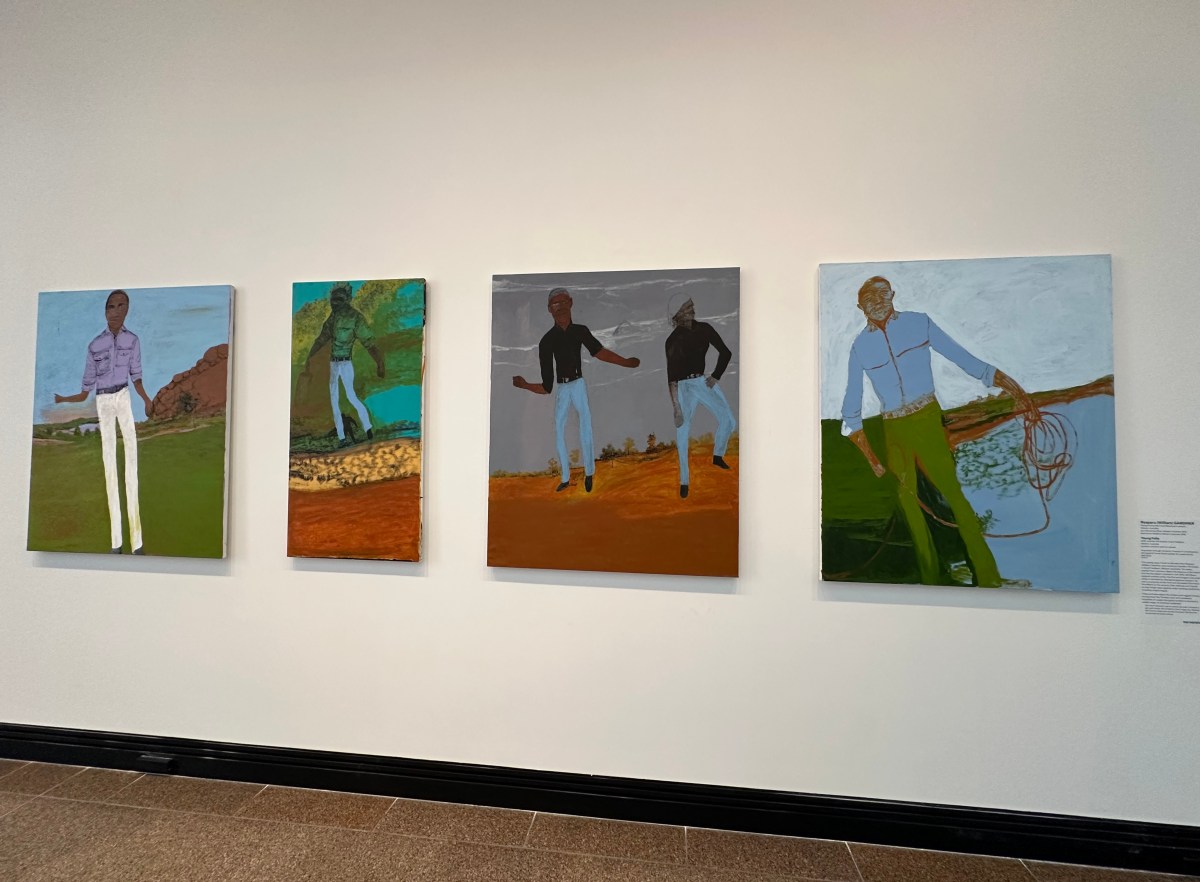
Too Deadly also captures the festival’s geographical and generational scope, through the clustering of artists and collectives. A pocket exhibition, Psychedelic Pastoral, in the main stair vestibule brings together the works of artist John Prince Siddon and Nyaparu (William) Gardiner, Wendy Hubert and Motobike Paddy Ngal – stockmen who worked across Western Australia and Northern Territory homelands from the 1940s onwards. Gardiner’s ghostly portraits reference the historic 1946 Pilbara strike. It is a fabulous grouping and although quite disparate in style, it works so well.
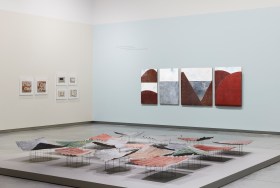
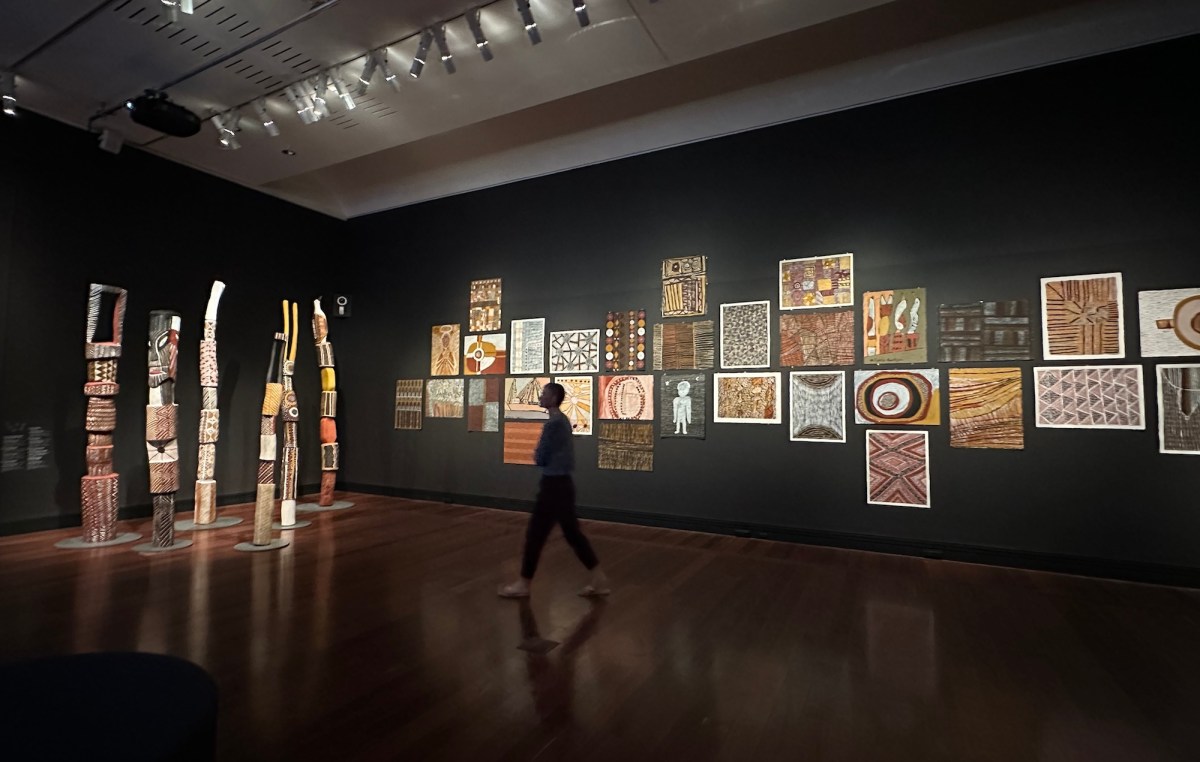
Nearby, Karen Mills’s abstract paintings are drawn into a conversation with barks and larrakitj by four incredible Yolŋu women, Dhambit Munuŋgurr, Mrs N Marawili and Marrnyula Munuŋgurr and Djakaŋu Yunupiŋu, as well as larrakitj by Ms (Mulkuṉ) Wirrpanda, some of the last painted before her passing in 2021. These works feel like quiet revolutions – materially experimental yet grounded in cultural continuity.
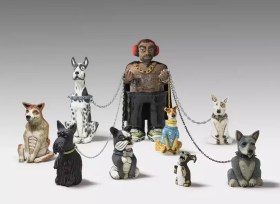
Downstairs, another highlight is a set of 33 works on heavy paper referencing ceremonial body designs, made by Tiwi artists across three art centres. They share the space with a group of cheeky Mokuy spirits by Nawarapu Wunuŋmurra, along with his important breakthrough work, Waŋupini larrakitj (2017), a video developed with the Mulka project to animate an anthropological archive.
Tarnanthi: a festival at a crossroads
The unspoken tension beneath this celebratory show is the question of funding. Tarnanthi has thrived thanks to major sponsorship from mining giant BHP, whose initial five year commitment with $17.54 million was renewed in 2021 for another three years. With that agreement now concluded, discussions continue about the festival’s next phase.
Both Cumpston and AGSA Director Jason Smith assure ArtsHub that the festival will continue, and that positive conversations with BHP are currently underway to ascertain the level of their future support.
That said, rather than commissioning new large-scale works, this edition wisely takes the form of a survey – a moment of reflection and recalibration. Investment in Too Deadly was diverted into a major publication and the commissioning of authors, ensuring that Tarnanthi’s legacy is both recorded and re-examined.
Read: How a festival’s legacy shifts perception
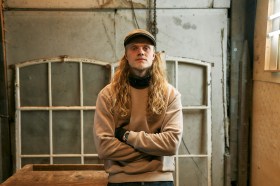
Cumpston’s departure also signals a generational shift. Working alongside her on this edition was Carly Tarkari Dodd, a Kaurna, Narungga and Ngarrindjeri artist who first attended Tarnanthi as a teenager in 2017 and later exhibited in 2019. Her involvement points to the festival’s enduring power to nurture emerging voices – not just artists, but also future curators and leaders.
Tarnanthi is more than an exhibition
The tenth anniversary celebrations extended beyond AGSA’s walls. In the gallery courtyard, The Blak Laundry – a project by Ngugi Quandamooka artist Libby Harward and Gamilaroi artist Dominique Chen – offered a witty, interactive space where visitors could put complex topics ‘through the wash’. With working washing machines and playful dialogue, it captured Tarnanthi’s ability to hold both humour and gravity at once.
The Tarnanthi Art Fair also returned, this year at Adelaide University’s Union House. Involving more than 30 art centres, the new venue’s proximity to AGSA worked, but it also split and divided the fair across two floors, and the low-ceilinged rooms were not ideal either, diluting the energy of previous editions.
Overall, Tarnanthi continues to be the defining platform for contemporary First Nations art and ideas in our times. Its growth beyond the city to now tour nationally, with curated elements also touring internationally, is testament to its success.
Too Deadly is not just a look back – it’s a testament to how art can build legacies, bridge generations and shape the cultural consciousness of a nation.
Too Deadly: Ten Years of Tarnanthi runs to 18 January 2026 at the Art Gallery of South Australia in Adelaide, and across two dozen partner venues statewide. A selection of works will travel to six regional venues from 2026 to 2028.
The writer travelled to Adelaide as a guest of the Art Gallery of South Australia.
Discover more screen, games & arts news and reviews on ScreenHub and ArtsHub. Sign up for our free ArtsHub and ScreenHub newsletters.