
It was written more than four centuries ago but there’s something very familiar about Shakespeare’s King Lear. The tale revolves around a narcissistic king, his power untethered to wisdom. The world has witnessed such rulers incessantly across the centuries; many would say a certain orange-hued politician in the United States fits the mould.
In The True History of the Life and Death of King Lear and his Three Daughters at Sydney’s Belvoir St Theatre, the eponymous King Lear (Colin Friels) plans to finally step down – but not before dividing his kingdom between his three daughters. Lear wants to divide his power in proportion to their love for him, thereby setting up a kingdom after his own fashion.
Of course, it all goes awry. Lear ends up rewarding his deceitful daughters Goneril (Charlotte Friels) and Regan (Jana Zvedeniuk). He learns too late that his daughter Cordelia (Ahunim Abebe) is the honourable, loving one.
The play’s resonance in 2025 is beyond doubt. Power sans wisdom is evident everywhere. But has Belvoir has done it justice? Certainly, the actors have.
The Life and Death of King Lear review – quick links
King Lear draws out powerful performances
Friels is a leviathan as the complicated, deeply flawed Lear. Only thespians at the top of their profession can hope to master a character so nuanced and so large – as Friels does here.
Supporting the adage ‘the apple doesn’t fall far from the tree,’ his daughter Charlotte (with fellow acting royalty Judy Davis) puts in a riveting performance as Goneril.
Ahunim Abebe is excellent; her role as Cordelia a stunning follow-up to her recent triumph in the Sydney Theatre Company’s Circle Mirror Transformation.
Peter Carroll as the Fool is another standout, although some will find director Eamon Flack’s vision for the character quixotic.
Stark minimalism and missed opportunities
But there are issues with this production. There is minimalism and then there’s… this.
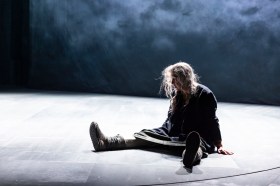
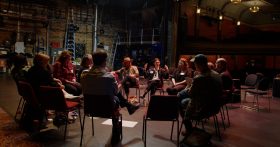
There is literally no set to speak of. The ‘set’ is simply a plywood floor, while 11 simple black chairs – of the type you might find at Bunnings – are lined up against a wall.
The main visual concession to theatricality is Friels drawing a circle in chalk on the floor at the play’s outset. Many of the show’s key moments take place within this circle.
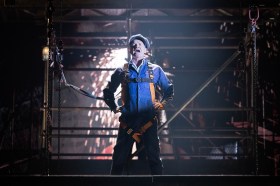
The set designer here is Bob Cousins but it’s difficult to ascertain much in the way of design. It’s a similar story with costumes. The actors don generic street clothes. It’s as though costume designer James Stibilj was tasked with going to Myer to source the outfits.
Justifications for such minimalism in the theatre usually run to ‘letting the words take centre stage’ or ‘allowing the story to shine’. Budgetary constraints can also be the unspoken elephant in the room. But a dearth of creativity or even sheer laziness might also be ascribed.
Whatever the reason for these creative choices, they rob the production of theatricality and effect.
Read: 2026 season announcements: our rolling guide to the performing arts
Better creative choices are evident in the work of fight director Nigel Poulson. (He was also fight director on Bell Shakespeare’s King Lear last year.) The fight scenes are realistic and exciting.
The smatterings of live incidental music to punctuate the performances (courtesy of Hilary Geddes, Jess Green and Arjunan Puveendran) are also welcome, providing some relief from the production’s starkness.
Long name, long play
Flack’s title for this play is instructive. It was originally written by Shakespeare as The Tragedy of King Lear and is usually presented simply as King Lear. The longwinded moniker used here – The True History of the Life and Death of King Lear and his Three Daughters – supposedly emphasises the play’s broader scope beyond the king’s story.
But the longer name feels like a bit of a slog, arguably mirroring the audience experience in this three-hour, fifteen-minute production with two intervals.
It’s hard to escape the conclusion that this show is very much for hardcore fans of the Bard only.