
We’re told it early, often, and with increasing urgency. Be happy. Choose joy. Optimise your mindset. If you’re sad, frustrated or even bored, something has gone wrong and needs to be fixed.
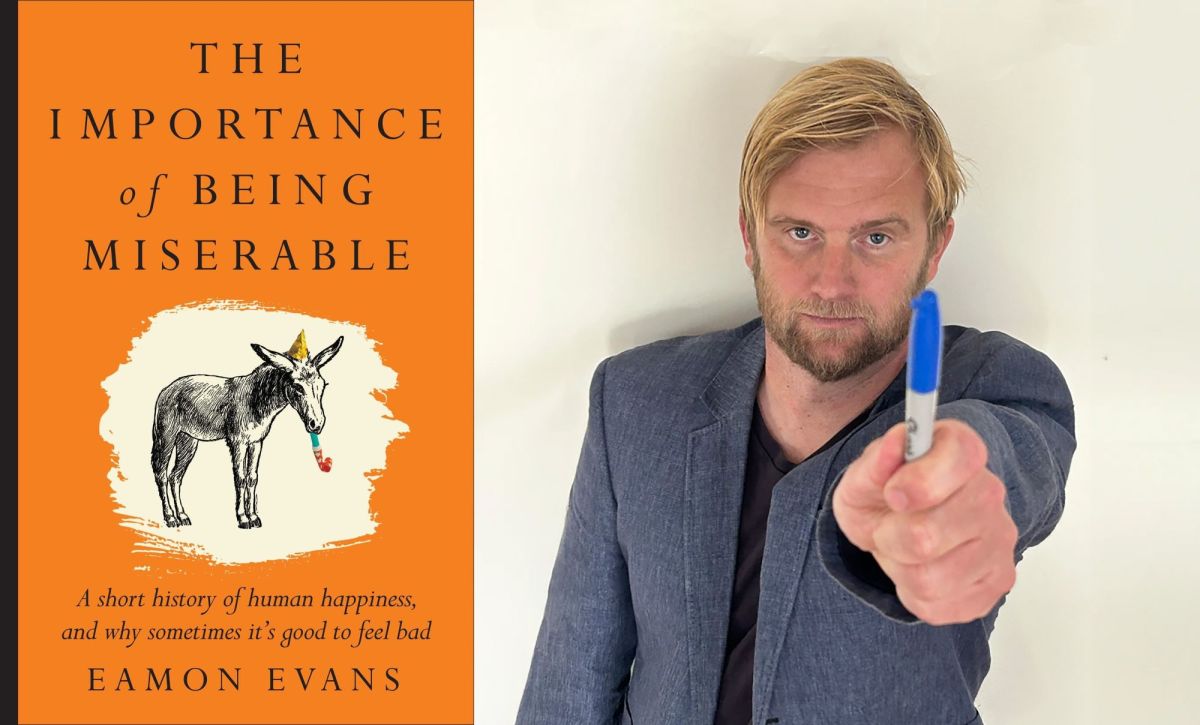
But in The Importance of Being Miserable, author, philosophy graduate and former ScreenHub contributor Eamon Evans makes an unexpectedly uplifting case that sadness is not a glitch, but an essential part of life.
He blends pop philosophy, history and sharp-edged humour to challenge the idea that happiness should be a constant emotional state. Organised as a chronological journey – from ancient civilisations through to the wellness industry and late stage capitalism – his book argues that the pursuit of permanent happiness is about as productive as, in Evans’ words, ‘nailing jelly to a wall’.
What makes his approach effective is Evans’ personal voice. By leading hard into satire and embracing a conversational tone, he invites readers into his wry, clear-eyed world where philosophers, ancient myths and modern wellness culture all get skewered with the same lightly irreverent touch.
The origin of happiness
To make his case, Evans begins with language and the origins of the word ‘happiness’. As he tells ArtsHub: ‘Happiness derives from the Old Norse root hap, or the word happenstance. It means luck. It’s a mishap, something that happens to you. It’s not something that you make happen.’
He adds, ‘and in German the word for happiness is glück which is also a word for luck. In all the Latin languages – Italian, French, Portuguese, Romanian – it basically means you are blessed … Happiness was not seen as a sort of a self-help project, something that was within your control. Happiness was seen as luck or a cosmic accident.’
Changing cultural attitudes
In The Importance of Being Miserable, Evans argues the problem isn’t that we want to be happy, it’s that modern culture has turned happiness into a default setting, then quietly blamed us when we fail to maintain it.
One of the book’s most effective metaphors reframes misery in everyday terms. Instead of treating sadness as a personal failure, Evans suggests treating it the way we treat rain. We don’t ‘blame ourselves’, as he says, if rain comes, but rather we grab an umbrella, wait it out, and watch what grows from it.
Where the book really distinguishes itself is in how convincingly it situates this argument within history. Evans doesn’t claim certainty about how prehistoric humans felt; instead, he uses vivid comparisons – describing early life as something closer to ‘an episode of Alone, only with fewer snacks and no chance of a Netflix deal’ – to emphasise how foreign the idea of emotional fulfilment would have been in a world organised around survival.
He then sketches a broad shift from eras where suffering was treated as fate or even virtue, particularly in medieval Europe, where greed and pride were sins and meekness was praised.
But the decisive rupture comes much later. Evans argues that modern happiness culture was ‘supercharged’ in the early 20th century, when capitalism shifted from meeting needs to manufacturing desire. By the 1920s, he says, many basic demands had been met, at least in the Western world, and economic growth began to depend on creating new wants. Happiness then became inseparable from consumption, promised as something to chase, buy and sustain.
By the time Evans arrives at the 20th and 21st centuries, the groundwork has been thoroughly laid. Advertising, wellness culture and social media inherit this long history, making happiness inseparable from consumption. What emerges across the book is a clear throughline: the more happiness becomes something we are expected to engineer, the more emotionally precarious it becomes.
Read: The Endless Sky review: Di Morrissey delivers an endearing outback saga
Just as important as the argument is how Evans delivers it. The book’s style is sharp, comical and occasionally chaotic – a tonal choice that proves crucial to its success.
Drawing loosely on the ancient Greek concept of tragic comedy, Evans welcomes the idea that misery, when examined closely enough, becomes funny – not because it’s trivial, but because it’s universally human. Self help gurus are ‘motivational cheeseballs’, wellness consumers are chasing transcendence through ‘$200 yoga mats’ and ‘vegan bath bombs’, and the very definition of happiness stretches from ‘fine dining’ and ‘reading’ to ‘invading Ukraine’.
These jokes don’t dilute the argument; they expose how easily the pursuit of happiness slips into farce. Beneath the humour, though, sits a quietly hopeful proposition. As Evans tells us: ‘There is genuine value in all of our bad experiences because the lower your lows, the higher your highs can be’. Misery, after all, is heavy territory. Without humour, it would be unbearable.
The Importance of Being Miserable by Eamon Evans is published by Simon & Schuster.

This article is published as part of ArtsHub’s Creative Journalism Fellowship, an initiative supported by the NSW Government through Create NSW.