
After having some misgivings about the use of alternative (and some cases traditional) spaces by other productions at Perth Festival, I had a happy experience with WA Youth Theatre Company’s Scenes from the Climate Era, which was in many respects the best use of space as well as the most well-rounded and well-realised festival show I’ve seen so far.
Scenes from the Climate Era review – quick links
Reworking Victoria Hall
To be sure, Victoria Hall in Fremantle has been used for theatre and live performance before, not least as the home venue for Deckchair Theatre (which was defunded and ceased to exist in 2012) and subsequently Fremantle Theatre Company (which likewise wound up in 2025). However, it’s always been a problematic venue, with its cavernous acoustics, towering ceiling and tiny proscenium stage.
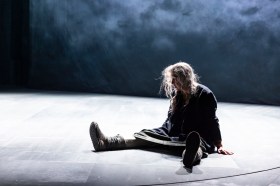
To solve this problem, director Amelia Burke and designer Charlotte Meagher wisely decided to stage the work in traverse on a raised catwalk with tiered seating for the audience on either side, running across the building rather than down its length.
Meagher’s design for Scenes from the Climate Era also involved an inverted forest of translucent seaweed-like streamers hanging from the ceiling above the stage, which further compressed the visual field as well as enabled some simple but telling lighting effects by Matt Erren. Otherwise the set simply involved a table and a collection of chairs, which could be easily removed or reconfigured by the ensemble cast of eight, all wearing street clothes and aged between 12 and 24.
Choose-your-own future
Scenes from the Climate Era consists of 66 short scenes that can be selected in any combination and presented in any order, and deals with the seachange in understanding and expectations about climate change since the early 2020s.
Globally speaking, and for young people in particular, it feels as if we’ve entered an era of existential questions about hope, meaning, purpose and agency with no apparent solution or end in sight.
Finnegan’s play risks being caught up in a certain humanism, even narcissism, where questions about ‘feelings’ supersede questions about deeper structural issues, seeking liberation without necessarily telling us what is to be done. In terms of form and content, Scenes from the Climate Era is also hardly radical; none of the scenes chosen involved audience participation or even direct address, and the characters mostly appeared to be solidly middle-class.
ArtsHub: POV review – live cinema refracts real life at Perth Festival
That said, the community hall venue and traverse staging implicitly opened things out to include the audience, and the youthful cast gave things a sense of urgency and diversity, at least in terms of their age.
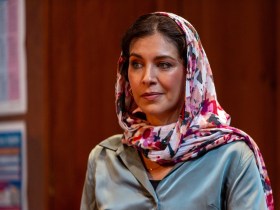
More importantly, there was a sense of what might be called practical (as opposed to sentimental) hopefulness that was implicit in the casting, and a vital sense of agency was conveyed by the performers, as they chose the scenes they wanted to perform.
Best’s direction showed them to their best advantage (if you’ll pardon the pun), especially in terms of the use of space and ensemble movement. The performances were uniformly (but in each case, uniquely) confident, energetic, expressive and autonomous. At the risk of sounding sentimental: there is hope with young people like this in the world.