It starts with a silent call-out as the crowd files in. A montage of uncannily animated orientalist images – Gérôme’s Snake Charmer and The Slave Market; stills from The King and I and the brown-faced Lawrence of Arabia; John Thomson’s photograph of a Chinese prisoner in cangue. Images loaded with familiarity and historical violence, flickering onscreen like ghosts.
Onstage, in front of this projection, a lone, black-clad figure sits on a small stool, apparently watching. They lie down, rise, sink again, suspended in varying stages of lethargy and languor, perhaps absorbing the weight of what is being shown.
Post-Orientalist Express: quick links
Post-Orientalist Express: into the realm of Eun-Me Ahn
Enter choreographer Eun-Me Ahn – avant-garde artist and enfant terrible of Seoul – dressed in drag-ified Cantonese opera robes, beckoning the lonely figure into another world. Ahn moves with intentional exaggeration, prompting early titters from the opening night audience.
A crossing follows. A boat, spotlit. A woman on the sea. The floor becomes water, a black lacquered surface holding a single cone of light. Lead dancer Hye Kyoung Kim emerges with commanding presence, her hypnotic movements and expressions drawing us into the altered realm of the Post-Orientalist Express.
Post-Orientalist Express: tradition reworked
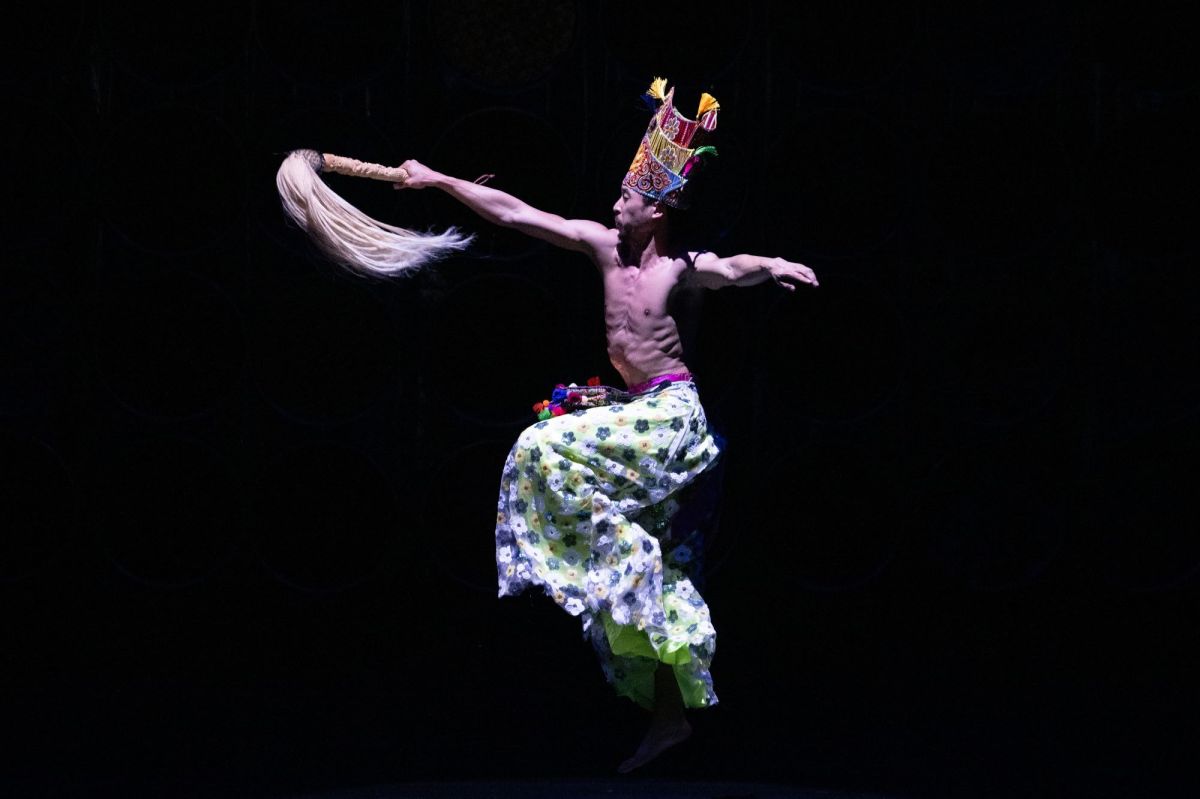
What comes next arrives in waves. Glimpses of neon; amorphous shapes; playful, excessive costuming that is sometimes stripped back to reveal the human form beneath. Tradition is not rejected but reworked – rock-pop-electro renditions of traditional forms, dancers of all genders wearing ceremonially gendered attire as they cavort with each other, with history and with expectation itself. Ahn harkens toward traditionalism just to twist it, tease it, pushing it to the brink of parody.
Lighting and set design track these tonal shifts. The work moves from minimalism into riotous maximalism as the stage opens to reveal a full back wall of colour and texture: enamel trays arranged in neat rows, occasionally becoming screens for projected imagery.
Read: Observer, Observed review: public art about public surveillance for Sydney Festival
The choreography and direction of Post-Orientalist Express treads a volatile line between the gaudy, the circus-like and an almost childlike, abrasive, irrepressible youth – while staying grounded in bodily grace and experienced athleticism. Ahn’s energy is irreverent and confrontational, particularly in relation to her audience: predominantly white, upper-middle-class, middle aged and likely primed with expectations of ‘Asian’ dance as something refined, modest, imperial – akin to Shen Yun. Often, this feels deliberate. Perhaps it is Ahn’s way of subverting the bashful, deferential ‘Asian’ myth altogether?
Post-Orientalist Express: energetic performances
Ahn herself takes to the stage to embody her characters. A Buddhist shaman, a cheongsam-clad karate powerhouse, a ghost bride. This last appears like a vision straight from a fever dream or ancestral haunting – Coppola’s Dracula caught in domestic ritual, steam rising from a Chinoiserie teapot like some kind of summoning.
In these solo moments, Ahn exhibits a spectacular command of stage presence. Experience is written directly through her body. She is playful, deviant, sharp and keen to surprise. Her look is almost monk-like, heightening the thrill of her subversions. Joyfully, Ahn dances between the extremes of chaos and discipline, excess and restraint.
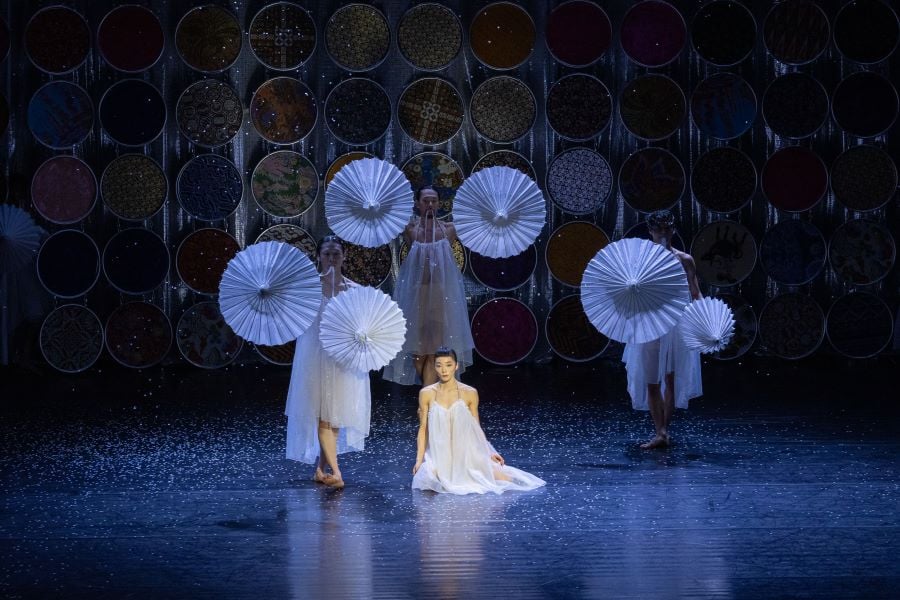
The ensemble’s stamina is astonishing, charging relentlessly from piece to piece, wielding staffs, ceremonial brooms, giant masks. At one point, the work flips into a Power Rangersish kung-fu sequence (a homage to Bruce Lee?) with ape crawls, nunchucks and karate howls – so satirical it tips into minstrelsy. Suddenly, it retreats into stillness. A reprisal of the bride, stripped back. White paper umbrellas. Cherry blossoms falling in gentle eddies. Snow carpeting the stage. Mourning, austerity, meditation.
Post-Orientalism, Unresolved
In Post-Orientalist Express, Ahn draws freely from East, Southeast and South Asian dance languages – some more legibly than others. Thai influences dominate early, Japanese aesthetics surface later. The pastiche is meant to feel intentional, provocative. Yet, as with the opening video sequence, there is a promise of an interrogation of orientalism that doesn’t quite hold.
The admiration for Asian dance cultures is clear, but what is being said about post-orientalism remains unresolved. Are we shucking off the alterity of Western-centric frameworks – Asia as a mishmash exotic monolith – or simply performing for them in different ways?
Perhaps this ambiguity is the point. Performed in this context – this theatre and this audience, with ticket prices hovering between $99 and $129 – the question of who this work is for hangs heavy. There is a deliberate nonsensicality at work. Maybe Ahn is saying, ‘You won’t know what’s from where anyway. Isn’t this what you came to see?’ And then shoving it all back at her audience, refracted through her own excess.
The result is like an acid-trip fever dream into the spirit realm – what I imagine some people seek when they go on ayahuasca retreats. Visually exhilarating, energetically undeniable, Post-Orientalist Express is a feat of human stamina and theatrical spectacle. If it lacks a fully articulated post-orientalist critique, it nevertheless offers a lavish aesthetic feast of globalism – not quite so radical, but a strange dance solidarity among the orientalised.
Post-Orientalist Express ran from 9-10 January at the Roslyn Packer Theatre as part of Sydney Festival 2026.

This article is published as part of ArtsHub’s Creative Journalism Fellowship, an initiative supported by the NSW Government through Create NSW.