
Darkness parts, but imperfectly. Framed by blackest night against a backdrop of burnished gold and silver, Eurydice hangs in the balance between life and death. This astounding feat of aerial accomplishment in Orpheus & Eurydice is Olympian in all senses of the word, calling up both the will of the gods and the mighty mortal athletes who have competed across the ages.
This magnificent collaboration between Opera Australia and physical theatre company Circa depicts many versions of the doomed mythological figures. Presenting Christoph Gluck’s 18th-century opera Orpheus & Eurydice with a libretto by Casanova’s mate Ranieri de’ Calzabigi, it’s epic in scale and chimerical in form.
Orpheus & Eurydice review – quick links
Eurydice’s descent into the underworld
We join this vision of the doomed lover, here depicted by Circa ensemble member Kimberley Rossi, after her first terrible fate. Not all men, suuurrre, but blooming heck, she copped a lot of crap from blokes.
Offstage, Eurydice’s just been harassed by bee-loving sex pest demigod, Aristaeus. He’s the progeny of Apollo and the Thessalian princess, Cyrene, whom the shitty sun god kidnapped. Faithful until the bitter end, Eurydice fled Aristaeus’ unwanted advances, alas stepping on a viper in her haste.
And so in Circa artistic director Yaron Lifschitz’s magnificent production, breathing fresh life into the ancient tragedy, she is sped into Hades’ underworld in a blaze of light and blinding shadow.
Interestingly, Gluck skips over this unfortunate detail, but in this staging, the snake’s cruellest kiss is signalled in lighting designer Alexander Berlage’s nightmarish flash of green as Eurydice tumbles into the abyss.
Enthrallingly contemporary and mesmerising in its mythic bones, this new staging is at once the future of opera and the very essence of the eternal. Australian-Chinese conductor Dane Lam, in a black suit shimmering with iridescent lines, effervescently conducts Orchestra Victoria through Gluck’s entrancing retelling.
Boofheads and bastards

Opera Australia pairs sterling soprano Samantha Clarke as our key Eurydice, resplendent in a red dress, alongside crackling countertenor Iestyn Davies’ Orpheus. The latter had one job.
Hades, moved by the widower’s unending tears and no doubt swayed by his (also abducted) queen Persephone, makes a bargain with Orpheus. Alas, Hades, too, is a twat, with his contract riddled with small print, as Olympian pacts always are.
Lyre-plucking Orpheus can be reunited with his lost love if (a) he personally voyages into the underworld to lead Eurydice out, (b) never looks back while doing so, and (c) refrains from telling her the exact nature of this dubious deal.
Gluck somewhat cheekily places a teeny bit of blame for what follows on a devastated Eurydice, who mourns in Italian, ‘What fatal, terrible secret does Orpheus hide from me?…I am consumed with grief; will you not console me?’
However awful her death, Eurydice finds ‘tranquil oblivion,’ only to be rudely hauled out by her grieving husband, who then refuses to look at her or explain what the hell is going on. Sure, Gluck has her erupt in a fit of jealousy, and her agonising cries for Orpheus to turn back wrack us all as we witness their duplicated downfall.
But it’s all his fault, really. Like any arrogant blunderer attempting IKEA assembly without reading the instructions, Orpheus is so hungry for their reunion that he can’t follow the rules, and down into the depths Eurydice stumbles again.
Orpheus & Eurydice blends opera and circus arts
Opera Australia’s awe-inspiring production of Orpheus & Eurydice makes full use of the Regent Theatre stage, whirling us into a maelstrom of mythical proportions.
On one hand, director Lifschitz’s accompanying set design is minimalist. Clarke and Davies’ impeccably portrayed plight plays out on a mostly bare stage, adorned only with asylum-style bare bones beds – Orpheus’ mental anguish writ intimate – and a shonky green house in which Eurydice is caged.
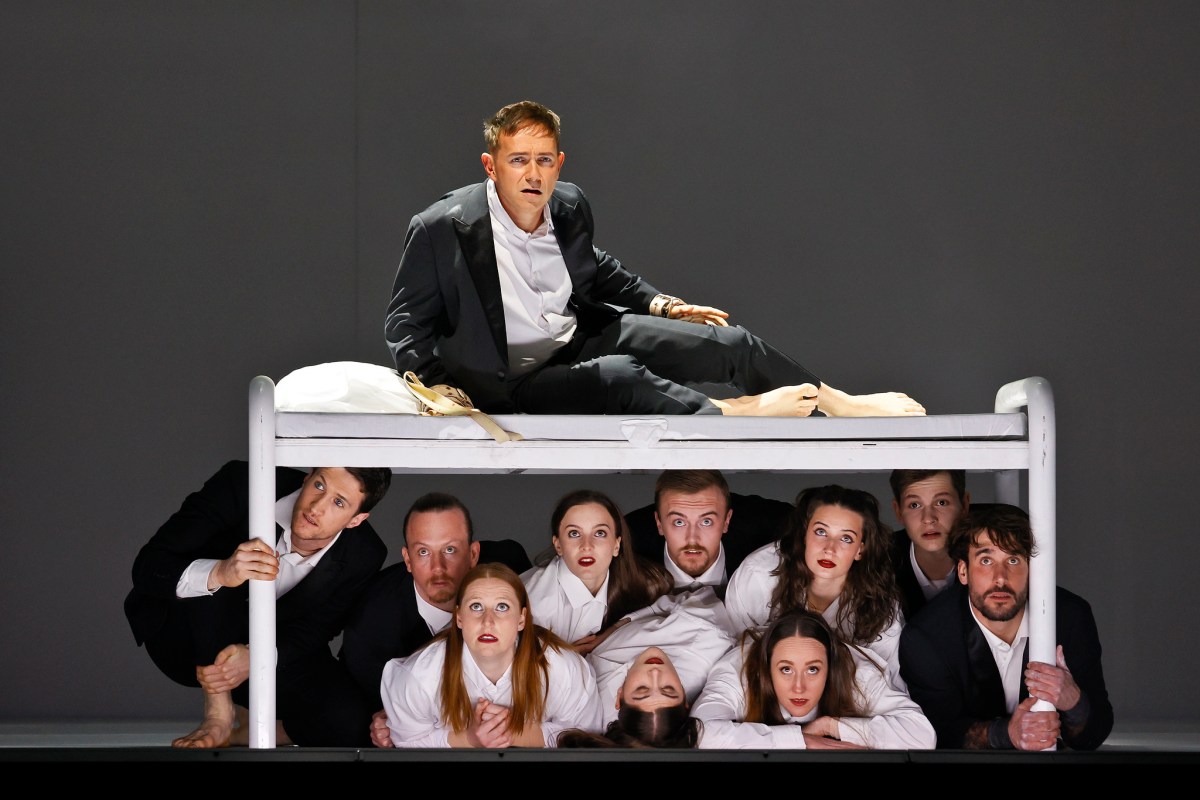
But projection designer Boris Bagattini’s bedazzling video art ignites the space. Surtitles appear and fade away in a whisp of smoke or a rain of tears. It’s almost as if the surtitles, too, are choreographed by Lifschitz, associate director Bridie Hooper and the Circa ensemble. They part like mist on the wind to make way for towers of muscular humans who swirl and dash, climb and crash, and plunge in death-defying gasps.
Costume designer Libby McDonnell’s subtle work evokes the union of problematic naiad Salmacis and the beautiful Hermaphroditus, reforged into one body. The red dresses, black suits and white robes are worn by Orpheus and Eurydice, their many mirror images and assorted onlookers, dancing through a cornucopia of gender-queer combinations.
Opera Australia’s marvellously melancholy Greek chorus, accompanying Circa’s finest, uphold the majesty of Clarke and Davies’s union. Sometimes quite literally.
Kudos to the opera performers for boldly embracing the circus elements of Orpheus & Eurydice, crossing a bridge of muscular bodies on trusting foot and taking to the corde lisse, swinging beneath Berlage’s burning lighting rig, which rises and falls under the thunderous eyes of Zeus.
Lifschitz’s triumph – capturing the desperate heart of this lavishly sorry tale, clashing futilely against the whims of tyrannical titans – finds love in a hopeless place. I will never forget its final image, daubed in blood and hanging on destiny most dire.
Should Orpheus have left Eurydice in peace?
As Paradise Lost scribe John Milton put it, ‘The mind is its own place, and in itself can make a heaven of hell, a hell of heaven.’