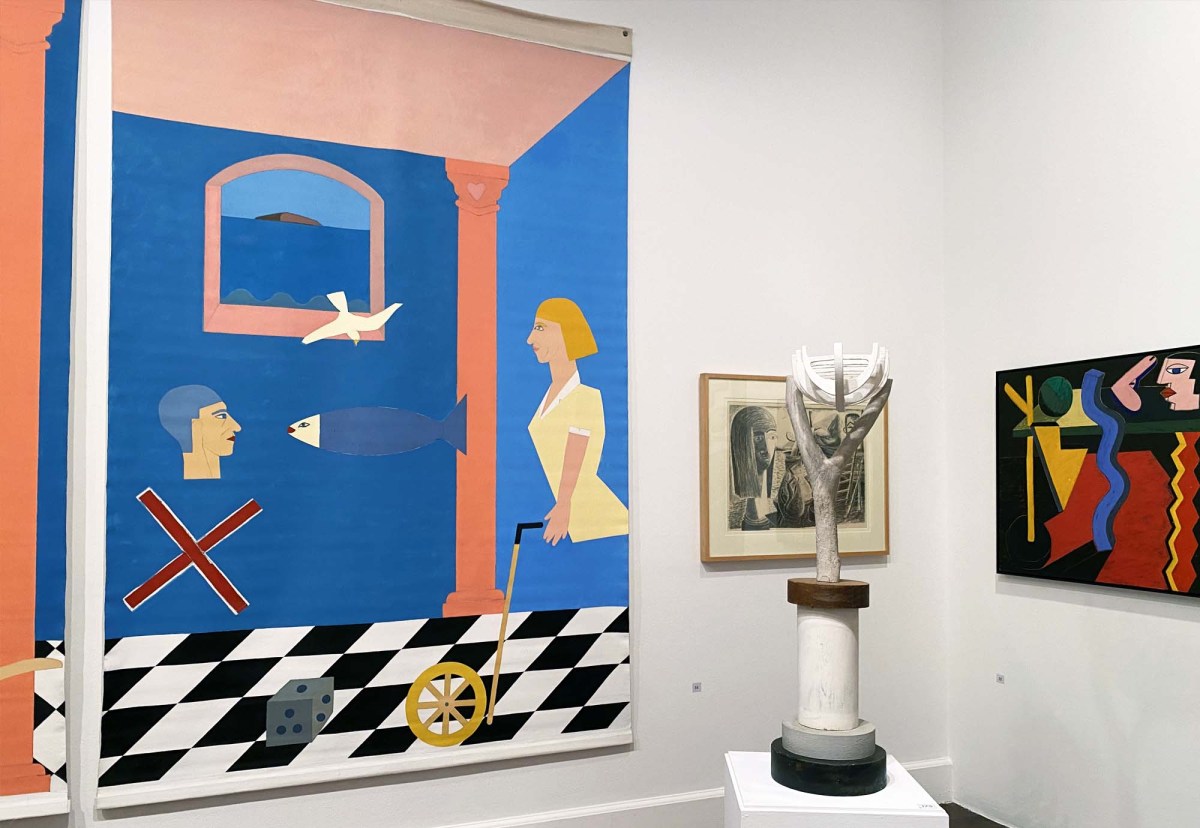
Walyalup Fremantle Arts Centre’s survey show of the late artist Theo Koning (1950-2022) is both a fascinating journey through the artist’s life and a deeply evocative ode to the port-side city he called home.
Koning was born in The Netherlands in 1950 but moved to Western Australia with his family at the age of three. It was therefore the WA coastline (rather than Dutch canals) that shaped his world view.
Indeed, Koning’s life in the Western Australian suburbs is a prominent feature of Objet d’Art – Theo Koning and his Creative Self. Many of the works in this survey exhibition bear signs of backyard life in and around Perth and Fremantle – replete with chook coops, driftwood pieces and scrappy ends of wire.
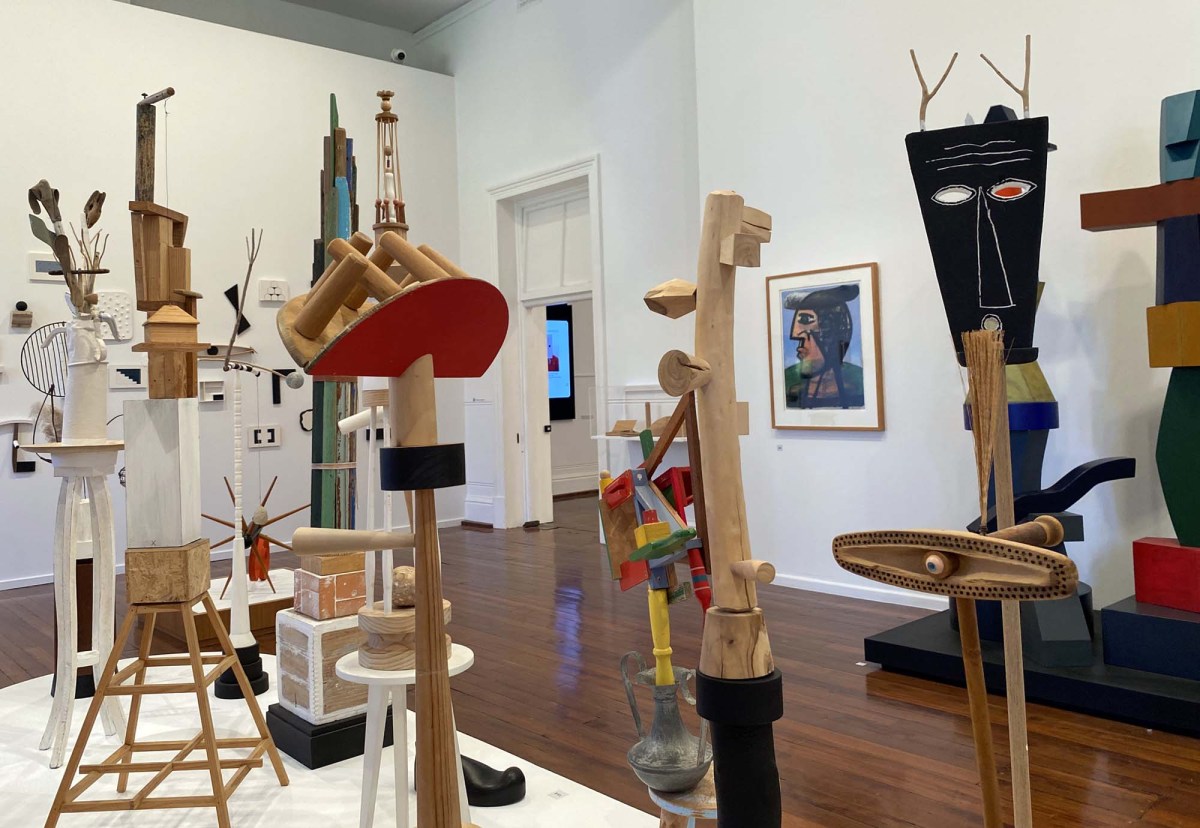
Another of the show’s defining elements is the emphasis placed on the surprising ways Koning transformed the everyday objects he encountered in his daily life into entirely new forms.
Theo Koning review – quick links
An energetic and cheeky approach to art-making
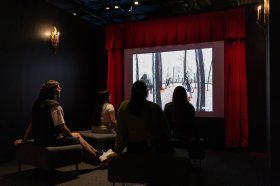
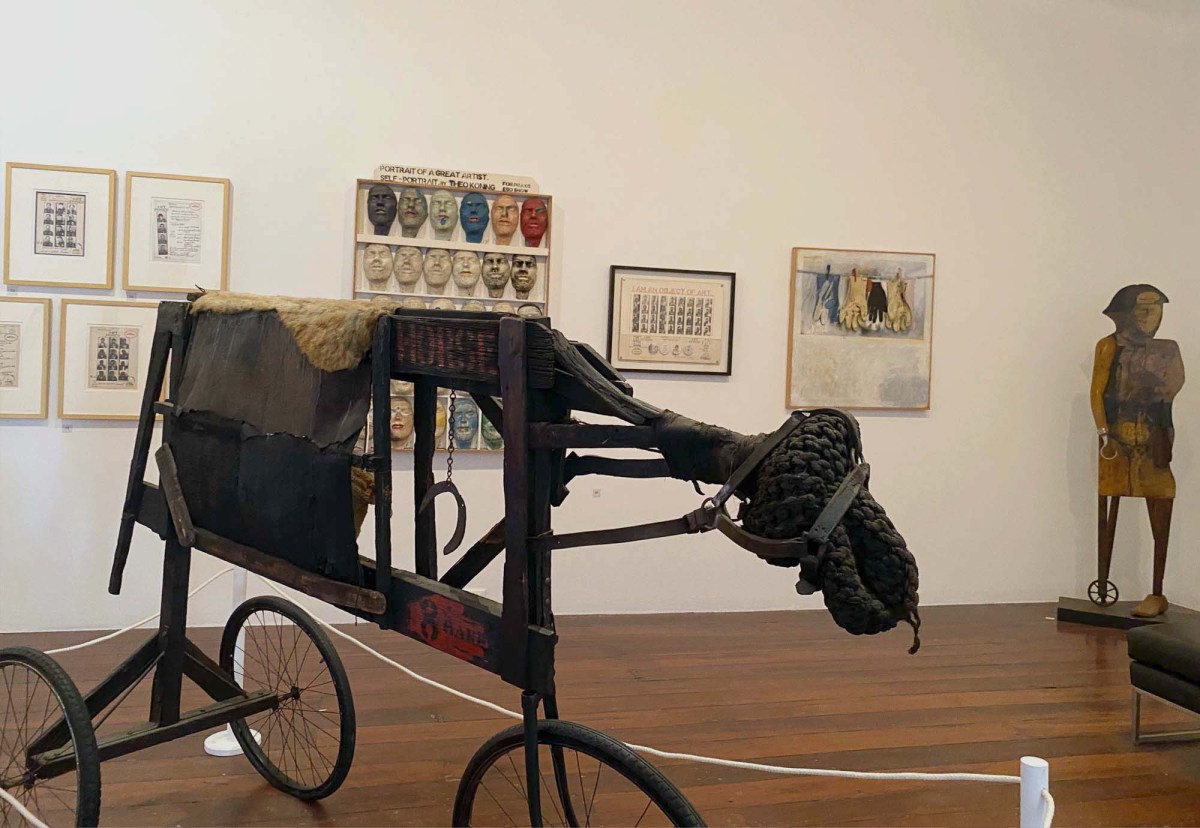
The show’s first ‘chapter’ is installed in a small darkened gallery space. We see a range of Koning’s earliest works, introducing us to his energetic, unpretentious approach to art-making and his cheeky, self-deprecating style.
Works like Self Made Man (1975), Portrait of a Great Artist (1976) and Glove Painting 1 (1976) reveal how the artist was negotiating his place as a young practitioner in the art world while also immersing himself in the simpler delights of his daily routines (which no doubt involved time spent in the garden and the backyard shed).
This group of works – especially some of his black-and-white prints and his wall-hanging assemblage-sculptures – are richly layered in meaning (sometimes religious) and are among strongest in the entire show.
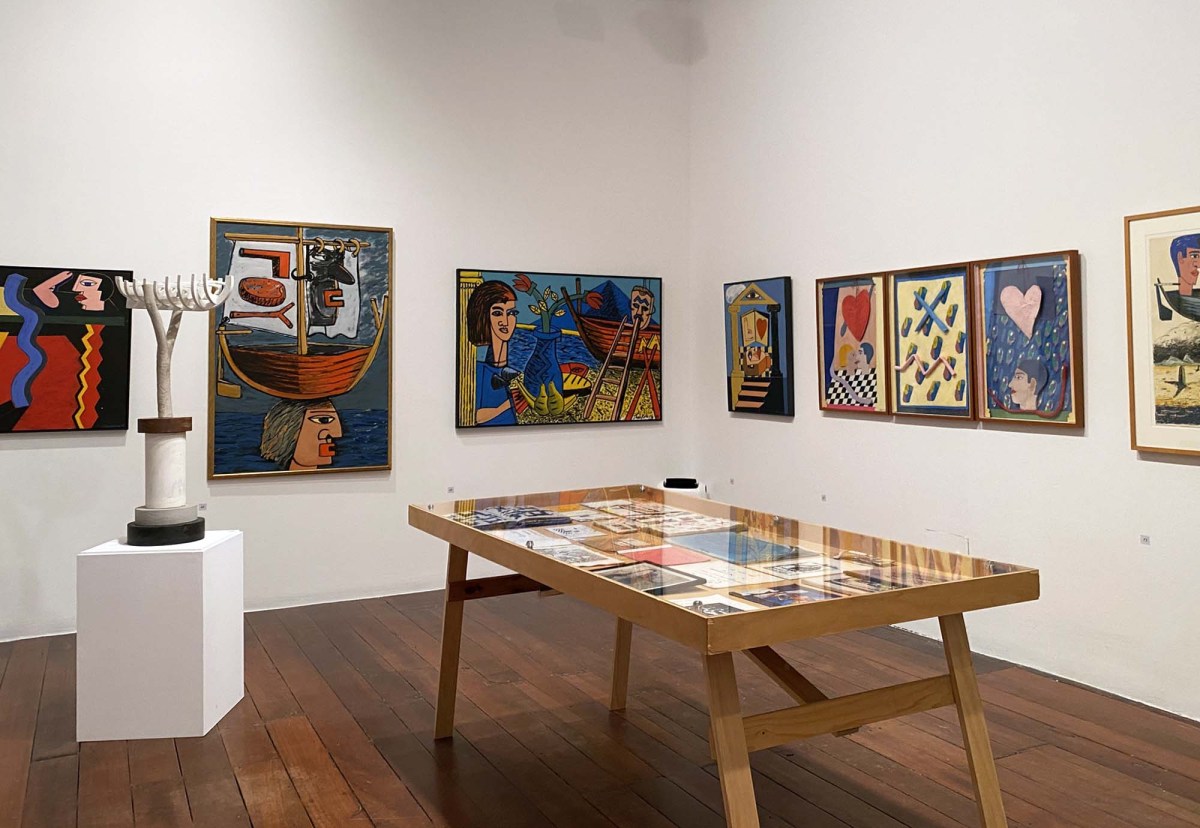
The exhibition’s next section, titled Temple of Love (1981-1989), shows Koning’s creative interests from an entirely different point of view.
Gone are the resin colours and whitewashed sculptural forms of the 1970s. In their place are brighter canvas works in hues of red, yellow and blue. Key works in this section include his paintings Self Portrait (1984) and Recreation (1985).
At this point, while viewers have only been exposed to works from the first two decades of Koning’s career (in a practice that spanned over 50 years), there is already a strong sense of this artist’s capacity to plumb the depths of his own psyche while simultaneously gathering up superfluous bits and pieces from his surface world to remind viewers that life on earth is both extraordinarily complex and incredibly fleeting.
Theo Koning’s struggles for recognition
Koning’s practice was far more than a philosophical journey because he was also an artist with an active role within WA arts scene. This aspect of his career is evident in his poster designs, displayed in the gallery’s corridor spaces.
These designs are mostly for local arts festivals, commissioned by the likes of the City of Fremantle and what was then the Perth International Arts Festival (now Perth Festival).
But despite this flow of design work through the 1980s and 1990s, other prints made at this time show a distinct lack of recognition from other parts of the art world.
In his witty poster work Art Attack v Art Gallery (1980), it is clear that the artist felt locked in constant heavyweight battles for support from his state gallery, the Art Gallery of Western Australia.
In comic strip style, this poster gives a blow-by-blow account of a ‘local artist’ boxer who is attempting to overpower an ‘Art Gallery Champion’ in the ring. But the gallery champion’s ‘below the belt’ manoeuvres and some ‘dubious points decisions’ allow them to retain the prize in the end.
There is further evidence of the artist’s struggle for support in several other works from this time.
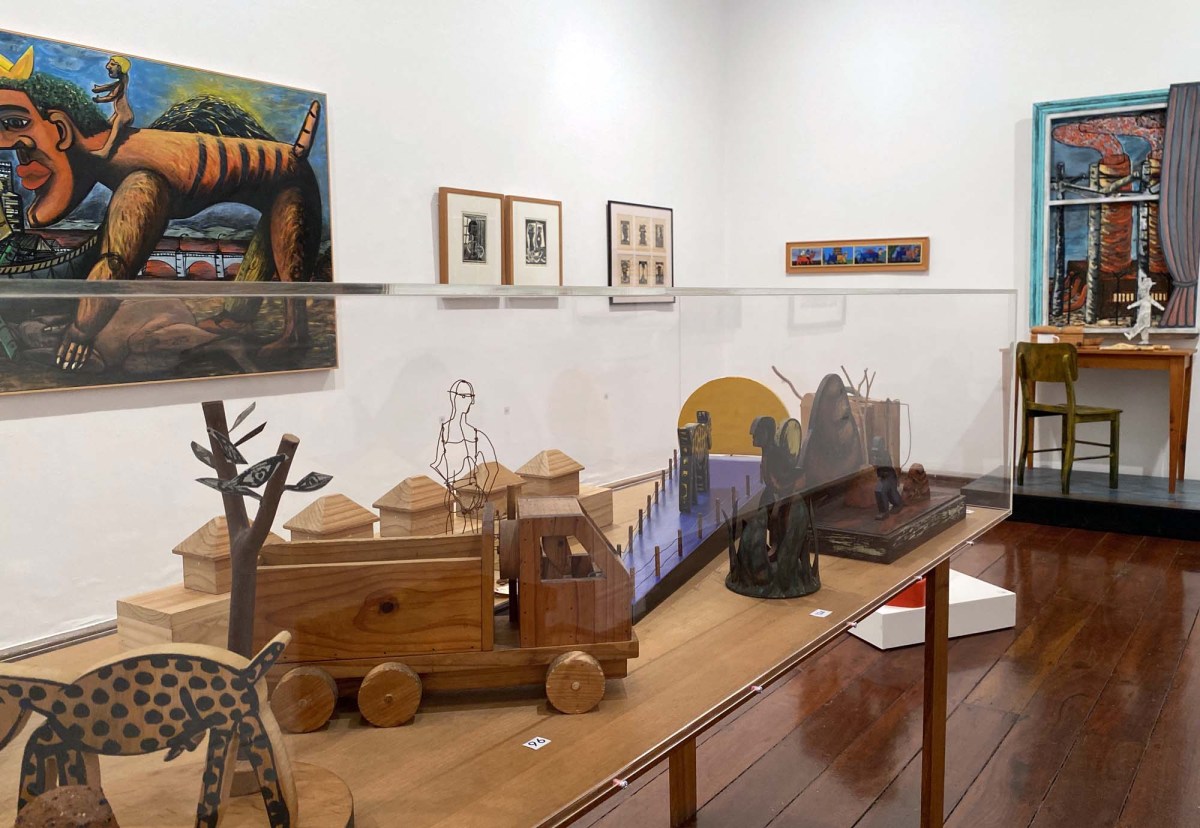
His small wooden sculpture work Man and his burden #1 (1992) depicts a man straining to drag a mound of earth or rock along the ground behind him. (This figure is a reoccurring motif in Koning’s work.) The scene conjures the grind of life’s day-to-day challenges, but also hints at bigger moral questions and the weight of man’s experience on account of being human.
Philosophical motifs thread through a 50 year practice
Other repeated images point towards to similar existential ideas. In many works in Objet d’Art – Theo Koning and his Creative Self, we see an egg, a wheel, an eye, or a fish. These motifs portray aspects of Koning’s here-and-now realities, but also point to otherworldly spheres governed by faith and the unknown.
Whatever the meaning of these images, they are, in the context of this exhibition, effective threads that guide us through his vast practice.
Overall, this survey is indeed a stimulating journey – but there is one small missed opportunity that holds it back from greater clarity.
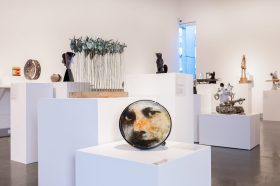
In its concluding section (installed in the largest gallery space) the artist’s final works – which are more pared-back, less colourful and more object-based than previous works – appear somewhat hidden among an array of other, more painterly works from previous years.
Perhaps the logic here is to ensure viewers leave the gallery with strong feelings of Koning’s overarching signature styles and techniques. But given the retrospective’s attention to chronology, it was a shame not to see a more dedicated salute to his distinctive and more minimalist ‘late period’ works.
That aside, there is so much nuance, intimacy and feeling conveyed throughout this epic show that viewers cannot help but commune with Koning’s playful, witty, wordly (and otherworldly!) imagination.
It’s a dynamic tribute to an artist who, among other things, had a wonderfully expansive mind and such razor sharp interest for every surface he encountered, from the ground beneath his feet to the distant horizon that pointed him to realms beyond our reach.