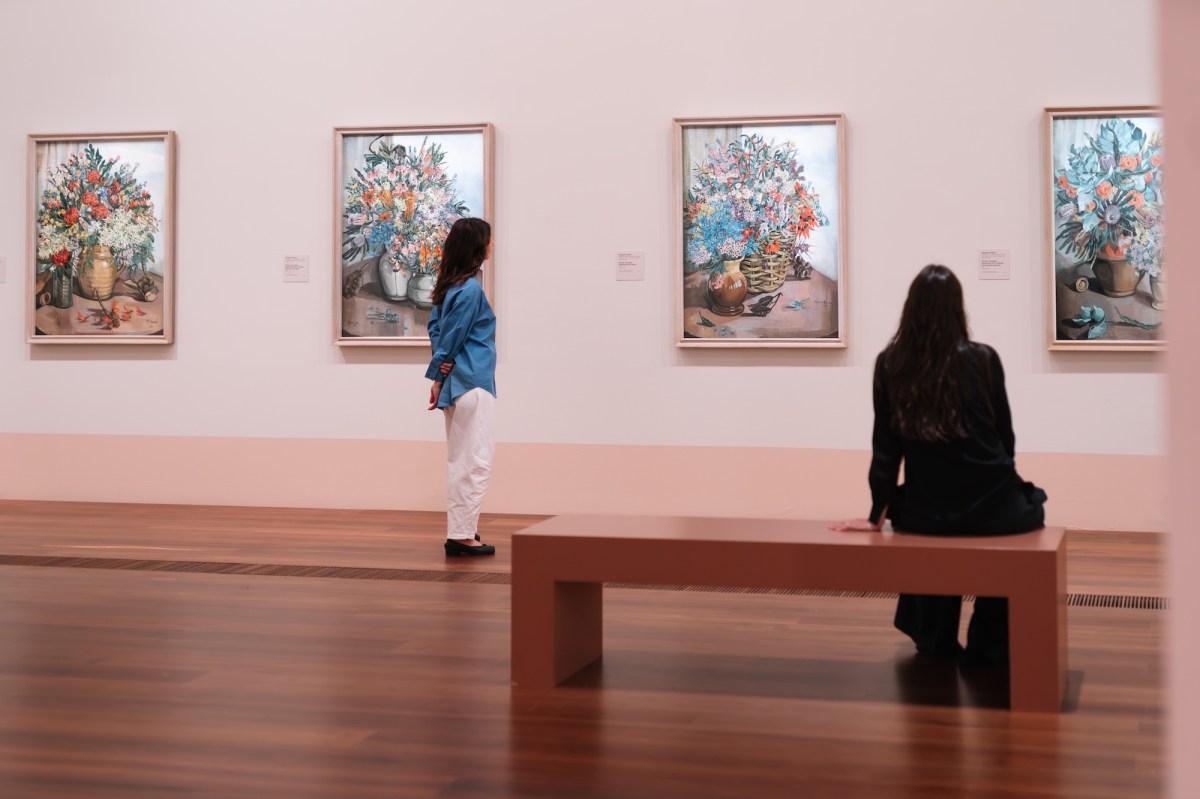
There is an immediate pleasure to viewing the latest retrospective on Margaret Preston’s work at the Nationgal Gallery of Victoria in Melbourne. Soft peach walls set off her saturated palette, while thoughtful pairings place her work in conversation with artists who complicate, rather than simply reinforce, her place in Australian art history.
This is not simply an exhibition simply about a prolific career of pretty paintings. Co-curators Beckett Rozentals and Michael Gentle use Preston’s work to examine the contradictions of Australian modernism: its international influences, its search for a distinctive national identity, and the problematic appropriation of First Nations cultural material that became central to Preston’s vision of Australia.
Margaret Preston review – quick links
Preston: an intrepid sponge
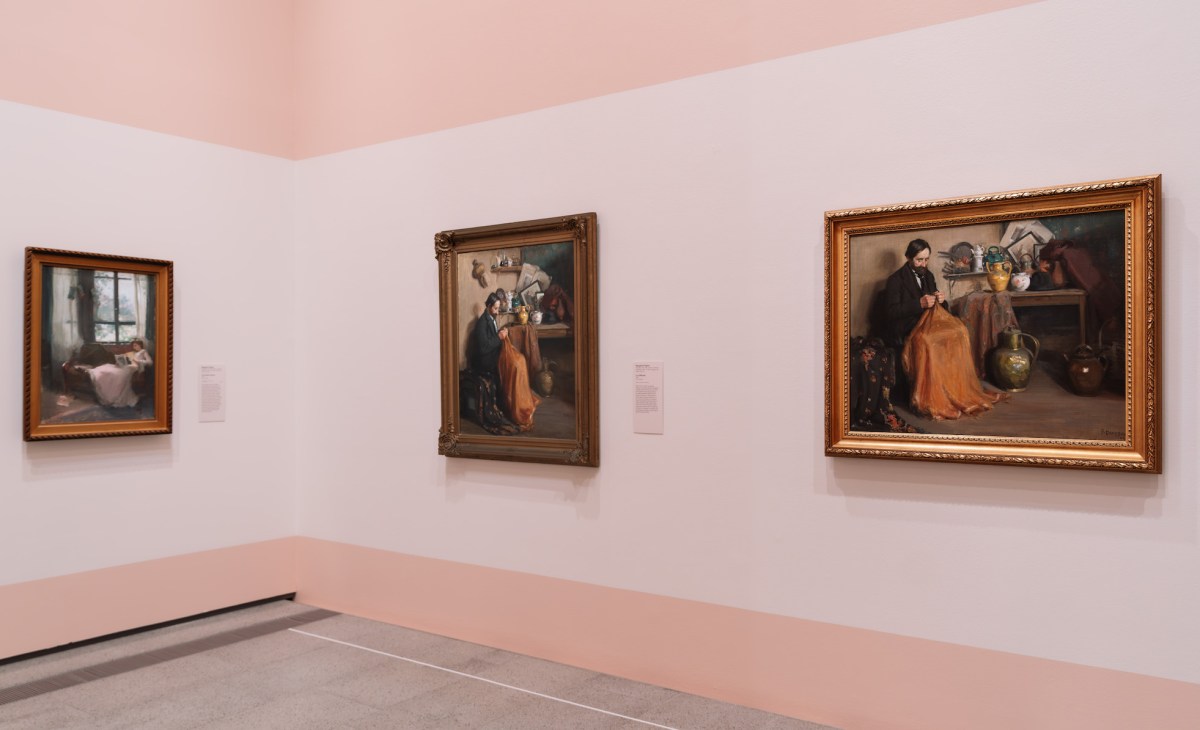
Preston was an intrepid traveller, and the exhibition begins in Europe in 1904, revealing Preston’s engagement with European traditions, particularly Dutch still life. A bowl of onions becomes almost sensory, while oranges seem to pop from their moody settings. Here, a great pairing from 1906 – Preston’s Le chiffonier, alongside The rag mender by her long-time travelling companion and partner Bessie Davidson – demonstrate their sponge-like zest for learning.
The viewer moves through Preston’s subsequent encounters with Post-Impressionism and Japanese woodblock printing, transforming her approach to colour, composition and form. We witness her still lifes becoming increasingly animated by cropped forms, and her modernism take on a playful quality and a graphic intensity that stayed across her career.
The exhibition is particularly good at showing this evolution without turning it into a neat progression. However, the exhibition’s real strength emerges when this formal brilliance collides with the politics of appropriation.
Understanding Preston’s cultural appropriation
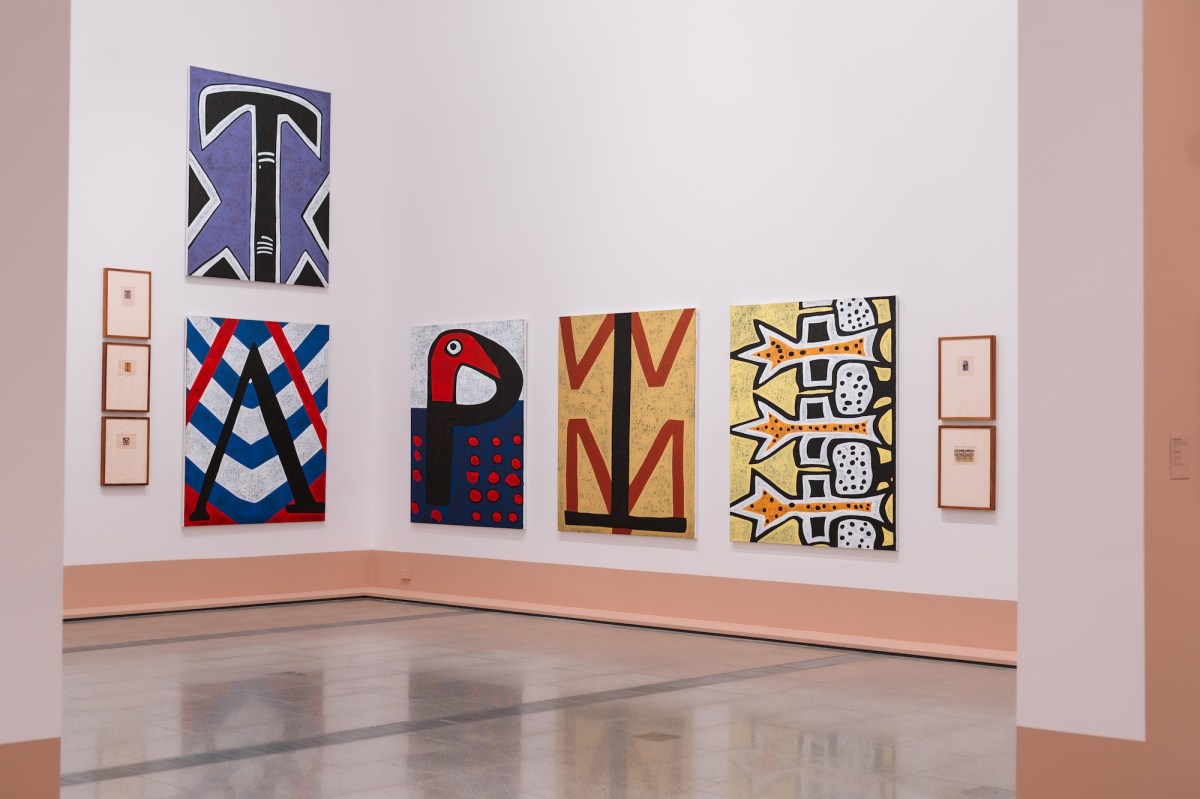
In the third gallery, we encounter Preston’s first artwork referencing Aboriginal Australia, the woodcut The third generation (c1923). It hangs within sight of a suite of 1927 gouaches Preston titled Aboriginal design. Taken from the sacred motifs, one is a Pikan shield acquired by the Australian Museum in 1891. While the original shield had bullet holes – evidence of the frontier wars – Preston has lifted their bright, stylised design only.
Contemporary Aboriginal artist Gordon Bennett recreated these gouaches in 2010, enlarging and deliberately re-orientating them. Shown alongside Preston’s works at dOCUMENTA 13 in 2012, the installation is recreated here, and is one of the exhibition’s high points.
Melbourne. Photo: Phoebe Powell.
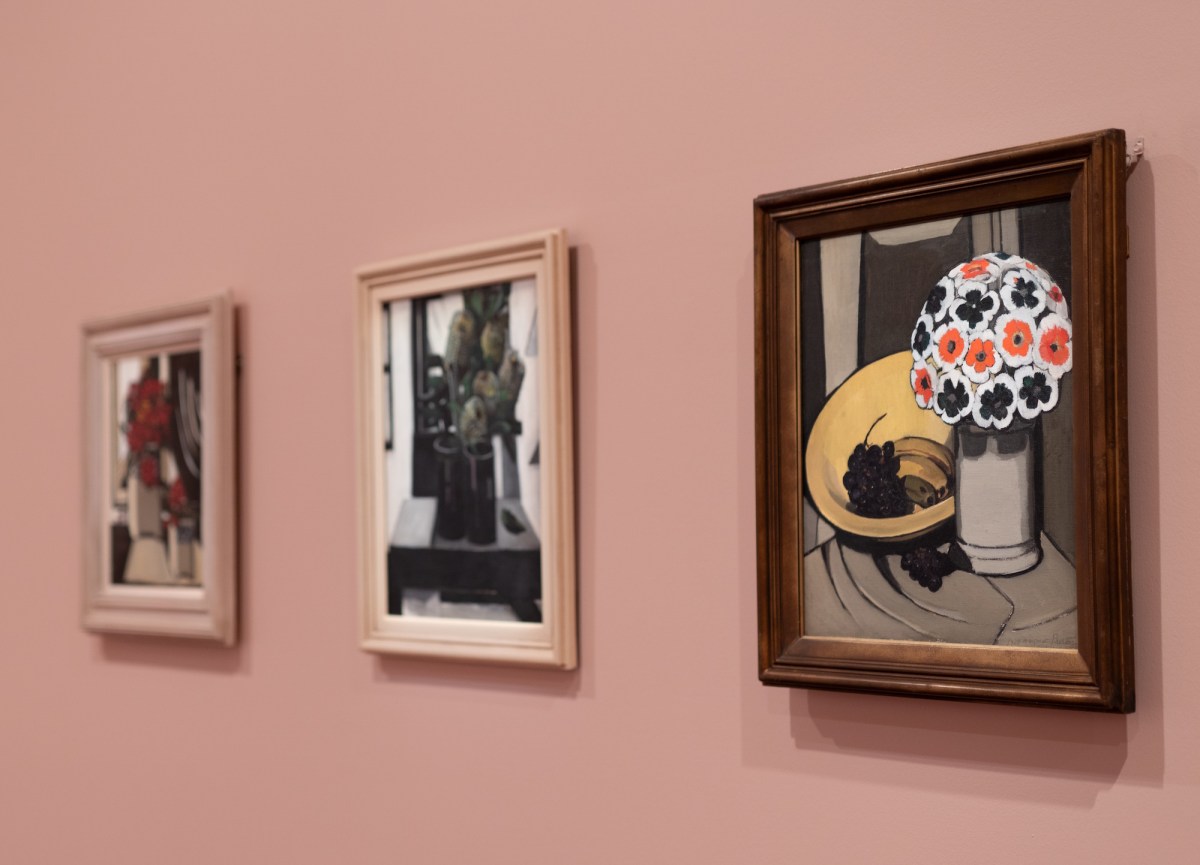
The conversation continues with Preston’s painting Aboriginal flowers (1928), which depicts feather flowers made by First Nations Ngunbay women in Queensland as tourist souvenirs. Painted as a semi-Cubist domestic interior, it demonstrates her ability to fuse a broad net of Australian material with the visual language of European modernism.
What we are witness to is Preston claiming these visual references for herself, extracting objects and designs from their cultural contexts and transforming them into her idea of a national aesthetic.
This gently provocative pairing is continued with a commission by the late Bidjigal (La Perouse) artist Marilyn Russell, who created three shellwork boxes that connect continuing cultural practice and family histories. They respond to a box depicted by Preston. The commission is one of a number that give agency to First Nations artists to respond to Preston’s works, and not simply illustrate the argument but interrupt it.
Trevor Nicholls’ Homage to Margaret Preston (1988), for example, asks what makes an image ‘Australian’, while Gordon Bennett’s works near the exhibition’s exit provide a final reckoning, treating Preston’s appropriation as a form of violence and reminding us that this is not simply a question of aesthetic influence, but of historical and cultural consequence.
The curators handle this difficult history exceptionally well. Rather than retrofitting contemporary judgement onto a historical artist, they reveal how appropriation operated within Preston’s own thinking, and how closely it was connected to the assimilationist culture of the period.
A formidable modernist
In a side gallery, nine of the 10 large-scale paintings created for the 1939 New York World’s Fair and Golden Gate International Exposition in San Francicso are hung together – a coup for the NGV.
We are not used to seeing Preston on this scale. The works speak to her ambition, although some feel thinner and more bleached than the smaller works with which she is more familiar. Yet they arrive at an important moment in Australian nationalist thinking, 150 years after British invasion, and her belief that she was leading a nationalist charge through art.
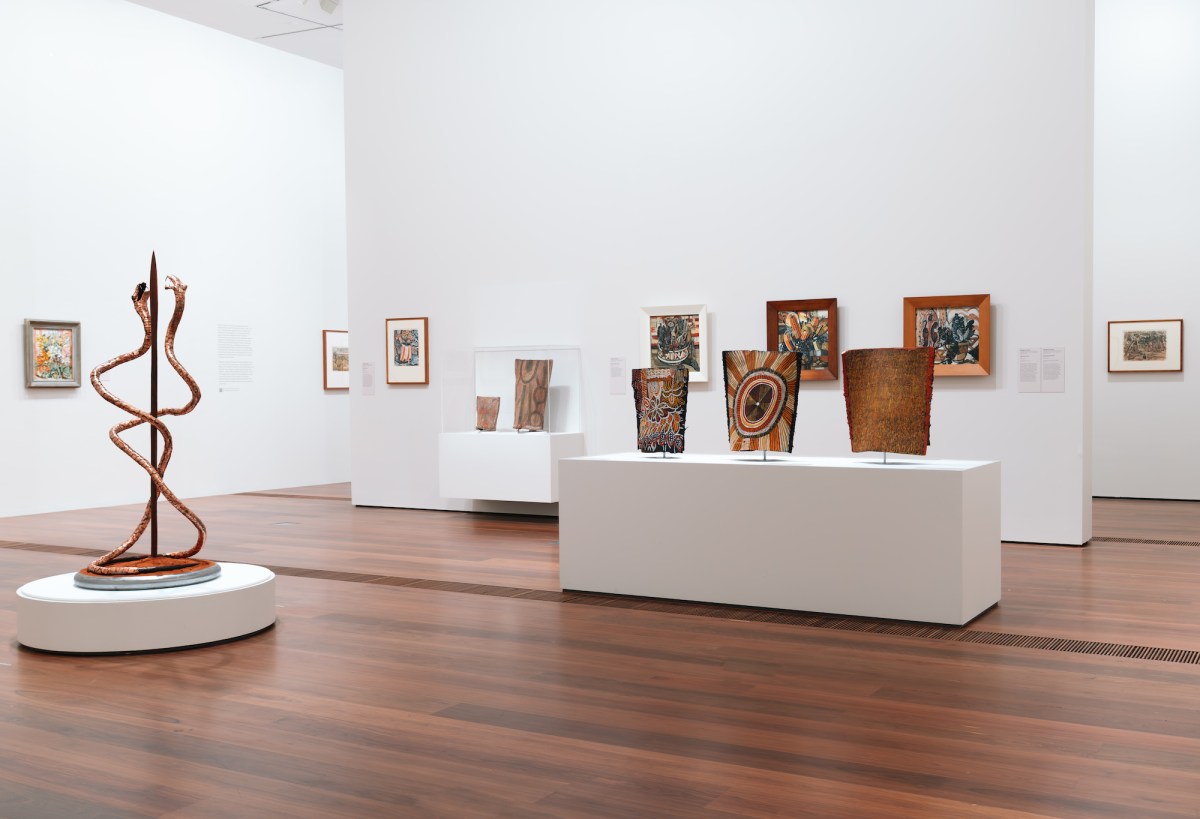
One of the most effective strategies used in this exhibition is following cultural material from museum object, to Preston’s studio, to painting, and ultimately into Australian homes. Orchid spray, for example, draws on an illustration of a Warumungu ground drawing recorded by anthropologist Baldwin Spencer in 1901 and reproduced in a book. Preston appears to have taken this sacred story from the page and made it her own.
Six decades on, Preston takes us full circle
The exhibition concludes with Preston’s Self portrait (1930), commissioned by the Art Gallery of New South Wales – the first portrait commissioned from a female artist. Confident and direct, Preston looks back at us. She reportedly said at the time: ‘I am a flower painter – I am not a flower.’
It brings us full circle. More than six decades after her death, Preston remains one of Australia’s most celebrated, and contested, modernists. The achievement of this exhibition is that it allows those contradictions to remain visible. Its beautiful installation draws us in, but its carefully negotiated juxtapositions keep shifting the ground beneath our feet.
In a joint statement, the curators explain the exhibition, ‘resists the comforting idea that Preston simply became more sensitive to First Nations culture with age’. But this is not an exhibition of condemnation. Preston deeply valued the aesthetic of First Nations designs, repeatedly arguing for their significance through writings, lectures, exhibitions and collecting objects.
The exhibition neither sanitises nor cancels Preston. Instead, it makes us look harder at the histories embedded in her work. She will always remain a formidable artist: an adventurous modernist, exceptional colourist, teacher, writer and advocate for design.
Margaret Preston continues at the The Ian Potter Centre: NGV Australia in Melbourne’s Fed Square until 31 January 2027.
The writer travelled to Melbourne as a guest of NGV Australia.