There’s a particular audacity in an Australian artist taking on the United States of America’s founding myth. Premiered at the 2026 Adelaide Festival, Manifest Destiny is the latest body of work by South Australian photographer Alex Frayne but he doesn’t merely dip a toe into the US. Rather, he spent three years on the road from 2022 to 2025 to create this series – and the result is an image of a nation less triumphant and more threadbare.
Alex Frayne’s Manifest Destiny review – quick links
A fever-dream portrait of decay
The conceptual hook is the 19th century doctrine of ‘manifest destiny’ – the belief that the US was divinely ordained to expand across the continent. Viewing this exhibition, however, one can’t ignore the elephant in the room – Trump.
The US in Frayne’s Manifest Destiny is mottled with economic fatigue and cultural fracture: fentanyl-strewn sidewalks in Los Angeles, emptied Ozark towns, Bible Belt fanaticism, lone figures adrift in parking lots, and abandoned motels. He turns to parts of the country ignored by mainstream media – towns that are the backbone of Trump’s MAGA movement – and captures where the mythology of the American Dream gives way to reality.
It is absolutely a political statement, and the outcome is a kind of fever-dream portrait of a superpower in freefall.
Walking through a nation in freefall
Visitors enter the exhibition through a staged retro American motel reception – the kind that peppers the lonely highways and a frequent motif in Frayne’s images. He leans into analogue, shooting almost entirely on a medium-format camera and developing in makeshift darkrooms like hotel bathrooms.
This format gives his images a grain, depth and color saturation that heightens the feeling that the country is stuck in its past glory.
Frayne’s screen background has taught him how to read a landscape for its narrative potential, and with a devotional commitment to mise-en-scène. Further, his compositions have a cinematic quality with long shadows and saturated dusk light, with the architectural relics treated like characters themselves. It is a noir sensibility he has gained a reputation for through his earlier series, Adelaide Noir and Theatre of Life.
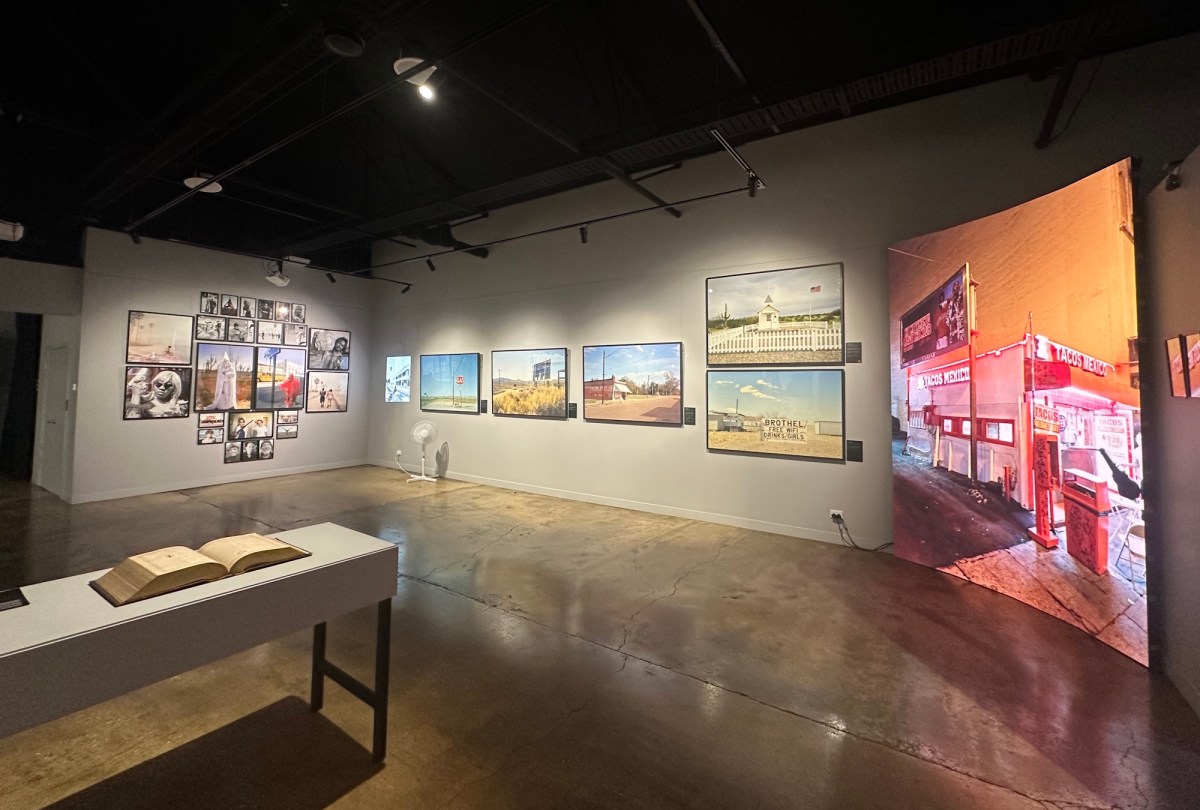
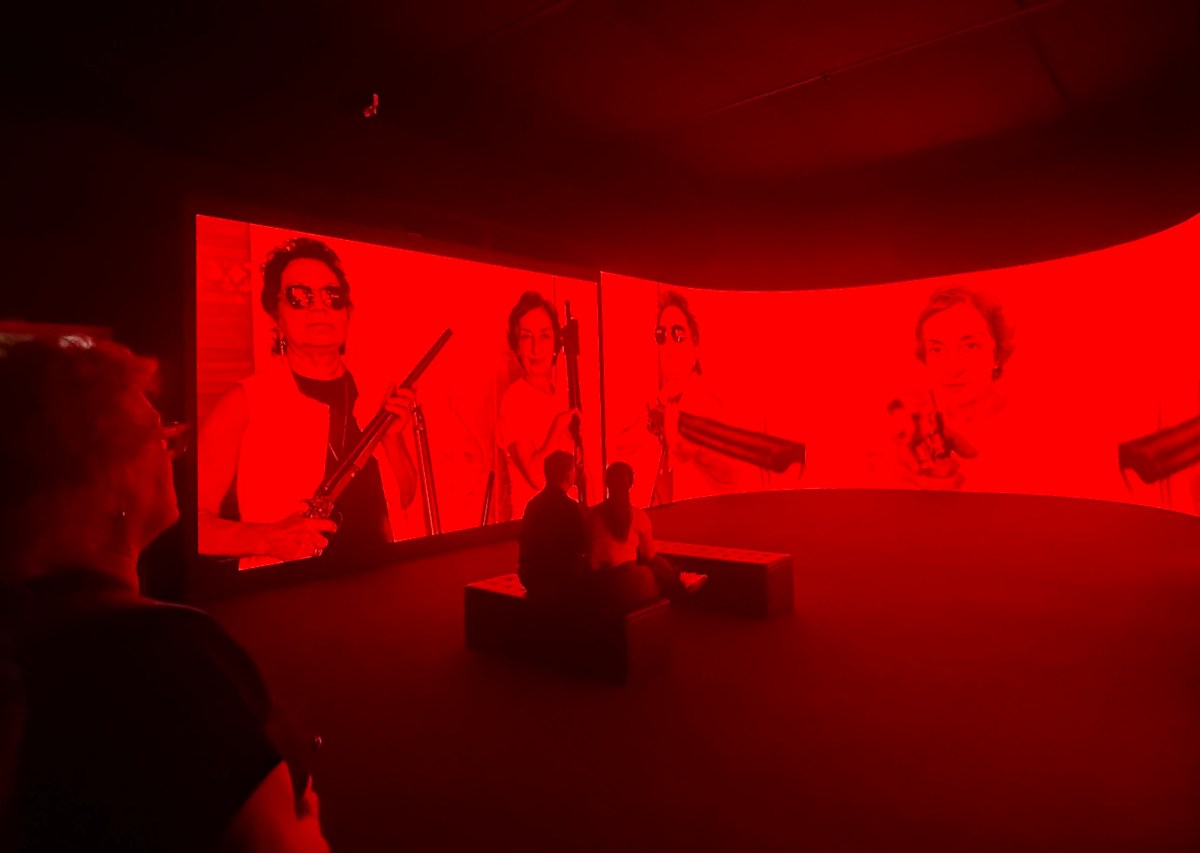
Inspired by the Vegas Strip, Frayne has collaborated with digital artist Liam Somerville to punch his pictures into a semi-immersive, U-shaped LED environment. The arc of images is squared off with a further screen, where Frayne plays the role of narrator, reflectively overseeing this landscape of broken dreams.
The narrative flows together in three acts: freedom, power and decay. It is completed with a soundscape by Donnie Sloan. Overall, I would describe it as more theatrical than immersive. My criticism is that you feel too connected to the exhibition, with light spills, noise and movement snaring your focus, to have a true immersive encounter – a flaw that could have been easily solved. This bleed also cuts the installation into two, rather than compressing that conversation across screens.
ArtsHub: Yield Strength: Adelaide Biennial review – grunge rupture and eloquent overlays
Fly-in voyeurism or valid collective critique
The project edges toward poverty-porn and fly-in voyeurism – something I have always felt uncomfortable with, when artists use another’s culture for their narrative, especially when aestheticised for a festival audience.
Frayne addresses the voyeur label by leaning into his status as an outsider. He doesn’t claim to own the culture or speak for it; instead he makes the point that we all live in the shadow of American cultural exports, from Hollywood, to Netflix, Fox News and social media, and that as consumers we have a right to question its truth. Frayne adds that by taking the role of outsider that distance allows him to interrogate what he sees with a freedom.
This tension hovers throughout the exhibition. In the end, whether it’s voyeuristic is up to the viewer. Where Manifest Destiny ultimately succeeds is in its refusal to resolve that discomfort. Frayne doesn’t offer solutions. Instead, he constructs a hall of mirrors: America as exported myth, refracted back through an Australian lens steeped in cinema. The immersive format amplifies this reflexivity; we are not just looking at images of empire, we are engulfed by them – just as we are every day.
Frayne has staged a provocative encounter that asks whether the dream was ever coherent, and as someone who lived for many years myself in the US, I’d have to agree – this disconnect between myth and reality is one, I think, the world has finally cottoned on to. Frayne captures it succinctly, caught between seduction and repulsion.