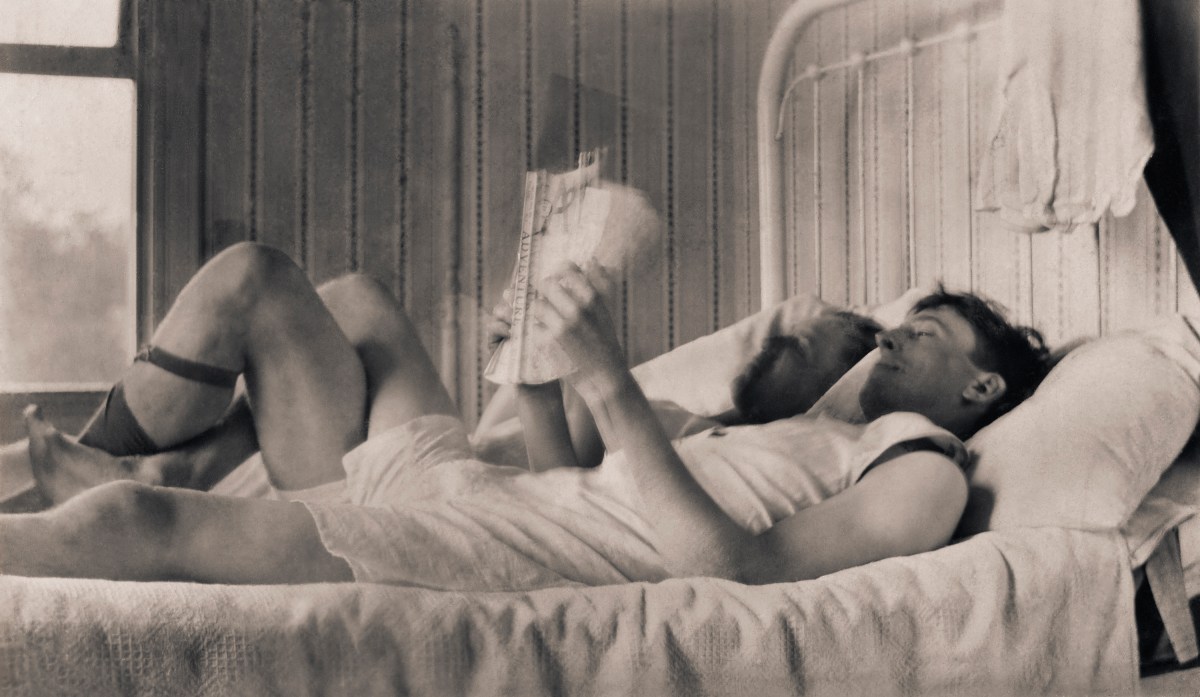
The ‘unmistakable look of love’ is what a pair of private collectors from the US say unites their historic photography collection, which forms a touching but limited window into queer lives of the past.
LOVING at Qtopia in Sydney showcases photography from between the 1850s and 1950s from the collection of US-based couple Hugh Nini and Neal Treadwell, who have trawled flea markets, auction houses, family albums and online collections for the historic imagery.
Each photo on display shows a pair of people who the collectors believed had this look of love in their eyes. As the photos were collected secondhand, most are presented without context – only their country of origin.
It is this act of reading into the relationships in the photos that gives the exhibition its emotional power. Signs of affection in each image vary in subtlety, from faces or shoulders pressed close, to limbs wrapped around each other and lips locked.
Seeing evidence of historic queer love is a heartening reminder that these stories have always existed and didn’t begin at the Stonewall riots or first Mardi Gras – even if they weren’t always documented.
LOVING review – quick links
A queer history of love
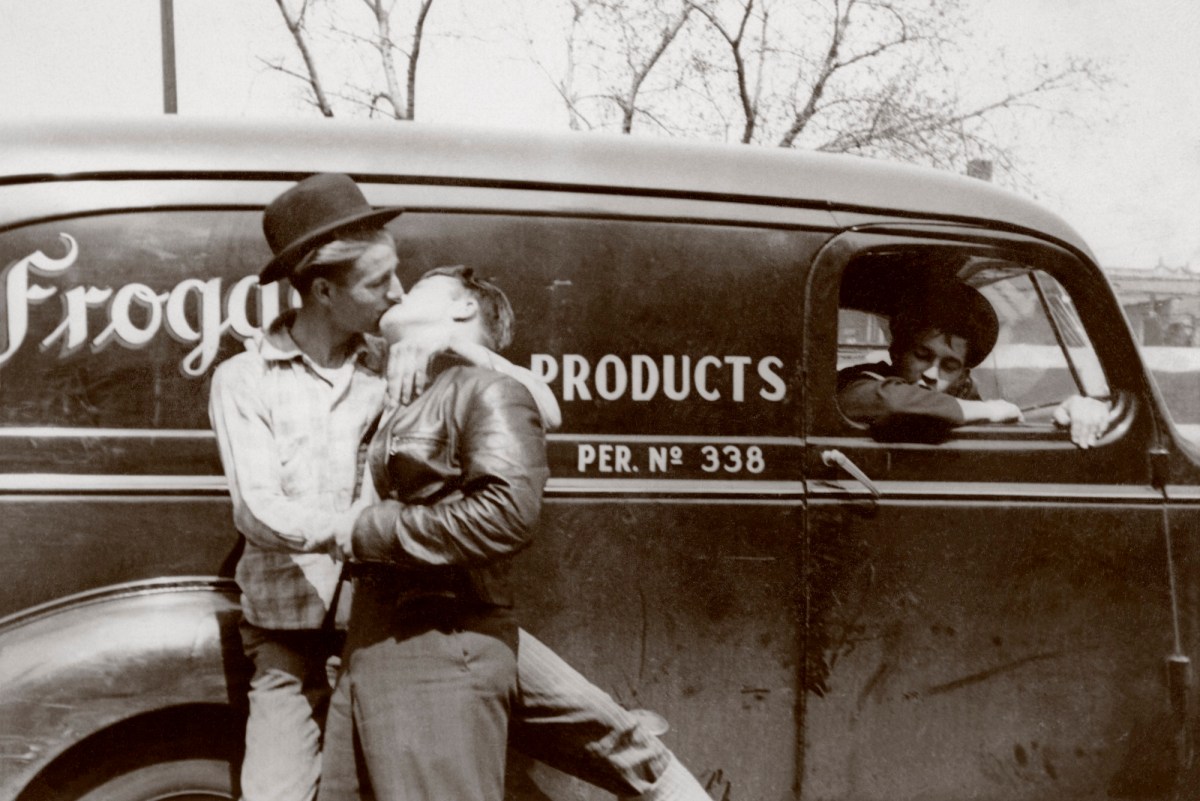
Though we don’t know the individual stories or identities of each portrait’s subjects, as a collection they point towards an intimate and tender queer history of love, rather than what is so often a history of criminality.
LOVING has previously shown in Canberra and Melbourne as well as across Europe, and has come to Qtopia Sydney just in time for Mardi Gras season as a collaboration with the Delegation of the European Union to Australia.
The photographs are presented in two rooms at Australia’s only permanent centre for queer culture and history, alongside a video of collectors Nini and Treadwell explaining their motivations behind tracking down the photographs across the globe.
Read: Sydney Mardi Gras 2026: culture highlights for artsy queers
Qtopia Assistant Curator Jeremy Smith said the collectors and museum have been ‘very careful’ not to put labels on the type of love seen in the photos due to a lack of historical information.
‘You can’t project from the present to the past,’ he said.
‘If you were in the 1850s there wasn’t a word “homosexual”. You might have “sodomy” or those criminal words like “buggery”.’
History and materiality
The works are spread across walls, in large display tables and also printed on large sheer curtains that adorn the first room of the show.
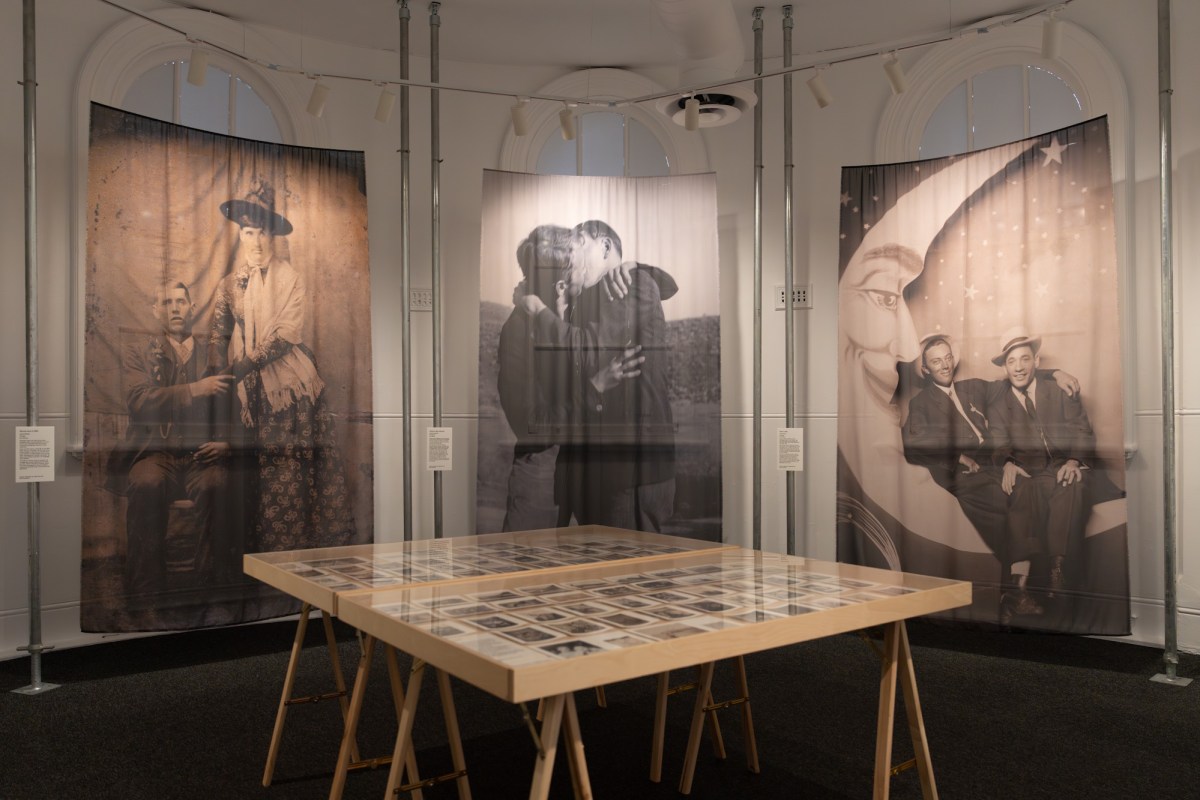
The works enlarged on curtains are vital, as they provide a sense of materiality and texture which is lost in reprints of the imagery that makes up the majority of the display. Only one photograph here is an original print, which is also the show’s only Australian image.
In the Australian photo, two men from Sydney stand in a formal setting, sharply dressed in suits with their arms interlinked. Each man’s expression is stony, but it’s easy to read a sense of affection and even possessiveness in the touch between the two.
Accessing a local queer history through the visibly aging photograph is heartwarming, and brings to mind histories which have not been told. It also highlights the materiality which much of the show lacks, as the collection’s originals are locked away in a safe inside Nini and Treadwell’s New York home.
Queer photography and diversity
The stories told by the photographs in LOVING are limited by the collection’s focus on white gay men from Europe and the United States.
Smith and Qtopia Curatorial Director Holly Riding have cleverly stretched the collection by forefronting more diverse pairings, but it’s hard not to notice that the queer museum’s show doesn’t quite cover the whole rainbow.
Couples who appear more racially or gender diverse than those in many of the other prints are given bigger space in the show through enlarged prints on curtains, but still comprise a fraction of the exhibition.
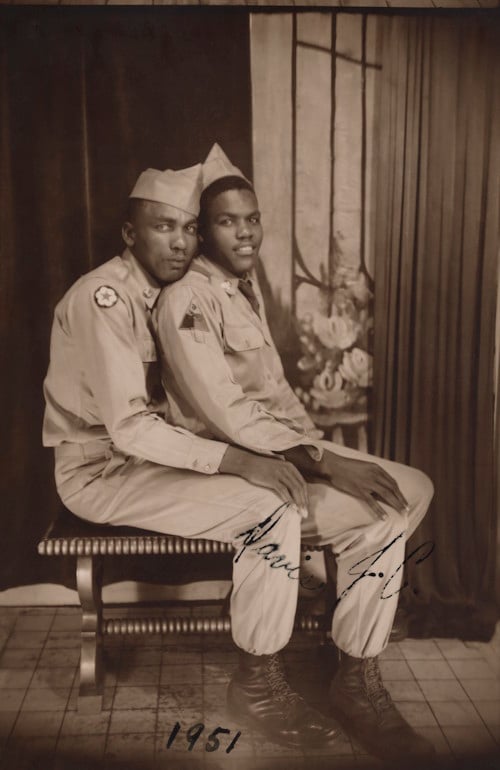
As Smith tells ArtsHub, it was important for the Qtopia team to ‘get it as diverse as possible’.
‘It’s really key that we’ve forefronted not only gender diverse individuals but different ethnicities and different scenes,’ he said.
‘Clearly it’s a private collection of two caucasian gay men and that’s entirely their prerogative to choose the images they want, so we’ve just tried to highlight that within this exhibition, there’s so much diversity.’
While the show doesn’t quite show a universal love unrestrained by prejudice, it does refreshingly foreground the joy and continuity of queer history through a limited archive.
LOVING: A Photographic Collection of Love, 1850s-1950s is on show at Qtopia Sydney until 1 March. It is a ticketed exhibition.

This article is published as part of ArtsHub’s Creative Journalism Fellowship, an initiative supported by the NSW Government through Create NSW.