In her performance artwork Keep the Chains Tight, recently performed in Sydney, Ukrainian-Australian artist Kiera Brew Kurec drew on personal and cultural references to navigate questions of tradition.
What keeps traditions alive? Is it the quiet repetition of labour, carried by withered hands, or the bright spark in the eyes of those who inherit stories of the past? What happens when traditions come under threat, and something as delicate as a decorated egg becomes an act of resistance and remembrance?
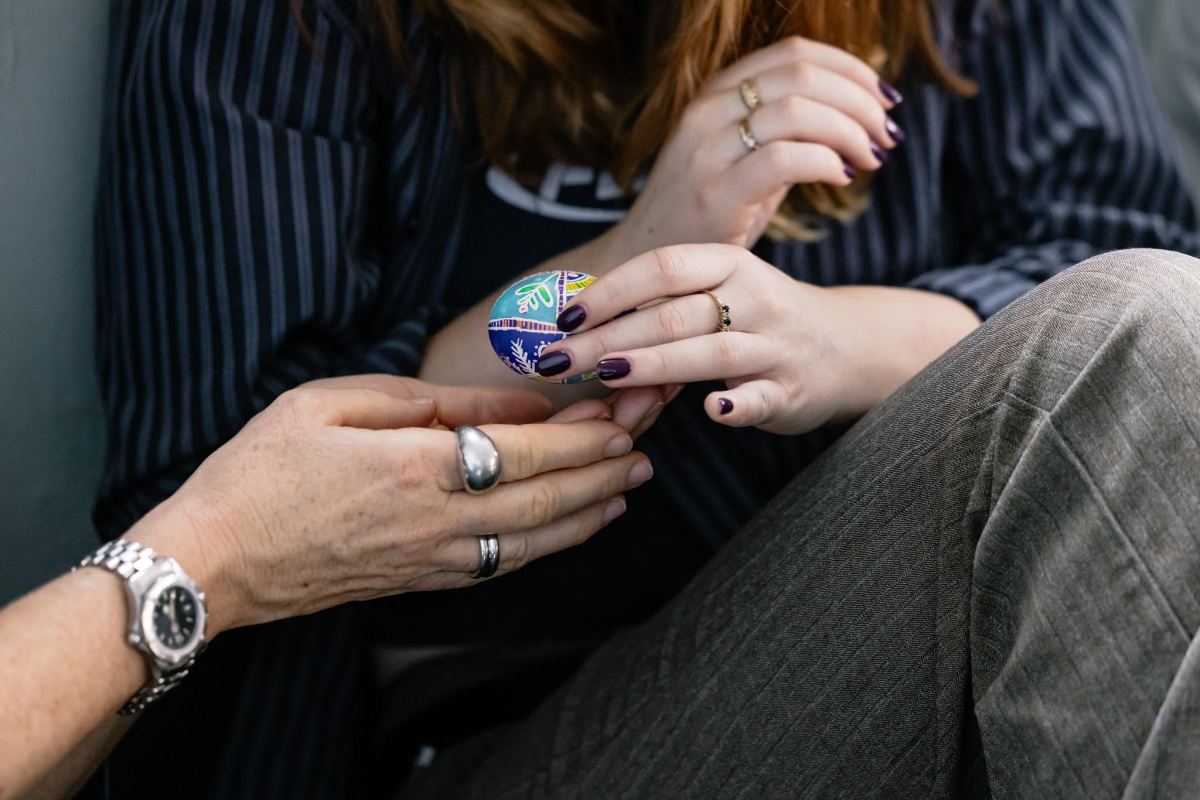
In Keep the Chains Tight, performers worked with psyanka (писанка), a dyed egg associated with Ukrainian Easter. Created using a wax-resist method, intricate designs are ‘written’ in layers of wax and dye rather than painted.
Rooted in pre-Christian ritual and later absorbed into Christian symbolism, these eggs have long functioned as talismanic objects, carrying meanings of protection and renewal.
Suppressed and systematically erased under Soviet rule for their religious and distinctly Ukrainian significance, the practice was driven underground, with many objects destroyed and much of the symbolic language lost.
Kiera Brew Kurec review – quick links
Reviving lost traditions
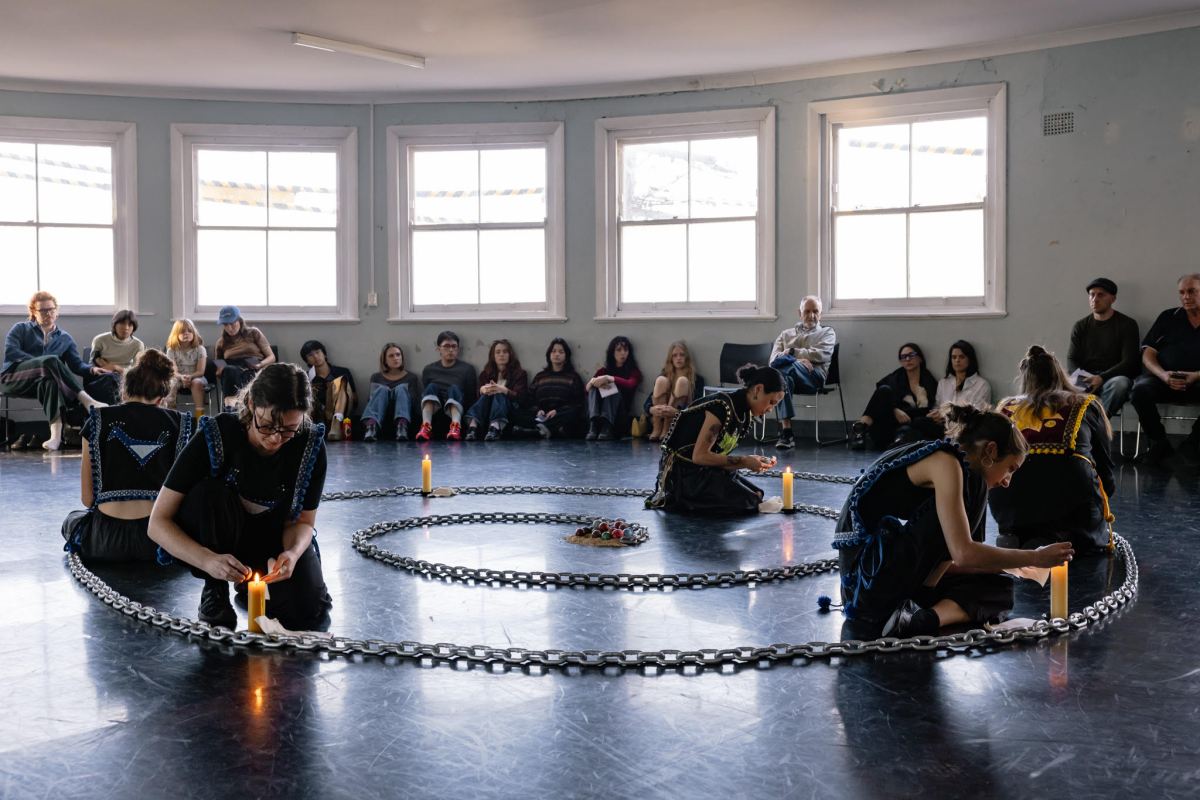
Keep the Chains Tight was performed at the Randwick Literary Institute in Sydney, where it unfolded over the course of an hour.
Entering the space, a heavy chain lay coiled into a loose spiral on the floor, punctuated by thick candles. At the centre of the spiral, resting on a bed of wheat grains, sat a pile of dyed eggs layered in black beeswax.
The performers, dressed in black, wore vests threaded with colour, each marked by a symbol that bound them in groups, also echoing the hieroglyphic language inscribed onto the pysanky. They entered the chain spiral one by one to select an egg and a candle. In a slow, deliberate rhythm, they stroked the egg against the candle flame.
As the black beeswax softened, it was wiped away onto white cloth and colourful geometric designs emerged. If each gesture was an offering, each mark was a revelation.
Symbolic meaning and reinvention
The performers in In Keep the Chains Tight were not guided by a soundtrack or explicit instruction. Instead, the learning was embedded in their relationships: a master holds the knowledge of pysanka-making; the apprentice recalls and re-performs it; another group learns through repetition, handling and cleaning the pysanky; and finally witnesses observe the performance too.
In this way, Brew Kurec investigated how cultural knowledge is transmitted through a chain of practice and observation. Yet this knowledge can also shift, reshaped by those who carry it, as their own interpretations are folded into the inherited practice.
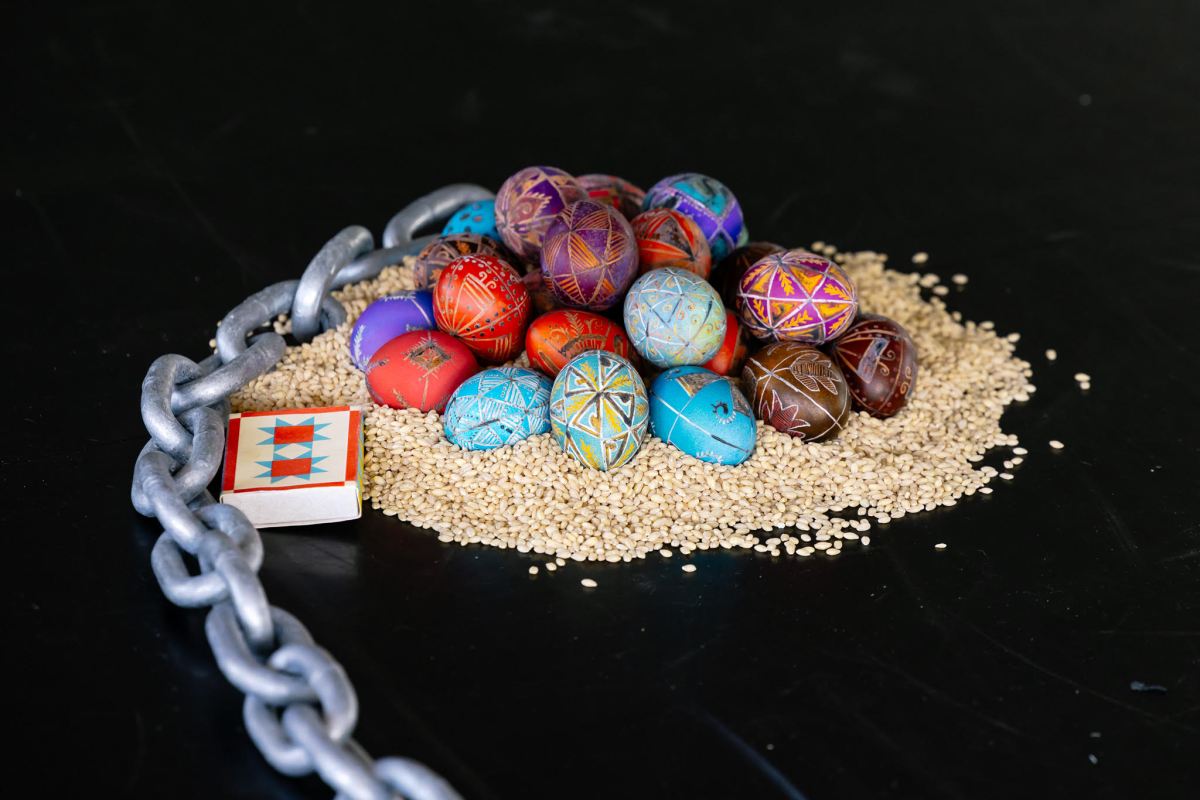
During the performance, the spiral became a boundary as much as a path. Those not engaged in the labour remained outside it, as if held at its edge by an unseen force that both protected and elevated the eggs at the centre.
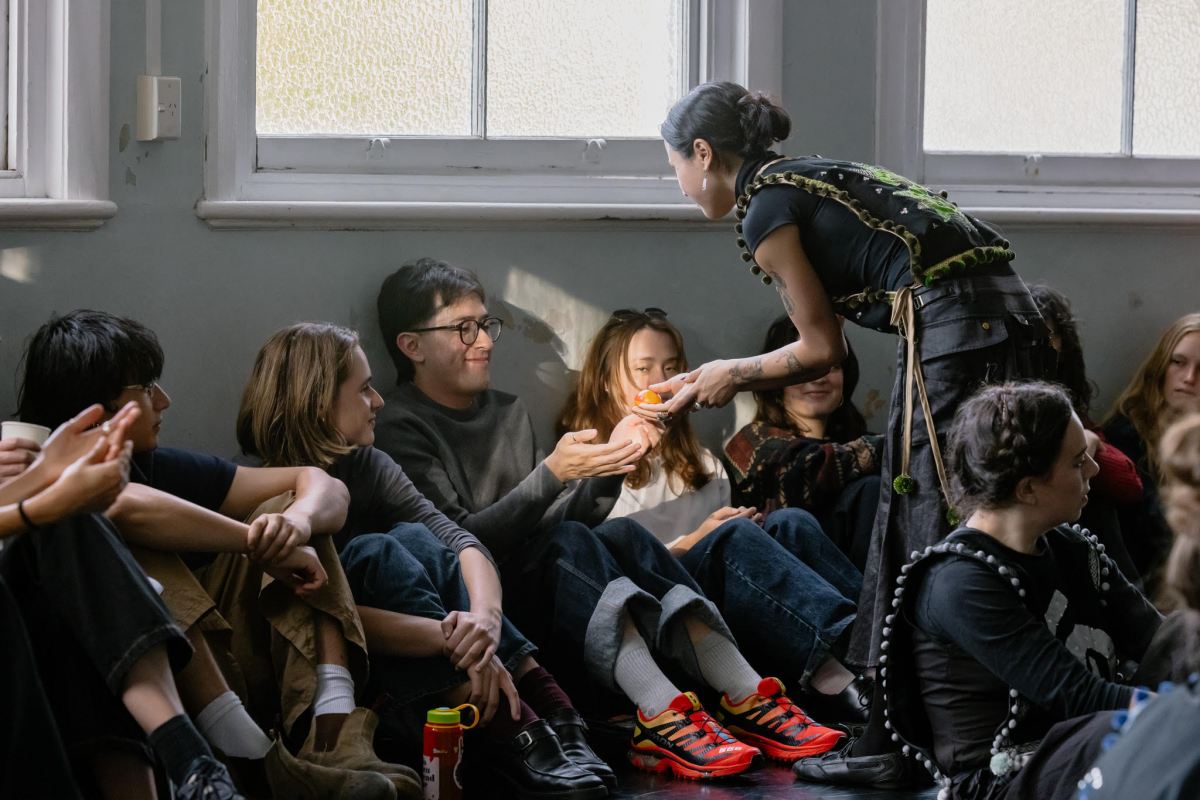
When the cleaned eggs were passed to the audience, many assumed the process had reached its conclusion, but the work resisted such finality. The performers, absorbed in their repetitive task, became carriers of tradition too: the act of passing the eggs transmitted not just an object or a craft but a system of knowledge.
Holding onto the chain
As a child, I tried my hand at pysanka writing, though I would grow impatient with the slow melt of wax, often burning the egg against the flame. Watching the performers return, again and again, to the candles on the ground, I recognised this labour as both discipline and devotion. It is within this slow meticulous process – the repeated stroking, melting, wiping and passing – that tradition is both enacted and transformed.
Watching Keep the Chains Tight, my gaze softened, drawn to the flicker of candles as they slowly burned down. For me, Brew Kurec’s performance work extended beyond the pysanky to speak to the embodied labour of memory.
In the final moments of Brew Kurec’s performance, the room fell silent. The performers completed the last gestures, melting away the final layers of wax. One by one, the candles were extinguished.
As part of the Ukrainian community, I’ve witnessed how culture persists through repetition and the careful passing of knowledge across generations. Keep the Chains Tight revealed the colours, patterns and structures of this transmission, asking what is preserved and what is at risk as these fragile systems are either carried forward or allowed to fade.
To hold the chain, as the work insists, is to remain within this process.
Keep the Chains Tight unfolded with a quiet intensity that favoured immersion over spectacle. While the hour-long performance could test attention at times, this endurance ultimately reinforced the work’s thematic concerns, making its time demands feel purposeful rather than indulgent.
For those unfamiliar with Ukrainian traditions, the work may initially have felt opaque, offering few explicit entry points. However, its emphasis on gesture, rhythm and shared labour transcended cultural specifics.
Brew Kurec’s strength as an artist lies in this translation of intimate ritual into a broader performance language, positioning her practice within a contemporary field concerned with durational work, diasporic identity and the preservation of cultural knowledge.
Where this work was less resolved was in its reliance on conceptual framing, which at times risked distancing audiences without prior context. Nevertheless, it is precisely this tension between intimacy and distance, endurance and attention, that gives the work its impact.
For the Ukrainian community, however, it resonated as much more than an instance of representation. The work affirmed how cultural identity persists as it is carried through ritual, adapted through generations and sustained across diasporic experience. As the catalogue text stated: “Keep the chains tight, keep дітей (children) safe, keep the ritual burning. Hold egg to flame.”
Kiera Brew Kurec’s Keep the Chains Tight was performed on 28 March at the Randwick Literary Institute, Sydney.

This article is published as part of ArtsHub’s Creative Journalism Fellowship, an initiative supported by the NSW Government through Create NSW.